QuestMobile 2026 Half-Year Report on the Development of the AI Application Market
Today, I'd like to share the 2026 H1 AI Application Market Development Insight Report. According to QuestMobile data, as of May 2026, the monthly active users (MAUs) of native AI apps, AI app plugins, device vendor AI applications, PC web-based AI applications, and PC client-side AI applications reached 499 million, 644 million, 755 million, 172 million, and 18 million respectively, representing year-over-year changes of +85.4%, -7.9%, +14.0%, -22.8%, and +20.1%. Meanwhile, in terms of user stickiness, the monthly per capita usage frequency for these five categories stood at 92.7 times, 60.9 times, 51.4 times, 25.3 times, and 26.9 times respectively.
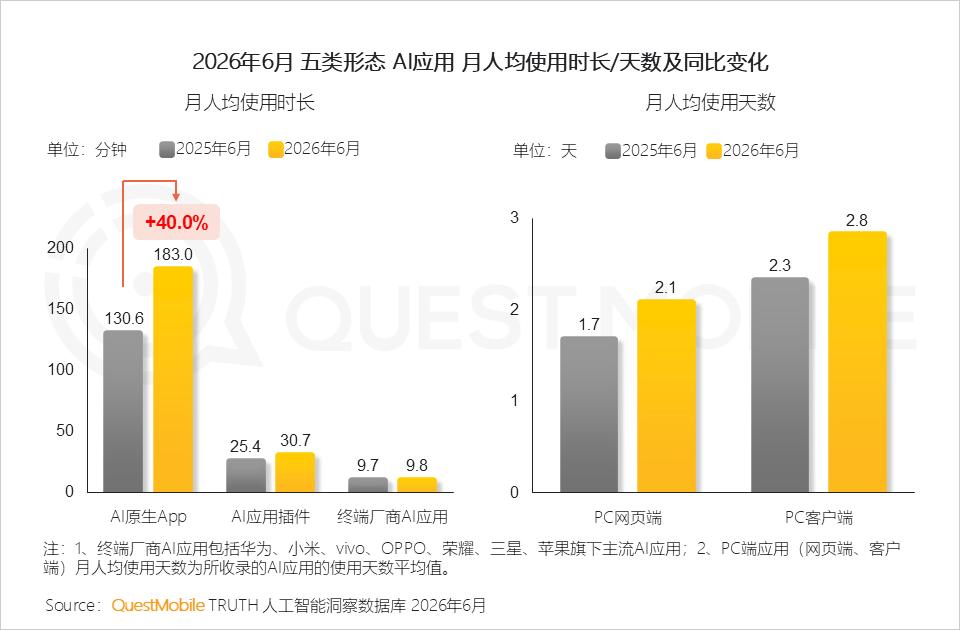
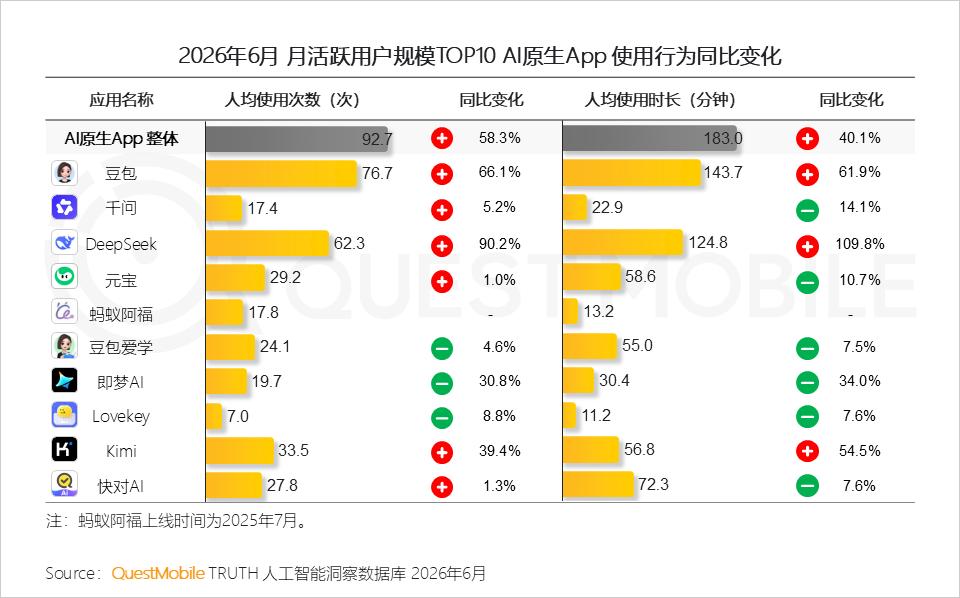
It is evident that driven by iterative model capabilities, fierce competition for user entrances among major tech firms, and real-world application deployment, native AI apps have achieved explosive growth over the past few months, breaking away from the previous pattern where they were overshadowed by device vendor AI applications and AI plugins. Not only has their monthly per capita usage frequency surged 58.3% year-over-year, but their monthly per capita usage duration has also hit 183.0 minutes, up 40.0% year-over-year, fully crossing the threshold of being a daily necessity for users.
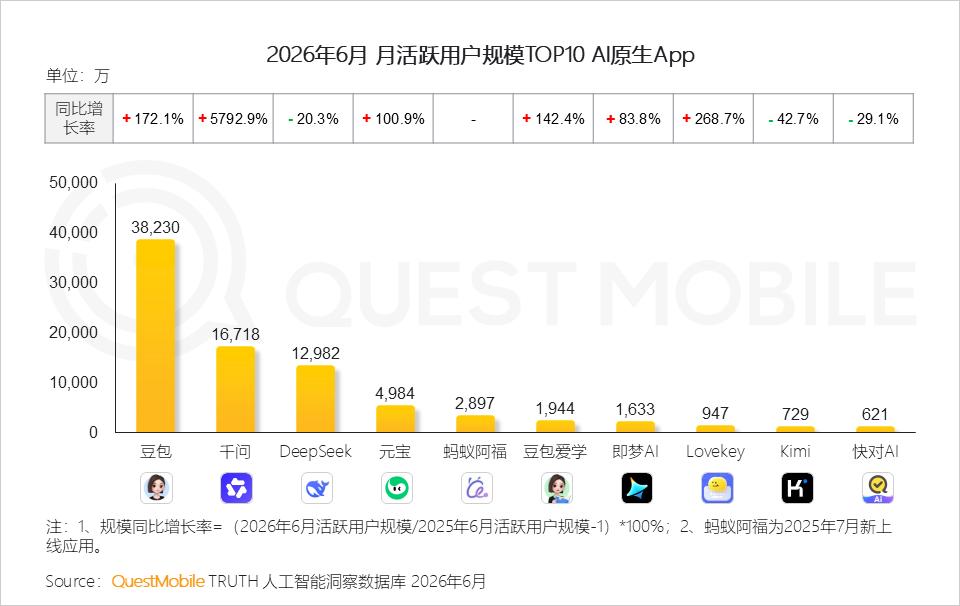
Specifically, the top 10 market landscape has stabilized, with the first tier consisting of Doubao, Qianwen, and DeepSeek recording MAUs of 382 million, 167 million, and 130 million respectively. Under the Matthew Effect, year-over-year growth rates are highly concentrated among these top-tier players: Doubao saw a 172.1% increase, while Qianwen's growth rate reached an astonishing 5792.9%.
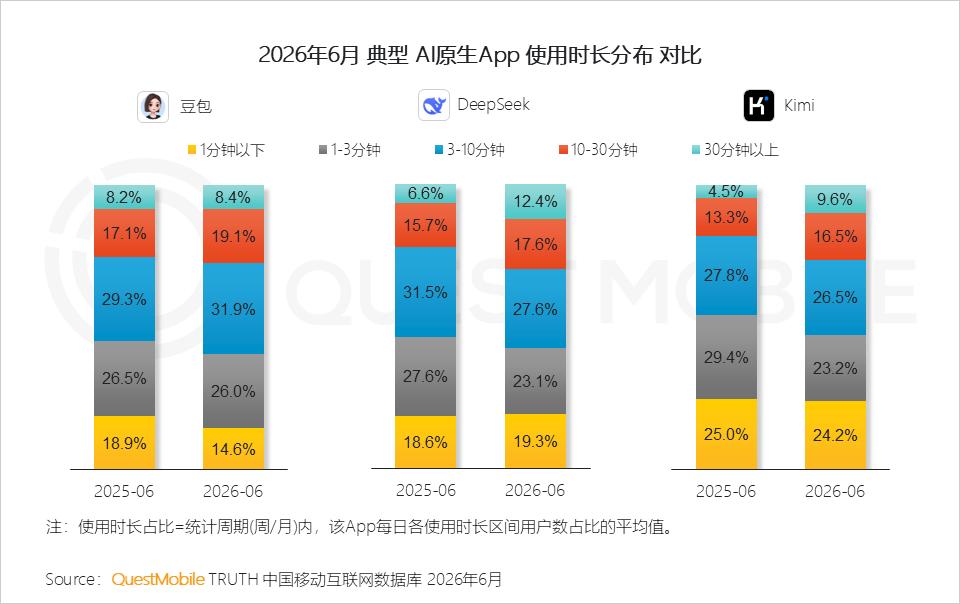
Furthermore, differentiated application models have emerged among leading players: on one hand, distinct user mindsets have been established. Doubao is positioned for fragmented, high-frequency usage, with 40.6% of sessions lasting less than 3 minutes; DeepSeek targets deep-thinking, long-duration use cases, with 30.0% of sessions extending beyond 10 minutes. On the other hand, commercialization trials have not negatively impacted user engagement. For example, Doubao reached an all-time high of 178 million MAUs the day after its professional paid version was launched, demonstrating users' willingness to pay for enhanced capabilities.
Notably, differentiation is even more pronounced in the more critical AI Agent domain, where four distinct development paths have gradually taken shape: device vendors are seizing user entrances via system-level underlying integration (such as Huawei - Xiaoyi Claw, Xiaomi - miClaw, Honor - YOYOClaw); major tech firms are building closed service loops through ecosystem connectivity (such as Qianwen Task Assistant, WeChat Xiaowei, Alipay Abao); deep application developers are targeting desktop office execution scenarios (such as Tencent WorkBuddy, AutoClaw); and there are specialized products focused on multi-agent collaboration, including Lobster AI and TRAE Work.
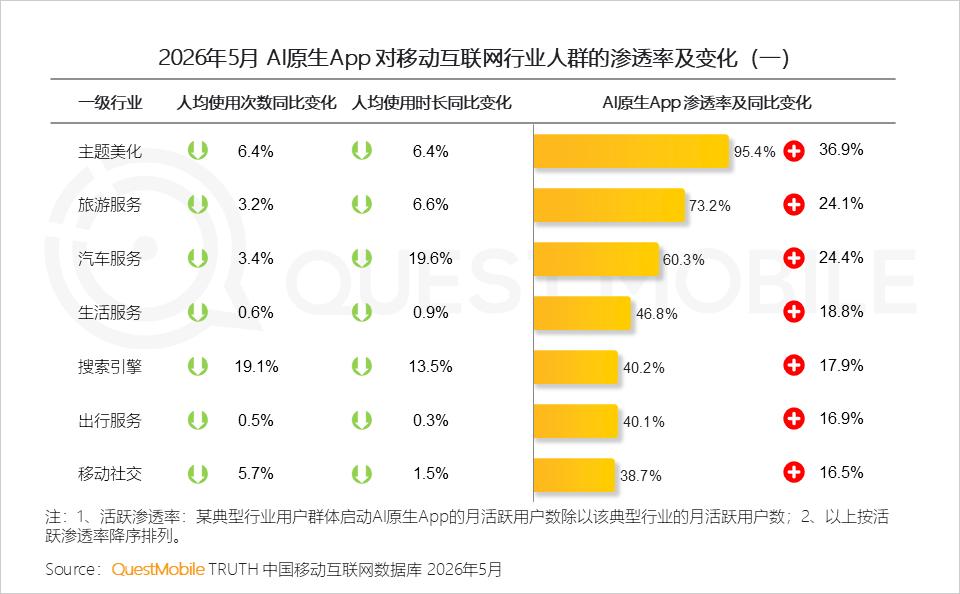
The widespread adoption of AI Agents has further accelerated the restructuring of the mobile internet in the AI era: app features and services are being transformed into invocable capabilities, while app content has become a core source of materials for AI search. This has led to two major emerging trends: first, user stickiness for apps across multiple verticals continues to decline, especially in categories like theme customization, travel services, automotive services, local life services, search engines, and mobility services, where both per capita usage frequency and duration have dropped year-over-year. This clearly signals that traditional app operators, particularly intermediary-style applications such as vertical media platforms, are facing an unprecedented industry transformation.
Second, major tech firms are dismantling their standalone apps and building Skill matrices within their flagship products to enable seamless access to underlying services. For instance, Alibaba has converted core products including Taobao, Amap, and Alipay into Skill-enabled systems, breaking down e-commerce search, route planning, and payment functions into independently invocable capabilities. ByteDance centers its ecosystem around Douyin and Jianying, encapsulating trend discovery, video generation, and document processing as reusable Skills. Tencent has built a comprehensive Skill matrix covering social, office, and daily life scenarios based on WeChat, WeCom, and Tencent Docs...
For more detailed insights, please refer to the full report.
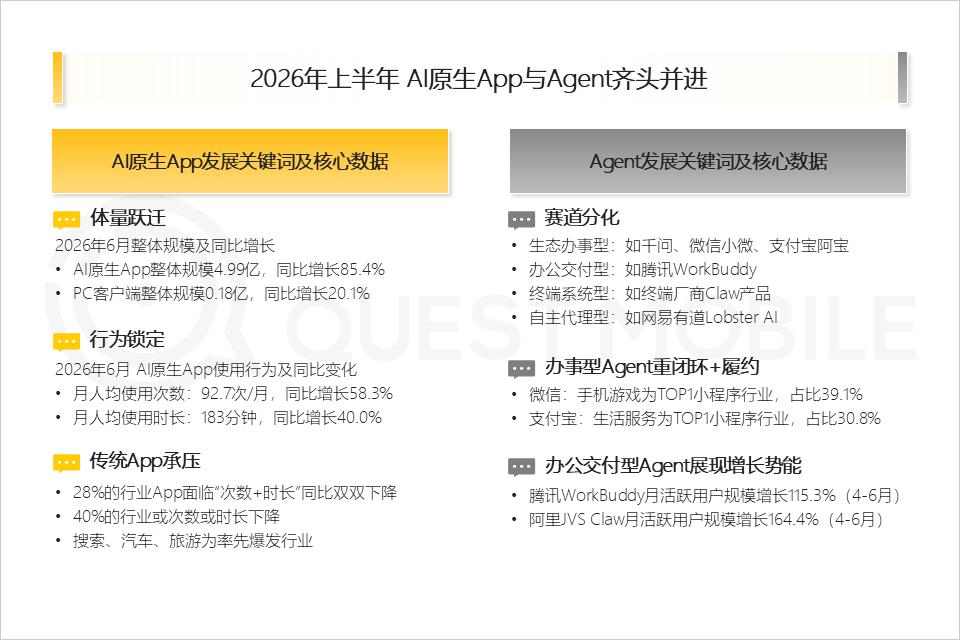
2026 AI Application Market Development Semi-Annual Report Summary (Part 1)
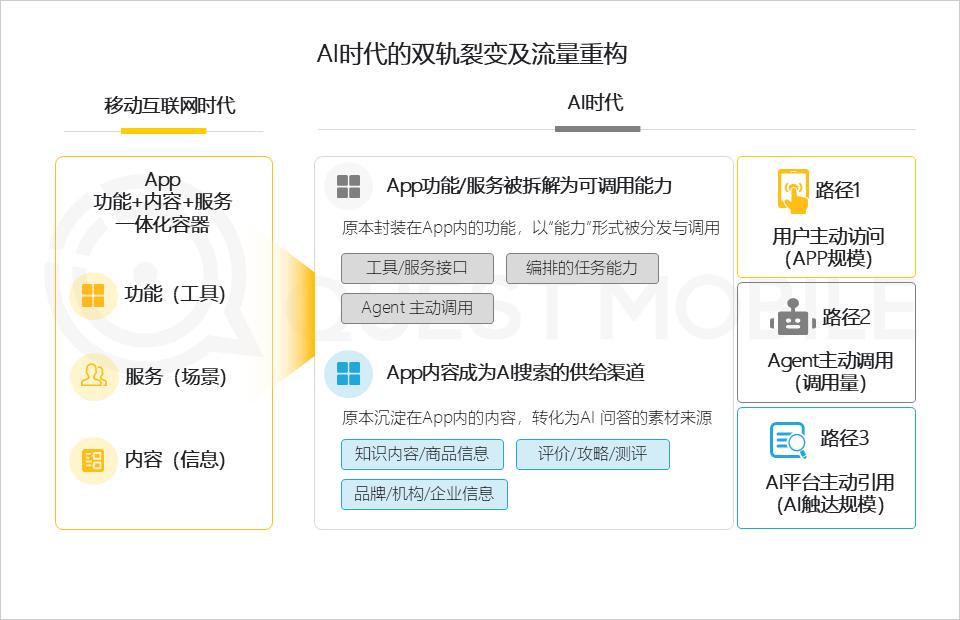
2026 AI Application Market Development Semi-Annual Report Summary (Part 2)
AI Advancing in Parallel with "Deep Capability + Cross-System Collaboration": Native AI Apps Systemically Restructure the Underlying Logic of the Mobile Internet
1. The 2026 H1 AI application development landscape features simultaneous "deep scenario expansion" and "user entrance enlargement": native AI apps and PC client-side AI applications are deepening support for complex use cases, while on-device AI on smartphones is broadening the interconnected experience boundary. Together, these three segments define the core development trends for the second half of the year.
According to QuestMobile data, in June 2026, the overall MAU of native AI apps reached 499 million (up 85.4% year-over-year), device vendor AI applications hit 755 million (up 14.0% YoY), and PC client-side AI applications recorded 18 million MAUs (up 20.1% YoY).
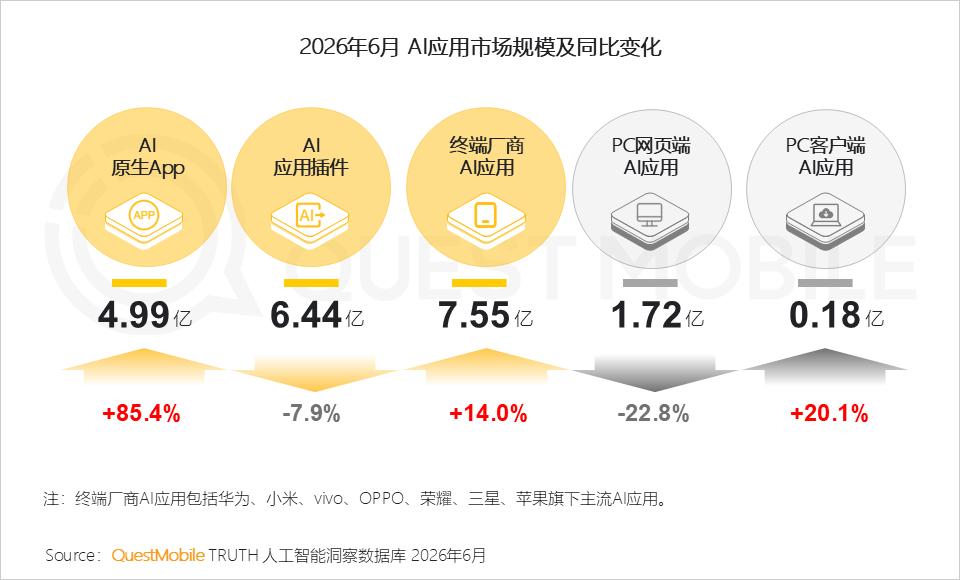
2. The user base of native AI apps saw a sharp surge during the 2026 Spring Festival, establishing a benchmark for deep AI experiences. Smartphone vendors expanded interactive touchpoints through new device launches, while the PC segment consolidated its position as a productivity foundation. The development of these three categories concretely embodies the core theme of "Deep Capability + Cross-System Collaboration".
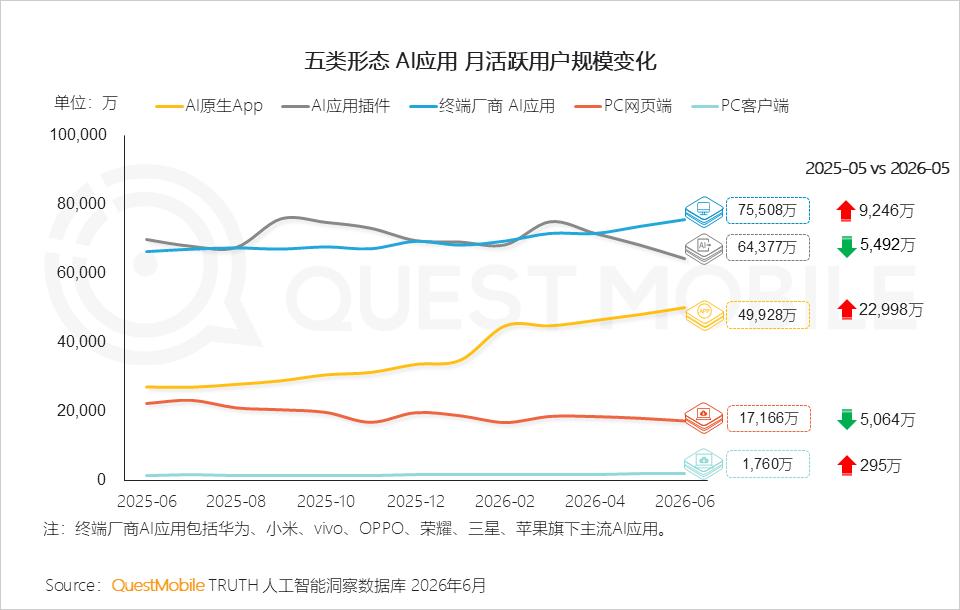
3. Native AI apps have pulled ahead of other applications with a monthly per capita usage frequency of 92.7 times. This structural advantage not only reshapes user habits but also translates into extremely strong user lock-in effects.
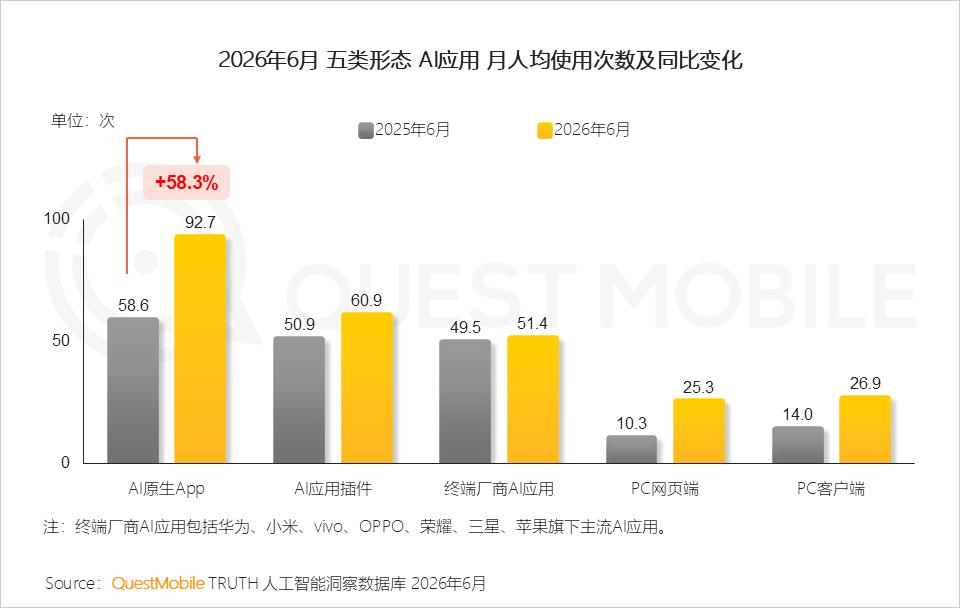
4. In terms of usage duration, native AI apps have achieved a several-fold gap over traditional apps, creating a generational experience difference that drastically raises the barrier for users to switch away from AI-powered products.
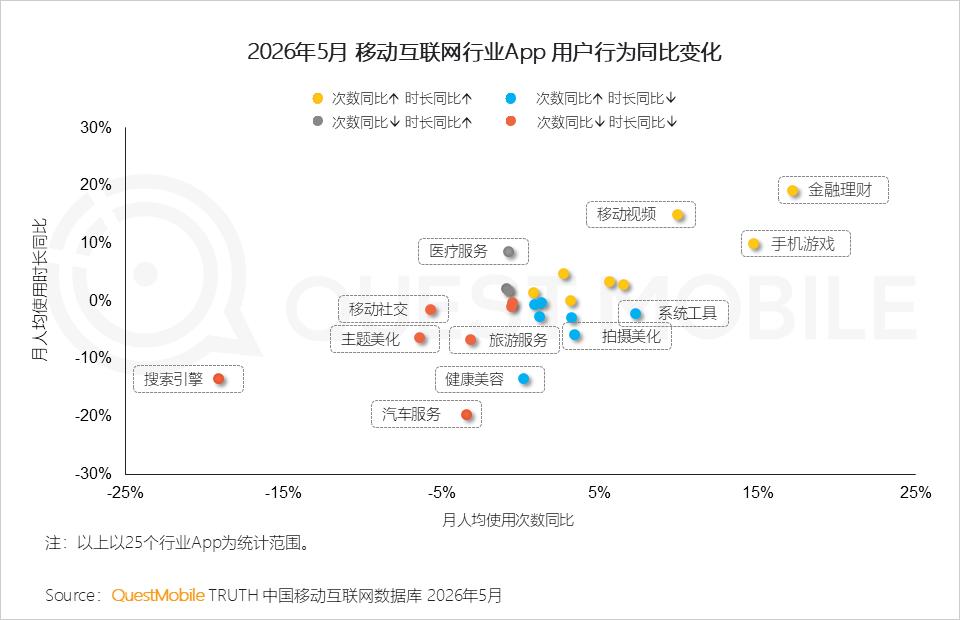
5. As a result, most mobile internet-era apps are facing declines in usage frequency or duration, and the underlying logic of the entire industry is being gradually and systemically restructured by native AI apps.
QuestMobile data shows that among all industry app categories, 28% have experienced simultaneous year-over-year declines in both usage frequency and duration, while 40% have seen drops in either one of the two metrics. Segments including mobile video and mobile games have achieved dual growth with AI empowerment, proving the value-added potential of intelligent transformation.
6. The core value of AI lies in its end-to-end workflow integration capability. Thus, its restructuring logic trades shortened user behavior paths for centralized control over value distribution: the deeper the integration, the more value converges to AI platforms.
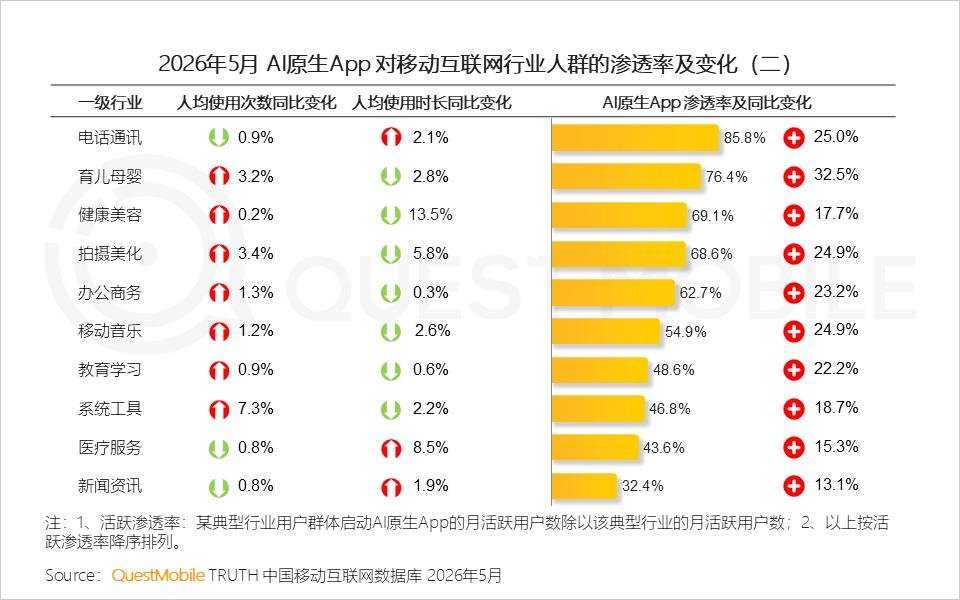
Search is the most typical example of "behavior path restructuring". According to QuestMobile data, in May 2026, the traditional search industry recorded year-over-year declines of 19.1% in per capita usage frequency and 13.5% in per capita usage duration. Additionally, by taking over decision-making rights, AI is aggregating industrial chain value to AI platforms, with the automotive and travel industries being the first segments to see this trend materialize.
7. Apps in tool-focused or short-workflow industries will likely evolve toward functional atomization (i.e., becoming invocable Skills). In the office and business domain, development is clearly pointing toward Agent-driven cross-system business workflow restructuring, accelerating value aggregation to the AI execution layer.
The Matthew Effect Persists Among Leading Native AI Apps, Subscription Payment Models Are Proven Viable, and Payment Agent Closed Loops Are Fully Established
1. Traffic from native AI apps is highly concentrated among top-tier players, with the Matthew Effect continuing to amplify. The dominance of leading platforms is further reinforced by their first-mover advantages in ecosystem entrances, data flywheels, and commercialization.
QuestMobile data shows that in June 2026, the MAUs of Doubao, Qianwen, and DeepSeek reached 382 million, 167 million, and 129 million respectively.
2. Advanced algorithm optimization and product iteration are reshaping the stickiness growth curve: Doubao focuses on the practical implementation of "Model as Agent", while DeepSeek prioritizes cognitive breakthroughs via "Reasoning as Agent".
These two developments not only cater to the growing demand for refined user experience but also validate that Agent technology has moved from conceptual proof on PCs to widespread real-world deployment on mobile devices.
3. Iterations in Agent technology are driving scenario stratification, simultaneously covering two core user needs: "lightweight interactive tasks" and "deep, high-value deliverables".
According to QuestMobile data, in June 2026, the share of users with sessions longer than 10 minutes for Doubao, DeepSeek, and Kimi reached 27.5%, 30.0%, and 26.1% respectively, representing year-over-year increases of 2.2%, 7.8%, and 8.4% compared to 2025.
4. Against the backdrop of large-scale user expansion and growing high-value user demands, Doubao officially launched its paid subscription version on June 24, targeting six core office scenarios and implementing precise user tiering via exponentially expanded premium features.
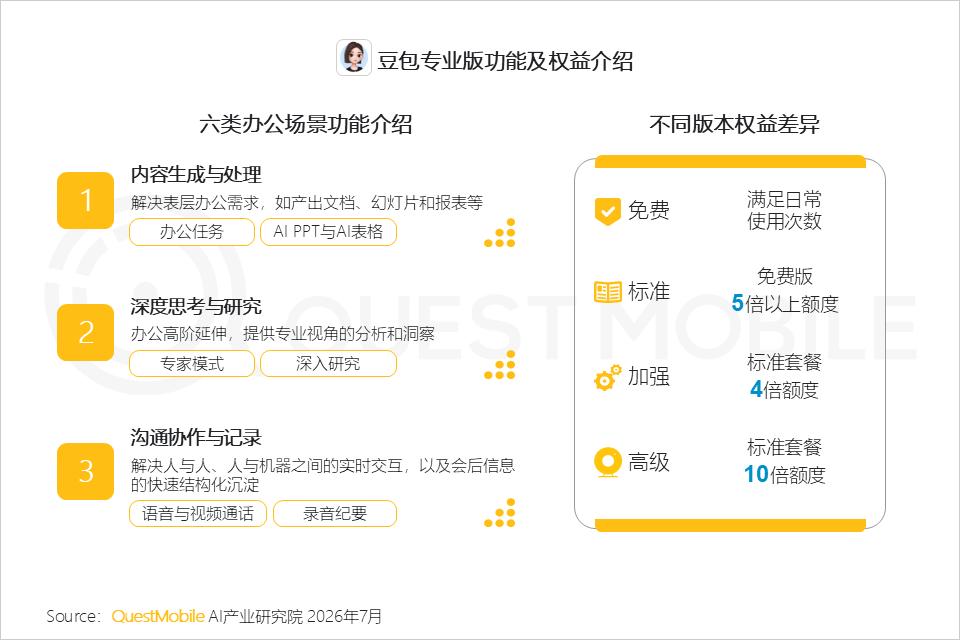
5. Following the Claw technology boom earlier this year, office productivity has re-emerged as a top-priority scenario. By launching its paid professional version that seamlessly connects mobile app and PC clients, Doubao has built a cross-device collaborative closed loop, effectively capturing and amplifying the full-year commercial dividends of the "AI + Office" trend.
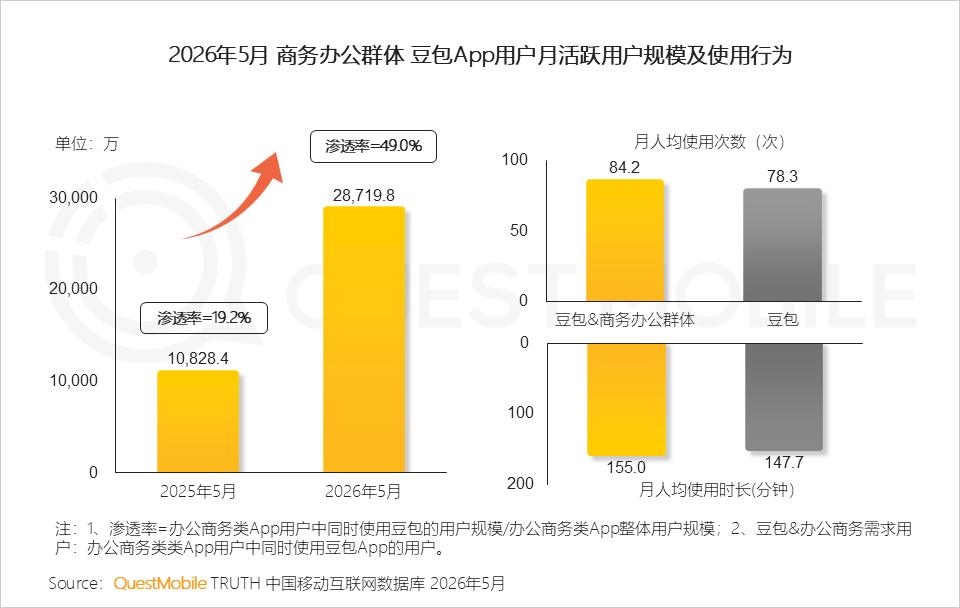
6. QuestMobile data shows that as of the end of June, the user activity across Doubao's three product forms remained steady, with the mobile app adding 13.78 million new users compared to May. This proves