36Kr Exclusive | Former Bosch Autonomous Driving Algorithm Engineer Launches Startup to Build a Haptic Large Model with Synthetic Data

Haptic glove (Source/Enterprise)
This article contains approximately 2400 words, with an estimated reading time of 6 minutes
Author丨Ou Xue
Editor丨Yuan Silai
36Kr has learned that spatial intelligence firm "Dayan Technology" has recently completed a multi-million-yuan angel round of financing, led by Songhe Qingzhan, with participation from state-backed institutions including Zhejiang Provincial Financial Holdings and Guangzhou Panyu Innovation Fund. The funds will be primarily used for haptic large model R&D, construction of robotics data production lines, and team expansion.
Founded in May 2025 in Tongxiang, Zhejiang, "Dayan Technology" is a spatial intelligence company focused on 4D world reconstruction, world models, and controllable diffusion model technologies.
Founder and CEO Yang Lin holds a PhD in Computer Science from the National University of Singapore, with 7-8 years of in-depth experience working on autonomous driving algorithms at enterprises including Suteng, Coreway, BYD, and Bosch Suzhou. In addition, the company's core technology draws on over 20 years of accumulated expertise in digital twins and haptic interaction from the team led by Chief Scientist, Academician of the United Nations Academy of Sciences, and Academician of the Canadian Academy of Engineering, Elsadek.
Yang Lin told 36Kr that he has observed that previous demand in the data market was dominated by automotive synthetic data, but starting in 2025, robotics data orders have surged dramatically.
"Automotive data volumes have not increased, and have even declined slightly. As competition in robot hardware intensifies, the industry is shifting focus to developing advanced 'robot brains', and the bottleneck for these systems lies in data availability," Yang Lin stated.
At present, "Dayan Technology" has developed three product lines:
The first is the synthetic data business: focusing primarily on synthetic data, combined with first-person perspective "heterogeneous acquisition" data collection, to serve autonomous driving and robot training. It has a prominent cost advantage – traditional manual annotation of a single frame may cost more than ten yuan, while Dayan's synthetic data costs only a few cents, with gross profit margins exceeding 60%.
The second is haptic data acquisition equipment: the company has independently developed China's first haptic glove with force-tactile interaction, the "Shadow Gauntlet", as well as head-mounted devices, featuring 29 array units, 1015 haptic contact points, and a maximum response frequency of 300Hz, capable of simultaneously capturing human hand posture and haptic feedback.
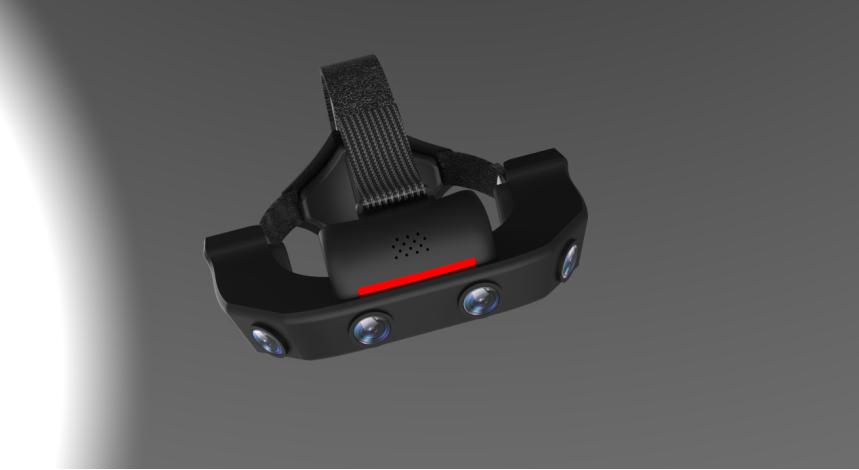
Head-mounted device (Source/Enterprise)
The third is the haptic large model: this represents the company's ultimate goal, scheduled for release in the second half of this year. This model uses multi-modal input, incorporates physical constraints in the latent space, and outputs the force direction, magnitude, and optimal posture when grasping objects. No comparable public product currently exists in China.
Having been established for only about a year, "Dayan Technology" has already achieved commercial implementation. The company's revenue in the first quarter of this year has exceeded 10 million yuan, and it has established partnerships with multiple leading robotics companies, with plans to deliver its first customized embodied intelligence "brain" project by the end of the year.
In addition, overseas expansion is a key strategic priority for the company next year. The company plans to set up a subsidiary in Saudi Arabia from late 2025 to early 2026 to promote the export of its hardware and data services. At the same time, the company does not rule out extending downstream once its haptic large model matures, attempting to develop differentiated "robot brain" solutions.
The following is an edited excerpt from 36Kr's interview with Yang Lin:
36Kr: What is the biggest technical bottleneck in the current robotics data industry? How are you addressing it?
Yang Lin: There are currently two main bottlenecks. The first is efficiency – the production capacity of the data flywheel cannot keep up with demand, and the iteration efficiency of domestic autonomous driving models lags significantly behind Tesla. The second is precision – customers' requirements have evolved from upper-body posture tracking to full-body tracking, and now they even need to solve the challenge of leg posture extraction under occlusion conditions. Pure vision solutions cannot solve the problem of hand occlusion, so haptic data must be incorporated.
Each individual module has mature existing technologies, but integrating all of them to operate efficiently together leads to a geometric increase in complexity. Our approach follows two parallel paths: first, combining synthetic data with heterogeneous acquisition to rapidly generate large volumes of high-quality valid data at extremely low cost; second, independently developing haptic data acquisition equipment to directly obtain haptic information from occluded portions at the hardware level – a rarely seen approach in the industry.
36Kr: Your heterogeneous acquisition costs are much lower than real machine collection costs. How does this business model achieve viability?
Yang Lin: Our specific method is to partner with scenarios such as unmanned supermarkets and front warehouses, allowing staff to wear our head-mounted devices and gloves during their normal working hours. By providing a daily subsidy of 100 yuan, we can obtain 8 hours of continuous data. Of course, not all of this 8-hour data is directly usable; after processing through our data production line, only about half or less remains valid. Even so, the cost is an order of magnitude lower than real machine data collection.
Why is real machine data collection so expensive? It requires building dedicated material factories, dividing factory buildings into small cubicles, and having robots repeatedly perform the same tasks inside, resulting in daily costs of thousands or even tens of thousands of yuan, while the proportion of valid data remains low.
Our logic is: since robots ultimately need to work like humans, directly collecting human data and then mapping it to robots – despite some inherent loss – can compensate for this error with the large volume of human data available. Moreover, our data production line itself is continuously optimized, with the loss rate steadily decreasing.
36Kr: How high are the technical barriers for your hardware haptic gloves and head-mounted devices? Would it be easy for others to copy them?
Yang Lin: Let me put it this way: integrating haptic feedback and hand skeleton posture extraction into a single glove is not currently available on the market. This involves a series of engineering challenges including sensor design, circuit layout, crosstalk prevention, and anti-interference measures – none of which are simple. The hardware threshold for the glove itself is quite high, and we have applied for multiple patents in core links.
But even more critical is the combination of software and hardware. Our devices are purpose-built to serve the haptic large model, with data formats, calibration methods, and preprocessing workflows all deeply coupled with model training. Even if others disassemble our gloves and replicate identical hardware, without the supporting models and algorithms, the value of the device will be greatly diminished. Conversely, our model training relies on this equipment to continuously generate high-quality data. This forms a closed loop of software and hardware that cannot be replicated through a single dimension.
Investor Insights:
Yan Yang from Songhe stated: Dayan Technology is a spatial intelligence company focused on 4D world reconstruction, world models, and controllable diffusion model technologies and applications, providing high-quality synthetic data and high-fidelity pre-training fields for sectors including autonomous driving, embodied intelligence, and digital twins.
Value Point 1 – Exceptional Team: The overall team is relatively young, with core members all possessing 5-10 years of R&D experience in autonomous driving and AI fields. They have complementary expertise in core technical links such as algorithms, perception, and decision-making systems, as well as product and market capabilities, and have a long history of working together, resulting in strong team cohesion.
Value Point 2 – Huge Market Potential: The data synthesis market is in a rapid growth phase, with China's 2024 market size reaching 2.1 billion yuan, and an estimated 2030 market size of 23 billion yuan; the embodied intelligent robot market is widely regarded as the next trillion-yuan track following autonomous driving.
Value Point 3 – High Project Scarcity: The company's spatial intelligence solution based on world models enables precise perception, modeling, and decision-making for complex environments, and startup companies operating in this niche field are relatively rare domestically.
Value Point 4 – Products Validated by Customers: The products have moved beyond the lab to the market, gaining customer validation and industry recognition, with the business model achieving preliminary verification, laying a solid foundation for large-scale commercial implementation.
Value Point 5 – Haptic World Model Fills Domestic Gap: Leveraging the leading position and influence of Academician Abdulmotaleb El Saddik in the global haptic technology field, the company not only operates an embodied data business, but also possesses the capability to develop and deploy model-layer solutions.