Stephen Chow's "Strict Selection": Who is Creating "Kung Fu Women's Football Team"?
This weekend, a new blockbuster hit the domestic film market.
According to data from Maoyan Professional Edition, *Kung Fu Women's Soccer* directed by Stephen Chow has surpassed 600 million yuan at the box office in just three days since its release. Its projected total box office has skyrocketed from the initial 1.428 billion yuan to 2.505 billion yuan, making it a strong contender for the second spot on the domestic film box office rankings alongside *Love Letter to Grandma*.
More intriguing than the numbers is the list of production companies. Topping the credits for *Kung Fu Women's Soccer* is not a long-established film enterprise from Beijing or Shanghai, but Shenzhen Film Studio — a wholly-owned subsidiary of Shenzhen Media Group.
This big-budget production, supported by the Shenzhen Municipal Publicity and Culture Fund and filmed entirely on location in Shenzhen, together with *Love Letter to Grandma* which earned nearly 1.9 billion yuan at the box office on a modest 14 million yuan budget, points to an emerging reality: Shenzhen is carving out a new position for itself in China's film market.
For a long time in the past, the industry defined Shenzhen as a "ticket hub" rather than a "production base" — it had a large number of cinema screens and contributed significantly to box office revenue, but was barely involved in content creation. Now, the consecutive breakout successes of two major films from the same city can no longer be dismissed as coincidence.
Of course, there is still uncertainty over whether the 2.5 billion yuan projected box office will be realized. But a more pressing question than box office performance is: how did Shenzhen's film and television industry rise to prominence? After producing multiple cross-over hits, can Shenzhen continue to reshape the national film and television industry landscape?
The Producer
"It's the signature 'Kung Fu + Soccer' combination, with that one-of-a-kind, authentic nonsensical humor that only Stephen Chow can deliver." This is a representative comment from reviews of *Kung Fu Women's Soccer*.
At a time when big-name directors and A-list celebrities are losing their ability to guarantee box office success, Stephen Chow's drawing power remains astonishing. The public keeps highlighting the record-breaking numbers: the film secured a last-minute release date with almost no pre-release promotion, yet still became the fastest-selling summer release this year to break 10 million yuan in pre-sales. On its opening day, it captured over 80% of the daily box office with less than 50% of screening slots, and shattered multiple Chinese film industry records including the number of opening-day screenings for a summer release.
However, a look at the film's production credits reveals a noticeable shift: the traditional "Hong Kong flavor" has faded considerably, replaced by a strong Shenzhen presence. Beyond the aforementioned production company, filming locations, and financial support, the iconic soccer stadiums and beach scenes featured in the film can all be found in Shenzhen.
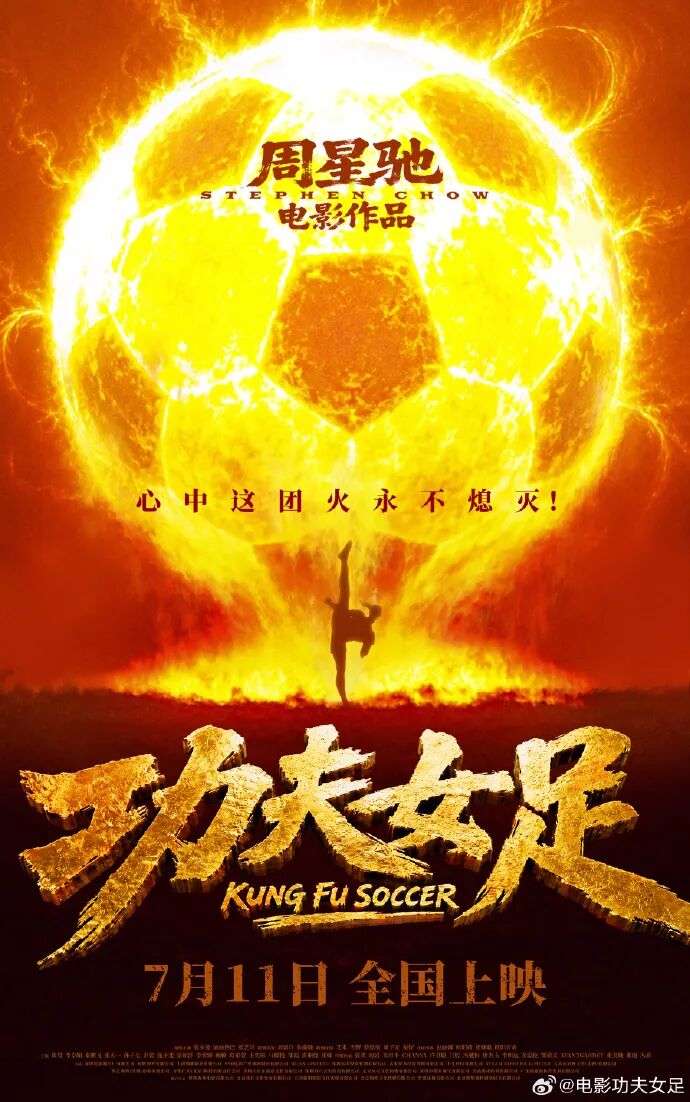
Image source: Official WeChat account of the film *Kung Fu Women's Soccer*
This is not Stephen Chow's first collaboration with Shenzhen. In 2016, *The Mermaid*, shot at Dongshan Lujiao on Shenzhen's Dapeng Peninsula, achieved a global box office of 504 million US dollars with around 100 million viewers in China. Dongshan Lujiao has since become a popular tourist attraction.
Beyond serving as a mere filming location, Shenzhen has positioned itself as a "producer" in the film industry. As a city renowned for its technological innovation, Shenzhen excels at pooling resources and integrating diverse elements.
According to local media reports, behind Shenzhen's production of *Kung Fu Women's Soccer* lies its effort to build the "first stop for Hong Kong film and television resources entering the mainland". Amid the ongoing northward migration of numerous production companies and film practitioners, Shenzhen — which borders Hong Kong — has naturally become a crucial entry point for these resources.
Take Qianhai as an example. As the site of the Shenzhen-Hong Kong Modern Service Industry Cooperation Zone, it has already attracted resources such as TVB's 77 Culture and Emperor Group's New Reflection Film Company.
The convergence of various film and television resources has also paved the way for Shenzhen to enter a period of explosive hit production.
Just last month, *Love Letter to Grandma* — the dark horse of this year's domestic film market — was also a Shenzhen production. Among the four production companies: Golden Ant Film, Damai Entertainment, Rongde Holdings, and Lichun Pictures, all except Damai Entertainment are based in Shenzhen. Local media reports also indicate that the film received key attention and support from the Publicity Department of the Shenzhen Municipal Party Committee.
This time, Shenzhen brought together Chaoshan cultural and film resources: the film itself is a typical Chaoshan story, and director Lan Hongchun hails from Jieyang. As Lan noted, Shenzhen's strong inclusiveness allowed him to make films "outside the conventional framework" while finding like-minded collaborators, enabling his "Chaoshan Family Trilogy" to come to fruition, culminating in *Love Letter to Grandma*.
The Latecomer
In fact, just a few years ago, insufficient resources were still a major bottleneck for Shenzhen's film and television industry.
At the 17th China (Shenzhen) International Cultural Industries Fair held in 2021, a film director frankly stated in an interview: "Shenzhen still lacks sufficient supporting facilities for the film industry. Back in 2013, when I wanted to shoot my graduation project in Shenzhen, I couldn't even find a decent clapperboard, let alone professional color grading equipment for post-production or purpose-built sound stages for filming."
A common industry consensus at the time was that China's film and television resources were largely concentrated in Beijing. Any region lacking talent or resources had to travel north to find them. Many also observed that most of Shenzhen's representative film enterprises and projects at that time had deep ties with Beijing-based companies.
Nevertheless, as a latecomer, Shenzhen had clear potential for breakthroughs. The head of a Shenzhen-based film startup pointed out that Beijing, Shanghai, and the Jiangsu-Zhejiang region already had a mature, established system that made it extremely difficult for new companies to stand out. Shenzhen, with its unique geographic location, strong economic strength, and existing production foundation, was highly appealing to emerging enterprises.
Today, Shenzhen's "latecomer advantage" aligns perfectly with the industry's growing call for a return to content-driven storytelling.
Peng Xiaozhao, a researcher at the Finance Development and State-owned Assets Research Institute of the China Development Institute (Shenzhen), analyzed the success of *Love Letter to Grandma* in a published article, noting that Shenzhen is free from the complex social connections and capital burdens that characterize the traditional film circles in Beijing, Shanghai, and Guangzhou. Creators do not have to pander to capital preferences, allowing their work to return to the essence of art: focusing on real people, exploring genuine human nature, and highlighting the joys and sorrows of ordinary people at the grassroots level.
What still amazes many is that *Love Letter to Grandma* features an entirely non-professional cast and a low production budget, with much of its funding coming from small local Chaoshan businesses. It completely defied the long-accepted "proven success formula" of big IPs, A-list celebrities, high-concept genres, and massive marketing campaigns that had dominated China's film industry.
For a film industry still in its early stages of development, Shenzhen's mature industry support system has provided an extra boost.
Peng Xiaozhao pointed out that in recent years, Shenzhen has introduced a series of practical measures to promote high-quality development of the digital creative industry. Notably, in 2019, it pioneered the "Shenzhen Low-Budget Film Implementation Planning Command", breaking away from the old model where the government either "provided funding without intervention" or "had non-professionals guiding professionals". Instead, it implemented a two-pronged support system of "artistic oversight + distribution assistance": industry experts are responsible for early-stage script selection and artistic quality control, while the Cinema Association manages subsequent screening arrangements and distribution.
Lan Hongchun mentioned that Shenzhen provided substantial incentives, allowing him considerable creative freedom. The support policy, which "does not require personal connections — you simply submit an application online following the official procedures", laid a solid foundation for the production of *Love Letter to Grandma*.
The New Growth Engine
Why is the film and television industry so important to Shenzhen?
In 2011, Deng Yiguang, then a member of the Shenzhen Municipal Committee of the Chinese People's Political Consultative Conference, submitted a proposal titled "Building Shenzhen's Film Industry". He argued that developing a world-class film industry as the flagship of Shenzhen's cultural sector would effectively address the city's long-standing disadvantages of limited land resources and relatively short cultural heritage in its "third phase of development", while helping Shenzhen establish its global cultural identity as an international and creative city.
As a young city that has experienced decades of rapid growth, Shenzhen has continuously broken economic records, but its cultural development has lagged slightly behind. Since shortcomings define the upper limit of urban development, Shenzhen has often been labeled a "cultural desert".
Shenzhen has long been committed to overcoming this cultural constraint. As early as 2004, it launched the "Cultural City" strategy, striving to build itself into a "City of Libraries", "City of Pianos", "Design Capital", and "Animation Base". The following year, it designated the cultural industry as its fourth pillar industry, giving rise to the annual Cultural Industries Fair.
The film and television industry is widely recognized as the "locomotive" of the cultural sector, with a long industrial chain, strong multiplier effects, and far-reaching influence. It not only generates economic benefits, but also creates profound cultural impact, and can even drive the upgrading of the technology industry — a case of "one move activating the entire board".
Shenzhen's technological advantages can be seamlessly integrated into the film and television industry.
For example, over the past decade, Shenzhen has led the iteration of consumer electronics terminals, aligning perfectly with the industry's shift from large screens to mobile devices. At this year's Cultural Industries Fair, AIGC became a hot topic in the film sector, with high expectations for Shenzhen to play a leading role in driving a new round of upgrades to the film production system.
As described by local media, Shenzhen is a rare all-in-one natural film studio in China, integrating futuristic urban landscapes, mountain-sea scenery, cultural heritage, technological industrial zones, and authentic everyday life scenes. Its cyberpunk-style cityscape is also poised to become a natural filming location, inspiring the creation of more film and television works.
More notably, Shenzhen is entering a new phase of cultural industry development. According to statistics, in 2025, the revenue of Shenzhen's cultural enterprises above designated size reached 1.514 trillion yuan, accounting for nearly 10% of the national total. This means that 1 in every 10 yuan of China's cultural industry revenue comes from Shenzhen. Furthermore, its year-on-year growth rate reached 16.6%, the highest among all trillion-yuan cultural industry cities in the country.
Having emerged as the fastest-growing cultural industry hub, can Shenzhen further achieve new breakthroughs in reshaping the national film and television landscape?
This article originates from the WeChat public account "City Evolution", written by Yang Qifei, and published by 36Kr with authorization.