Loss is not the most difficult problem for SERES
After AITO achieves brand upgrading, how can it translate scale into profit?
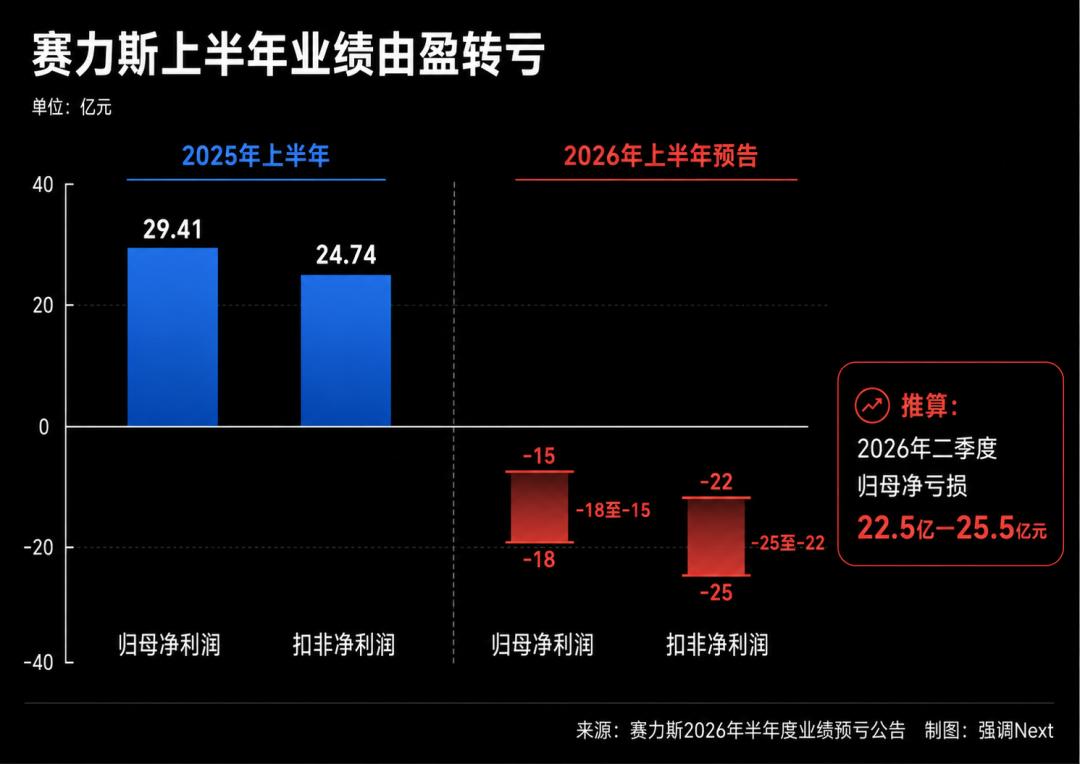
On July 12, Seres released its performance forecast, expecting a net loss of 1.5 billion to 1.8 billion yuan attributable to shareholders in the first half of 2026, compared with a net profit of 2.941 billion yuan in the same period last year.
Since the company still posted a net profit of 754 million yuan in the first quarter, it is estimated that the net loss attributable to shareholders in the second quarter alone reached 2.254 billion to 2.554 billion yuan. Its core subsidiary, AITO Automobile, is expected to lose 1.9 billion to 2.15 billion yuan in the second quarter. The reasons given by Seres include price increases for memory chips, industrial metals and lithium carbonate, as well as the write-down of book value for some existing assets due to technology iteration and model upgrades.
Similarly, GAC Group also expects a net loss attributable to shareholders of 4.06 billion to 4.57 billion yuan in the first half of 2026. GAC already recorded a loss of 656 million yuan in the first quarter, which means its loss in the second quarter alone is estimated to be around 3.4 billion to 3.9 billion yuan. The reasons given by GAC also include rising raw material prices, increased sales investment and changes in product mix, compounded by falling sales of joint-venture brands, reduced investment income and exchange losses.
The automotive industry is collectively facing profit squeeze caused by rising costs and price competition. Seres' losses cannot be entirely blamed on its Huawei partnership model, nor can they be simply attributed to the company's operational mismanagement.
But compared with GAC, what makes Seres special is that it previously had industry-leading gross margins and strong product pricing power, yet quickly turned from profit to loss in a single quarter. The problem is not just the magnitude of external shocks — more crucially, after AITO's rapid growth, how can Seres convert its established brand recognition, sales volume and high gross margins into a profit model that is less vulnerable to cost cycles.
01. High Gross Margin, Low Net Profit
In 2025, Seres recorded operating revenue of 164.888 billion yuan, with a gross margin of 26.88%. Its gross margin even approached 30% in the third quarter. However, its net profit attributable to shareholders was only 5.957 billion yuan, corresponding to a net profit margin of about 3.61%. Its non-recurring profit net profit was 5.136 billion yuan, with a non-recurring net profit margin of around 3.11%.
In other words, every 100 yuan of revenue generates nearly 27 yuan in gross profit, but ultimately only around 3 yuan is left for shareholders.
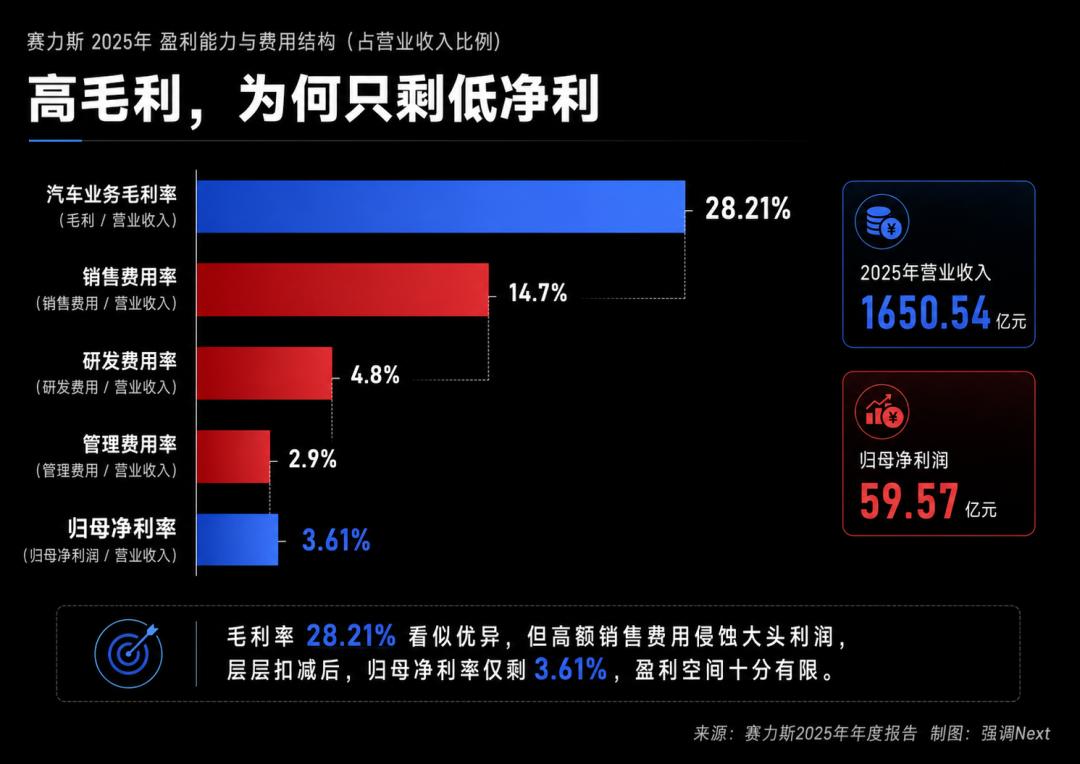
The main intermediate expenses are sales, R&D and administrative costs. In 2025, Seres' sales expenses reached 24.194 billion yuan, accounting for about 14.7% of revenue. Its R&D expenses hit 7.954 billion yuan, up 42.4% year on year, while administrative expenses stood at 4.787 billion yuan. Including capitalized portions, total annual R&D investment reached 12.512 billion yuan.
Pressure already emerged in the first quarter of this year. Seres' revenue rose 34.46% year on year in the quarter, but its net profit attributable to shareholders only increased 0.89%, while non-recurring net profit dropped 73.87%. The company explained that one of the main reasons was a 743 million yuan year-on-year increase in R&D expenses.
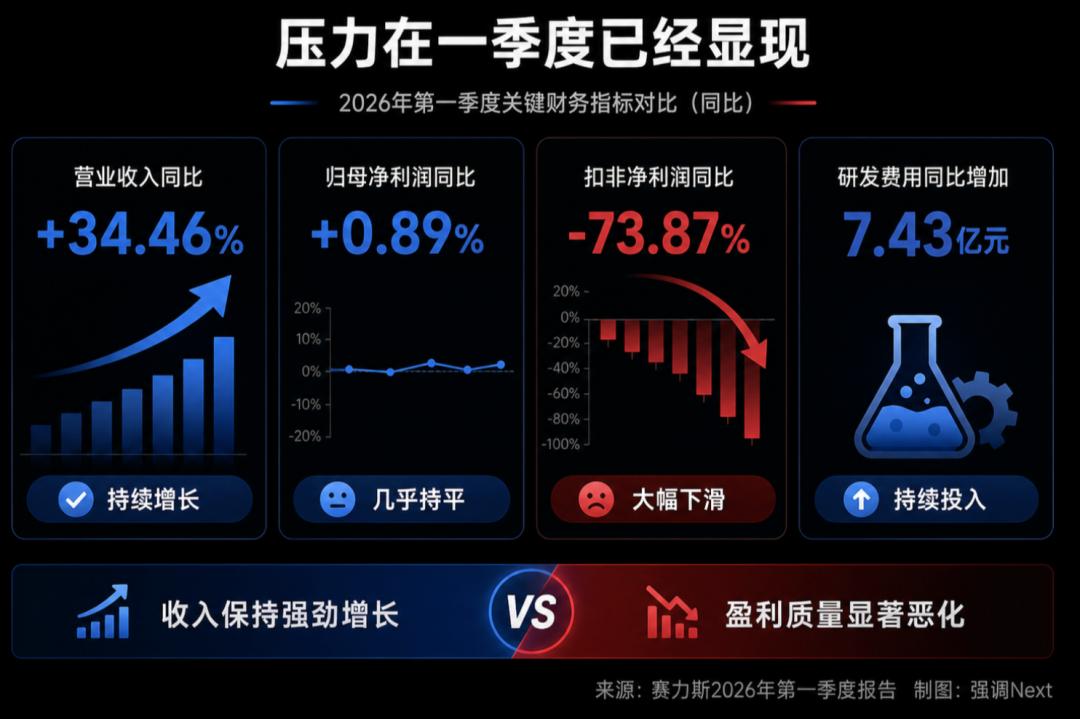
Judging from financial data, Seres' problem is that its high gross margins are paired with high sales investment, high R&D spending and high coordination costs. Its net profit margin, which was only 3 to 4 percentage points, can be quickly eroded once hit by rising raw material prices, product transitions and asset impairments.
02. The Next Step in Huawei Partnership Is Not "Decoupling"
Seres' Hong Kong IPO prospectus reveals that from 2022 to 2024, the company's procurement from its largest supplier (the Huawei ecosystem) surged from 5.8 billion yuan to 42 billion yuan, with its share of total procurement rising from 14.5% to 30.2%. In the first half of 2025, it made another 20 billion yuan in purchases from Huawei, pushing the proportion up further to 33% — equivalent to nearly 30% of its total revenue of 62.36 billion yuan in the same period.
According to official statements, this sum covers expenses for "purchasing components such as smart cockpits and driving assistance systems" and "procurement of development, sales and promotion services". Seres also explicitly stated in its prospectus that no profit-sharing arrangement exists. However, multiple industry media outlets estimated based on vehicle pricing that under the Huawei Smart Selection model, the Huawei ecosystem can roughly obtain close to 10% of revenue from each vehicle's selling price (2% technology licensing fee + 8% sales channel service fee). For AITO's main product line priced between 300,000 yuan and over 400,000 yuan, the revenue flowing to the Huawei ecosystem per vehicle is often estimated to exceed 100,000 yuan. Based on this calculation, the total amount AITO has paid to the Huawei ecosystem from 2022 to the first half of 2025 has approached 75 billion yuan.
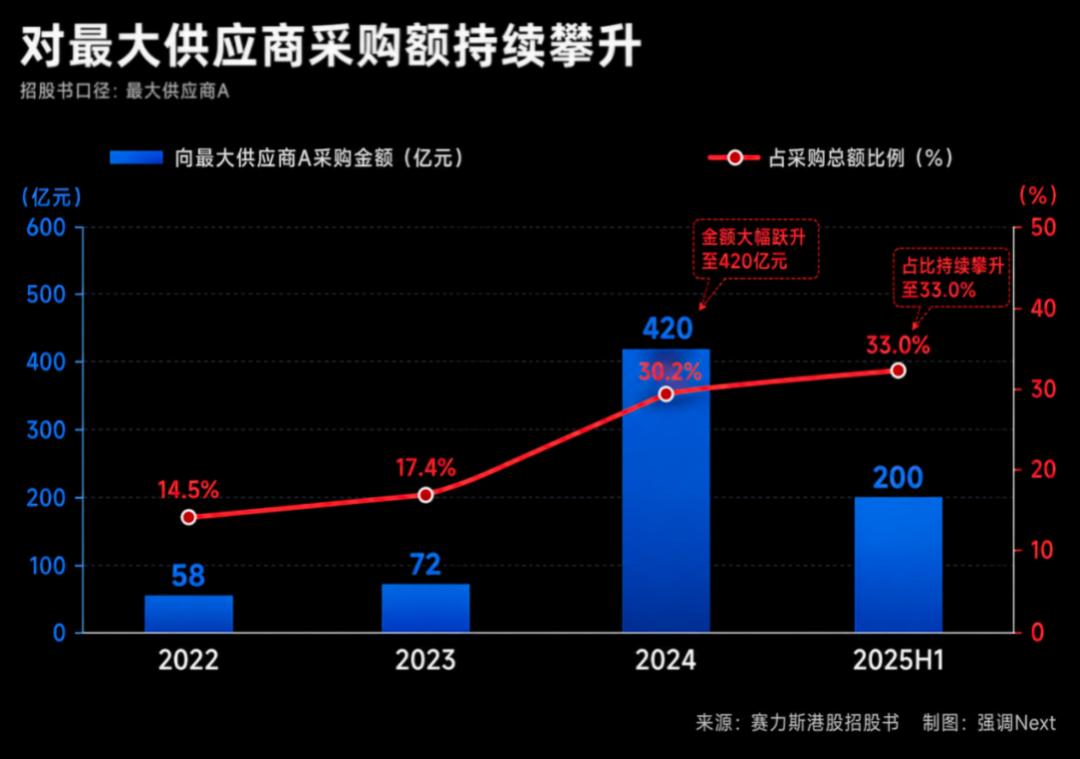
The rising procurement volume is often cited as proof of Seres' reliance on Huawei. However, focusing only on procurement amounts can easily overlook the value this partnership has created for Seres.
AITO has quickly secured premium pricing capabilities, intelligent technology strengths and a nationwide sales network. If Seres had to build all these resources from scratch, it would take far longer and incur much higher costs. The Huawei partnership is not a simple explanation for Seres' profit issues — instead, it has been the core driver of its growth over the past few years.
What truly needs adjustment is not the partnership itself, but whether Seres can unlock greater economies of scale as the collaboration enters a mature phase.
As AITO's sales volume expands, expenses for advertising, distribution and services should not grow in lockstep with revenue indefinitely. The intelligent systems, electrical/electronic architectures and manufacturing platforms of different models also need to improve reusability, to avoid massive re-investment and asset write-offs every time a vehicle generation is updated.
Seres does not need to replicate BYD by taking full control of batteries, chips, intelligent driving and cockpit systems in-house. This would not align with its existing capabilities, and could create new heavy asset burdens. A more practical path is to concentrate limited R&D resources on differentiated links such as vehicle integration, manufacturing, chassis technology, range-extender systems and user data.
For Seres, genuine technological autonomy does not mean manufacturing every component in-house — it means retaining full capabilities in product definition, cost control and system integration, even when switching partners.
03. AIVA Does Not Need to Replicate AITO
AIVA offers Seres an alternative development path.
Saidong Technology has introduced investors including local state-owned capital and CATL, and partnered with Volcano Engine to develop smart cockpit systems, while autonomous driving assistance is provided by DeepMotion. Seres' shareholding has been reduced to 32.96%, meaning it has chosen not to bear all the capital and operational risks of the new brand independently. AIVA's first mass-produced model is scheduled to launch this year, targeting the market segment above 200,000 yuan.
AIVA is often interpreted as Seres' attempt to build a second independent technology ecosystem outside Huawei, but simply changing partners will not necessarily improve profitability.
It should instead serve as an operational model experiment.
Since AITO has already secured a strong position in the premium market, AIVA does not need to duplicate a costly separate brand, channel and service system. It needs to prove that Seres can launch competitive products in the mainstream mass market with a leaner organization, lower upfront investment and a more open supply chain.
This requires Seres to exercise restraint with AIVA. The number of models should not expand too quickly, its R&D and manufacturing platforms should maximize reuse of existing systems, and marketing investment cannot follow the aggressive high-spending pattern commonly used for new brand launches.
Otherwise, AIVA may generate a new wave of R&D, sales and channel expenses before it even starts generating revenue. Seres would then go from supporting one high-cost partnership system to carrying the burden of two high-cost systems simultaneously.
04. This Loss Also Provides an Adjustment Window
Seres currently has sufficient capital reserves to cover short-term losses. At the end of 2025, the company's monetary funds reached 87.287 billion yuan, and its asset-liability ratio dropped significantly from the previous year. This loss will not immediately threaten the company's ability to continue operations.
This also means Seres does not need to immediately slash all R&D and brand investment for the sake of short-term profitability. The automotive industry's product cycle dictates that reckless spending cuts could lead to product gaps in the coming two to three years.
A more reasonable adjustment is to reclassify which expenditures can accumulate into long-term capabilities, and which only serve to maintain temporary sales volume.
Investments in vehicle platforms, manufacturing systems, user data and core integration capabilities are worth continuing. Duplicate model development, overly frequent product updates and marketing spending that fails to deliver economies of scale need to be compressed.
This is what differentiates Seres from traditional automakers like GAC. While GAC needs to address multiple challenges including declining joint-venture brands, self-owned brand transformation and bloated organizational structures, Seres has a more focused business with a clearer path for adjustment.
It does not need to build a new brand from scratch, nor prove that consumers accept the AITO nameplate. Its next task is to reduce the sales, R&D and coordination costs incurred for each vehicle sold.
Therefore, judging whether Seres' profitability can recover should not focus solely on whether it will return to profit in the second half of the year.
More importantly, after AITO's sales rebound, will sales expenses continue to grow in lockstep? After model upgrades are completed, will asset impairments decline significantly? After AIVA is launched, will it establish a leaner operational model, or add an entirely new expense system?
If these positive changes materialize, the first-half 2026 loss can be regarded as a stress test caused jointly by rising costs and product transitions.
If revenue resumes growth while expenses continue to rise at a similar or even faster pace, then the real problem Seres needs to solve will no longer be raw material prices — but how to manage an automotive company that has already reached 100-billion-yuan revenue scale.
This article is from WeChat Official Account "Emphasis Next" (ID: leo89203898), author: Dingshan, editor: Xiaobai, published with authorization from 36Kr.