Producing hundreds of episodes daily or still clinging tightly to IP, how will the "second half" of AI short dramas unfold?
In the first half of 2026, the atmosphere in the AI short drama track felt more like a gamble than ever before.
On one side lies the bustling scene of skyrocketing registration numbers and continuous capital inflows, while on the other is the harsh reality of piles of abandoned accounts, user acquisition costs outpacing ROI, and platform traffic restrictions.
Two years ago, the group of entrepreneurs who were loudly proclaiming "AI will revolutionize film and television" now stand collectively before a critical choice: should they continue to rush into the market, betting on efficiency and scale; or decisively exit to stop losses, or pivot to focus deeply on IP development?
There is no standard answer to this question. But the rises, falls, failures and survivals that have already occurred may help us see clearly what the hidden cards on every table really are.
Today, follow "TopKlout" to break them down one by one~
Two Tracks, One Dilemma
Let's start with a set of data.
According to data from iiMedia Research's "2025-2026 China AI Comic Drama Industry Trend White Paper", the market size of China's AI animated micro-short drama industry reached 18.98 billion yuan in 2025, a year-on-year increase of 276.3%, marking an explosive growth phase for the industry.
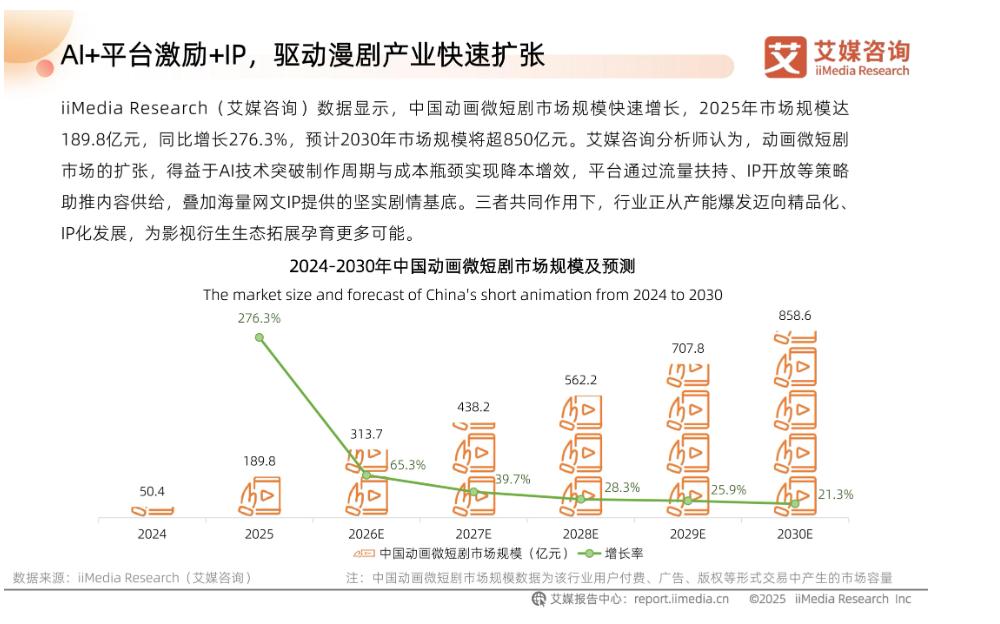
Image sourced from iiMedia Research
2026 has been further defined by the industry as the "first year of live-action AI short dramas", with capital, platforms and production parties all ramping up their layouts in this sector.

Image sourced from Douyin
But beneath this boom lies a hidden reality: over 90% of comic drama companies in the industry are not profitable. In other words, the vast majority of the flood of new players are losing money just to chase visibility.
Where does the problem lie?
AI tools have indeed driven production thresholds down to rock-bottom prices. Content that used to take a team a week to shoot can now be completed by one person sitting at a computer typing a few prompts. But the price of this lowered threshold is that competitive barriers have been pushed to the extreme.
Because everyone can do it, competing on efficiency has become the only path. But when everyone is competing on efficiency, efficiency itself ceases to be an advantage.
Thus we witness a cruel divergence.
Either, create ultra-fast consumer products, producing hundreds of episodes daily, using scale to survive, grabbing a wave of traffic dividends before the platform algorithms catch up;
Or, create ultra-durable products, spending months polishing one IP, using emotion and trust to retain users, betting that fans will pay for the characters.
There is almost no middle ground.
This is the "life-or-death choice" facing AI short drama entrepreneurs today. And the vast majority of them chose the wrong destination from the very beginning.
Scaling to the Ceiling, Winning Hearts to Build Moats
From the end of 2024 to the first half of 2025, a group of MCN matrix accounts pushed the path of "maxing out traffic" to its extreme.
They used AI tools to mass-produce short dramas with themes like "humble son-in-law", "warrior god" and "dominant CEO", driving the cost per episode down to the thousand-yuan level, and frantically pushed out volumes of content for traffic investment. In the early stage, relying on platform traffic sharing, cases of top matrix accounts earning millions monthly were not uncommon.
But very soon, the ceiling crashed down.
Homogenized content flooded the market, and user swipe-away rates soared. User acquisition costs rose from a few cents in early 2025 to several yuan, with ROI for a large number of accounts breaking below 1.0.
At the same time, Douyin and Kuaishou began to apply algorithmic traffic restrictions to "low-quality, homogenized" AIGC content, causing traffic for some matrix accounts to plummet off a cliff.
According to reports from Tech Planet, industry insiders revealed that platform reviews began to tighten from March and April. Comic drama output was high but getting content approved became difficult, with the one-pass approval rate dropping sharply from the previous 60% to around 30% or even lower. This means that with unchanged costs, revenues were directly cut by roughly one-third.
Those who ran to the end of the traffic path found that the end was a wall.
On the other track, players who made their way into fans' hearts followed a completely opposite logic.
They did not compete on output volume, but on aesthetics, thematic depth and production details. Essentially, they were using AI tools to do "handcrafted work".
Independent creator @Spongecake serialized self-made AI short drama "I Swapped Souls with the Person I Hate the Most" on platforms including Douyin, Xiaohongshu and Bilibili. With its unique visual style and delicate storytelling, likes per episode steadily exceeded 10,000. The creator not only secured brand advertisements, but also received an exclusive interview invitation from Keling official team.


Image sourced from Xiaohongshu and Bilibili
A similar story happened with @Chunri Dongman, an account under Yuxiao Entertainment MCN. It gained 200,000 fans with the work "Engine Oil Stained with Fragrance", and the two most common words in the comment section were "update soon". Even if peers used the exact same script, fans still only recognized its version.
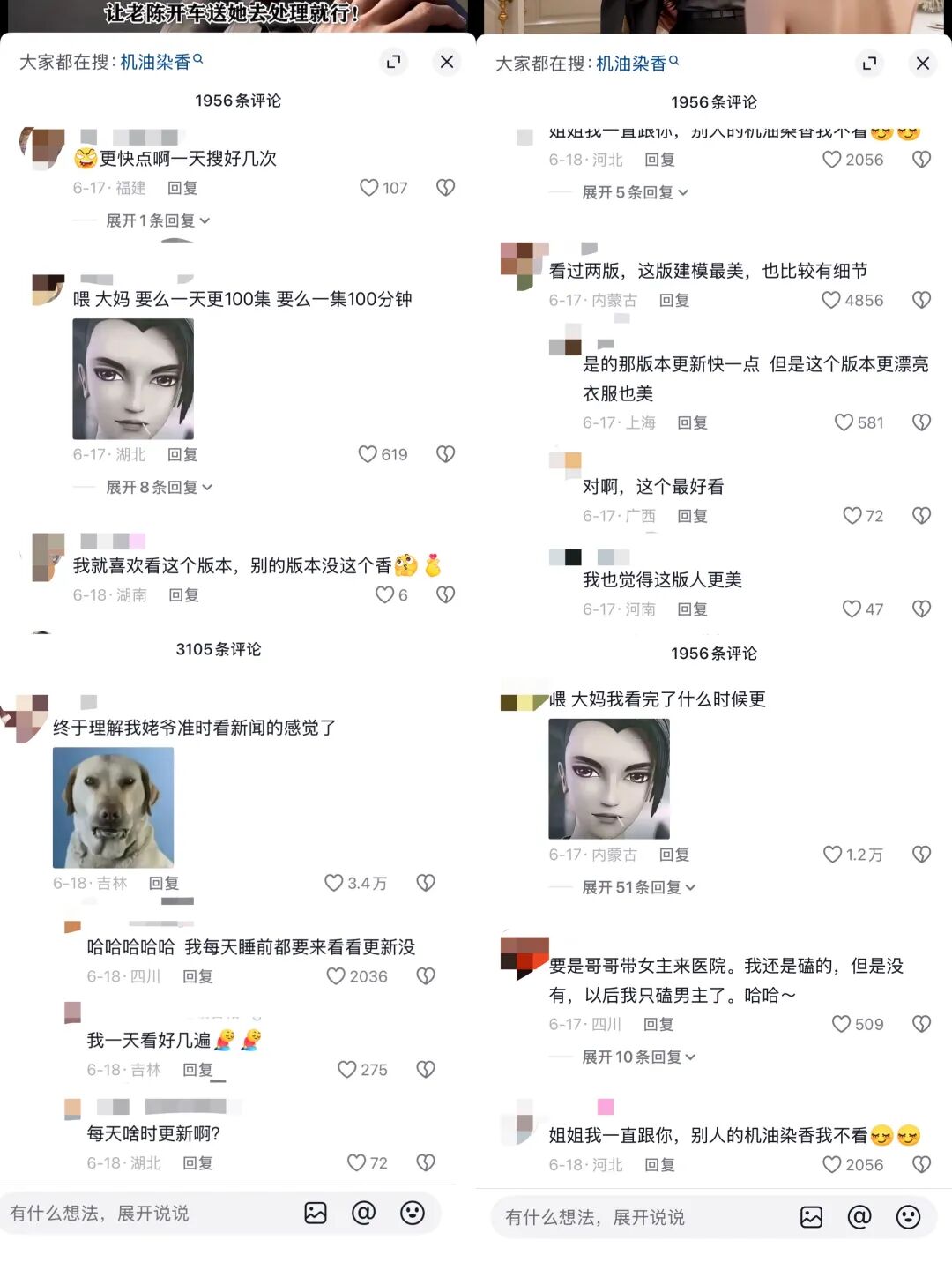
Image sourced from Douyin
The reason is simple: its 3D modeling is more refined, with more attention paid to details like clothing folds and light and shadow effects. These "painstaking efforts" form an irreplaceable competitive barrier.
In the view of "TopKlout", the moats of these two directions are completely different.
The traffic track competes on efficiency and cost, with its ceiling being platform algorithms and user tolerance. Once the algorithm changes, revenue can drop to zero. The fan track competes on creativity and IP cultivation patience, with its ceiling being the depth of emotional resonance. Once an IP is firmly established, its value increases as time accumulates.
But the harsh reality is that there is a huge mismatch between the capability model of most teams and their choices.
Those who excel at scaling content may not have the patience to polish quality works, while creators with content genes often look down on the traffic business. It is this mismatch that has spawned a third playbook.
Dual-Track System: The Most Rational High-Stakes Gamble
Faced with this life-or-death choice, many leading MCNs have come up with the dual-track system as their solution. Since choosing either side could lead to mistakes, bet on both.
The so-called dual-track system refers to using large-scale AI mass production of content to maintain cash flow, while deploying elite teams to focus on original AI IP development, aiming for brand upgrading. One leg scales content to sustain operations, the other builds IP to achieve breakthroughs.
Sounds reasonable, right?
But not everyone can pull off this strategy.
A large number of small and medium-sized teams tried to replicate the dual-track model, only to lose on both sides: their mass-produced content was demoted by platforms due to scattered resources and declining quality; their premium content direction failed to produce works distinct from shoddy products due to a lack of screenwriting and directing talents.
This reveals a harsh truth: the essence of the dual-track system is capability transfer, not simply adding an extra production line.
Teams that excel at creating "traffic-oriented" content may not have the genes to build IP; creators who can polish high-quality works will likely end up with unsatisfactory results on both sides if forced to focus on scaling content.
Teams without inherent content genes cannot make either track work properly.
But regardless of whether the dual-track system works or not, all players must ultimately answer the same question: where does the money come from?
Where Does Revenue Come From? Three Profit Models and Three Ways to Survive
At the AI short drama gaming table, the people who can actually make money are probably completely different from what you imagine.
Category 1: Top-tier premium works that enter platform revenue-sharing pools.
This is the most "orthodox" path for AI short drama commercialization: create high-quality works, enter revenue-sharing programs, and secure brand placements.
Represented by Hongguo Short Drama, the platform has established a tiered premium support and revenue-sharing system for high-quality AI short dramas, offering high minimum guarantees plus tiered revenue-sharing dual benefits for S and S+ level top AI comic dramas and AI live-action short dramas. Relying on its huge user base of over 300 million monthly active users and highly immersive viewing scenarios, Hongguo AI Short Drama has also become a high-quality content carrier for brand placements and scenario-based product promotion, thanks to its differentiated stylized visual presentation and young content audience.

Image sourced from Hongguo Short Drama
But very few teams can make it onto this path. The thresholds for screenwriting capabilities, production standards and platform relationships are no lower than those of traditional film and television.
Category 2: Dimensionality reduction monetization through post-conversion links.
A more hidden yet more stable way to make money comes from online novel and game platforms.
Some companies with IP reserves position AI short dramas as "advanced user acquisition materials", using AI to quickly generate short dramas adapted from high-energy clips of novels or games, which are then distributed on Douyin and Kuaishou, with users redirected directly to the corresponding apps after clicking.
According to industry observations, the post-link conversion efficiency of this model is significantly higher than that of traditional feed ads. The profit does not come from the short drama itself, but from paid reading and game top-ups in the subsequent links. The short drama is merely a "bait" to attract traffic.
This is why some AI short dramas leave you wondering how they make money — because they were never meant to profit from the short drama itself.
Category 3: Paid unlocking and fan economy.
Some AI short dramas with strong suspense and highly appealing characters are being tested on platforms with a "free first few episodes, paid unlock for subsequent content" model. The key to this path is that the IP must have characters that users genuinely care about.
A notable phenomenon is that some virtual characters incubated in AI short dramas are developing independent commercial lives — they have fan groups, start live-streaming marketing, and generate revenue beyond the dramas themselves. This is the most appealing yet hardest-to-replicate monetization ceiling for AI short dramas.
But all three categories above belong to the "successful" players.
The path for most people is to stop updating, then switch to another way of survival.
Since the second half of 2025, a large number of AI short drama accounts have fallen into stagnation. But their operators have not disappeared; instead, they have shifted to three hidden survival modes: first, "selling shovels", transforming to offer AI short drama training, with course sales profits eight times higher than drama production within half a year; second, "harvesting the remains", converting discontinued accounts into novel promotion accounts or game promotion accounts to capture the last wave of long-tail traffic; third, "taking OEM orders", exiting the C-end battlefield and taking on B-end orders such as cultural tourism promotion and brand customization, with stable demand and mild competition.
When the gold rush recedes, those who sell shovels are always the most stable. This is a business far older than AI short dramas.
Closing Remarks
At this point, we can return to the initial choice.
Seize the market horizontally, or enhance user stickiness vertically? Neither path is absolutely better, but the industry has crossed a critical inflection point: traffic dividends are fading, and trust dividends are on the rise.
If you have automated production lines and post-link monetization channels, horizontal market expansion remains a viable short-term business. But you must be clear that this is a race against algorithms, which could end at any time with rule changes.
If your core competitiveness lies in your understanding of stories, human emotions and visual expression, vertical deep cultivation is the only path to long-term value. You need to be able to endure loneliness, dare to spend one or two years nurturing an IP, and accept the reality of no profit in the early stage.
Follow through or exit? Our judgment is: staying stuck in indecision, trying to have it all, is the biggest cause of failure. Exiting gracefully is not shameful, and reconciling with yourself is a required course for entrepreneurs. But if you choose to move forward, you must complete a cognitive leap: from "AI can make short dramas" to "using AI to plant good stories deep in people's hearts".
AI can generate millions of frames of images, but it cannot create a moment that people care about. In this casino where algorithms spin at high speed, only those who root themselves deep in people's hearts will never be cleared off the table.