From Tata leaks to Tesla's exit: The closing argument for India's new energy vehicle dream
At the end of June 2026, a notification from the dark web sent simultaneous waves of tension through Cupertino and Palo Alto. Tata Electronics, Apple's core manufacturing partner in India, had its internal network breached by the ransomware group WorldLeaks, with over 200,000 confidential files totaling 630GB uploaded online for unrestricted public download.
The leaked materials included not only the motherboard schematics of the iPhone 18 Pro, specifications for the A20 Pro chip, camera module parameters, but even the supplier list that Apple has long regarded as its top-tier trade secret.
Yet outside the spotlight of mainstream public discourse, this unprecedented massive commercial data leak at the Tata Group also involved Tesla. The globally renowned new energy vehicle giant had a large number of component design documents that it had commissioned Tata to manufacture in recent years, which were also exposed to the public alongside Apple's confidential information.
On one side was Apple, which suffered catastrophic losses, and on the other was Tesla, which was caught in the crossfire. Countless core competitive assets of these two global leaders in their respective industries were completely leaked in a single cyber intrusion incident.
Tata is India's largest conglomerate. Its subsidiary Tata Electronics acquired Wistron's Indian iPhone plant in 2023, then took a 60% stake in Pegatron's Indian subsidiary in 2025. It is estimated that Indian-manufactured iPhones will account for 26% of the global total in 2026. However, this company, which Modi had positioned as the "face of Make in India", had servers exposed to the public internet, severely flawed permission isolation, and high-privilege accounts that could be easily compromised with a single phishing email.
From the perspective of the automotive industry, this massive fiasco at Tata only makes sense when viewed in conjunction with several other concurrent news stories from the same timeline.
In the first half of this year, Reliance Industries' power battery cell project in Jamnagar, which was billed as India's equivalent of CATL, had faced three consecutive delays since 2021. The project was eventually forced to adopt a scaled-down implementation plan after its scheme of acquiring production equipment from China at the end of last year to steal technical blueprints completely collapsed. The original goal of in-house cell manufacturing to achieve full self-sufficiency across the entire EV PACK production chain was abandoned, and the company reverted to importing finished cells from China for in-house assembly. Even so, the annual production capacity that finally came online reached only 1.4GWh.
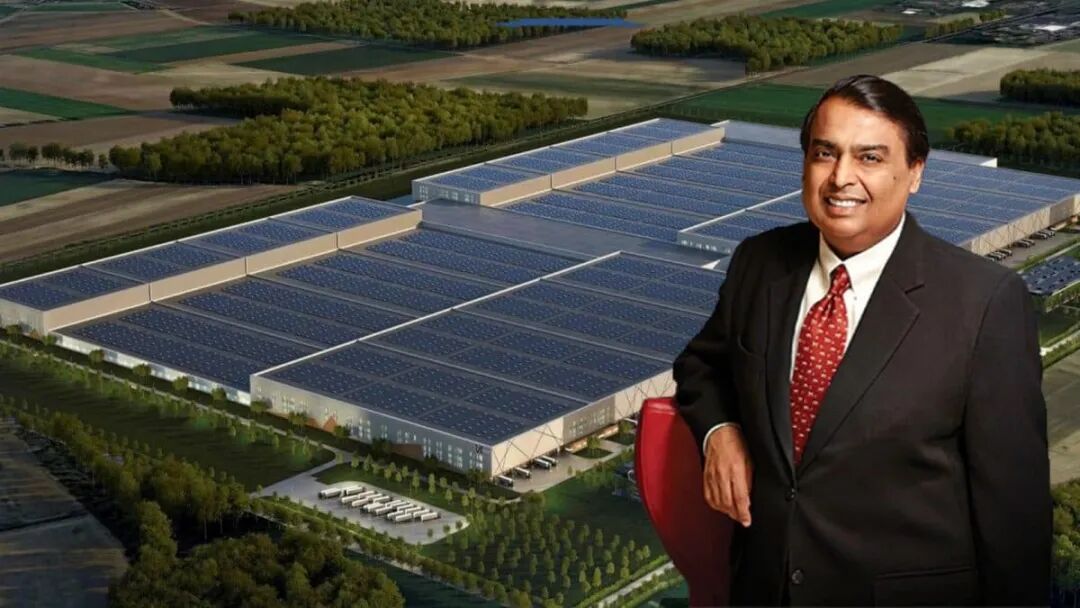
Figure | Promotional image from the Reliance Group showcasing its battery gigafactory in Jamnagar, Gujarat, India. The person in the photo is Chairman Mukesh Ambani
However, Reliance's failure is far more than just a single project setback. It essentially reflects that India's new energy vehicle industry plan, which has been in place for the past five years, has reached a complete dead end after five years of chaotic implementation. Back in 2021, the Indian government pledged to invest 181 billion rupees (approximately $2 billion at the time) in its PLI-ACC (Production-Linked Incentive for Advanced Chemistry Cells) scheme, with the ambitious goal of building 50GWh of local power battery capacity within five years, which it hoped would create over 1 million jobs across the entire industry supply chain.
As of May 2026, the result of this policy is that the total operational local power battery capacity in India, including cell assembly operations, is a mere 1.4GWh, achieving a fulfillment rate of only 2.8%. Calculated based on an average 70kWh battery per pure electric vehicle, this capacity can only meet the demand for 20,000 vehicles. For Modi, who had overhyped the initiative, it is no surprise that almost none of the promised subsidies were actually disbursed.
After five years of negotiations between Tesla and India, India's Minister of Heavy Industries officially confirmed in May 2026 that the "India Gigafactory plan has been permanently terminated".
With complete failure in domestic cell manufacturing, zero disbursement of pledged subsidies, and the exit of the industry's leading player, even a top-tier contract manufacturer like Tata managed to leak unreleased product information from both Apple and Tesla online. By mid-2026, Modi's new energy vehicle initiative, announced back in 2017, was no longer suffering from slow implementation - it had fundamentally failed.
The Ambitious Vision on Paper and the Harsh Reality
On March 31, 2024, in New Delhi, India's capital, officials from the Ministry of Heavy Industries, in an almost panicky manner, pulled the plug on the FAME II subsidy scheme (Faster Adoption and Manufacturing of Electric Vehicles Phase II) a full 15 months ahead of schedule. This was supposed to be the flagship project of India's electric vehicle revolution, costing hundreds of billions of rupees, designed to pour real money into building an "Electric India".
However, as leading companies such as Hero Electric and Benling India came under investigation for allegedly defrauding nearly 3 billion rupees in subsidies, the scheme left behind not industrial prosperity, but a chaotic mess of regulatory failure.
This hasty termination perfectly encapsulates the broader reality of India's new energy vehicle policy: grand fanfare at the launch, followed by an unsustainable outcome. Dating back to 2016, the Indian government wove a seemingly comprehensive policy framework to catch up with the global decarbonization wave. From the demand-side FAME series schemes to the manufacturing-side Production-Linked Incentive (PLI), and the Scheme for Promotion of Manufacturing of Electric Passenger Vehicles in India (SPMEPCI) designed to attract foreign investment, its policy toolkit was as extensive as that of any major manufacturing nation. Yet when we shift our gaze from official white papers to the harsh realities of implementation, we see a completely different picture: a grand narrative is undergoing systemic collapse.
The aforementioned disastrous failure of the Reliance Group in its attempt at domestic lithium cell manufacturing was part of the PLI scheme. But by the end of 2025, not a single rupee of this massive subsidy had been disbursed. Beyond Reliance wasting huge sums of money on equipment that sat idle and rusted, the core issue was that the initially selected winning bidders were all highly unqualified. Apart from energy giants like Reliance Industries, the rest were industry outsiders with no battery expertise, such as Ola Electric (focused on electric scooters) and Rajesh Exports (focused on gold exports). The evaluation criteria heavily prioritized local content scoring, which effectively locked out established foreign power battery manufacturers with mature technologies. The end result was that "domestic power battery production" was reduced to nothing more than an empty slogan.
If the stagnation of the battery scheme was a case of ambition exceeding capability, then the SPMEPCI scheme targeting vehicle manufacturing faced a collective rejection by foreign investors.
The scheme was designed to use tariff reductions as an incentive, requiring global giants like Tesla and BYD to invest in local production facilities in India. However, the harsh conditions - a minimum investment of $500 million, year-on-year increasing local content requirements, and a steep 3% penalty for non-compliance - were clearly a predatory trap. Coupled with the Indian government's infamous "retrospective tax" practices, its well-documented reputation for arbitrary treatment of foreign investors, and repeated intrusive reviews of foreign companies, the inevitable negative outcome was hardly unexpected.
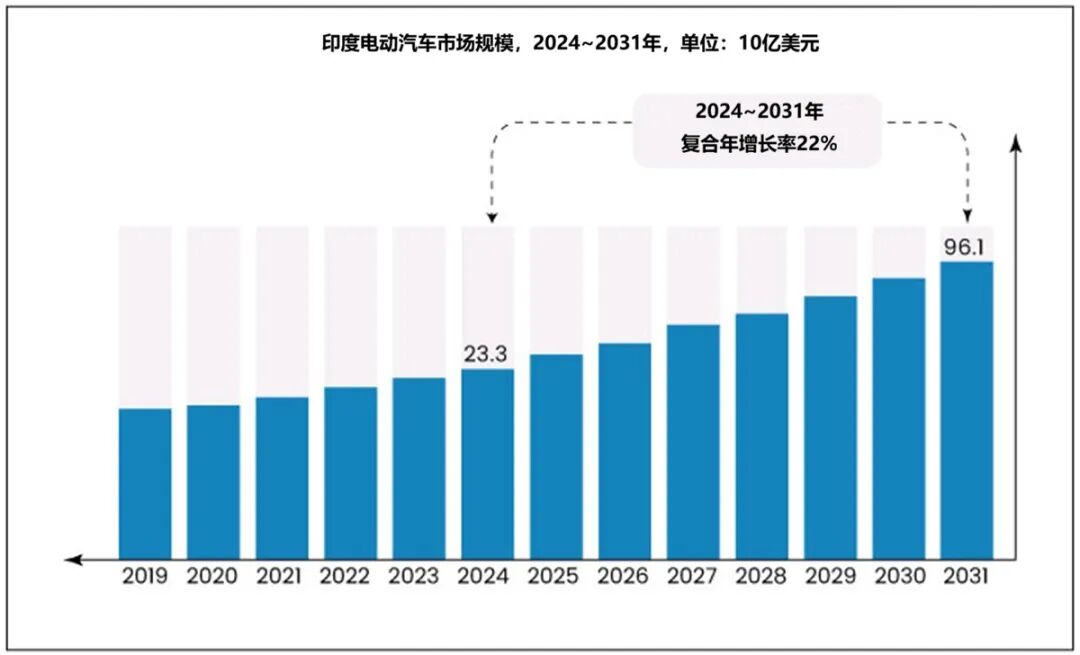
Figure | A 2016 trend forecast chart for India's new energy vehicle market over the following 15 years, published by the leading UK market research firm Persistence Market Research. To be frank, from today's perspective, this is less a rigorous market forecast and more of a wishful thinking
On October 21, 2025, the application window officially closed with a grand total of zero submissions. This marked the total collapse of India's "market for technology" bait-and-switch model. BYD did explore opportunities back in 2023, proposing a $1 billion investment plan to build a 100,000-unit annual capacity vehicle plant in India using CKD (Completely Knocked Down) assembly. But Indian authorities rejected the CKD model, demanding that a large number of supply chain enterprises be forced to set up local operations. BYD subsequently abandoned its application, opting instead to pay high import tariffs while retaining full operational control.
Similarly, Tesla also officially abandoned its factory construction plans, choosing instead to test the market by importing high-priced vehicles. The two new energy vehicle giants from China and the US reached exactly the same conclusion about the Indian market.
The policy chaos has directly rippled through to the market level. The PM E-DRIVE scheme (India's National Electric Mobility Mission), which replaced FAME II, extended its deadline to 2028, but drastically cut subsidy amounts to fill the fiscal gap, halving per-unit subsidies for two-wheeled vehicles. This led to the rapid collapse of Ola Electric, the highly touted local EV startup. Once lionized by SoftBank and Indian media, the company is now mired in a flood of quality complaints, with over 95% of its showrooms shut down for lacking proper operating licenses, and sales plummeting off a cliff. Ola's struggles expose the industry-wide crisis: caught between fading subsidies and a fragmented supply chain, local assembly operations with no core technological expertise cannot survive.
Today, India's streets still echo with the roar of internal combustion engines. While officials continue to repeat the slogan that "30% of new vehicle sales will be electric by 2030", the reality is that EV penetration for passenger cars hovers around 4%, with a vehicle-to-charger ratio as high as 235:1. From the prematurely terminated FAME II, to the PLI-ACC scheme that delivered zero results, to the SPMEPCI scheme that attracted no interest at all, India's new energy strategy is trapped in an impossible loop: it wants high tariffs to protect its fledgling domestic industry, yet cannot provide a functional supply chain. It craves foreign investment to bring in technology, yet refuses to grant foreign investors the respect and security they deserve.
The drumbeat of policy announcements continues, but all India has to show for it are half-finished factory ruins that will never be completed. This high-stakes gamble has been a total and utter failure.
The Unresolvable Deadlock: Protection Cannot Escape Dependency
The collapse of India's new energy strategy was not caused by a single accidental misstep. From the very beginning, it was constrained by several structural deadlocks that interlock and tighten the more India struggles.
The first deadlock is the delusion of "de-Sinicization" in the supply chain.
Indian policymakers have a clear calculus: the core of new energy vehicles is not the finished car itself, but the three core electric systems (battery, motor, electric control) that sit at the top of the supply chain, which are overwhelmingly dominated by Chinese suppliers. Thus, from the PLI-ACC scheme to the DVA (Domestic Value Added) assessment under the PM E-DRIVE scheme, the implicit message of the policy design is clear: India wants the low-cost Chinese supply chain to drive EV penetration, but does not want Chinese companies to profit from the Indian market.
This clever calculation has resulted in a contradictory, self-defeating tug of war.
On one hand, 75% of India's lithium batteries and over 60% of its motor magnetic materials are imported from China. If India stops importing from China, it will have to source from Japan and South Korea at far higher costs. As a result, local content rates for the three core electric systems remain stuck at only 12% for batteries (counting only PACK assembly), and less than 8% for motor controllers. On the other hand, even after BYD's $1 billion joint venture proposal was rejected, the company faced visa denials for its executives and a combined $64 million "transfer pricing" tax audit. BYD ultimately decided to focus on fully built vehicle exports, absorbing the full 100% import tariff. Even under these conditions, BYD sold nearly 5,400 vehicles in India in 2025 - 15 times Tesla's sales volume. Choosing to pay tariffs rather than build a local factory is the clearest possible verdict on the investment environment.
The absurdity reached new heights in the PLI-ACC selection process. With so few companies willing to participate, after filtering out lead-acid battery manufacturers Exide and Amara Raja, the winning bidders were Reliance, Ola Electric (a two-wheeler EV maker), and Rajesh Exports (a gold export firm).
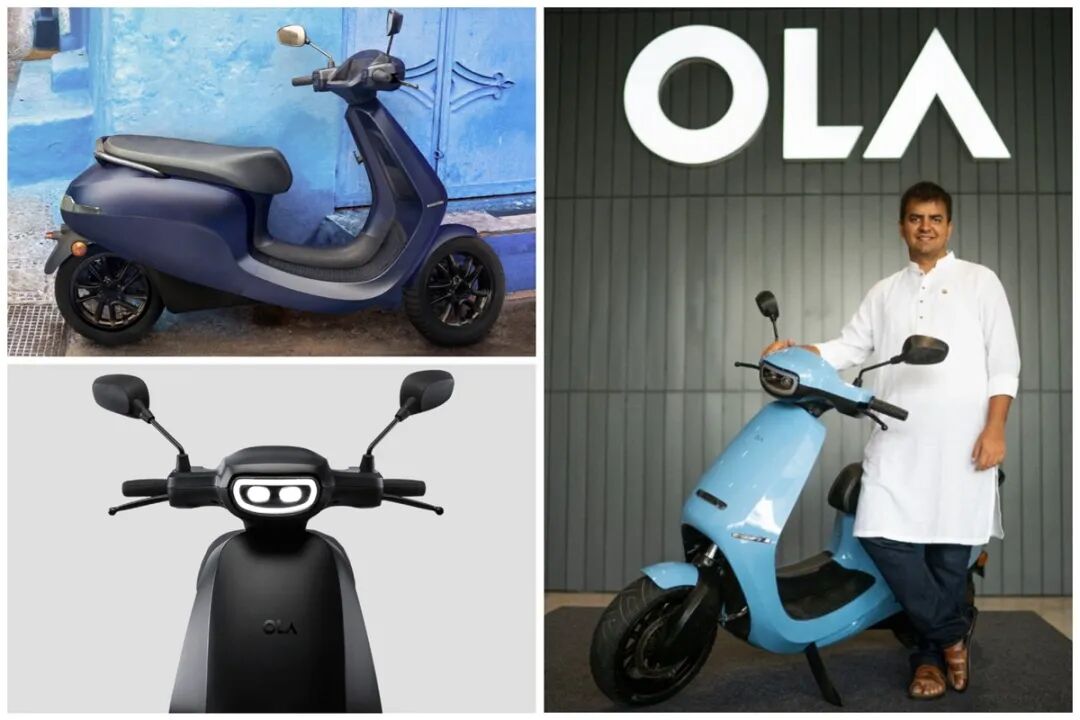
Figure | Ola Electric, a participant in the PLI-ACC scheme, whose core business is electric two-wheelers. The absurdity of this situation is equivalent to a domestic e-scooter brand in China announcing it will build lithium battery factories - no one would take that seriously. To make things even more ridiculous, the other winning bidder Rajesh Exports is a company specializing in gold import and export...
The second deadlock is the predatory "nurture then slaughter" investment attraction model, which no rational investor would fall for in 2026.
The design logic of SPMEPCI is classically Indian: it requires investors to pour $500 million into building factories first, then achieve 25% local content within three years and 50% within five years, before qualifying for a reduced 15% tariff on vehicles priced above $35,000 (down from the original 70%-110% rate). But there is a catch: the preferential tariff quota is limited to only 8,000 vehicles per year. There are also mandatory local sales targets: starting from the fourth year, annual sales in India must reach 50 billion rupees, rising to 75 billion rupees in the fifth year, with a 3% penalty on total sales for non-compliance.
In reality, business negotiations are often about making bold opening offers before reaching a compromise. Elon Musk spent five years negotiating with Indian officials starting in 2021, with talks deadlocked over whether tariffs should be cut first or factories built first. Musk's position was that India should first reduce its 70-110% import tariffs to test whether Tesla vehicles could gain a foothold in the Indian market, before committing to factory investment. India, however, insisted that the $500 million factory investment must come before any tariff reductions. The end result was that after dragging its feet until 2026, Musk simply walked away from the deal.
In fact, India's infamous "graveyard for foreign companies" reputation, fueled by its retrospective tax policies, is well known worldwide. Beyond the high-profile Vodafone case, Ford suffered massive losses from arbitrary tax penalties, destroying India's credibility in the global business community. When the application window closed on October 21, 2025, the number of submissions from global automakers was zero. Although Hyundai, Kia, Mercedes-Benz, and Volkswagen had conducted exploratory visits, they only expressed "interest" in public and ultimately submitted no formal applications.
The third deadlock is policy instability, which has even harmed domestic industry players.
Some argue that foreign companies avoid India for fear of being exploited. But the reality is that India treats all companies equally badly, including its own domestic enterprises.
FAME II was originally designed as a three-year flagship scheme with a 100 billion rupee budget. But in May 2023, per-unit subsidies were cut from 15,000 rupees/kWh to 10,000 rupees/kWh. Then in February 2024, the government announced the scheme would be terminated on March 31 that year, over a year ahead of the original schedule. While officials claimed a replacement scheme would be launched, the subsequent PM E-DRIVE scheme, despite extending the deadline to March 2028, halved two-wheeler subsidies to 5,000 rupees, capped total eligible units at 2.479 million, and exhausted the quota for L5 category three-wheelers by December 2025, immediately closing the scheme.
The cost of these arbitrary policy shifts was that Ola Electric, the domestic industry showcase, became the first victim of the very subsidy rules it benefited from. The sudden reduction of subsidies caused its sales to collapse. Desperate to avoid the FAME subsidy cap,