Seres posted a huge loss of 1.8 billion yuan in half a year, its stock price has fallen for 9 consecutive months, and its market value has evaporated by 200 billion yuan
Why Are Sales Rising Yet Losses Keep Piling Up?
On the evening of July 12, Seris announced its 2026 semi-annual pre-loss forecast, projecting a net loss of 1.5 billion to 1.8 billion yuan for the first half of the year. In the same period last year, Seris posted a net profit of 2.941 billion yuan.
Among its entities, core subsidiary Seres Automobile Co., Ltd. (AITO Motors) recorded a net loss of 1.05 billion to 1.3 billion yuan in H1.
The puzzling detail is that on the sales front, Seris delivered a total of 160,779 units in H1, marking a 5.60% year-on-year increase; its Q1 financial report showed a gross margin of 26.24%, ranking it in the top tier of domestic automakers.
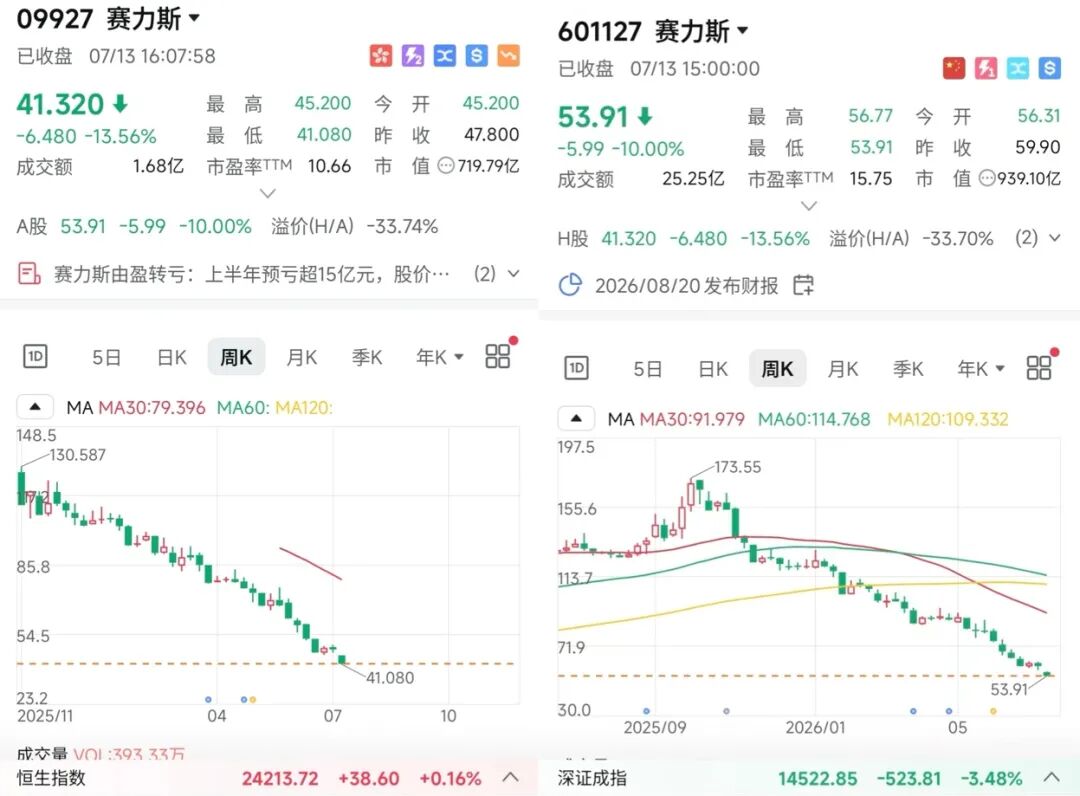
Right after the pre-loss announcement, Seris' A-shares hit the daily 10% limit down on July 13, while its Hong Kong-listed shares plummeted 13.56%.
Looking at the longer-term trend, Seris' stock price has been on a downward trajectory for more than nine consecutive months.
Taking its A-shares as an example, its market capitalization has fallen from a peak of just over 300 billion yuan to 93.9 billion yuan, eroding more than 200 billion yuan in value.
While Seris' A-shares once enjoyed a period of glory, investors in its Hong Kong-listed shares have faced far more painful returns.
Higher Production Costs and Asset Value Adjustments
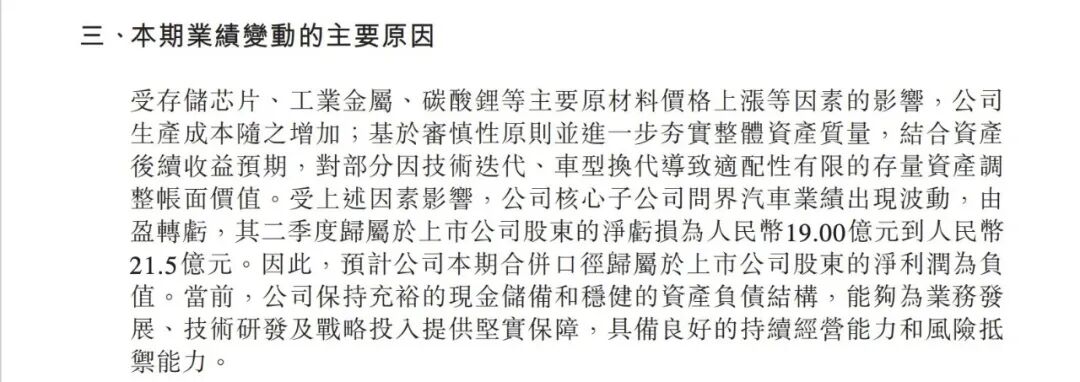
The announcement cited two key reasons for the projected losses: rising raw material prices and asset impairment.
Specifically, the price of lithium carbonate surged from 80,000 yuan per ton in the same period last year to 180,000 yuan per ton; storage chips saw an even starker jump, rising from 20 yuan per unit to nearly 100 yuan per unit, a fivefold increase.
AITO focuses on high-level intelligent driving and premium cabins, so each of its vehicles uses more chips and electronic components than other new energy vehicles, making the cost shock from raw material price hikes far more severe for its operations.
Seris Chairman Zhang Xinghai stated that due to the aforementioned factors, the average cost of each AITO vehicle has increased by 15,000 to 20,000 yuan.
Turning to asset impairment, the announcement used somewhat convoluted wording: "adjusting the book value of some existing assets with limited adaptability due to technological iteration and model updates."
In plain terms, this means that after new vehicle models are launched, molds for older models, outdated hardware inventories, and some production line equipment will no longer be usable — requiring a concentrated provision to write down their value, with the corresponding loss recorded in this period's financial results.
This type of loss is a standard financial practice during model transition phases, as it does not consume operating cash flow and will not recur repeatedly.
Shifting Sales Mix and Rising Expenses Despite Cost Pressures
Beyond the cost increases noted in the official announcement, changes to the sales structure have also impacted profits to a certain extent.
In H1 last year, AITO's best-selling vehicle was the M9, with an average price above 500,000 yuan, delivering over 62,000 units, followed by the M8 and M7.
This H1, the landscape shifted: the M7, priced around 300,000 yuan, became AITO's top seller, with the M6 taking on the bulk of sales volume in Q2.
While overall sales appear to be growing, per-vehicle profitability is not guaranteed.
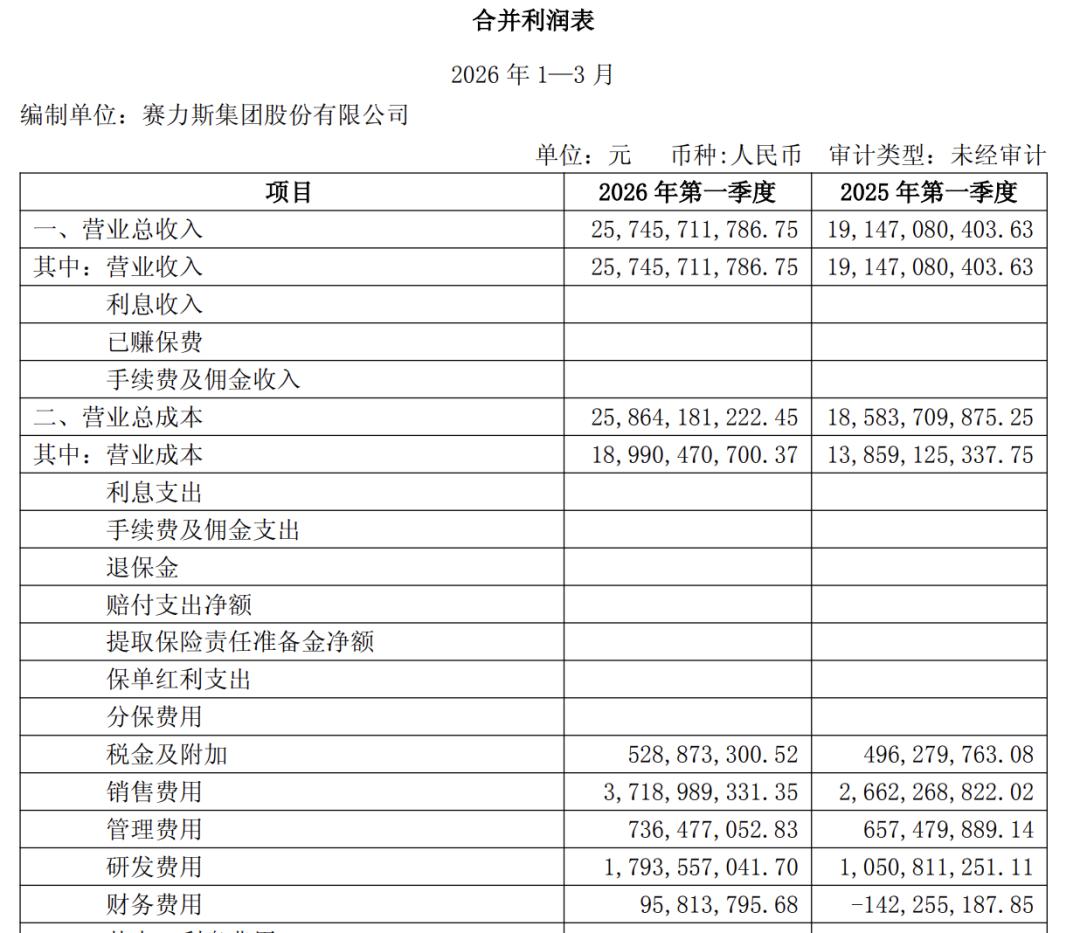
At the same time, Seris' sales expenses have surged dramatically once again.
Seris' total sales expenses for 2025 reached 24.19 billion yuan, representing a sales expense ratio of 14.7%. By comparison, BYD's sales expense ratio in the same period was only 3.3%.
In Q1 of this year alone, Seris' sales expenses hit 3.719 billion yuan, marking another 40% year-on-year increase.
Additionally, according to Seris' prospectus, the company paid 20 billion yuan in procurement fees to Huawei in H1 2025, accounting for roughly one-third of its total revenue in that period.
Estimating based on sales volumes from the same period, this equates to a payment of 136,000 yuan to Huawei for every vehicle sold.
Over the longer timeframe from 2022 to H1 2025, Seris has cumulatively paid Huawei over 75 billion yuan.
Diminishing Uniqueness and Industry-Wide Pressures
Even more concerning to investors than the losses is the fading exclusivity of the AITO brand.
Huawei's Automotive Business Unit is accelerating its "Five Brands in Parallel" strategy: alongside Seris' AITO, there are Chery's Luxeed, BAIC's Arcfox, JAC's Maextro, and SAIC's Shangjie.
The prime shelf space in Huawei's retail stores, priority for new technology launches, and marketing spotlight that once belonged exclusively to AITO are now divided among five partners.
That is not all. If Huawei's "Jing" series brands are also counted — including GAC's Qijing, Dongfeng's Yijing, and SAIC-GM-Wuling's Huajing — AITO would only hold a 1/8 share of Huawei's automotive ecosystem.
Jin Yuzhi, CEO of Huawei Intelligent Automotive Solutions BU, revealed that by the end of 2026, more than 80 vehicle models will be equipped with Huawei's ADS intelligent driving system, with total cumulative installations expected to reach approximately 3 million units.
At the same time, the entire automotive industry is facing challenging conditions. In H1 2026, domestic passenger car retail sales totaled 8.701 million units, down 20.2% year-on-year.
Due to the shrinking overall market, the vast majority of automakers have seen slower half-year sales growth, with their full-year growth targets under pressure, and the industry's average profit margin has fallen to just 3.4%.
With the domestic market becoming increasingly saturated, what about overseas expansion? The overseas market is far less fiercely competitive than the domestic one, and each vehicle sold there can generate higher profit margins.
In H1 2026, China's auto exports reached 5.096 million units, up 65.3% year-on-year, marking the first time half-year exports have surpassed 5 million units. June alone saw monthly exports exceed 1 million units for the first time.
But Seris missed this export wave. In full-year 2025, its total sales of pure electric vehicles across 17 overseas markets amounted to only 2,846 units, with Israel alone accounting for 1,720 of those sales.
By contrast, BYD exported 789,400 units overseas in H1, up 68% year-on-year, with overseas sales making up over 40% of its total volume; Chery exported 944,000 units in H1, up 71.5% year-on-year; Geely exported 474,000 units in H1, a staggering 158% year-on-year increase.
Launching Saida Auto and Entering Embodied Intelligence
Facing these multiple pressures, Seris is actively exploring new paths to break through its challenges.
On June 9 this year, Saida Technology, a subsidiary under Seris, launched a brand-new automotive brand called AIVA.
The strategy for this new brand is completely different from AITO's. AIVA has put forward the concept of "AI-Defined Vehicles" — prioritizing AI development first, then building the vehicle around it.
Its first mass-produced model, the AIVA ME7, is scheduled to launch in 2026, targeting the market segment above 200,000 yuan.
As a brand fully led by Seris itself, Saida Auto is partnering with ByteDance's Volcano Engine for in-cabin systems; for intelligent driving, it is collaborating with DeepMotion, seeking to explore an alternative development path outside of Huawei's ecosystem.
Another strategic direction is embodied intelligence.
On June 15 this year, Seris' humanoid robot "Xiao Sai" made its debut, capable of completing full-process operations including autonomous walking, visual recognition, voice interaction, material handling, and in-store reception services.
The company also announced that it will roll out a series of embodied intelligent products within 2026, including bipedal humanoid robots, quadruped robotic dogs, and wheeled collaborative robots.
Entering the robotics industry at this juncture may not be early, but it at least catches the current window of opportunity.
From its earlier days as Dongfeng Xiaokang to its partnership with Huawei, Seris once reached its peak riding the success of the AITO brand.
Now that AITO's exclusivity is fading, whether these new initiatives can deliver new growth curves beyond AITO remains to be seen.
This article is from the WeChat public account "Tech Daily Push" (ID: apptoday), written by Xiao Rujian, edited by Zhou Weipeng, and published with authorization from 36Kr.