Why do milk tea shops treat empty bottles of Xianyuehuo like they are worshipping a deity?
Recently, while ordering milk tea, Mr. Bad Review noticed a strange thing: in the past, the staff at the beverage bar would hide the ingredients they poured into the machine as much as possible, doing everything they could to prevent customers from seeing exactly what was in the buckets.
Now, however, many milk tea shops are openly placing bottles of "Yuexianhuo" on their counters, and some stores even stack the empty bottles up as a visible, eye-catching signboard.
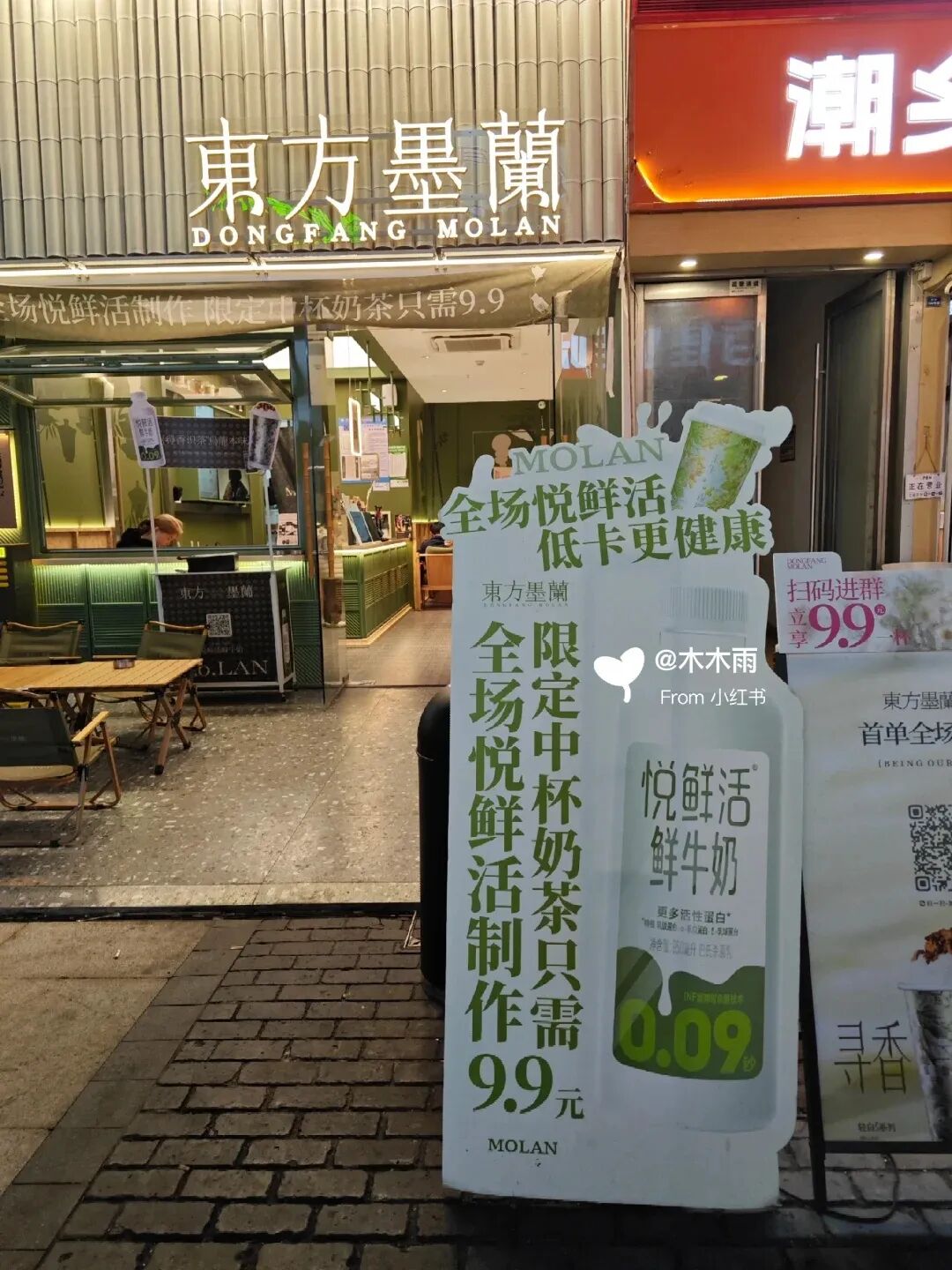
Some netizens have joked that Yuexianhuo is like a man's 180cm height: if you have it, you will definitely find every possible way to show it off.
We did a quick bit of research and found that Yuexianhuo's breakthrough into the tea and coffee industry did not happen overnight.
Back in 2023, Yidiandian launched a "switch to fresh milk" option nationwide. For an extra 3 yuan, customers could replace non-dairy creamer with Yuexianhuo. A year later, Yidiandian went a step further and directly launched its A2 Fresh Milk series, putting the Yuexianhuo name right into the product title.
Driven by the enthusiastic support of Yidiandian's loyal customers, Yuexianhuo made its first large-scale appearance in the view of milk tea and coffee lovers.
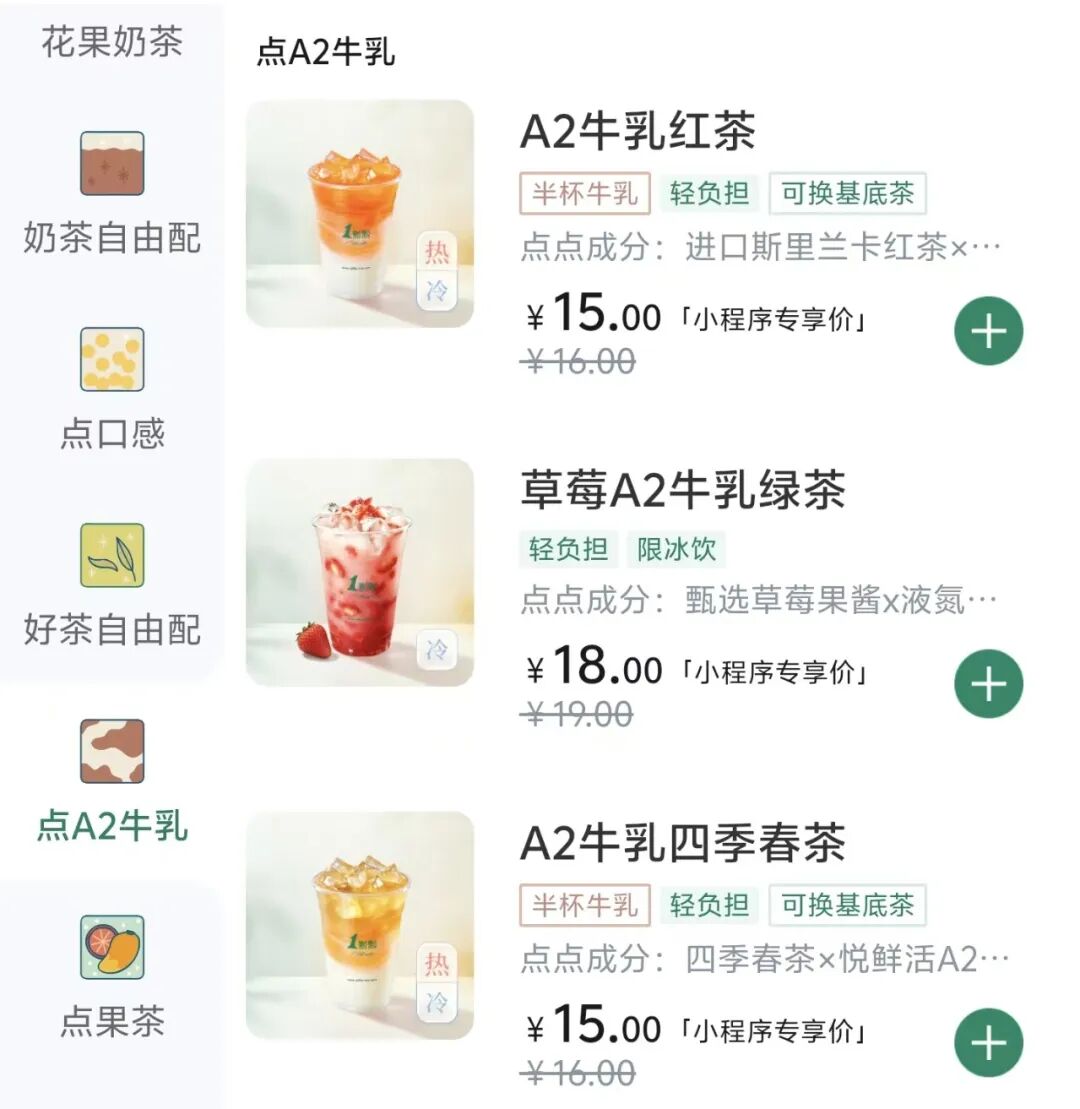
As the supply chain continues to improve, and consumers' demand for healthier milk tea surges, more and more brands have started including Yuexianhuo in their product names, ingredient lists, and menu descriptions.
Why do shops insist on showing off that they use Yuexianhuo to everyone who walks in?
Simply put, they are catering to consumers' increasingly discerning taste preferences.
With intense competition in the industry, using "real milk, real tea" has become the basic standard for the beverage sector. And according to Junlebao's prospectus, Yuexianhuo already holds a leading position in the domestic high-end fresh milk category by market share.

So when milk tea shops and coffee shops neatly stack these milk bottles — which you might even think are too expensive to buy in supermarkets — right next to the cash register, that premium, high-value feeling immediately hits you.
By displaying Yuexianhuo, the shop is essentially sending an implicit message: "Look, I'm using milk that you yourself would hesitate to buy at full price."
These outlets are using the simplest possible method to polish their own image by leveraging the established premium reputation of the Yuexianhuo brand.
What surprises Mr. Bad Review even more than the fact that so many milk tea and coffee shops use Yuexianhuo is that the ones proudly displaying these bottles are not just those high-end brands with an average order value of 20 to 30 yuan — they also include Lucky Coffee, which focuses on affordable coffee, and Mixue Bingcheng, which targets mass-market, low-tier beverage consumers.
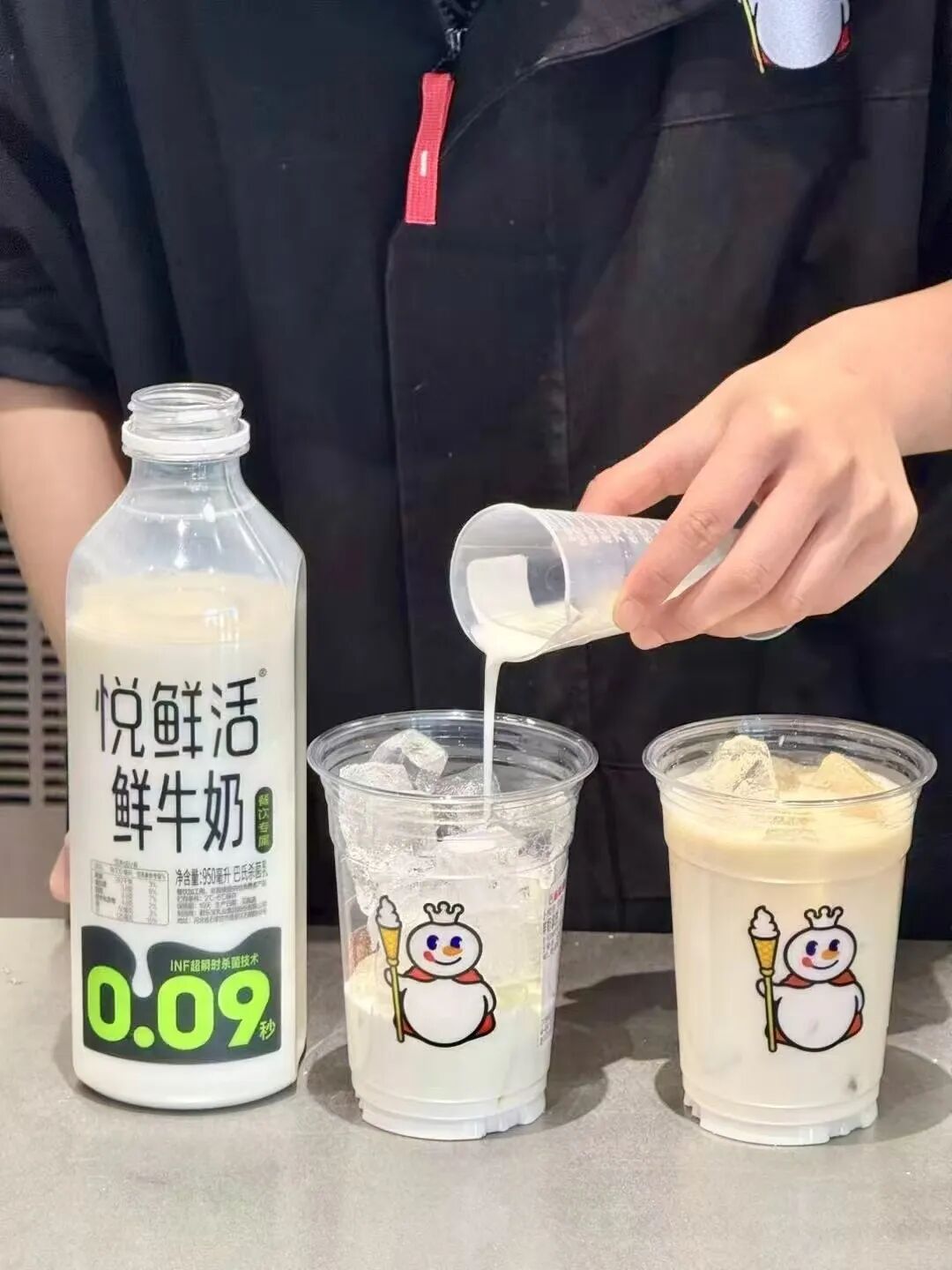
Even discount stores like Hotmaxx, which have branched out to run coffee stalls selling Americanos for 3.9 yuan and lattes for 6.9 yuan, still place Yuexianhuo bottles prominently on their counters.
What's even more remarkable is that after adding this seemingly pricey premium milk, these extremely low-cost drinks have not seen any noticeable price increases.
The answer is straightforward: because Yuexianhuo is not actually that expensive, and it should not be that expensive.
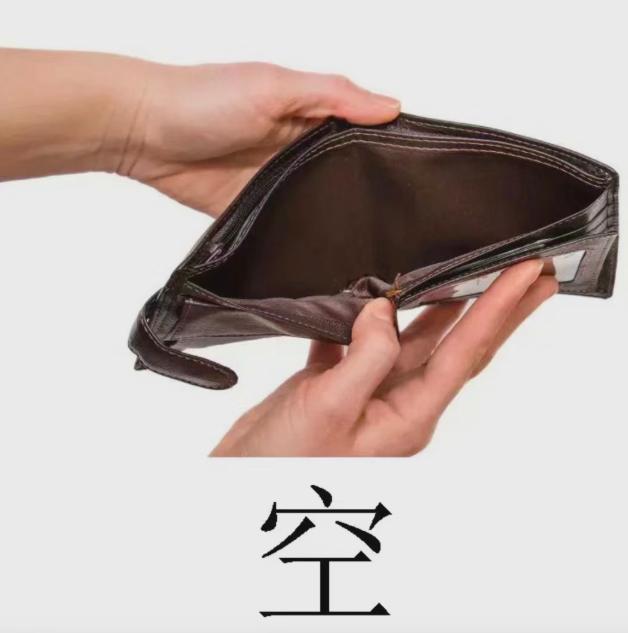
The reason we usually think Yuexianhuo is expensive is that we mostly see its retail price at offline convenience stores and supermarkets, which makes a small dent in our wallets.
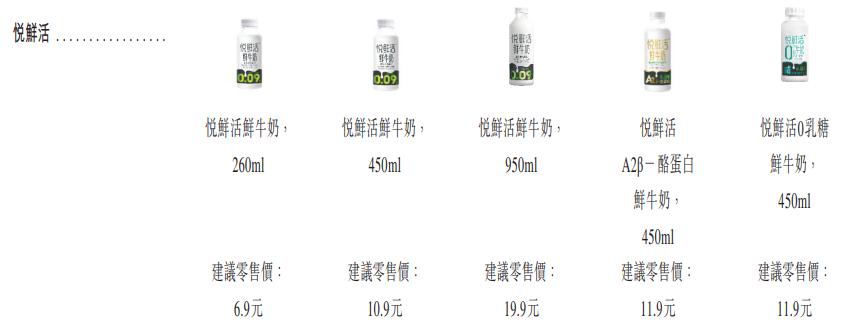
As clearly stated in Junlebao's prospectus, the suggested retail price for Yuexianhuo is 6.9 yuan for a 260ml bottle, 10.9 yuan for 450ml, and 19.9 yuan for 950ml...
Not to mention that many retailers do not follow Yuexianhuo's suggested pricing at all.
Once you look at online platforms, you will find that you can get Yuexianhuo at such a good discount that the low price feels almost unfamiliar.
Mr. Bad Review used to have a long-term subscription for Yuexianhuo fresh milk, and the price was roughly 10 yuan per liter.
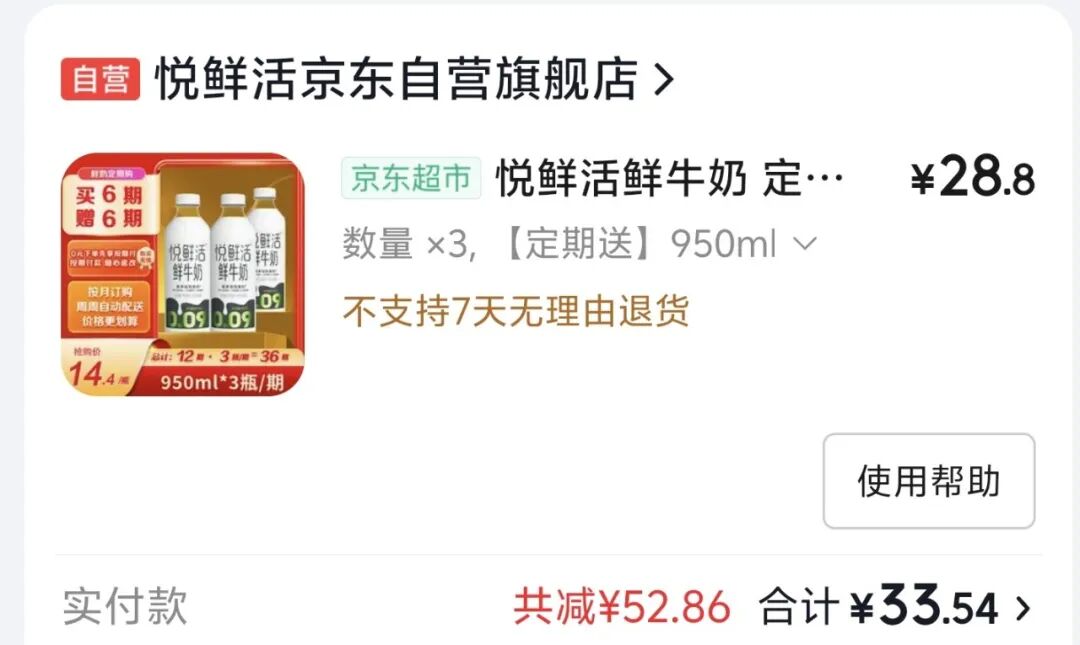
And for milk tea shops, their procurement cost is even lower.
Junlebao's prospectus mentions that the average selling price of its fresh milk category was around 10.0 yuan per kilogram in 2024, and dropped to roughly 9.4 yuan per kilogram in the first three quarters of 2025.
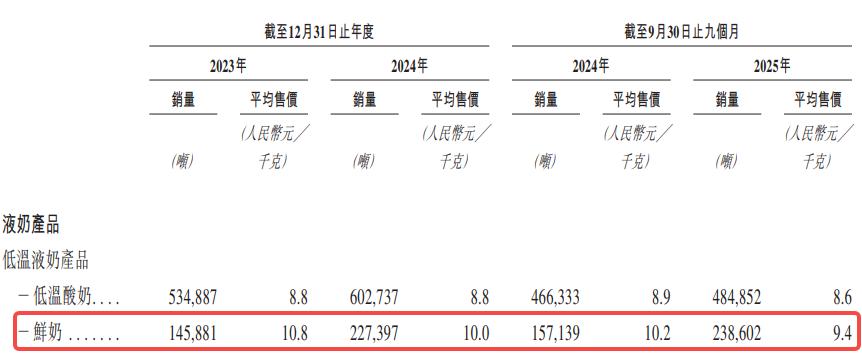
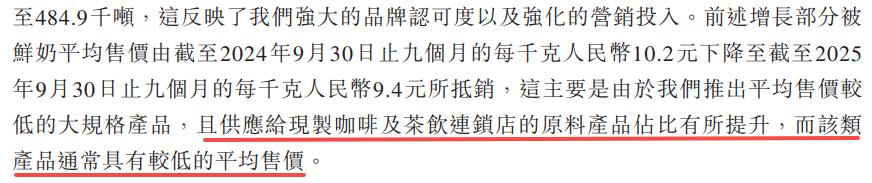
They also explicitly stated that one of the reasons for the drop in the average fresh milk price is the increased proportion of large-format products and raw material products supplied to ready-to-drink coffee and tea chains.
So the purchase price for milk tea shops is definitely even lower than the 10 yuan per liter we can get when shopping online.
The harsh truth is that we have been paying too much for Yuexianhuo in our daily purchases.
To explain this clearly, we need to talk about the hidden complexities behind the fresh milk industry.
Contrary to most people's expectations, the cost of a bottle of fresh milk is usually not determined by raw cow milk or production equipment, but by cold chain logistics and write-offs of expired products.
The milk we buy in our daily lives generally falls into two major sterilization process categories.
The first is pasteurization: heating milk at 72 to 85 degrees Celsius for a dozen seconds, which preserves the active nutrients and flavor to the greatest extent. The trade-off is a shelf life of only 3 to 7 days, requiring full-process refrigeration — cold chain vehicles make daily deliveries, the sales radius cannot extend beyond 150 to 300 kilometers, and all unsold milk on shelves has to be written off.
The second is ultra-high temperature (UHT) sterilization: exposing milk to temperatures above 135 degrees Celsius for a few seconds, resulting in a shelf life of at least six months. Most shelf-stable brick-pack milk uses this process, but the downside is that almost all active nutrients are destroyed, and the flavor is noticeably compromised.
Yuexianhuo takes a third path, the INF process that it highlights on all its packaging: instant sterilization at around 150 degrees Celsius for 0.09 seconds.
According to Junlebao, this process preserves the taste and most of the nutrients, while extending the shelf life to more than two weeks.
Don't underestimate that extra week or two: this allows milk to be transported across provinces in large batches with lower frequency, expanding the sales radius to over 1000 kilometers, and reducing the write-off rate of unsold products on store shelves.
All things considered, the commercial cost of this type of "ultra-pasteurized milk" is actually much lower than that of traditional pasteurized milk.
At this point, many people might question what Mr. Bad Review is saying about "ultra-pasteurized milk": according to your explanation, Yuexianhuo is heated to 150°C, so it should be classified as UHT sterilized milk, but the bottle I have at home clearly labels Yuexianhuo as pasteurized milk.
Some of Yuexianhuo's early packaging was simply marked as "sterilized milk"
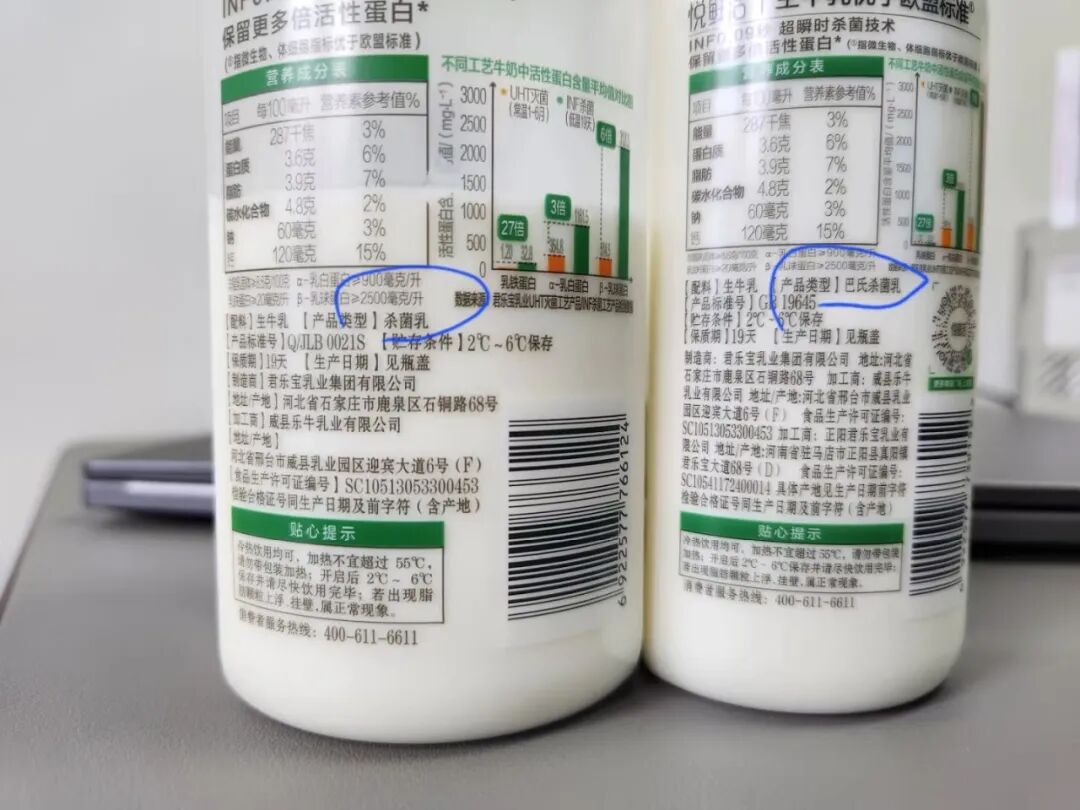
This is actually the discrepancy between the provisions of the national food safety standard and our common understanding.
We usually think of pasteurized milk as the product made by "heating at 72 to 85 degrees Celsius for a dozen seconds", but the problem is that under the current standard, pasteurized milk is not defined by its sterilization method.
The official standard wording states: "Liquid products made exclusively from raw cow (goat) milk as the raw material, through pasteurization and other processes."

In the final analysis, as long as the final product meets the required standards for protein content, maximum total bacterial count, coliform bacteria and other indicators, it can be classified as pasteurized milk.
In this way, Yuexianhuo effectively took an alternative route, bypassing the traditional pasteurization process to produce milk that meets the current national standard parameters for pasteurized milk, which allows it to label its product as "fresh milk" on the packaging.
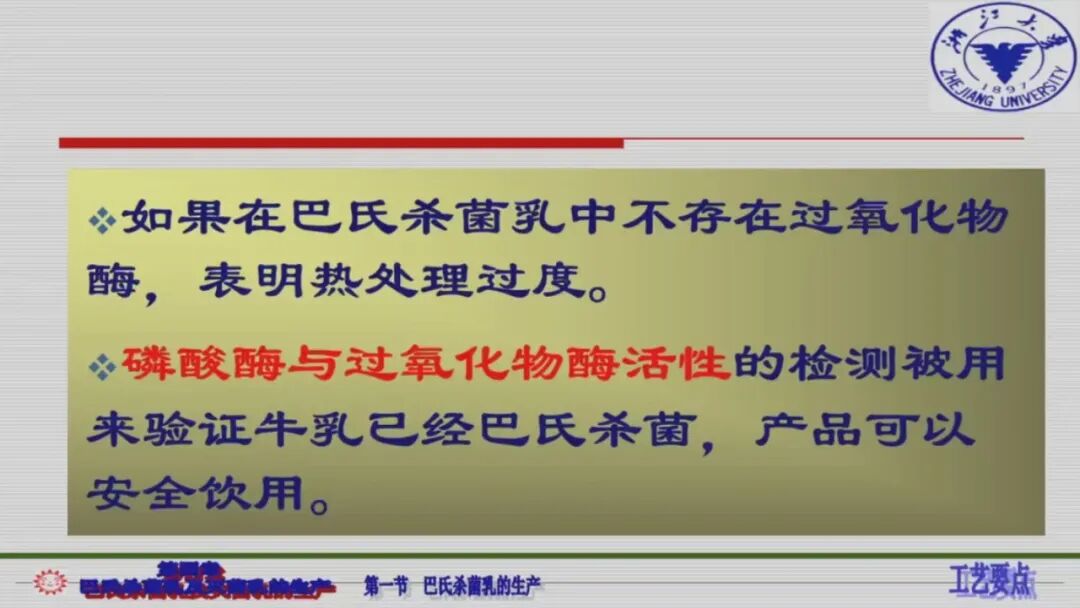
But if you make a direct comparison, even though Yuexianhuo, which uses the new high-temperature sterilization technology, has little difference from real pasteurized milk in key nutrients such as calcium and protein, most of the more delicate active substances like immunoglobulins and lactoperoxidase have been largely destroyed.
To be fair, Yuexianhuo hasn't really deceived us — the small print on the bottle is very clear:
Yuexianhuo claims that "compared to Junlebao's UHT sterilization process, this product retains more lactoferrin, α-lactalbumin, and β-lactoglobulin" — and it is not making that comparison against real traditional pasteurized milk at all.
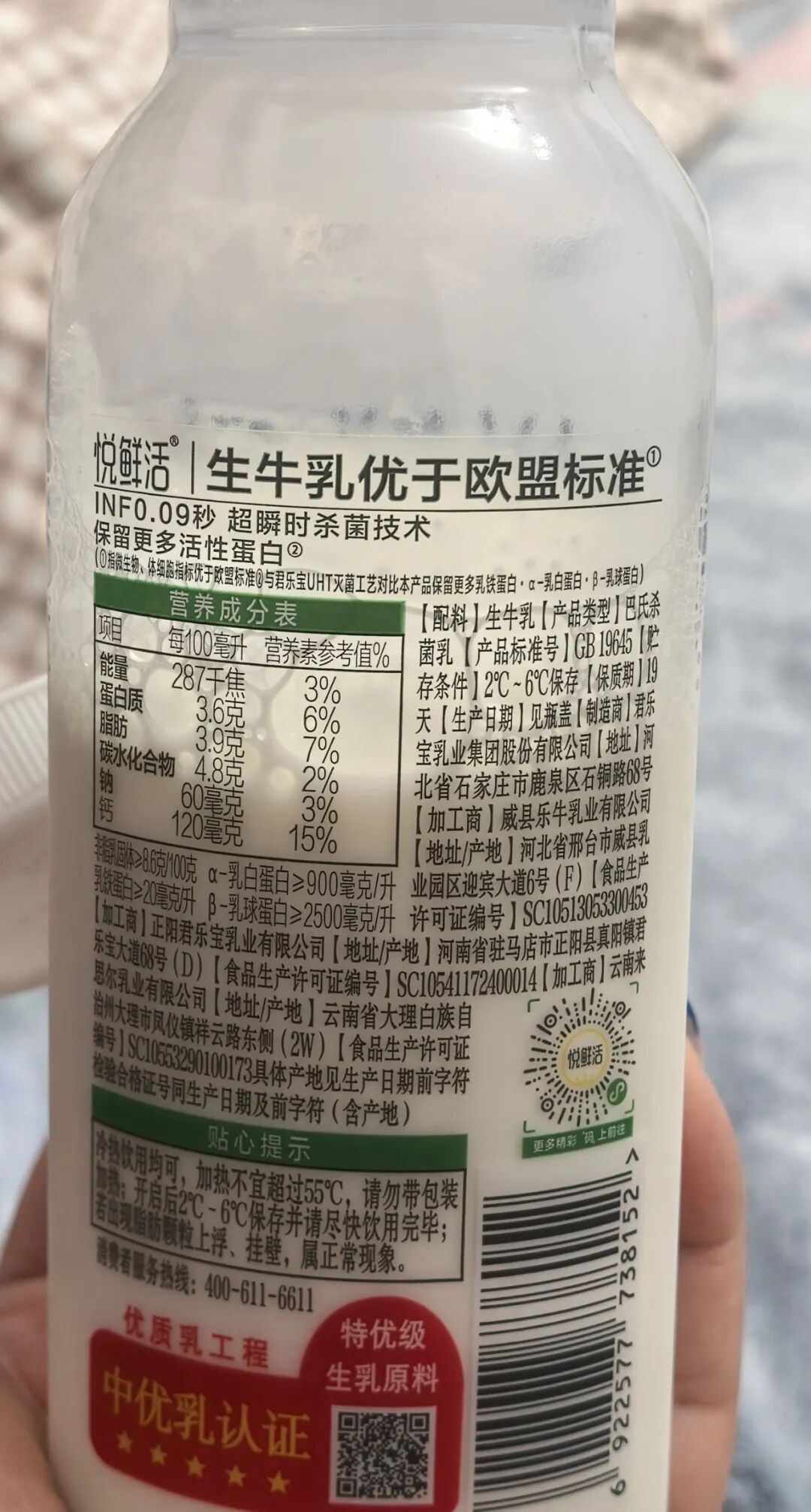
Moreover, this kind of "edge-walking" status that Yuexian