Why doesn't Pinduoduo fight the AI entrance war?
When AI redistributes consumption entry points, who can grasp the certainty of the merchandise world?
In China's internet landscape of 2026, AI entry points have become the de facto "lifeline of next-generation traffic" recognized across the entire industry.
Alibaba continues to ramp up investment in Tongyi Qianwen, ByteDance is fully iterating Doubao, Tencent has launched Yuanbao, and Baidu is holding firm to Ernie. Almost all leading platforms are frantically laying out large models, intelligent Agents, and all-in-one AI assistants, attempting to lock all users' consumption decisions within their own AI entry points.
Pinduoduo alone is an anomaly.
It has no self-developed general large model, no consumer-facing super AI assistant, and has almost been absent from this nationwide battle for entry points. Instead, it has poured hundreds of billions of funds into fully rolling out the "New Pinmu" initiative, diving headfirst into upstream industrial clusters to transform the supply chain.
The outside world generally interprets this as Pinduoduo missing out on the AI wave, being strategically conservative, and even predicts that it will be left behind by this round of technological revolution. But in reality, Pinduoduo never intended to play cards at someone else's table from the very beginning.
What exactly are the bustling AI entry points competing for?
To understand Pinduoduo's choice, we must first grasp what this AI entry point battle is really about.
Traditional e-commerce platforms like Taobao and JD have been built on "shelves and user mindset" since their inception. Their transaction systems are based on "active user search and platform traffic allocation," relying heavily on front-end entry points to control merchandise exposure rights.
Whether it's refined category navigation or increasingly complex search algorithms, they all solve the same problem: helping users with clear or semi-clear needs complete the process of "finding" and "selecting" among massive products. Because of the act of "selecting," factors like "interface friendliness," "search efficiency," and "ownership of entry points" become critically important.
ByteDance's motivation for developing Doubao also stems from anxiety. Short-video traffic is inherently fragmented, with users jumping between different scenarios. A general AI entry point is needed to aggregate full-scenario demands and fill the gap in the e-commerce closed loop. Tencent holds social traffic but lacks an independent carrier for consumption decisions, making AI tools a key bridge to connect "social interaction and consumption."
The core business models of these major tech giants are deeply tied to "information distribution" and "attention monetization." The arrival of AI will directly rewrite their funnel logic, so their anxiety is both real and necessary.
But Pinduoduo has never had this fear from the start. It is never traffic entry points driving supply, but low-price supply creating demand.
Users come to Pinduoduo not because they "want to browse for good deals," but because they "know what they need to buy and come here for the lowest price."
The core value of AI conversational shopping—"helping users discover needs and assist in decision-making"—is precisely the feature that Pinduoduo users need the least.
Doubao and Tongyi are competing for ambiguous scenarios where "users are unsure what they want to buy," while Pinduoduo occupies the certain scenario where "users already clearly know what they need to purchase."
Not building an AI entry point is not about "inability," but about "no need"
The traffic foundation of traditional e-commerce is the search box. Users actively input their needs, and platforms allocate merchandise exposure through advertising and ranking. Whoever controls the search entry point can earn advertising revenue.
Pinduoduo, in essence, is a super traffic distribution machine anchored by price. As long as any product demonstrates an unparalleled price advantage across the entire network, the system will automatically tilt all platform traffic toward it, instantly turning it into a bestseller with hundreds of thousands of units sold.
This means that any AI Agent, as long as its underlying logic is rational and based on maximizing user benefits through cross-platform price comparison, will ultimately have to go through Pinduoduo.
Pinduoduo only needs to ensure that the lowest-priced, most cost-effective products are within its ecosystem. No matter how entry points change in the future, no matter which large model's Agent helps users make decisions, orders will eventually flow to it.
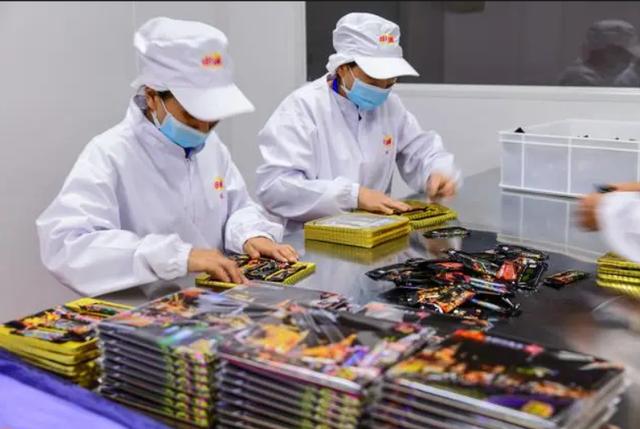
It does not need to compete for mindset entry points. Low prices themselves are the "gravitational field for orders."
Furthermore, the business model of AI entry points also conflicts with Pinduoduo's profit logic. Taobao's revenue mainly comes from advertising and paid ranking. While AI entry points may potentially replace traditional ads, Alibaba has to bear the cost of this "self-revolution" or risk being disrupted by external AI players.
However, in Pinduoduo's revenue structure, transaction service income (commissions) has surpassed online marketing revenue to become its largest source. In Q1 2026, Pinduoduo's transaction service revenue reached 56.3 billion yuan, a 20% year-on-year increase. Its business model is "earning commissions by facilitating transactions" rather than "selling ad slots."
Therefore, AI entry points are a defensive necessity for Taobao, but for Pinduoduo, they would only disrupt its existing rhythm. Its user decision-making path is already short and direct enough, with no need to be reconstructed by AI.
From the demand side, Pinduoduo's core user base consists of middle-aged and elderly consumers in lower-tier markets and county-level users. This group has two distinct characteristics: first, their consumption goals are highly specific, mostly targeting daily necessities and agricultural products with pre-determined purchase categories; second, they face high learning costs for complex AI conversational tools, and lengthy AI interactions would only increase order placement steps and reduce conversion efficiency.
In contrast, Taobao and Douyin's user base includes a large number of young consumers in first- and second-tier cities, who have aimless browsing habits and ambiguous shopping needs, requiring AI to tap into potential consumption demands. This difference in user needs fundamentally determines that Pinduoduo lacks the user foundation to seize AI entry points.
From the perspective of return on investment, building an AI entry point is also an "unprofitable" venture. Developing a general large model requires a R&D team of thousands of people, computing infrastructure with tens of thousands of GPUs, and continuous annual investment of tens of billions of yuan. Alibaba has announced it will invest 380 billion yuan over three years in cloud computing and AI, while Pinduoduo has no self-owned cloud platform nor B2B cloud business to spread out costs.
More importantly, in the current e-commerce industry, the marginal improvement that AI can bring to "extremely low prices" is actually very limited: the core factors determining product prices have always been supply chain bargaining power, operational efficiency, and economies of scale—not which model has more parameters or stronger conversational capabilities.
Pinduoduo's comparative advantage lies in supply chain efficiency, not in building entry points, so it must concentrate its resources on critical areas. Public financial reports show that Pinduoduo's R&D investment as a percentage of revenue has remained stable at 3%-4% in recent years. In 2025, Pinduoduo's total revenue was approximately 431.8 billion yuan, with R&D expenses reaching around 16.496 billion yuan, accounting for about 3.82%. In comparison, Tencent's R&D ratio exceeded 10% and Alibaba's was around 6% during the same period, making Pinduoduo's R&D investment appear exceptionally "restrained."
Its absolute R&D spending is growing rapidly, but its relative intensity is not prominent among China's major internet companies.
This restraint is also reflected in its external communications. During the four quarterly earnings calls in 2025, Pinduoduo's management almost never proactively discussed AI, nor did they want the capital market to hype it up as an AI concept stock. In contrast, Alibaba dedicated large portions of its earnings calls to elaborating on its blueprint for "cloud + large models + AI commercialization," while Tencent and Meituan both explicitly elevated AI to a group-level core strategic priority—creating a stark contrast.
Finally, the "Dedication" corporate culture established during Huang Zheng's era also dictates that Pinduoduo will not blindly follow trends. Looking back at Pinduoduo's development history, we can see that it almost never engages in anything that "looks good but is unrelated to its main business": food delivery, ride-hailing, cloud computing, financial ecosystems, content communities... No matter how lively other players' tables are, it only focuses on nurturing its own core territory.
Huang Zheng once said when explaining the Dedication culture, "At your position, do what you are supposed to do." This phrase applies equally to its AI strategy. The large model entry point battle is Alibaba, ByteDance, and Tencent's table. At that table, no matter how much money Pinduoduo spends, it may not catch up with the pioneers. It is better to pour all its resources onto the battlefield where it has the most advantages.
In his 2019 letter to shareholders, Huang Zheng proposed that Pinduoduo would become a "distributed intelligent agent network": instead of building an all-powerful super central brain, countless small models would be deeply embedded in various business links to improve the matching efficiency between users and products.
This efficiency and focus are also deeply embedded in its organizational management. Pinduoduo's organizational structure is known for its extreme streamlining: even after Temu expanded to more than 90 countries worldwide, its core operations team only numbers in the hundreds.
The company internally upholds a culture of "one person doing the work of three, getting paid for two." This DNA is inherently suited for efficient execution, but not for supporting a basic research team of thousands of people.
Making it compete with Alibaba and ByteDance on large model parameters is no different from asking a sprinter to run a marathon.
The second half of AI-powered e-commerce: Pinduoduo's clear-headed calculations
Pinduoduo not building a consumer-facing AI entry point does not mean it does not value AI. In Pinduoduo's strategic map, AI is not a facade for external storytelling, but an efficiency engine embedded deep within its e-commerce flywheel.
It only develops AI applications that are strongly related to the e-commerce supply chain and have clear return on investment: recommendation algorithm optimization, cross-platform price comparison, intelligent ad placement, customer service chatbots, risk control systems, supply chain demand forecasting, cross-border multilingual operations, consumer-facing interactive features... These AI capabilities are tangibly improving the operational efficiency of its entire ecosystem.
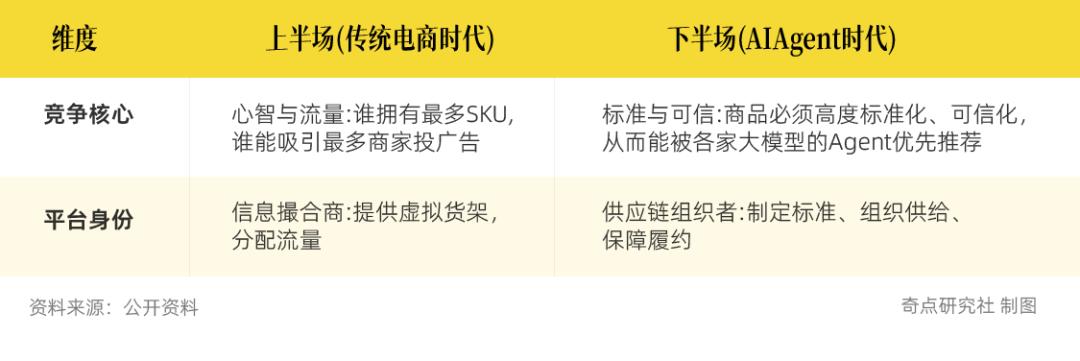
In the traditional e-commerce era, platforms' core identity was "information matchmakers": offering virtual shelves, competing on SKU variety and ad appeal, essentially collecting traffic taxes, with competition centered on "user mindset and product breadth."
But in the AI Agent era, when Agents compare prices across the entire network on behalf of users, their priority for recommendation is not the size of the platform's traffic, but whether products are highly standardized, trustworthy, and whether fulfillment is stable.
The platform's identity has accordingly shifted from an "information matchmaker" to a "controller of supply chain standards and fulfillment," taking charge of product ownership, standard setting, and fulfillment certainty.
It aims to use AI to redefine the full-link efficiency of products from factories to consumers: smart manufacturing, flexible production, inventory forecasting, and logistics optimization.
In Pinduoduo's logic, AI does not need to be a "super entry point" visible to users. It only needs to be a "sharper wrench" in the supply chain, ensuring that the same products can reach consumers at lower prices and faster speeds through its ecosystem.
This is exactly the significance of the New Pinmu initiative: it applies AI to links such as product standardization, industrial cluster traceability, and fulfillment data verification, so that every product comes with a "trust certificate" when any Agent retrieves it for price comparison.
Of course, this path is not without risks. By choosing to concentrate AI capabilities in vertical scenarios rather than investing in general large model R&D, Pinduoduo avoids massive infrastructure costs in the short term, which aligns with its consistent operational logic of pursuing return on investment.
But in the long run, this also means it may lack the right to speak in mastering the underlying rules of the AI era.
If future e-commerce competition further evolves into competition between fully automated Agents, general model capabilities, user interaction entry points, and consumption data accumulation may become new critical infrastructure.
At that point, can Pinduoduo continue to influence the transaction path relying on its supply chain advantages? If leading AI platforms close off cross-platform product access capabilities, can its own industrial cluster supply alone cover the full range of consumer demands?
More importantly, AI entry points not only represent traffic, but also new user demand data.
In the past, e-commerce platforms mainly understood consumers through search, browsing, and purchase records. But AI conversations allow users to actively express their budgets, scenarios, preferences, and potential needs. This information, which previously could not be structurally captured, may become an important source for future new product development and consumption trend forecasting.
Without this layer of active user feedback, can Pinduoduo continue to discover new consumption opportunities relying solely on transaction and supply chain data?
Pinduoduo itself is aware of this. While continuing to strengthen its industrial clusters and exclusive supply capabilities, it is also promoting the construction of product digital standards, hoping that its products can integrate into future AI transaction systems to hedge against the risks of missing out on AI entry points.
But both paths require time to mature. Industrial cluster transformation demands long-term investment, a large number of small and medium manufacturing enterprises still face insufficient digital capabilities, and capabilities like AI forecasting and flexible production rely on long-term data accumulation. Product standardization also requires industry-wide participation, and promoting unified data formats and transaction rules solely through one platform is no easy task.
Pinduoduo is not blind to the value of AI entry points—it has just made a clearer calculation: When AI redistributes consumption entry points, who can grasp the certainty of the merchandise world?
What the capital market values is also Pinduoduo's execution and delivery potential on the path of "AI as a tool + globalized supply chain."
In its 2026 China Internet Report, Goldman Sachs listed Pinduoduo as one of its key recommended stocks, forecasting a 2026 P/E ratio of around 10x. Catalysts include expected profitability inflection points for Temu, the potential for deep AI integration into e-commerce operations and supply chains, and the relatively solid "cost-performance mindset" in China's lower-tier markets.
In an era where entry points are redefined by AI, whether a platform without a super entry point can redefine e-commerce value relying on supply chain efficiency is Pinduoduo's biggest gamble.
This article is from the WeChat public account "Singularity Research Society", authored by Qiuyue, edited by Meng Wen, and published with authorization from 36Kr.