Looking at the chaos of commercial photography from the ban on Lingyin Temple, refined management is the way out
In recent days, the news that "Lingyin Temple in Hangzhou has fully banned commercial photography" has sparked widespread public debate.
According to the "Announcement of Lingyin Temple on Comprehensively Prohibiting Commercial Photography Activities" (hereinafter referred to as the "Announcement"), Lingyin Temple will fully ban all commercial photography activities for profit-making purposes.
Lingyin Temple emphasizes that no commercial photography teams or individuals are allowed to conduct shooting operations within the temple premises. For violations, temple staff have the right to dissuade, stop the behavior, and require relevant personnel to immediately cease shooting and leave the designated areas.
Is this decision made by Lingyin Temple truly reasonable?
The author of Jinlv conducted a small-scale survey within the industry. Both scenic area practitioners and tourists largely support Lingyin Temple's move, with some even calling out loudly: Please completely eradicate unregulated commercial photography in scenic spots.
01
Is commercial photography in scenic spots really that detestable?
Absolutely. A couple of days ago, the author of Jinlv visited Qingdao, originally planning to embark on a perfect Citywalk along a route connecting popular internet-famous check-in spots. Unexpectedly, the entire trip was completely ruined by rampant commercial photography activities.
At a newly popular coastal scenic area in Qingdao, several commercial photographers were lurking around the prime shooting spots, immediately pestering anyone who approached with the question "Do you need photography services?"
After politely turning down their repeated offers, the author intended to take photos on their own, only to find that almost all the spots with good views were firmly occupied by commercial photographers. Even when managing to sneak a few shots in the gaps, the poor angles and constantly blocked views completely killed the interest in taking photos.
The most absurd scene was that, while crowds of commercial photographers were noisily soliciting customers and taking photos, the official loudspeakers in the area were repeatedly broadcasting: "Please do not trust street-side photographers soliciting customers, to protect your legitimate rights and interests from being infringed..."
On various social media platforms, overwhelming complaints from netizens about the rampant commercial photography in scenic spots can be seen everywhere.
One highly upvoted comment from a netizen reads: I was pestered nonstop by commercial photographers in the scenic spot the whole day, with them repeatedly asking "Miss, do you want photos? Do you want photos? Do you want photos?..." These leeches are just like mosquitoes, buzzing around people, which is absolutely unbearable!
While tourists vent their frustration both online and offline, scenic area practitioners are also voicing their grievances.
"I'm fed up with cleaning up the mess left by these commercial photographers," a scenic area practitioner complained to the author of Jinlv. They and their team have put in all the hard, dirty, and tiring work to maintain the scenic area's environment, order, and public spaces in good condition, only to find that these commercial photographers have quietly infiltrated the area. They not only mess up the environment and order of the scenic spot, but also cause a large number of tourist complaints, disputes, and conflicts.
After causing all these problems, they simply leave without a trace, leaving the scenic spot to deal with all the tourists' demands. Whether it's tourists asking for refunds because they are unsatisfied with their photos, filing complaints due to violated rights, or coming to the scenic spot to mediate conflicts with commercial photographers...
Scenic areas are constantly overwhelmed by all the troubles caused by unregulated commercial photography. "I fully understand Lingyin Temple's move. It's only a matter of time before domestic scenic spots jointly crack down on unregulated commercial photography," the practitioner stated.
02
Theoretically, with rampant commercial photography leeching off scenic spots and tourists, causing huge losses to both sides, these commercial photographers should have made massive profits, right?
Interestingly, that's not the case at all.
The commercial photography industry in scenic spots has been in chaos in recent years, with practitioners facing widespread hardships. The industry has long been trapped in the quagmire of "oversupply and cutthroat low-price competition."
According to data from Qichacha, the number of registered companies related to "travel photography" — the largest segment of the commercial photography industry — has skyrocketed, rising from 575 in 2022 to 2,119 in 2023, and further reaching 2,593 in 2024, hitting the highest point in nearly a decade.
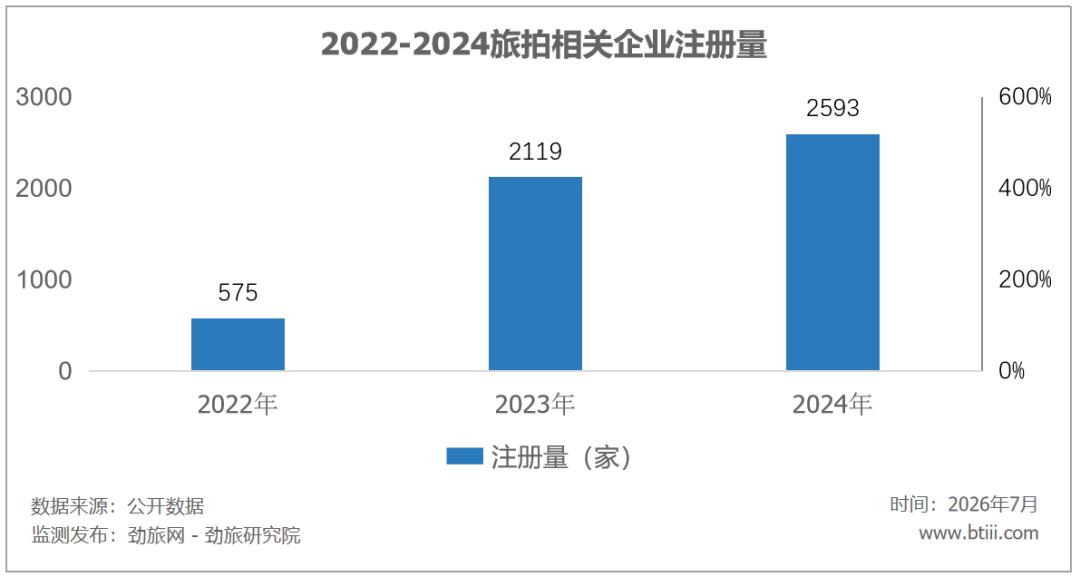
Although the number has slightly decreased in recent years, the overall scale of the industry remains huge.
How dense are commercial photography shops around scenic spots? According to a media survey, on the mere 700-meter street section from Donghua Gate to Wangfujing Pedestrian Street near the Forbidden City in Beijing, there are 89 travel photography shops, meaning tourists can almost encounter a photography shop every few steps.
And this only counts the officially registered, legitimate commercial photography shops.
The vast majority of commercial photography practitioners in scenic spots are unregistered individuals or small teams, either full-time or part-time — commonly known in the industry as "unlicensed street photographers." The number of this group cannot be accurately verified, but it is far larger than that of registered shops.
The unregulated growth of supply has pushed the cutthroat competition in scenic spot commercial photography to an extreme level, making low-price customer solicitation an inevitable trend.
Taking a popular tourist destination in southwestern China as an example: in 2023, a travel photography package including costumes, makeup styling, and follow-up shooting cost at least 299 yuan or 399 yuan per person. In 2024, the price dropped to 199 yuan, and from last year to now, it has even fallen below 100 yuan, with packages priced at just tens of yuan per hour widely available.
Even at such low prices, the revenue has to be split among multiple people, including sales staff, photographers, and makeup artists.
Little known to the public, the commercial photography industry chain in scenic spots has never centered around "photographers," but around "sales staff."
The author of Jinlv once exposed the sales commission structure behind commercial photography in scenic spots in that region:

A commercial photography salesperson can take away 60%-85% of the total revenue from a single order. A makeup artist only earns a commission of 30-40 yuan from one travel photography customer, while a photographer's commission from a single customer is only 20-50 yuan.
To help makeup artists and photographers earn more income, commercial photography shops in scenic spots encourage them to find alternative ways to generate extra revenue, and even set clear prices and commission percentages for various supplementary services.
Some commercial photography shops explicitly state in their makeup artist recruitment notices that makeup artists must have the ability to guide customers to make additional purchases. If they successfully generate extra revenue from a customer, they can earn a 50% commission on that additional spending.
Photographers are also required to have the ability to persuade customers to purchase extra digital photos (priced at 3-5 yuan per photo) or add more shooting locations (30-50 yuan per location, or negotiated separately), and they can also earn a 50% commission on any additional spending generated.
When the focus of scenic spot commercial photography shifts from "how to better serve customers" to "how to make tourists spend more money," the very foundation of this business begins to rot.
Ironically, even after exploiting tourists both openly and secretly, many commercial photography shops in scenic spots barely make any profit after splitting the revenue across all links, with 80% of them operating at a loss or breaking even.
Scenic spots are troubled, tourists are exploited, and commercial photography operators are losing money. The commercial photography industry in scenic spots has unexpectedly degenerated into a "lose-lose business that harms others without benefiting oneself," which is truly unbelievable.
03
While Lingyin Temple's full ban on commercial photography has been implemented, it has also sparked another concern: Although scenic spot commercial photography is plagued by numerous problems, the strong demand from tourists is real. Is such a complete eradication of the industry overly extreme?
"We fully understand the frustration of scenic spots and tourists, but the relationship between them and the commercial photography industry should not be a zero-sum game of mutual destruction. Instead, it should be a mutually beneficial partnership," a friend working in the scenic spot commercial photography industry explained to the author of Jinlv. The demand for high-quality photos taken in scenic spots is a rigid demand for tourists, and it continues to grow. This is the fundamental reason why the commercial photography industry has never been completely eliminated despite all the chaos.
For scenic spots, the value of commercial photography has actually increased rather than decreased in recent years.
In the past, scenic spots primarily relied on ticket sales, with revenue increasing as more tickets were sold.
Nowadays, scenic spots are operating as content-driven businesses. A scenic spot serves as a unique scene, and whoever can help tourists generate more high-quality content here can provide greater emotional value, thereby attracting more potential traffic and revenue.
Among all types of content, photos and videos are the easiest to create and have the strongest communication power.
After taking photos and videos, tourists will share them on social media, and this authentic UGC (user-generated content) is far more effective than any paid advertisement.
Except for a handful of top-tier scenic spots that already have massive traffic, for the vast majority of scenic spots, commercial photography is not a trivial, dispensable side business — it is a core service that will be essential for their future development.
04
My friend in the industry believes that what scenic spots should do now is not to completely eradicate commercial photography, but to promote its standardization, proceduralization, and systematization.
Specifically, improvements should be made in three core areas:
First, thoroughly crack down on unlicensed street photographers.
In fact, 90% of the negative incidents related to scenic spot commercial photography are caused by unlicensed photographers. Without fixed shops, official shooting permits from scenic spots, or advance online booking systems, these photographers wander around scenic spots or popular internet-famous streets to solicit customers on the spot, charging for photos immediately. Their operation costs for low-price competition are even lower, causing greater trouble for both scenic spots and tourists.
The joint efforts of scenic spots, tourists, and regulatory authorities should focus on eradicating unlicensed photographers and their illegal activities, rather than eliminating the entire commercial photography industry.
Second, implement a cooperation access system for commercial photography in scenic spots.
Only commercial photography shops and photographers who have completed official registration with the scenic spot are allowed to operate within the premises. Scenic spots should also set limits on the number of tourists using commercial photography services, as well as the allowed shooting time and designated shooting areas. Any registered commercial photography shops or photographers who are found pestering tourists within the scenic spot, especially those soliciting customers at extremely low prices, should be permanently banned from cooperating with the scenic spot.
Third, establish a complete set of standardized behavior guidelines for scenic spot commercial photography.
The practices adopted by Huayan Temple in Datong are worth referencing for other domestic scenic spots. The official "Guidelines for Shooting and Travel Photography" clearly stipulate the following rules:
Without prior permission from the scenic spot, travel photography is prohibited inside buildings such as the Bhagavati Sutra Hall, the Main Hall, and the Huayan Pagoda, as well as in public access areas including steps, staircases, and narrow passages within the temple complex.
During off-peak periods (weekdays, non-busy hours in the off-season), travel photography activities can be carried out in an orderly manner in designated areas inside the Puxian Hall, Amitabha Hall, Medicine Buddha Hall, Heavenly King Hall, and Guanyin Hall. During peak tourist periods (legal holidays, summer weekends, and other times when the scenic spot's tourist volume reaches the warning threshold), travel photography is prohibited in all the above-mentioned areas.
The following equipment is strictly prohibited during travel photography activities: flashlights, tripods, stabilizers, reflectors, fill lights, camera sliders, and blowers.
"These extremely detailed regulations clearly define the red lines for scenic spot commercial photography. Combined with strict management from the scenic spot, they can effectively eliminate most of the chaos in the industry," my friend emphasized. A blanket ban on commercial photography by scenic spots is a sign of inaction. Guiding the industry to develop in a regulated way is always more effective than simply blocking it.
05
The low-price cutthroat competition in scenic spot commercial photography is not an isolated incident; it is closely related to the overall macroeconomic environment.
This year, the Two Sessions of China clearly proposed to "thoroughly rectify cutthroat competition," indicating that "anti-involution" will become a major guiding principle for all industries for a long time to come.
Although scenic spot commercial photography seems like a small business, its market size exceeds 50 billion yuan, and it is related to the employment, livelihood, and future of countless people, so it cannot be ignored.
Fortunately, the scenic spot commercial photography industry is gradually breaking away from low-price competition with the joint efforts of multiple parties.
On one hand, regulatory authorities are strengthening supervision. Many regions have introduced public notice systems for commercial photography violations, and established red and black lists for commercial photography operators. By supporting high-quality operators and cracking down on illegal and unregulated ones, they are purifying the local commercial photography industry in scenic spots.
On the other hand, leading commercial photography operators are also taking action, jointly resisting low-price cutthroat competition. By publicly announcing the minimum price standards for scenic spot commercial photography, they are guiding the industry to move toward stable pricing, ensuring transparent consumption for customers.
At the end of the day, a complete ban is just an angry outburst. Refined, targeted management is the real solution. What truly needs to be completely eradicated are those unethical operators who turn a promising business into a one-time scam.
This article is from the WeChat Official Account "Jinlv Network", written by Chen Jie tigereat, and published with authorization from 36Kr.