36Kr Exclusive | A team led by a PhD from the Chinese University of Hong Kong and former DJI engineers has launched a consumer-grade quadruped robot startup, securing tens of millions of yuan in an angel round led by Zhengxuan Investment
Author | Qiao Yujie
Editor | Yuan Silai
Hard Krypton learned that Shenzhen Lumisition Robotics Co., Ltd. (hereinafter referred to as "Lumisition") has recently completed an Angel Round financing of nearly 50 million RMB, led by Zhengxuan Investment, with participation from institutions including Lights Capital, Lihe Capital, Songhe Capital, and Hengxin Future. The funds from this round will be mainly used for product R&D, algorithm iteration, and mass production preparation.
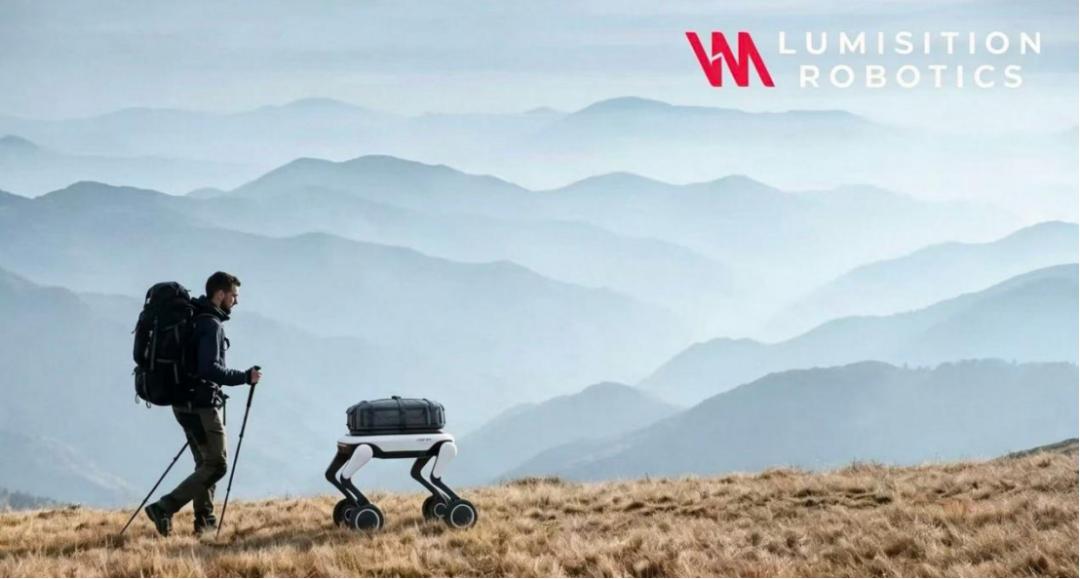
Lumisition was founded in February 2026, focusing on the consumer-grade quadruped robot market, aiming to enter outdoor scenarios with an "all-terrain mobile chassis" to address physical labor demands such as cargo transportation and mobility assistance. The company targets European and American households with detached homes, outdoor sports enthusiasts, and the elderly population, striving to transform quadruped robots from demonstration-oriented products into practical consumer-grade tools with real productivity.

(Source / Enterprise)
The company's founder and CEO Le Linzhu graduated from The Chinese University of Hong Kong with a major in robotics, holding a PhD and postdoctoral background in robotics. He is the co-founder of CUHK's LRL Lab, previously served as a core R&D member at DJI-Innovations, and co-founded Light Year Innovation Technology, a B2B quadruped robot enterprise.
Both the CTO and VP of Hardware are graduates of the robotics program at The Chinese University of Hong Kong. The CTO completed his undergraduate studies at Chu Kochen Honors College of Zhejiang University, specializing in reinforcement learning and motion control algorithms. The VP of Hardware earned his bachelor's and master's degrees from Huazhong University of Science and Technology (under the supervision of Professor Gao Liang), previously worked as an engineer at Roborock, has published 5 papers in IEEE/ASME TMECH, IROS, and ICRA, holds 7 invention patents, and has led the R&D of more than 5 joint motors, large-scale hydraulic humanoid robots, and multiple quadruped robot platforms.
Founder Le Linzhu told Hard Krypton that unlike some consumer robots that emphasize companionship and emotional value, Lumisition focuses more on "physical labor replacement" in real scenarios. For example, in European and American households with detached homes, residents often need to complete "last-mile" transportation tasks such as moving items from the garage to the house or from the parking lot to the doorstep. Meanwhile, the accelerating aging trend, rising care costs, and labor shortage have also created market demand for outdoor mobile assistance devices. Targeting different needs, Lumisition plans to launch products adapted to various terrains, including urban, light urban, and outdoor-grade models.
(Source / Enterprise)
Centered on the positioning of "all-terrain assistance", Lumisition has built a four-layer intelligent architecture, including perception intelligence, motion intelligence, intention intelligence, and role intelligence. The perception layer is responsible for acquiring environmental information; the motion layer, based on the team's years of research on reinforcement learning (RL) motion control, achieves stable movement and obstacle crossing in complex terrains; the intention layer uses Agent technology to understand users' complex instructions and behavioral preferences, for example, making autonomous decisions between prioritizing speed or safety; the role layer can dynamically switch between different functions such as transportation tool, campsite assistant, guardian, or family companion according to scenarios, and supports modular modifications — for instance, installing a seat to turn it into an intelligent wheelchair, or expanding it into a stroller.
In terms of technical routes, the company continues to lay out foundational models and data systems oriented to outdoor scenarios. The founder introduced that the industry generally lacks datasets covering complex unstructured environments, and quadruped robots can directly obtain rich physical information such as ground friction and stiffness during movement, making them not only mobile platforms but also natural data collection terminals. As the deployment scale expands, the company hopes to gradually form a data flywheel covering outdoor scenarios to build long-term competitive barriers.
In addition to algorithm R&D, Lumisition also regards reducing hardware costs as a key strategy for product implementation. In hardware design, the company emphasizes algorithm-driven R&D optimization. For example, it reconstructs the joint module design through multidisciplinary optimization algorithms, reducing the number of components from about 18 to 11, which lowers manufacturing and assembly costs while shortening the R&D iteration cycle. The navigation system adopts a combination of low-cost cameras and LiDAR, combined with technologies such as model distillation to reduce computing power requirements and reduce dependence on high-performance hardware.
Le Linzhu stated that the company's cost control does not rely on a single link, but is a systematic optimization covering the entire chain including product design, component selection, sensor configuration, navigation solutions, and model deployment. While ensuring performance, it fully leverages the advantages of the domestic supply chain to achieve more competitive product pricing.
Currently, Lumisition has completed prototype development and entered the testing phase. According to the plan, the company will launch a three-day outdoor hiking live-streaming test in October this year, and is expected to officially release the product at the 2027 CES exhibition, with mass production starting from April to May 2027.
The following is an excerpt from Hard Krypton's interview with founder Le Linzhu:
Hard Krypton: Why did you choose C-end-oriented quadruped robots as the entry point for this startup?
Le Linzhu: Choosing quadruped robots as the entry direction stems, on one hand, from the team's long-term technical accumulation. The core members come from the robotics lab of The Chinese University of Hong Kong, have participated in the development of multiple quadruped robots and humanoid robots, and have deep R&D foundations in full-stack hardware, motion control, navigation algorithms, and other areas.
We believe there are clear differentiated opportunities in the consumer-grade quadruped robot market. Most current products emphasize companionship, demonstration, or emotional value, while we position ourselves as an all-terrain mobile chassis / outdoor smart partner, solving real needs such as cargo transportation and mobility assistance, helping users complete physical labor in outdoor scenarios — we enhance human capabilities rather than replacing humans.
This positioning is highly aligned with our target audience. Our core users are people who own detached homes with yards, are accustomed to camping/hunting/DIY, and actively seek tools to enhance their capabilities — they naturally belong to the overseas "Garage Culture" and DIY modification ecosystem. For this group, the product is not a passive companion, but equipment that they can modify, expand, and put to their own use.
We hope the robot becomes a platform that can expand users' capability boundaries: supporting multiple application forms through modular modifications, such as transportation tools, camping assistants, and mobility assistance devices. The goal is always to enhance humans rather than replace them. Moving forward in this direction, our long-term vision is to extend "enhancement" from "moving objects" to "moving humans themselves", including future quadruped forms that can carry people. It does not replace humans with machines, but redefines how far a person can reach on their own.

(Source / Enterprise)
Hard Krypton: What algorithm innovations has the company made to achieve all-terrain motion capabilities?
Le Linzhu: To address the problem of obstacle crossing in complex terrains, we integrate Terrain Maps, online state estimation, and a foot structured reward mechanism to build a more robust perception and obstacle-crossing system, improving the robot's stable movement capability in discontinuous, rugged terrains.
In terms of motion generation, we proposed the LMV (Learn from Motion Video) framework, which directly learns motion policies from raw videos, reducing dependence on motion capture and simulation data, and using richer, more realistic, and scalable data to generate natural gaits.
In terms of navigation, we replace traditional geometric maps with semantic topological maps, upgrading navigation from "geometric pathfinding" that relies on spatial coordinates to "decision-based pathfinding" based on semantic relationships, which better meets navigation needs in complex environments such as homes and yards.
In addition, we have developed an interactive navigation framework that allows the robot to no longer be limited to pre-built maps and fixed path planning, but to actively use interactive objects in the environment to create traversable paths — for example, opening doors, moving chairs, or removing obstacles — thus gaining stronger environmental adaptability in semi-structured, frequently changing real scenarios.
Investor's Perspective
Project Lead from Zhengxuan Investment: The embodied intelligence industry is evolving from laboratory research to large-scale application, and Lumisition is a representative team that combines technological innovation and product implementation capabilities. With leading underlying robot motion control and autonomous navigation technologies as its core, the company has built integrated hardware-software capabilities covering key hardware and algorithms, developed an end-to-end Navigation model, focused on high-value new scenarios such as outdoors, and taken the lead in developing wheel-legged robot products that balance performance and commercial value. We believe that with the continuous maturity of embodied intelligence technology and the expansion of application scenarios, Lumisition is expected to grow into an important innovation force in the global mobile robotics field. Zhengxuan Investment will continue to accompany the team in long-term investment to create a brand-new product category.