Exposed to lead the redemption of Manus, what is Tencent's plan?
On July 10, the UK's Financial Times broke a story: Tencent is leading a consortium alongside ZhenFund and Sequoia China to buy back Manus from Meta at a valuation of $2 billion (approximately 13.6 billion RMB). Tencent will acquire the largest stake without taking a controlling position, while Manus will continue operating independently from its headquarters in Singapore.
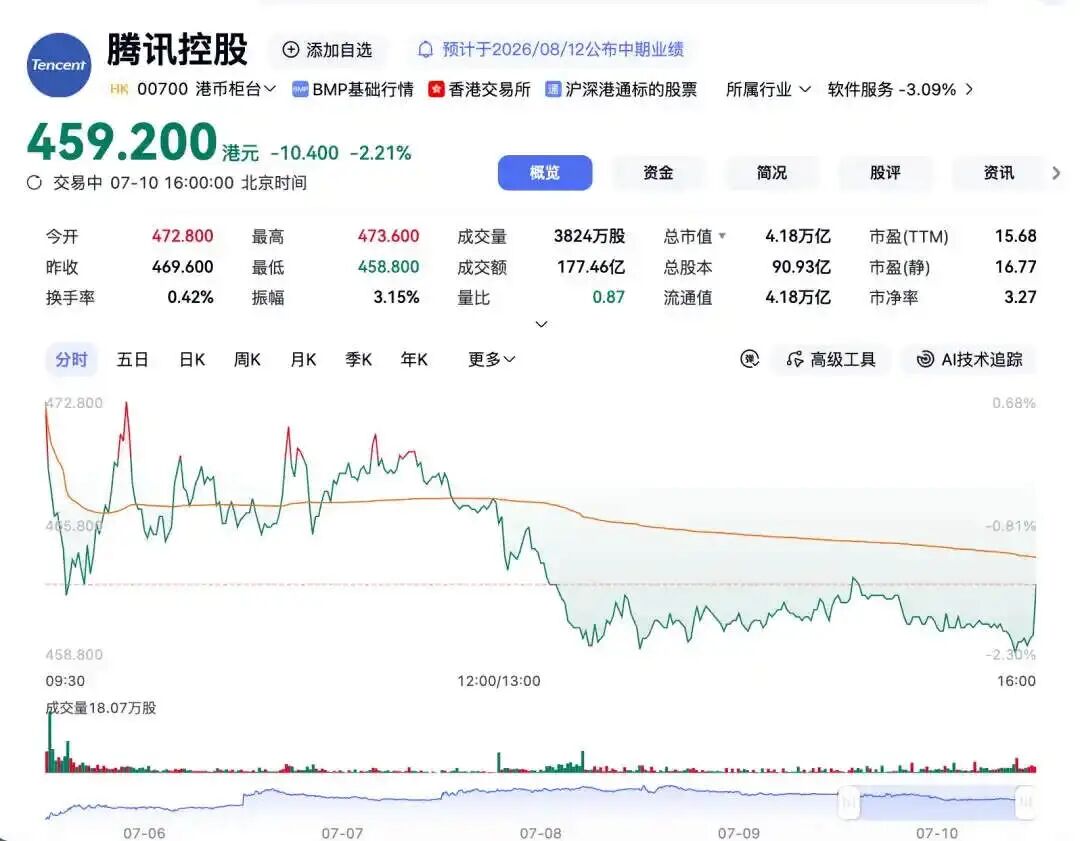
Following the news release, Tencent's Hong Kong-listed shares dropped by 2.21%.
This transaction seems puzzling at first glance: Tencent was neither an early major shareholder of Manus nor a prior business partner. Why is it leading this buyout? What is Tencent pursuing by spending $2 billion on a company it will not control?
Is $2 billion a reasonable price?
When Manus was acquired by Meta, its annualized revenue stood at roughly $100 million. Six months later, that figure surged to $400-500 million. A buyout at a $2 billion valuation translates to a 4-5x multiple of annual recurring revenue (ARR). How does this multiple compare to the broader AI industry? Anthropic is valued at around 20x ARR, and Zhipu AI's valuation multiple is even higher. At 4-5x ARR, this is effectively a floor price.
However, there is a logical reason for this low valuation: the quality of Manus' growth over the past six months requires a significant discount.
Manus' core product is a "general-purpose AI agent" — users issue instructions in natural language, and the system can autonomously open browsers, look up information, fill out forms, and send emails on cloud virtual machines to complete full sets of complex tasks. When it launched in March 2025, invitation codes were resold for as high as 50,000 RMB each, with demand far outstripping supply across social media platforms. This widespread hype demonstrated the product's unique differentiation: at that time, no other AI product on the market could independently operate a computer in this manner.
Following its acquisition by Meta, Manus gained three critical assets: Meta's ad targeting system (which drastically reduced customer acquisition costs), Meta's enterprise client network (which drove rapid B2B sales growth), and technical support from Meta's infrastructure (including computing power, storage, and security). Put simply, Manus' ARR jump from $100 million to $450 million over six months did not come from organic product growth, but from Meta acting as a powerful "accelerator."
Now that accelerator is being removed. Per the April investment ban issued by China's National Development and Reform Commission, Meta must delete all Manus user data stored within mainland China, terminate all technology licensing agreements, and restore localized data storage. This means Manus will have to rebuild its customer acquisition channels from scratch, re-expand its enterprise client base, and reconstruct its entire technical infrastructure.
Manus founder Xiao Hong is fully aware of these challenges. After the Meta acquisition, he was appointed as a Meta vice president, and his team was integrated into Meta's Superintelligence Labs, gaining full access to the Silicon Valley giant's resources. Now, all of that integration must be completely undone — data, systems, clients, and teams all need to be rolled back to their pre-acquisition state. This is no simple "return of purchased goods," but a highly complex surgical separation.
Why Tencent is stepping in to lead the acquisition
The first strategic move: securing a key position.
Tencent cannot afford to cede a leading spot in the AI Agent track. In March this year, Pony Ma first outlined his "shrimp farming" vision — rather than chasing the largest foundation model, Tencent would build an open agent ecosystem on top of its existing model capabilities. Tencent has already released its Hunyuan Hy3 large model, and WeChat is currently testing embedded AI agent features. However, Tencent has lacked a proven "killer application" in this space. Manus perfectly fills this gap: it is the world's first team to successfully validate the "general-purpose agent" concept and demonstrate viable commercialization.
Compare the agent layouts of competing tech firms: Alibaba has its Tongyi Qianwen model paired with the DingTalk ecosystem, ByteDance has Doubao paired with the Feishu ecosystem, and Baidu has Ernie Bot paired with its search ecosystem. Tencent's unique differentiator is WeChat — a super app with 1.4 billion users, which naturally serves as the largest traffic entry point and distribution platform for AI agents. But WeChat's current AI features are still in the testing phase, with no breakout hit products. If Manus is integrated into the WeChat ecosystem, it will immediately gain access to a far larger user base than it had under Meta. This is the core logic behind Tencent's "positioning" strategy: Tencent may not necessarily build the best agent itself, but it must ensure that the world's best agent operates within its ecosystem.
The second strategic move: ecosystem synergy.
Tencent is not acquiring a controlling stake, but gaining "top-tier access to Manus' internal information and product roadmap." Public corporate records show that Xiao Hong has long-standing ties to Tencent: his previous project Yiban Assistant, a WeChat public account management tool, received Tencent investment. When WeChat began testing its AI agent features, Xiao Hong was one of the first external users invited to participate. This close relationship means that even without a controlling stake, Tencent can deeply influence Manus' product direction, technology roadmap, and ecosystem integration. Being a minority shareholder also allows Manus to maintain its independent brand, avoiding direct competition with Tencent's in-house products WorkBuddy and Yuanbao.
A noteworthy detail: Tencent President Martin Lau publicly stated during this May's earnings call that "AI agents are increasingly emerging as a clear breakthrough use case" and that "our platform inherently possesses many natural advantages to host AI agents." These comments were not made casually.
The third strategic move: regulatory alignment. The timeline is clear: in April, the NDRC blocked Meta's acquisition of Manus; in May, the founding team launched a self-rescue plan; in July, Tencent stepped in to lead the buyout. This marks the first time China has invoked the Foreign Investment Security Review Measures to block a foreign acquisition in the AI sector, and this case will undoubtedly become a benchmark precedent. Tencent's role as the lead buyer carries far greater strategic value than pure financial returns.
Selling Kuaishou, investing in Kling, acquiring Manus: Tencent's strategic "industrial upgrading" in AI
When viewed alongside Tencent's recent series of capital moves, the logic behind this transaction becomes even clearer.
Tencent reduced its stake in Kuaishou, raising over 10 billion RMB in cash. Kuaishou competes with WeChat for user attention, and Tencent's Video Account has already developed into a fully independent ecosystem, making Kuaishou's strategic value for Tencent steadily decline. Tencent then deployed $200 million into Kling (the video generation platform) and led the consortium to invest roughly 4 billion RMB to acquire Manus (the general-purpose AI agent). Tencent is divesting legacy equity holdings with low synergy, and reinvesting in AI-native strategic assets.
Kling fills Tencent's gap in video generation capabilities, while Manus addresses its missing piece in general-purpose AI agents — two capabilities that are the most critical and underdeveloped in Tencent's current product portfolio. From its Hunyuan foundation model, to Kling for video generation, to Manus for general-purpose agents, Tencent is putting the final pieces in place to complete its full AI ecosystem map.
Nevertheless, real risks remain. Tencent is investing capital without taking a controlling stake, which means it cannot dictate Manus' overall strategic direction — it can only influence decisions, not make final calls.
More importantly, Tencent itself needs to fully integrate this new acquisition. The WeChat team, Hunyuan team, and WorkBuddy team are all working on agent-related products, and now Manus will be added to this mix. How resources will be allocated, how clear boundaries will be drawn between teams, and whether internal conflicts will emerge are all critical challenges Tencent's management must address.
From a financial perspective, acquiring an AI agent company with $450 million in ARR and strong ongoing growth at a $2 billion valuation is a cost-effective deal. From a strategic perspective, locking in a leading position in the track, gaining ecosystem synergy rights, and building trust with regulators is well worth the investment. From a risk perspective, the non-controlling stake, uncertainty over Manus' post-Meta growth trajectory, and competition from open-source alternatives all remain open questions.
Tencent's math for this deal adds up, but it still carries significant speculative risk. The company is betting that Manus can continue its strong growth after separating from Meta, and that the AI Agent track will truly become the next-generation human-computer interaction entry point.
This article originates from the WeChat Official Account "Zero State LT" (ID: LingTai_LT), written by Zhang Qian, edited by Hu Zhanjia, and republished with authorization from 36Kr.