Zhipu is expensive, MiniMax is hard to access
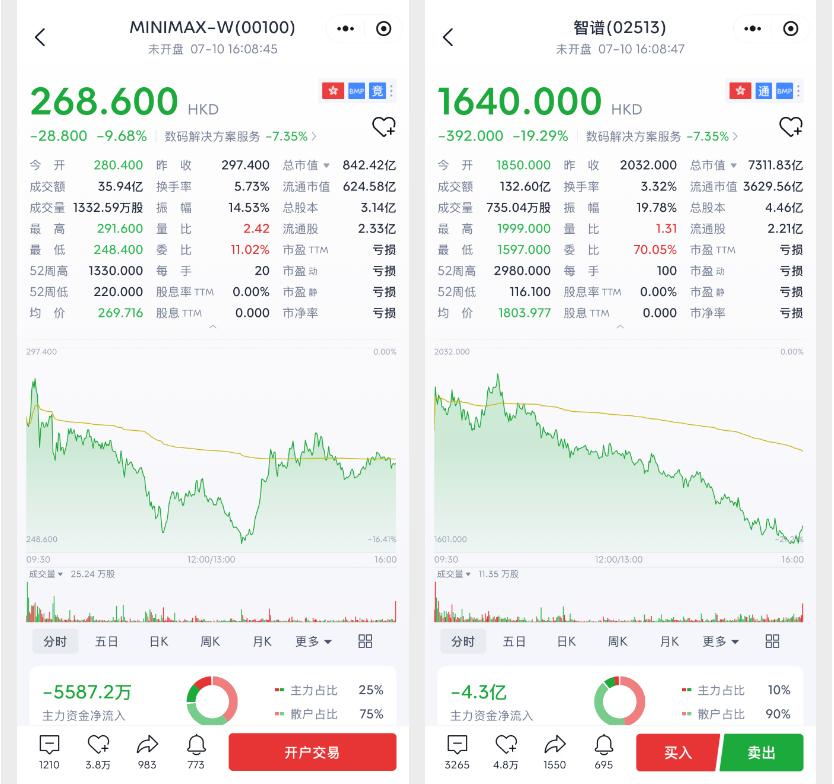
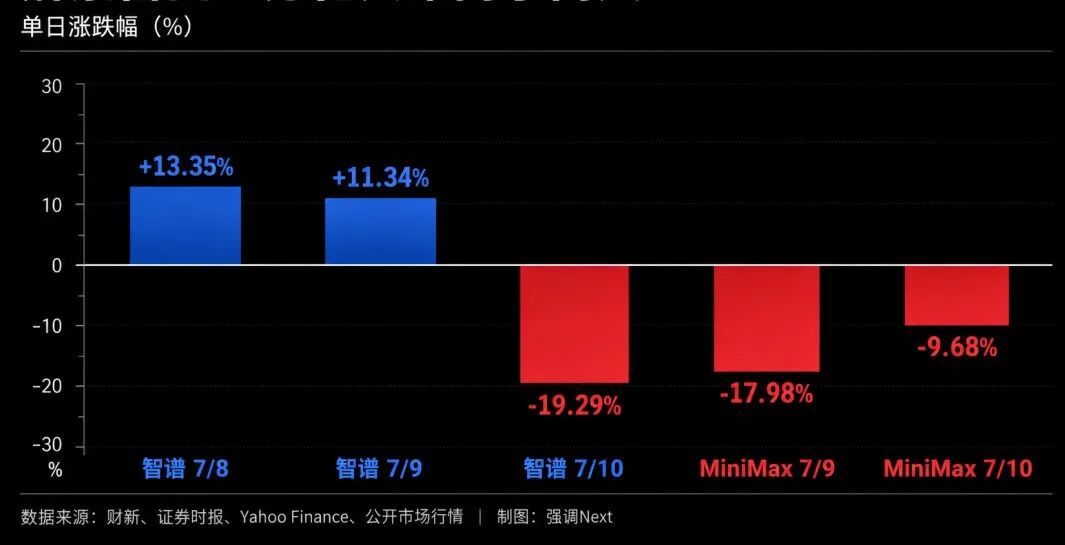
On July 9, MiniMax saw the lifting of the first round of restricted shares after its listing. Its share price dropped by 17.98% that day, and the total market value fell below HK$100 billion.
The next day, Yan Junjie, founder and CEO, released a company-wide letter announcing that he would no longer receive a salary before the company achieves AGI, and would allocate 5% of his personal shares for employee incentives and open-source ecosystem development. On the same day, MiniMax announced plans to raise approximately HK$16 billion in funding.
Suspending salary, gifting shares, and raising financing—MiniMax almost played all its cards to stabilize market expectations in one go. However, the share price still failed to stop falling. On July 10, MiniMax dropped another 9.68%.
Clearly, the company-wide letter conveyed the founder's attitude, but the financing plan altered the company's capital structure. The placement price was nearly 10% lower than the closing price of the previous day, and the convertible bonds could also be converted into new shares in the future. For existing shareholders, the first thing they saw was the pressure of share dilution.
In the same week, Zhipu also experienced the lifting of share restrictions, financing, and drastic stock price fluctuations. In the two trading days after the restriction lift, its share price rose by 13.35% and 11.34% respectively, with its market value briefly returning to HK$900 billion. On July 10, it plunged by more than 19%, almost falling back to the level before the restriction lift.
The divergence between the so-called "two giants of large models" only lasted for two days. Eventually, the market discussion went beyond just the lifting of restrictions. What people are talking about now is how much capital the two companies need, how much more they can raise, and whether their existing revenue can support such high valuations.
01. Two Different Restriction Lifts, the Same Pressure
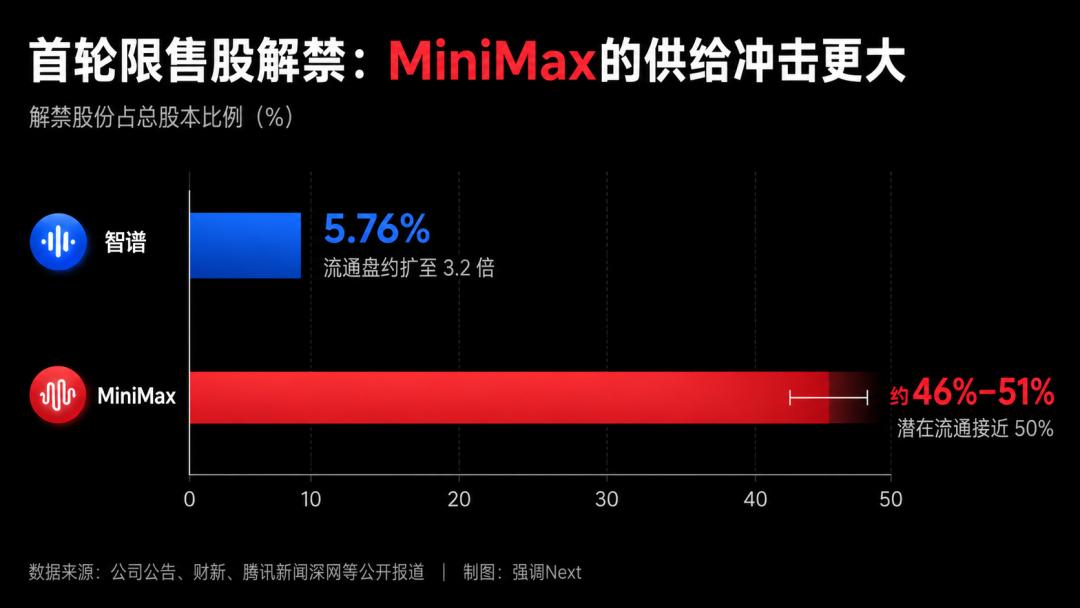
On July 8, Zhipu had approximately 25.6816 million shares released from restrictions, accounting for 5.76% of the total share capital. The holders were mainly 11 cornerstone investors. The proportion of released shares in the total share capital was not high, but due to the small number of previously tradable shares, the number of tradable shares after the restriction lift expanded to about 3.2 times the original level.
MiniMax's scale was much larger. According to statistics from Caixin, about 153 million shares were released from restrictions this time, accounting for more than 48% of the total share capital. Previously, its free-floating shares accounted for less than 6%, and after the restriction lift, the potential floating share ratio rose to nearly 50%.
Before the restriction lift, both companies organized public statements from their shareholders. About 70% of Zhipu's cornerstone investors stated that they would continue to hold their shares, while MiniMax claimed that more than 80% of its Pre-IPO and cornerstone shareholders had no intention of reducing their holdings. However, verbal promises cannot change the nature of the tradable shares.
The shares released by Zhipu this time mainly belonged to cornerstone investors, including state-owned capital-backed institutions, industrial funds, and long-term capital. MiniMax's scope of released shares was broader: in addition to cornerstone investors, it included a large number of pre-listing financial investors. For VCs and PEs with low holding costs and fund exit cycles, even if the share price has fallen significantly, they may still have considerable floating profits.
Therefore, the short-term rise of Zhipu's share price after the restriction lift cannot be simply attributed to "better fundamentals". MiniMax's decline does not entirely mean that shareholders are rushing to sell. The more direct differences lie in the scale of new tradable shares, the structure of their holders, and how much capital the secondary market can provide to absorb these shares.
On July 10, Zhipu also plunged sharply, which shows that a small number of tradable shares can push up the share price, but also amplify the decline. The lifting of restrictions is not a one-time release of negative factors, but a process of returning the share prices of both companies to more sufficient market trading.
02. Zhipu Has a Clearer Revenue Story, While MiniMax Still Needs to Prove Its Efficiency
The capital market prefers Zhipu, first of all, because its revenue path is relatively easy to understand.
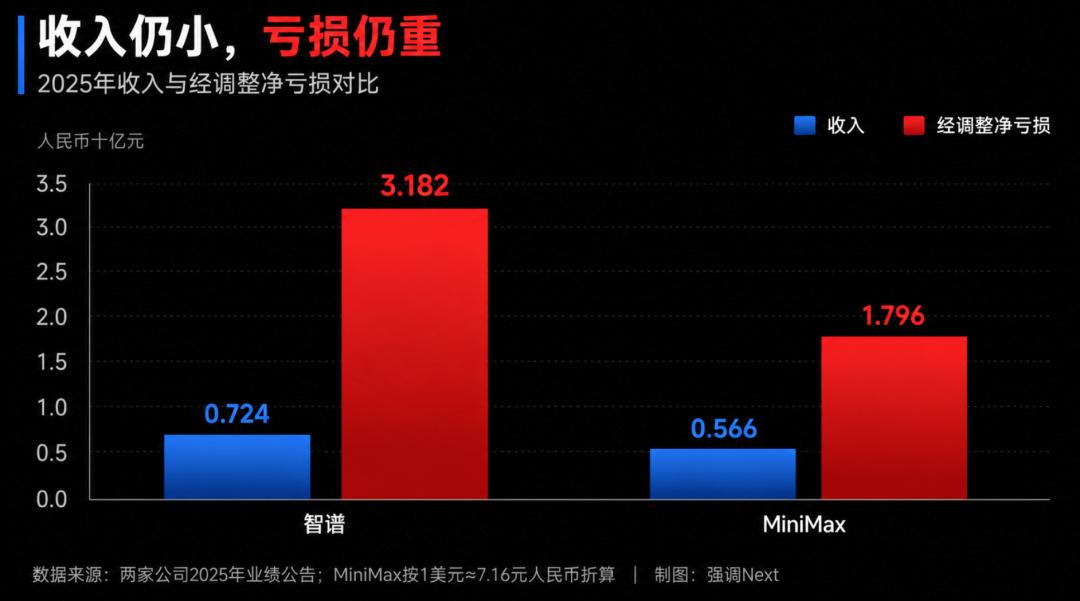
In 2025, Zhipu achieved revenue of 724 million yuan, a year-on-year increase of 131.9%. Among this, revenue from its open platform and API increased by 292.6% to 190 million yuan, revenue from enterprise-level agents increased by 248.8% to 166 million yuan, and revenue from enterprise-level general large models reached 366 million yuan.
The ARR of its MaaS API platform reached 1.7 billion yuan. The company also disclosed that after the API price was increased by 83% in the first quarter of 2026, the call volume increased by 400%. For a large model company, this at least proves that some enterprise customers are willing to continue paying for the model's capabilities.
However, the certainty of Zhipu's revenue is far from high enough to justify its entire valuation. In 2025, the company's adjusted net loss was 3.182 billion yuan, and its R&D investment was 3.18 billion yuan. Based on a rough calculation of its market value of about HK$906 billion on July 9 and its 2025 revenue, its price-to-sales ratio still exceeds 1200 times. What the market is buying is obviously not just the existing revenue, but also the scarcity of domestic foundational models and future market share.
In contrast, MiniMax's revenue in 2025 was about 79.04 million US dollars (about 560 million yuan), a year-on-year increase of 158.9%. The growth rate seems faster, but the revenue structure is more fragile.
MiniMax's C-end revenue accounts for as high as 67%, with a paid conversion rate of less than 1%. Its adjusted net loss was 251 million US dollars (about 1.7 billion yuan), which continued to expand year-on-year. Its flagship model M3, released in June this year, faced consumer resistance due to its pricing strategy, and was forced to cut its price by 50% just one week after launch. On the day of its release, the share price fell by more than 10%.
The visibility of its video model Conch AI has significantly decreased under the pressure from Kuaishou's Kling AI's independent financing and ByteDance's Seedance 2.0 which became a hit. More troublesome is that in April, five government departments issued a regulation banning the provision of virtual intimate relationship services to minors, which will be officially implemented on July 15. This directly impacts the core monetization scenarios of MiniMax's emotional companion apps such as Xingye.
The capital market has voted with its feet. JPMorgan Chase raised Zhipu's target price from HK$400 to HK$1800. For MiniMax, Citigroup lowered its target price from HK$1330 to HK$533 and included it in the short-term downside watch list. JPMorgan Chase downgraded its rating from "Overweight" to "Neutral" and cut the target price from HK$1100 to HK$400.
Therefore, the proportion of restricted shares lifted is just a trigger. What really caused this divergence is the quality of tradable shares and the certainty of the business model. Zhipu needs to prove that its high growth can be sustained, while MiniMax must first prove that its rapid growth can gradually narrow its losses.
03. Suspending Salary Is Just a Gesture, Financing Is the Core
On July 10, Yan Junjie released an internal company-wide letter in response to market fluctuations, conveying to the team and the market his determination for long-term development. At the same time, he used new financing to ease the cash flow anxiety brought by the restriction lift, trying to shift the market narrative from "shareholder selling pressure" back to "long-term technological development".
But for investors, what they care more about is the financing plan.
This time, MiniMax placed new shares at HK$268 per share, representing a discount of about 9.9% to the closing price on July 9. The initial conversion price of the HK$6.5 billion convertible bonds is HK$335 per share, a premium of about 12.6% to the previous day's closing price. The total financing from the two parts is about HK$160.4 billion, and the funds will be used for R&D, commercialization, working capital and general corporate purposes.
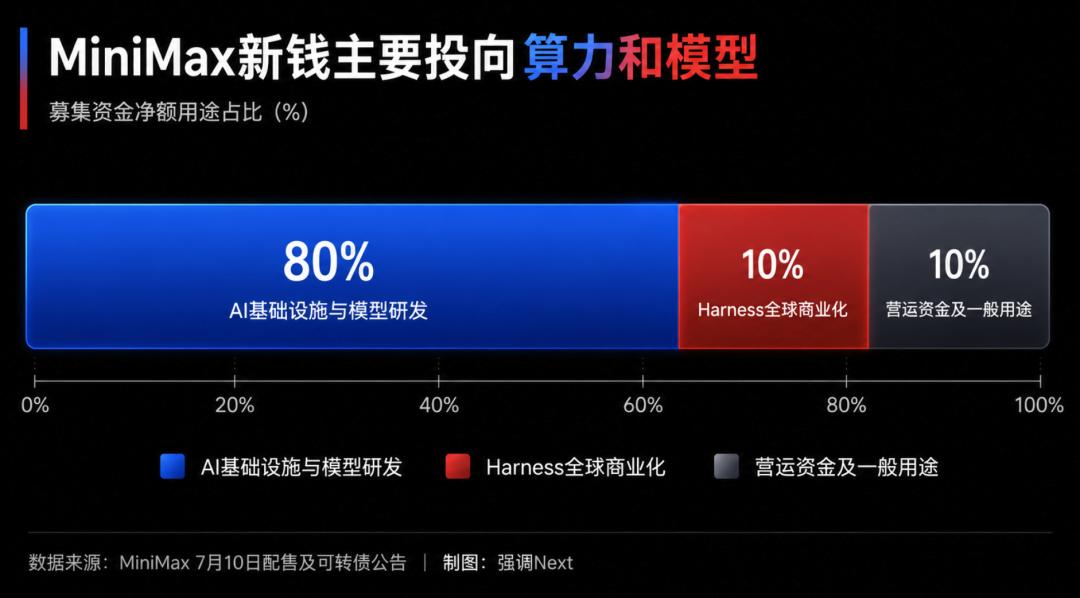
This sum of money has supplemented its capital reserves, but it also shows that large model companies still have very high capital consumption.
Zhipu's move was more aggressive. On July 9, the company announced that it would place up to 19.78 million new H shares at HK$1588 per share, raising about HK$314.1 billion. The net proceeds from Zhipu's IPO at the beginning of the year were about HK$4.896 billion. Before the placement, it had used about HK$4.588 billion of that fund, accounting for about 93%.
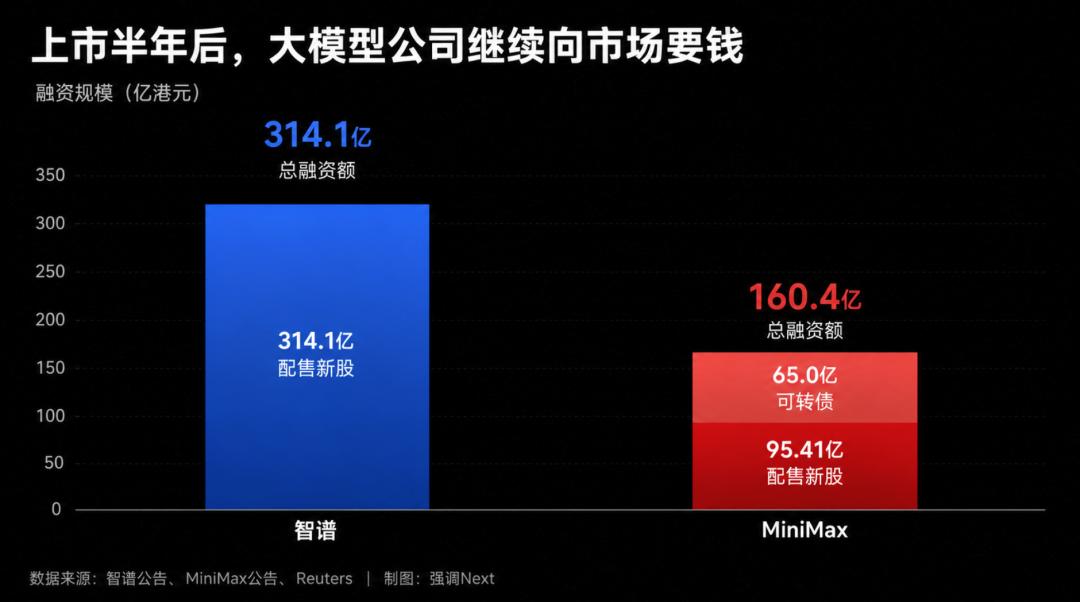
In other words, just half a year after their listing, Zhipu and MiniMax have collectively raised about HK$474 billion from the Hong Kong stock market. It is no accident that the two companies concentrated their financing during the restriction lift window. Model training, inference computing power, R&D personnel and product promotion all require continuous investment. Listing only gave them a financing entry point, but did not solve the problem of capital consumption.
They are also simultaneously preparing to list on the Sci-Tech Innovation Board (STAR Market) in mainland China. Zhipu's IPO tutoring status has entered the "tutoring acceptance" stage, and it plans to raise no more than 150 billion yuan. MiniMax also signed a tutoring agreement at the end of May, starting the preparation for its A-share listing. The demand for capital is obviously one of the important reasons why the two companies want to open up the "A+H" financing channel.
Therefore, this restriction lift did not produce a real winner.
At present, Zhipu has clearer enterprise revenue, but it also carries a more difficult-to-justify valuation. MiniMax's global users and multi-modal products retain room for growth, but it needs to improve its revenue quality and loss efficiency as soon as possible.
A company-wide letter can stabilize the team, but it cannot replace financial statements. HK$160 billion can extend the R&D cycle, but it cannot automatically bring a higher valuation.
What really matters next is the revenue growth rate, gross profit margin and cash consumption of the two companies after financing. Zhipu needs to prove that the HK$314 billion can continue to expand its commercialization, while MiniMax must prove that the HK$160 billion has bought more than just time. The interim reports that the two companies will release in August, and the larger-scale restriction lift in January next year, will be the key nodes that truly determine the direction of the second half of this "competition between the two giants".
· Data Source and Note: The data in this article comes from the announcements of the two companies and public market reports, as of July 10, 2026. It is for industry observation reference only and does not constitute any investment advice.
This article is from the WeChat Official Account "Emphasis Next" (ID: leo89203898), author: Dingshan, editor: Xiaobai, published with authorization from 36Kr.