Serving a plate of tomato scrambled eggs with an "ostrich egg" and daring to charge 520?
A plate of tomato and egg stir-fry priced at 520 yuan. Recently, a Shanghai restaurant used this most homely dish to once again expose the high-end catering industry's trick of "charging exorbitant prices relying on rare ingredients."
The restaurant's explanation sounds quite decent — it uses Australian emu eggs paired with imported tomatoes from Provence, and the cost of ingredients for a single serving exceeds 200 yuan.
But the interesting part is the chef's logic, which can be called a commercial genius: "Few people are willing to make it, and few people dare to order it," so "simply set the price high."
The logic of normal business is that reasonable pricing will attract buyers, and as more people buy, costs will naturally be diluted. Their approach is the opposite: because few people order it, they have to sell it expensively — so the burden of unsold inventory and inefficient turnover is entirely borne by the few consumers willing to try something new?
Many netizens mock it as a "blatant IQ tax," while others believe that the high procurement cost of niche ingredients justifies the relatively high price.
Looking beyond the surface of emotional opposition, similar incidents have actually emerged in endlessly in the past few years. The reality is that in recent years, the catering supply chain has become increasingly homogeneous, and everyone wants to find a shortcut to differentiation. Niche, exotic, and foreign-sounding ingredients have seemingly become a universal panacea for premium pricing in high-end restaurants.
But does being unpopular really mean being valuable? Among those internet-famous restaurants that became popular overnight thanks to exotic ingredients, how many have survived for more than a year?
Of the 520 yuan, how much is the ingredients actually worth?
The core argument of the restaurant's grievance is that "the cost of ingredients for a single serving exceeds 200 yuan," as if a sufficiently high cost makes the price justifiable. However, this packaged "high-end ingredient" may well be another kind of "emperor's new clothes."
Let's first talk about the emu egg, a name many people can't even pronounce smoothly.
The emu, commonly known in China as the "Australian ostrich," has a dark emerald green eggshell, weighing 500-700 grams per egg, equivalent to about 10-15 ordinary chicken eggs. The bulk purchase price in China's special breeding market is roughly 150-200 yuan per egg, and the retail price is even higher.
It does sound not cheap, but the core problem is that its "high price" is completely different from the natural scarcity of caviar and truffles.
Large-scale emu farming has long been carried out in Henan, Hainan, Guangdong and other places in China, and there is no insurmountable natural ceiling for production capacity. Its niche status is only due to low market demand and low circulation, which belongs to circulation scarcity rather than resource scarcity.
To put it bluntly, as long as there is money to be made, the breeding scale can be expanded at any time, and the price will drop accordingly.
Then let's look at the "Provence tomatoes" used as a high-end facade.
Many people, upon hearing the name, assume they are high-end goods imported from France. In fact, this variety has long been widely introduced and cultivated in Shandong and Shaanxi in China, with mature planting technology and stable annual output. For bulk procurement through catering channels, premium-grade Provence tomatoes only cost 4-6 yuan per jin, and the top-grade ones rarely exceed 8 yuan per jin.
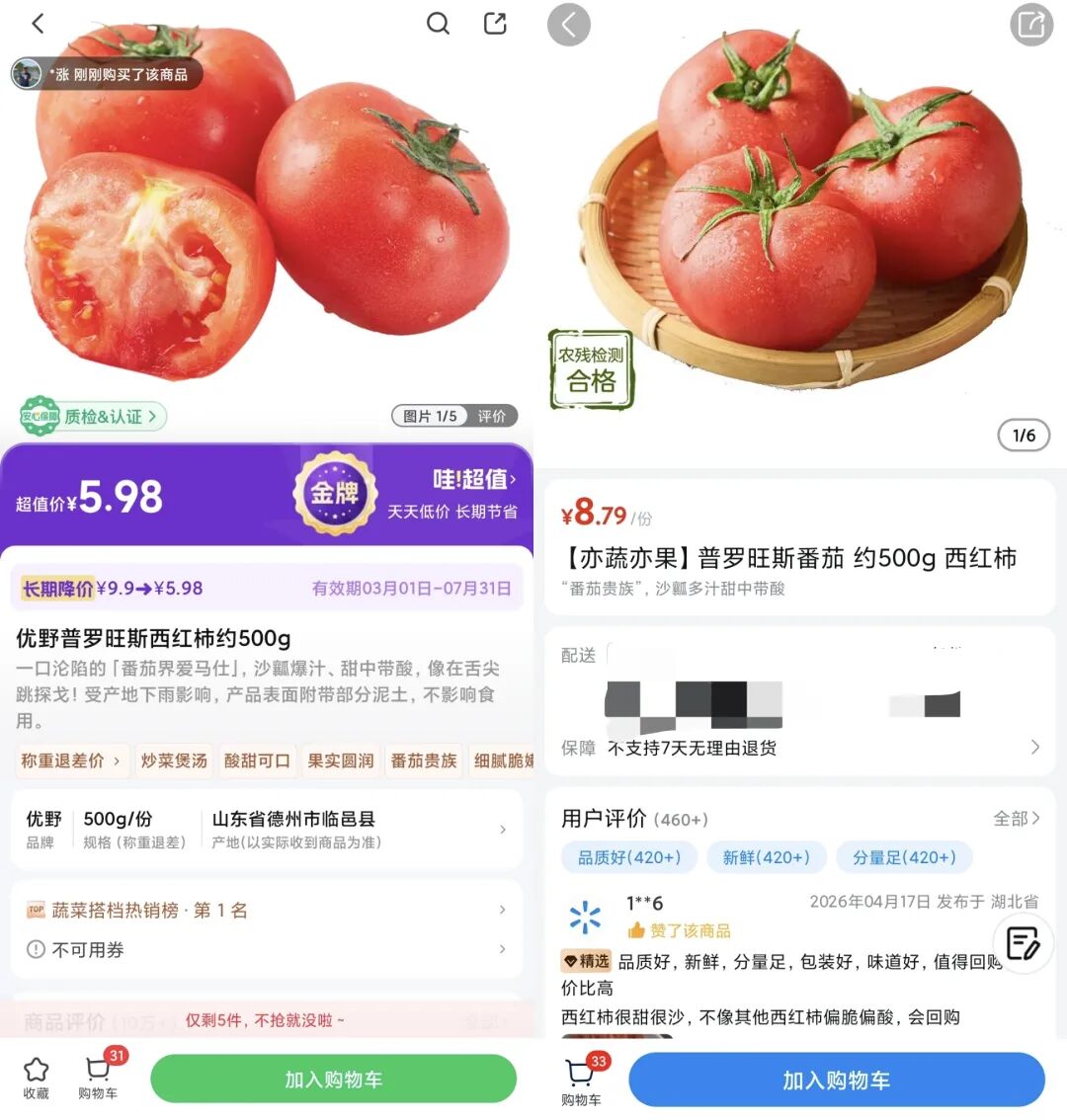
Image source: e-commerce platform
A serving of tomato and egg stir-fry uses at most two or three tomatoes, and the ingredient cost is at most 10 yuan.
Even if the merchant really chooses all pure imported fresh fruits, the cost is far from outrageous.
Referring to the quotations from European high-end ingredient suppliers, the retail price of fresh tomatoes from the Provence region in France is about 10 pounds per kilogram. Adding tariffs, logistics, losses and other costs, the CIF cost is at most about 100 yuan per kilogram. Converted to the amount used in a single dish, the tomato cost is at most 50 yuan.
Moreover, such imported fresh tomatoes are mostly supplied seasonally, and there are very few commercial channels that can provide stable supply throughout the year. The "Provence imported tomatoes" mentioned by some restaurants are essentially a marketing label used to boost their value.
Therefore, the "no profit" claimed by the merchant is most likely to include all the preparation losses of ingredients, cold chain transportation, and preparation labor costs.
But preparation losses and inefficient turnover are operational risks that merchants should bear. It is really a shrewd calculation to pass all the costs on to a few consumers who want to try new things, and package it as a "reasonable premium for rare ingredients."
Of course, catering pricing is never simply "cost × 2." Labor, rent, losses, including service and brand value, can all be reasons for premium pricing.
But the most untenable point of this dish is precisely that, apart from the raw materials themselves, there is no second point that can support the premium.
Many netizens who have experienced it on Xiaohongshu said that this dish is no different from the home-cooked version in terms of cooking techniques and taste. There is no exclusive craft, no complicated process. To put it bluntly, it is just to stir-fry expensive raw materials in the way of home cooking, and then serve it directly to the table at the finished product price.
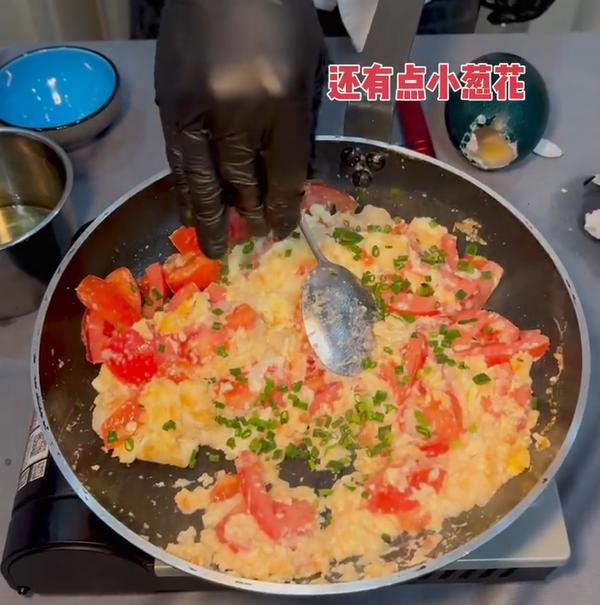
Image source: Xiaohongshu @ Northeast Gap-Tooth. Video screenshot
This is also the most difficult part to explain about this dish: it's not just about how much the emu egg is worth, but whether the finished product made by the restaurant combining several more expensive raw materials has gone beyond the cognitive range of ordinary tomato and egg stir-fry.
If the final finished product of the so-called high-end niche ingredients is still a plate of ordinary-tasting tomato and egg stir-fry, the controversy is not hard to understand.
Niche ingredient supply chains inherently carry risks
High-end catering's obsession with niche ingredients did not start with this plate of tomato and egg stir-fry.
Instead, it is a microcosm of Shanghai's high-end catering circle in recent years — when conventional ingredients can no longer create price differences through competition, merchants swarm to find premiums on unpopular, exotic, and story-rich raw materials.
The most typical example is the Canopia Restaurant that went viral last year.
This restaurant, which focuses on "ecological fusion cuisine," brought the rainforest scene to Shanghai, with a per capita consumption of 3,888 yuan. Only one table was open every night, and reservations were once scheduled for a month later.
All its highlights are tied to niche ingredients: for the appetizer, guests are asked to cut and eat leaves from potted plants directly; sour ants are used instead of vinegar to bring out natural sourness; bamboo worms are boiled into a sauce as a flavor base; and the most popular dessert is called "flowers inserted in elephant dung" — which is claimed to be made from the base of sterilized and crushed elephant dung.
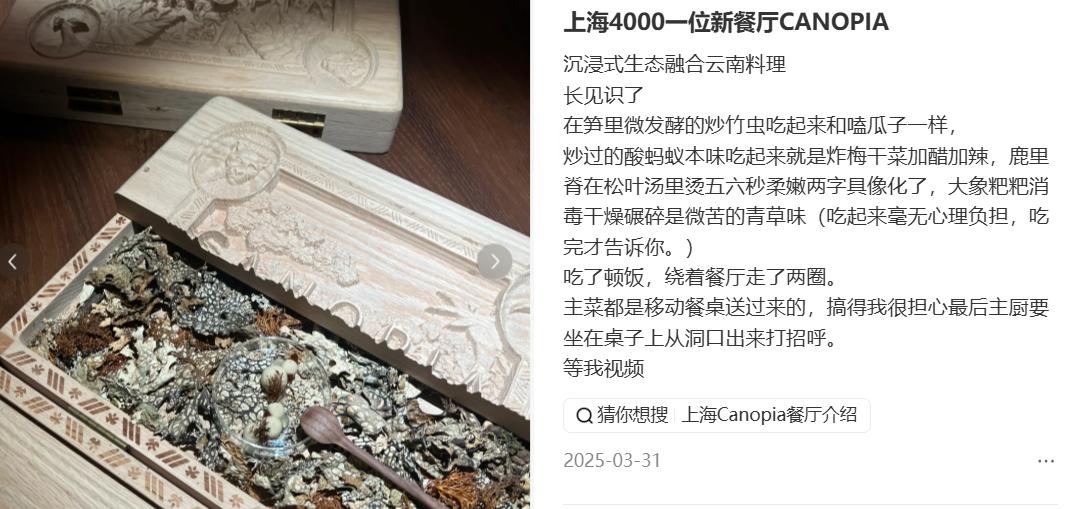
Image source: Xiaohongshu
Extreme exoticism brought extreme traffic.
The total views of related topics exceeded 100 million across the network, food bloggers rushed to visit, and the whole network was discussing whether it was worth spending 4,000 yuan to "eat dung in Shanghai."
But before the heat even lasted long, market regulators showed up. After verification, the salmonella in the elephant dung used by the restaurant exceeded the standard by 4 times, and the ingredients such as bamboo worms and ants did not obtain formal food raw material qualifications. The restaurant was directly filed for investigation and sealed up for violating the Food Safety Law. From being popular all over the network to completely closing down, it took less than two months.
This is not an isolated case.
Almost all the "niche ingredient internet-famous restaurants" that have popped up in Shanghai in recent years cannot escape the fate of "becoming popular in three months, fading out in half a year, and closing down in a year."
Some use various insects such as sour ants and bamboo worms, as well as special fermented products for molecular seasoning; some use wild plants from the deep southwest mountains to make creative dishes; some focus on various unpopular special poultry and livestock; and a larger part is keen to mark origins, varieties, and breeding methods that ordinary consumers are not familiar with.
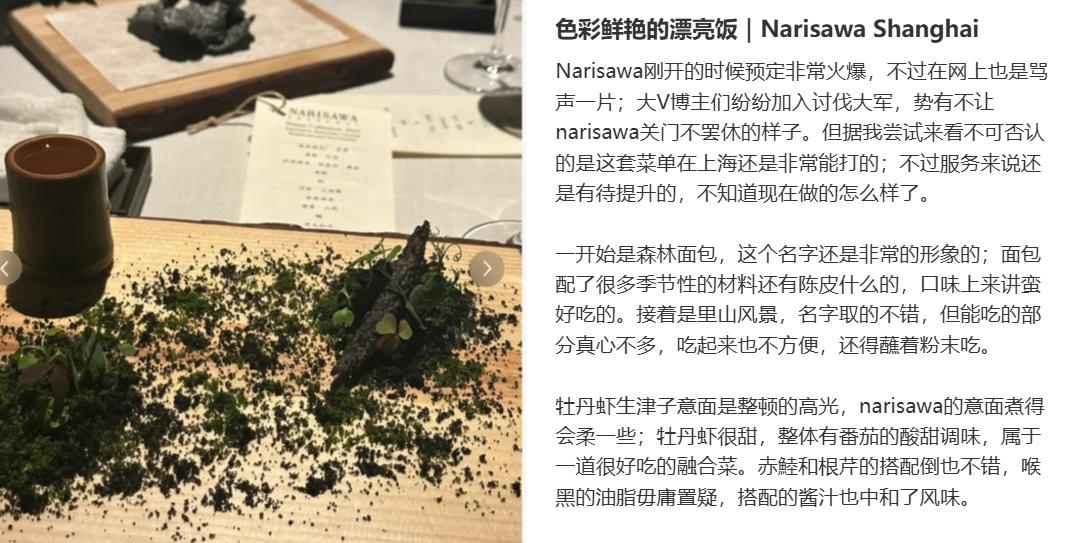
Image source: Xiaohongshu
Their paths are highly unified: find an ingredient that peers don't use, package it as "niche high-end" and "original flavor," and use food exploration content to detonate social platforms. At the beginning of opening, it is hard to get a reservation. Once the freshness fades, the passenger flow drops off a cliff immediately.
Data from the China Cuisine Association shows that the average life cycle of internet-famous restaurants is only 8-12 months, and less than 10% can survive for more than three years.
Why do they become popular quickly and fade away even faster? The reason is straightforward.
First of all, the demand for exoticism itself is a one-time thing, with no foundation for repurchase. The vast majority of people who check in at such restaurants are not motivated by eating, but by satisfying their curiosity and desire for social display.
After taking a set of photos and posting them on Xiaohongshu or Moments, the consumption demand is completely fulfilled. No one will repeatedly spend a lot of money to go to the restaurant for the same sense of exoticism. The customer base of high-end catering is inherently narrow, and losing repurchase means directly losing the basic foundation for survival.
Back to the industrial end, the supply chain of niche ingredients inherently carries risks.
The other side of "niche" is the absence of standardization, stable production capacity, and a mature circulation system.
It is normal for the quality of different batches to fluctuate, and it is not uncommon for the supply to be suddenly cut off. What's more troublesome is that many unpopular ingredients are in the gray area of food regulation. Take "elephant dung" as an example. Today it is still used as a creative selling point, but tomorrow it may be deemed non-compliant.
The National Health Commission's "Measures for the Safety Review and Management of New Food Raw Materials" clearly states that animals, plants, microorganisms, etc. that have no traditional eating habits in China, as new food raw materials, shall not be used in food production and operation until they have passed the safety review.
For a legitimate business, the core ingredients may have problems at any time, which is essentially a time bomb.
In fact, many merchants have a fatal misunderstanding about high-end catering: if I use ingredients that others don't use, it is high-end.
But the truly sustainable high-end ingredients are never those that consumers have never seen, but those that are "irreplaceable."
Caviar is expensive because of its unique flavor and naturally limited production capacity; wagyu beef is expensive because of clear standards for breeding techniques and taste grades. Their high prices are supported by real value, not just by "rarity."
The more a restaurant wants to use it to create differentiation, the more it has to answer a specific question: what irreplaceable value does this ingredient bring to this dish?
Everyone is competing for differentiation, but niche ingredients are never a universal panacea
Back to the core question: when the supply chain of conventional ingredients becomes more and more transparent, where should the differentiation of catering come from?
The answer is definitely not "who has the more unpopular ingredients."
In the past, when high-end restaurants talked about ingredients, there was still a certain information gap. But today, with the industrialization of catering, the homogeneity of the upstream supply chain is a consensus across the industry.
Most of the meat, eggs, and vegetables used by chain brands come from leading suppliers, with highly similar quality, specifications, and procurement price differences. To create a clear price gap in popular ingredients, you either rely on extreme craftsmanship or brand accumulation, but neither of these can achieve results in the short term.
Thus, "niche ingredients" have become the most clever shortcut.
Emu eggs, sour ants, and tomatoes with foreign-sounding origins naturally create a sense of distance. There is no need to polish cooking skills or accumulate reputation. As long as you replace it with a raw material that others have hardly seen, and then package it with the story of its origin, the per capita consumption can immediately jump to a higher level.
The more unfamiliar the name, the easier it is to tell the story; the less customers have seen it, the easier it is for the restaurant to raise the price. It seems to have found differentiation, but in reality, it is consuming its own product strength.
Niche ingredients themselves are not a sin.
The truly viable way to play is never to make niche ingredients into sky-high signature dishes to attract attention, but to use seasoning and matching to make the ingredients become the added value of the dish.
In the past two years, hamburgers have become popular again, and we can see similar differences. The hamburgers that people really remember are not simply stacking expensive ingredients such as sky-high wagyu beef, foie gras, and black truffles.
To make a hamburger delicious, you first need to handle the relationship between fat, sourness, sauce, bread, and patty. So we can see that chefs who truly understand ingredients will use niche blue cheese to neutralize the heaviness of fat, and use mushroom sauce, pickles, and other fermented flavors to create a layered taste that is both refreshing and fresh.
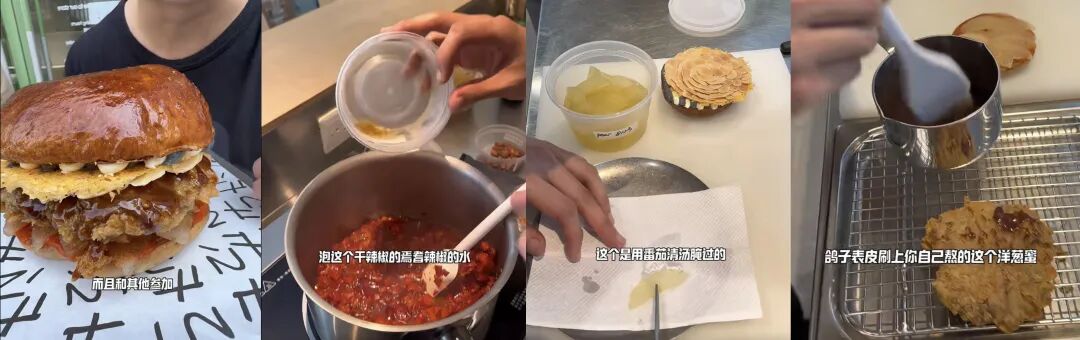
Image source: @ Xiao Li is a little hungry, founder of hoch Burger Festival
Expensive and niche ingredients are never the protagonist, but the finishing touch.