How Alibaba can shake off its "valuation discount" label amid its long-awaited rebound
Legend has it that King Gordias of Phrygia tied his chariot to an intricately knotted cord, with the rope ends hidden deep within layers of winding twists. An oracle proclaimed: whoever could untie this knot would become the king of Asia.
For hundreds of years, countless wise men came to challenge it, but none succeeded. Until Alexander arrived with his army, facing this millennium-old unsolvable knot, he drew his sword directly and slashed it, and the knot shattered instantly.
In 2026, China's internet giants are each facing their own Gordian Knot. E-commerce, search, social media, local life services — the core businesses accumulated over the past two decades have formed one intricate system after another: every line has its own logic, every line also carries its own burdens, and together they create a deadlock.
Take Alibaba as an example. Facing the transformation in the AI era, Alibaba possesses unique advantages: full-stack AI layout, the Tongyi large model, the growth rate of cloud computing, and the chip progress of T-Head, making it almost a one-of-a-kind scarce asset in China.
But since the start of this year, its stock price once plummeted from a high of around HK$180 to below HK$90; Tencent has fared no better, with its stock price also retreating by a third from its peak.
Entering mid-July, Alibaba's stock price finally ushered in a long-awaited strong rebound. This positive candlestick formed after the sharp decline this year has begun to prompt investors to ask a more fundamental question: What exactly is the market concerned about during this roller-coaster ride? Can Alibaba, riding this wave of rebound, break free from its valuation discount in one go?
In our view, the underlying logic behind this sharp correction in the valuations of Chinese internet concept stocks is shared: the industry valuations of existing businesses have entered a downward channel, the room for imagination for established incremental businesses is limited, and AI has not yet built a stable cash flow cycle.
Alibaba is undoubtedly the most prominent representative sample. Using it as an entry point, we will dissect the crux of the current valuation problem facing Chinese internet concept stocks, and attempt to answer the most anxious question on investors' minds: how to view and resolve the current valuation discount.
Stable Existing Business, but Valuation Is Suppressed
Before discussing valuation, we must first clarify the fundamentals. In terms of growth rate alone, Alibaba's e-commerce business has not underperformed in the past two years.
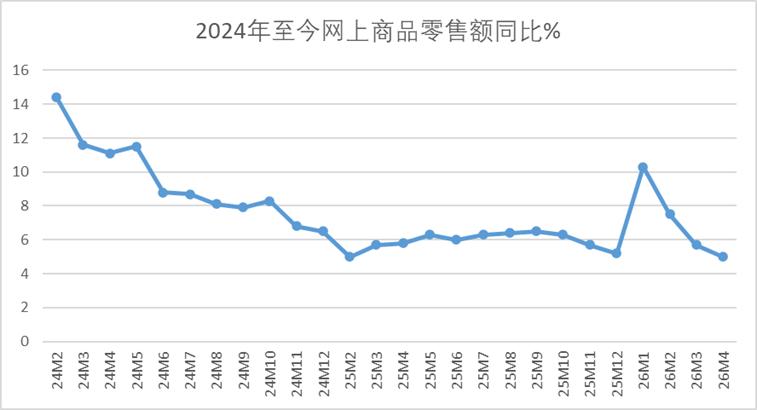
In the first quarter of this year, Alibaba's China commercial segment recorded revenue of 122.2 billion yuan in a single quarter, of which the e-commerce business accounted for 96.3 billion yuan, a slight year-on-year decrease of less than 1%. In the same period, total retail sales of consumer goods increased by 2.4% year-on-year, online retail sales of goods and services increased by 8.0% year-on-year, and online retail sales of goods alone increased by 7.5%. Looking at this quarter in isolation, Alibaba's e-commerce growth rate indeed lags behind the overall market.
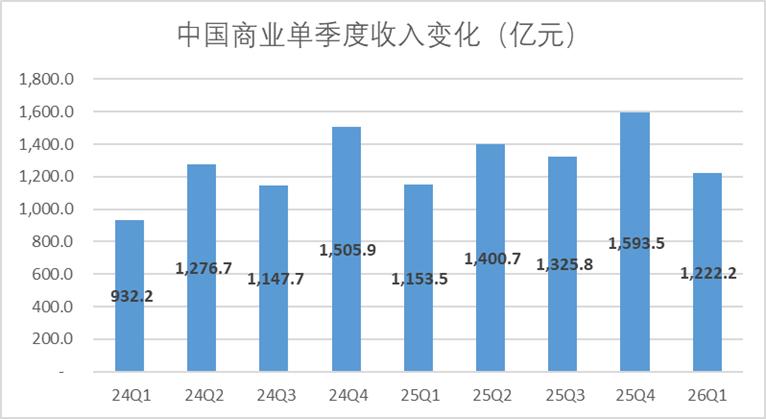
However, one quarter of relative weakness does not tell the whole story. From the second quarter of 2024 to the end of the third quarter of last year, thanks to the growth in customer management revenue, the actual growth rate of Alibaba's China commercial business line has consistently outpaced the growth rate of physical online retail sales in the same quarter. Over a longer time horizon, Alibaba's e-commerce base is quite solid. For a leading platform of such enormous scale, this achievement did not come easily.
But two objective facts cannot be ignored.
First, the growth rate of the entire e-commerce market is slowing down, while the competitive landscape at the top has become more crowded.
Since 2024, even with strong stimulus policies such as local consumption coupons combined with national subsidies, the growth rate of online retail sales has been on a downward trajectory. According to CICC's research report, the growth rate of e-commerce platforms in 2026 will be around 8%, significantly lower than the 12% in 2025.
Moreover, the current e-commerce market exhibits an obvious hammer-shaped concentration pattern: in 2022, the CR2 concentration ratio of domestic e-commerce was 60%, and CR5 was 84%; by the beginning of this year, CR2 had dropped to 57%, while CR5 had soared to 93%. The low-tier players have basically been cleared out, and the top tier is dominated by strong capital-backed players like ByteDance, Pinduoduo, and JD.com, leaving little room for incremental growth driven by horizontal competition.
Second, capital's interest in e-commerce platforms is fading.
The siphon effect of AI on the capital market is so strong that the vast majority of funds are uninterested in traditional internet businesses with high certainty. Since last year, Goldman Sachs and Morgan Stanley have successively lowered their target prices for traditional e-commerce platforms. Judging from the forward valuation based on growth rate, JD.com's 2027 forward price-to-earnings ratio is only 6.9x, leaving Alibaba's e-commerce business with limited valuation headroom.
The core business is still there, the "meat" on the plate remains, but more and more people are reaching for it. The stock competition surrounding e-commerce shows no sign of slowing down, so naturally the valuation cannot rise. More critically, the new incremental opportunities in instant retail do not seem that attractive either.
Incremental Breakthroughs, but Compelling Narrative Lacks
Since the second quarter of 2025, Alibaba has started disclosing single-quarter business data for its instant retail segment. Judging solely from the incremental growth of instant retail, as the latest player to enter the food delivery battle, Alibaba has achieved phased results. In the first quarter of this year, the growth rate reached 57%, and its market share caught up with its strong rival Meituan.
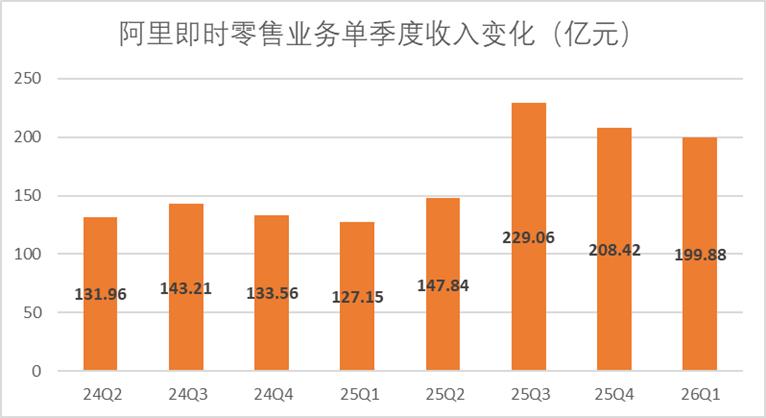
But the problem is, the attractiveness of the instant retail business is not enough to support a compelling valuation story.
Alibaba's cost control level has been mired in trouble since the food delivery war began. Although the narrative of curbing cutthroat competition is relatively clear, actual subsidies have not decreased significantly, and the recovery speed of unit economic profit (UE) per order has also fallen short of expectations. According to Everbright Securities' forecasts, the unit UE for instant retail will be -1.8 yuan, -0.8 yuan, and 0 yuan in fiscal years 2027 to 2029 respectively.
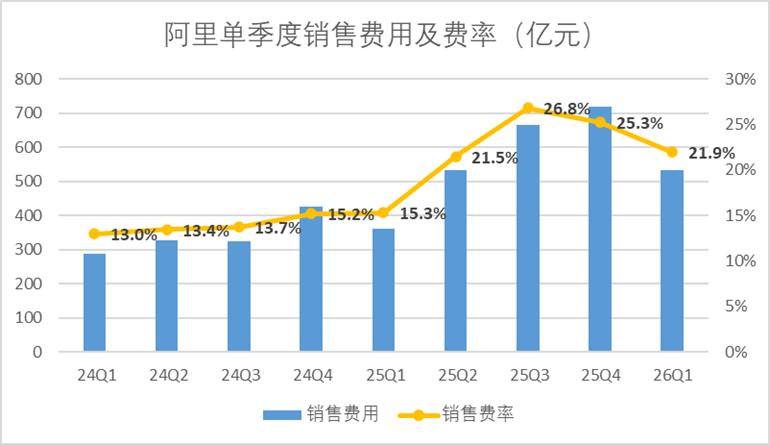
More critically, the driving effect of instant retail on Alibaba's main e-commerce platform cannot yet be reflected in financial report performance closely linked to valuation. As mentioned earlier, Alibaba's e-commerce year-on-year growth rate in the first quarter of this year lags behind the overall industry, which means the synergistic effect between instant retail and e-commerce has not been fully realized yet.
If we exclude the synergistic effect with e-commerce, even if instant retail can really build a profitable model in the short term, its contribution to the profit side will be very limited. A JPMorgan Chase report shows that in the global food delivery industry, Uber Eats' profit margin is only 3.3%. The food delivery business is a low-margin, tough slog on a global scale.
Instant retail has indeed helped Alibaba secure a "near-field e-commerce" ticket, and its market share catch-up has proven Alibaba's execution capabilities. But the market will never pay a premium for a business that is still incurring huge losses. For Alibaba, from a valuation perspective, the incremental narrative is not compelling enough.
Full-Stack AI Layout, but Closed Loop Not Yet Formed
Beyond traditional businesses, Alibaba is one of the few domestic companies that have completed a full-stack AI layout, and its scarcity is beyond doubt. The combination of "Tongyi large model + Alibaba Cloud + T-Head Semiconductor" gives it the potential to rival global tech giants at the underlying infrastructure level.
However, at the valuation level, Alibaba has not received corresponding compensation. Take Alibaba Cloud as an example:
· Compared with the world's leading cloud + hardware and software vendors, Microsoft Azure grew by about 40% year-on-year in Q1 2026. Deutsche Bank estimates Azure's real gross profit margin trajectory: around 60% in fiscal 2024, 56% in fiscal 2025, and 52% in fiscal 2026. It currently accounts for about 20% of Microsoft's revenue, and the combined current overall PE is about 34x.
· Compared with the world's leading cloud + e-commerce enterprises, China Merchants Bank International gives Amazon AWS a valuation of 28x PE and 15x EV/EBITDA. CMB International uses a forecast EV/EBITDA of 17.6x.
We break down Alibaba using the Sum of the Parts (SOTP) method: assuming the overall e-commerce business (domestic + overseas) has a PE-TTM of around 6x (the valuation range for mainstream e-commerce at present), the profit over the past 12 months (excluding flash sale impacts) is about 189 billion yuan, with a valuation of approximately 1.13 trillion yuan; for the instant retail business, referencing Meituan and considering the proportion of in-store business, calculated with an 80% discount, it is about 360 billion yuan; Cainiao's pre-listing valuation disclosed three years ago was 20 billion US dollars, and we assume a 50% discount rate, making its actual valuation around 70 billion yuan.
Then the market's actual valuation of Alibaba Cloud is about 280 billion yuan. Alibaba Cloud's growth rate is no less than that of Azure and AWS, but its profit margin is indeed not high — only 9.1% in the first quarter of this year, with an actual PE of around 20x, which is still significantly lower than AWS and Azure.
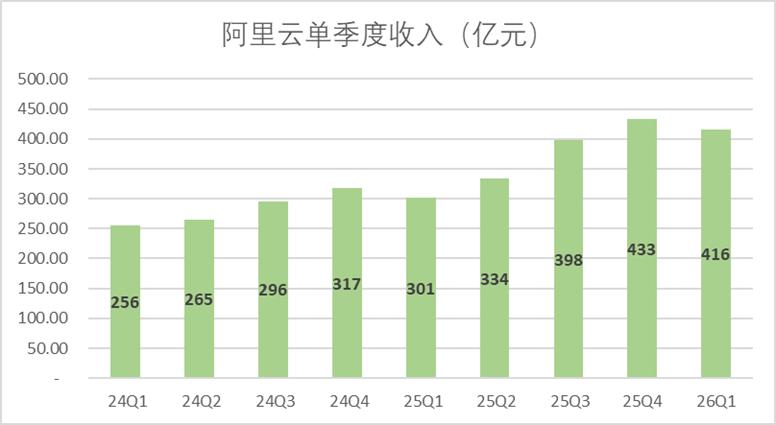
Where is the crux? The AI story in front of Alibaba has not yet formed a closed loop.
First, market investors are relatively concerned about Alibaba's cash flow capabilities.
Especially when the income statement is suppressed by existing businesses, over the past two years, Alibaba has been deeply involved in both the e-commerce battlefield and the instant retail battlefield. Meanwhile, its annual capital expenditure level of hundreds of billions of yuan focused on AI expansion will put enormous pressure on cash flow.
Second, Alibaba's AI model has not yet built a business model moat in its core capabilities.
Looking at Anthropic, the most popular AI large model enterprise today, there are countless possible paths for large model commercialization. But a track that can truly support a company with a trillion-dollar market cap must be strongly linked to productivity, and currently there are only two viable paths: programming and office productivity.
Coding capability is a key lesson that all domestic foundational model enterprises need to make up for in the coming period, and Alibaba's Tongyi is no exception. In addition, the DingTalk product has so far failed to bring about a good technological revolution in the office market. And although Alipay's AI-focused narrative spread rapidly, it ultimately deviated from the right path and is not enough to support the overall situation.
Before the two paths of coding and office productivity are fully operational, it will be difficult to build a complete loop for all AI investments. Large-scale capital expenditure requires strong feedback from the commercialization side, and before that is achieved, it will inevitably continue to face skepticism.
The Sword to Break the Valuation Discount
Returning to the opening question of the article. This mid-July rebound has lifted Alibaba's stock price from below 100 yuan back above 110 yuan. But the rebound has repaired sentiment, not valuation.
Alibaba faces three problems: the e-commerce profit pool is being gradually diluted by competition, instant retail is still burning money to gain market share, AI capital expenditure is expanding while the commercial closed loop has not yet formed. On the same income statement, cash flow is tightening, expectations are lengthening, and the valuation discount is squeezed out in this way.
The rebound provides a window. When market sentiment recovers, investors are willing to re-examine asset quality. Alibaba holds the scarce full-stack AI layout, the leading cloud computing business in China, and T-Head's progress in the chip field. These things were obscured by panic when the stock price fell below 100 yuan, and the rebound can bring them back into the spotlight.
But whether the rebound can turn into a reversal depends on whether the market believes Alibaba can plug the gaps on its income statement one by one. The e-commerce profits need to be stabilized, instant retail losses need to narrow, and AI investment needs to find the shortest path to commercial implementation. If even one of the three things is not done, the rebound will remain just a rebound.
The path ahead is steep, and the only way is upward, but Alibaba is being pulled back by too many factors. From e-commerce to instant retail, and then to AI, Alibaba's valuation story has covered three chapters. Each chapter is logically sound on its own, but the market has given it an overall valuation discount. The scarcity of full-stack AI is almost unmatched in China, and there is indeed an expectation gap, but the realization of that gap requires time.
However, besides waiting for time to give the answer, Alibaba has a more proactive path to take.
As we previously revealed in the research report "How Chinese Industrial Giants Like Xiaomi and Midea Can Break Free from the Cognitive Misconception That 'Bigger Equals Stronger'", the experience of global industrial giants over the past decade has repeatedly verified one thing: when the business logic, growth curves, and capital attributes within a group have completely diverged, spin-offs are the most effective tool for valuation repair.
General Electric split its healthcare, energy, and aviation businesses into three independent companies; Western Digital separated its hard drive and flash memory businesses for public listing; Siemens divested its healthcare and energy businesses one after another. All these operations have, without exception, unlocked asset value suppressed by group-level discounts.
After Western Digital's spin-off, the combined market cap of its hard drive and flash memory businesses rose more than twenty times. General Electric rebounded from its bottom, and Siemens' three business segments are now independently priced according to their respective industry logic.
The dilemma Alibaba faces today is highly similar to the state these industrial giants experienced at a certain stage. E-commerce is a mature cash cow, instant retail is a growth-oriented business burning money for market share, while Alibaba Cloud and AI are full-stack technology platforms. The three types of assets have completely different risk preferences, valuation methods, and capital requirements. Crowded onto the same income statement, the result is mutual drag.