The "lobster craze" has already cooled down, so why are telecom operators still clinging to it?
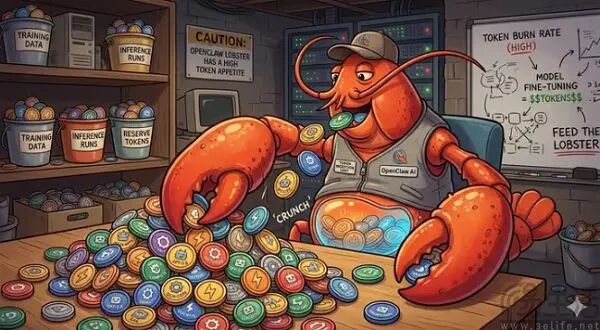
The tides in the internet industry come one after another, with no one able to stay in the spotlight forever. The once red-hot "Lobster" (OpenClaw) that dominated the scene this spring has now faded into obscurity, its name nearly disappearing from news of major internet tech giants. But one man's meat is another man's poison: the "Lobster" that internet companies barely talk about anymore is treated as a treasure by telecom operators.
At the recently opened 2026 China Internet Conference, Luan Xiaowei, Vice General Manager of China Telecom, stated in his speech that AI is no longer just an auxiliary tool, but a core force that reshapes production relations. He also noted that "facing this global, historic transformation, China Telecom will proactively embrace it, fully integrate into it, continuously improve the integrated system of computing power, platforms, data, large models and agents, and drive the transformation of enterprise operations from traditional traffic-based operations to Token-based operations."
Similarly, China Mobile recently launched the new "Claw Message App" service, creating a remote SMS control channel for various "Lobster" agents on PC devices, solving two major pain points: not having the computer nearby, and easily missing agent push notifications. It is reported that users can send text in the SMS app to issue tasks, no SMS fees will be charged for sending commands, and they can repeatedly adjust commands to debug the agents.
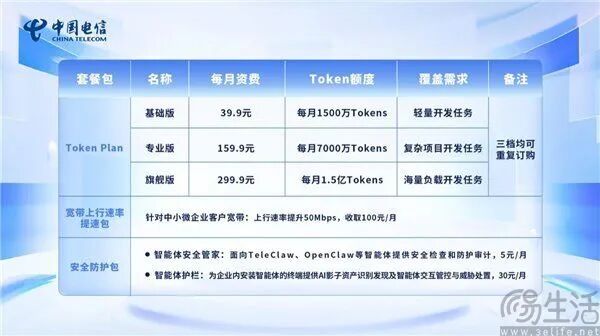
Earlier, the three major telecom operators launched a variety of Token packages. Taking China Telecom's Token Plan for individual and family customers as an example: the Light Enjoy Plan costs 9.9 yuan including 10 million Tokens per month, the Premium Enjoy Plan costs 29.9 yuan including 40 million Tokens per month, and the Ultimate Enjoy Plan costs 49.9 yuan including 80 million Tokens per month.
While operators are talking about scaling up Token operations, their current way of selling Tokens is even less mature than their past approach to selling mobile data. At present, the operators' Token operation model is to provide their own computing power, infrastructure and communication services, integrate third-party models, then package the services and set prices for them.
The problem is, selling traffic and selling Tokens are not the same: the latter has to go through the "middleman" of large AI models.

The computing power comes from the operators' servers, but Token consumption happens on the model side, meaning the billing process is effectively controlled by large model vendors. Meanwhile, the widely recognized mainstream large AI models are mostly developed by internet giants and AI unicorns, such as Alibaba's Qwen, DeepSeek, Zhipu AI's GLM, and Moonshot AI's Kimi, while the operators' self-developed models like China Telecom's Xinghe Large Model and China Mobile's Jiutian Large Model are largely unknown to the public.
In a sense, operators are acting as distributors in the business of "selling Tokens", which is not conducive to packaging Tokens into high-quality AI services that users can clearly perceive. So why are the three major operators still firmly betting on Token operations? The reason is that as the mobile internet demographic dividend has been fully exhausted, selling traffic is a business with linear growth, while Token generation and circulation can achieve exponential growth.
To be precise, selling traffic is not even a steadily growing business for operators now, but a "time bomb" on the verge of decline. Official data from the Ministry of Industry and Information Technology shows that in 2025, China's monthly average data usage per user (DOU) continued to rise, but the revenue of mobile data services in the telecom industry declined. The total mobile internet access traffic reached 395.8 billion GB, up 17.3% year on year, and the monthly average data usage per user hit 20.74 GB, up 14.1% year on year. However, the 2025 revenue of mobile data services in China's telecom industry was 609.7 billion yuan, down 3.1% year on year.
The policy of number portability between operators is like the Sword of Damocles, forcing operators to compete over "who can lock users into their own ecosystem better". Tariff packages have gradually shifted from focusing on call minutes and SMS counts to general traffic, dedicated traffic, rollover benefits and contract discounts, with the billing logic evolving from "selling communication capabilities" to "locking users in for a fixed period".
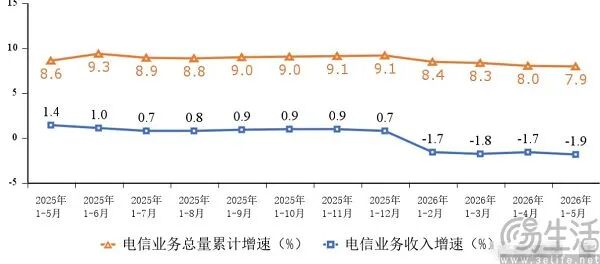
The end result is that internet traffic is still growing, but under the pressure of cutthroat competition, operators have no choice but to drive down traffic prices. Latest statistics show that in the first 5 months of this year, the total telecom business revenue nationwide reached 735.5 billion yuan, down 1.9% year on year, while the total telecom business volume calculated at constant prices rose by 7.9%.
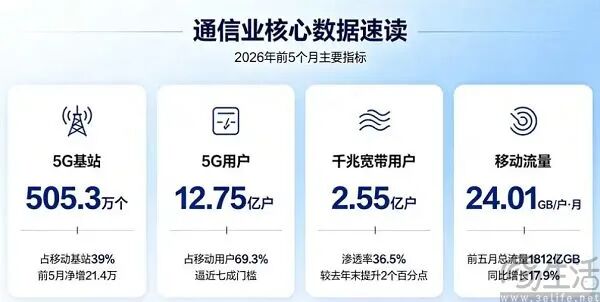
In short, operators are now facing a situation where "they are doing more and more work, but earning less and less money". With traditional business revenue continuing to decline, they can only pin their hopes on new business lines. Compared with selling traffic, the advantage of selling Tokens is that users have higher budget and stronger willingness to pay.
The "Lobster" is almost the "chosen one" for AI commercialization. On one hand, it gives users psychological satisfaction that "running a Lobster agent means keeping up with the AI era", on the other hand, its usage cost is surprisingly high. Even the later Hermes Agent that rose to prominence with relatively low Token consumption is still far more expensive than traditional services, only cheaper than the "Lobster".
The old joke from the early mobile internet era that "you leave the Lobster running, and wake up to find your house belongs to the operator" has a new version in the modern age. This is because the core capability of agents is to call tools, which requires autonomous multi-step reasoning, planning, trial and error, and reflection. Even for a simple command like "check the weather", the agent has to go through the full process: break down the task goal first, list the execution plan, call tools for verification, then self-check the result. Complex tasks may trigger dozens of such cycles.
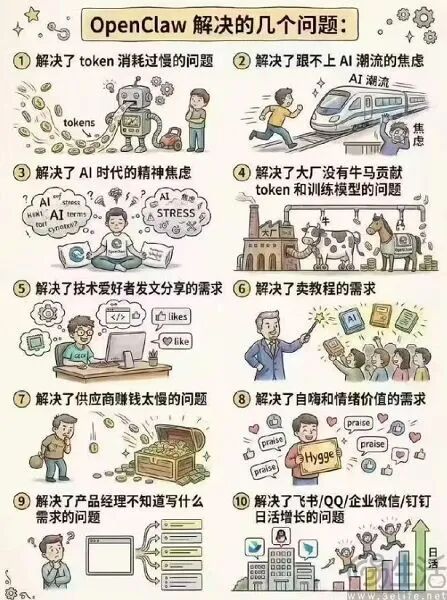
The working logic of agents inherently generates a large amount of invalid Tokens that users cannot see or use, which is undoubtedly welcomed by vendors selling Tokens. Moreover, agents can indeed help some individuals and companies boost productivity, allowing them to shift their valuable human resources to high-value scenarios. The actual business value converted from Token consumption can not only cover the cost, but also generate profits.
In short, the current users with massive Token demand are either very well-funded, or have far above average ability to create value. In this case, instead of haggling over every penny with ordinary users over traffic packages, operators would be better off selling Token packages to AI pioneers with strong willingness to pay.
This article is from the WeChat Official Account "3eLife" (ID: IT-3eLife), written by 3eJun, published with authorization from 36Kr.