Splitting e-commerce business, rectifying script-based product promotion, Kuaishou gives "lifeline" to repurchase rates
Kuaishou E-commerce has rolled out two aggressive measures in quick succession.
On July 9, as reported by Iyiou, Kuaishou E-commerce completed a new round of organizational restructuring, redefining its business landscape into three independent core lines: brand and commercialization business, creator business, and white-label merchant industry business.
Among them, Kang Le oversees the brand and commercialization business, Song Zhen takes independent charge of the creator business, and the white-label merchant industry business is further divided into three segments—premium consumption, daily life consumption, and daily necessities consumption—based on customer unit price and decision-making path.
On the same day, Kuaishou E-commerce released a special governance announcement, declaring a strict crackdown on the illegal business model of "script-based traffic diversion + PK co-hosted sales". Once detected, immediate penalties will be imposed with no prior warning or rectification period.
The organizational restructuring and special governance were implemented intensively within the same month. While seemingly independent measures, they both target the same core issue: the repurchase rate.
"Low-Price Trap" and Brand Anxiety
Kuaishou E-commerce's urgency to split its business and rectify chaos primarily stems from its slowing growth momentum.
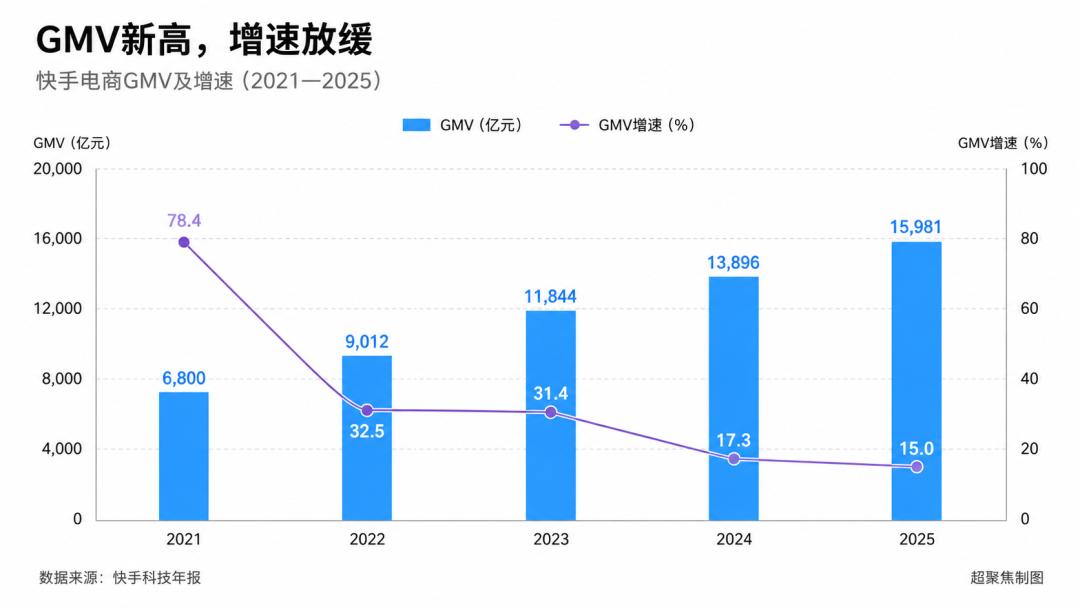
In 2021, Kuaishou E-commerce's GMV growth rate reached as high as 78%. By 2025, its annual e-commerce GMV hit 1.6 trillion yuan, with a year-on-year growth of 15%. The growth rate plummeted from 78% to 15%, a drop of 63 percentage points over five years.
User growth is also far from optimistic. From 2021 to 2025, Kuaishou's daily active user growth rate dropped all the way from 15.58% to 2.76%, and its monthly active user growth rate slowed from 12.68% to 2.11%. In the fourth quarter of 2025, the platform lost 8 million daily active users compared to the third quarter. The end of traffic dividends has become an established fact.
The combination of slowing GMV growth and stagnant user growth leaves Kuaishou E-commerce facing a fundamental problem: how to sustain the continuous growth of its e-commerce business without relying on new traffic as a driving force?
The only answer lies in repurchase—encouraging existing users to buy more and more frequently. Xiao Gu, President of Kuaishou E-commerce, once proposed the concept of "trust-based e-commerce". According to official data, the overall repurchase rate on Kuaishou's platform is as high as 50%, and the repurchase rate for the same brand reaches 75%.
However, behind the high repurchase rate lies structural vulnerability: a high repurchase rate does not equate to high-quality repurchases.
A large number of repurchases on Kuaishou come from low-priced essential goods sold by white-label merchants, such as tissues, cleaning products, and personal care sundries that cost just a few yuan. The profit per order is only a few mao or a few yuan. No matter how high the repurchase frequency is, if the customer unit price remains at a low level, the revenue ceiling of the e-commerce business becomes clearly visible.
The structural characteristics of Kuaishou E-commerce's product assortment confirm this point. According to Feigua Data, apparel products account for over 25% of its offerings, jewelry, beauty, and health products make up about 22%, and the rest are scattered categories such as daily necessities and food.
Dominated by non-standard products, with low decision-making thresholds, high emotional dependence, and direct supply from industrial belts, this product assortment fits the impulsive consumption scenario of live streaming rooms but inherently rejects brand premium, resulting in a weak presence of brands on Kuaishou.
Thus, the problem evolves into the fact that Kuaishou E-commerce needs repurchases from brands and repurchases from mid-to-high customer unit price categories, which is exactly the dilemma that the organizational restructuring attempts to solve.
The organizational restructuring on July 8 divided Kuaishou E-commerce's business into three independent core lines: Kang Le oversees the brand and commercialization business, Song Zhen is responsible for the creator business, and the white-label merchant industry business is split into three segments—premium consumption, daily life consumption, and daily necessities consumption—based on customer unit price and decision-making path.
On the surface, this is a rearrangement of the organizational structure, but its underlying logic is the hierarchical management of "repurchase value".
Kang Le is in charge of all brand businesses related to e-commerce and commercialization, with the widest scope of responsibilities. He once worked in Alibaba Entertainment in charge of regional sales, joined Tencent in 2018, and joined Kuaishou in 2021, where he successively took charge of the e-commerce beauty and personal care sector, the apparel industry, and the Merchant Development Center.
Placing the brand business and commercialization business under the same responsible person means that brands' operations on Kuaishou are no longer just about "selling goods", but a systematic project deeply integrated with advertising placement and brand marketing.
What brands need is not a one-off GMV sprint, but a sustainable repurchase model, which precisely requires the support of commercialization capabilities.
Song Zhen takes independent charge of the creator business, benchmarking against the creator team of Douyin E-commerce. Song Zhen joined Kuaishou's commercialization department in 2021 and once served as the head of Kuaishou E-commerce's Fast Brand division. Creators play three roles simultaneously: content producers, product distribution channels, and trust carriers. The independent establishment of this business reflects Kuaishou's emphasis on the professional management of the creator ecosystem.
In Kuaishou's "trust-based e-commerce" logic, creators are the core link connecting users and products. The efficiency of creator operations directly determines users' willingness and frequency of repurchases. Separating it from the previously mixed business segments essentially brings the intangible asset of "trust" under professional management.
The white-label business is divided into three segments—premium consumption, daily life consumption, and daily necessities consumption—led by Chen Zitao, Gao Yamei, and Li Jing respectively.
The division is based on customer unit price and decision-making path: daily necessities consumption corresponds to high-frequency, low-unit-price essential products with strong repurchase attributes; premium consumption corresponds to mid-to-high-unit-price categories that require trust endorsement to complete transactions; daily life consumption falls between the two.
The goal of refined operations is to ensure that every purchase of every type of user can be more accurately received and more efficiently converted into the next purchase. This is precisely the micro foundation for improving the repurchase rate.
By comparing the architectural evolution of Douyin E-commerce, we can gain a clearer understanding of the intention behind Kuaishou's this adjustment. In mid-2023, Douyin E-commerce had divided its industry operations into Group A (branded merchants) and Group B (small and medium-sized merchants, white-label merchants). Kuaishou's further segmentation of the white-label business into three segments goes a step beyond Douyin's Group B in terms of granularity.
However, there are differences in their logical starting points: Douyin "naturally serves" its existing brand resources, while Kuaishou needs to "proactively persuade" brands to settle in. This means Kuaishou has higher strategic investment intensity and faces greater challenges on the brand side.
Responding to Regulation and Proactively Eliminating Risks
If the organizational restructuring builds infrastructure for the repurchase rate on the supply side, then the special governance on July 9 removes obstacles for the repurchase rate on the demand side.
The governance announcement released by Kuaishou E-commerce targets the illegal business model of "script-based traffic diversion + PK co-hosted sales".
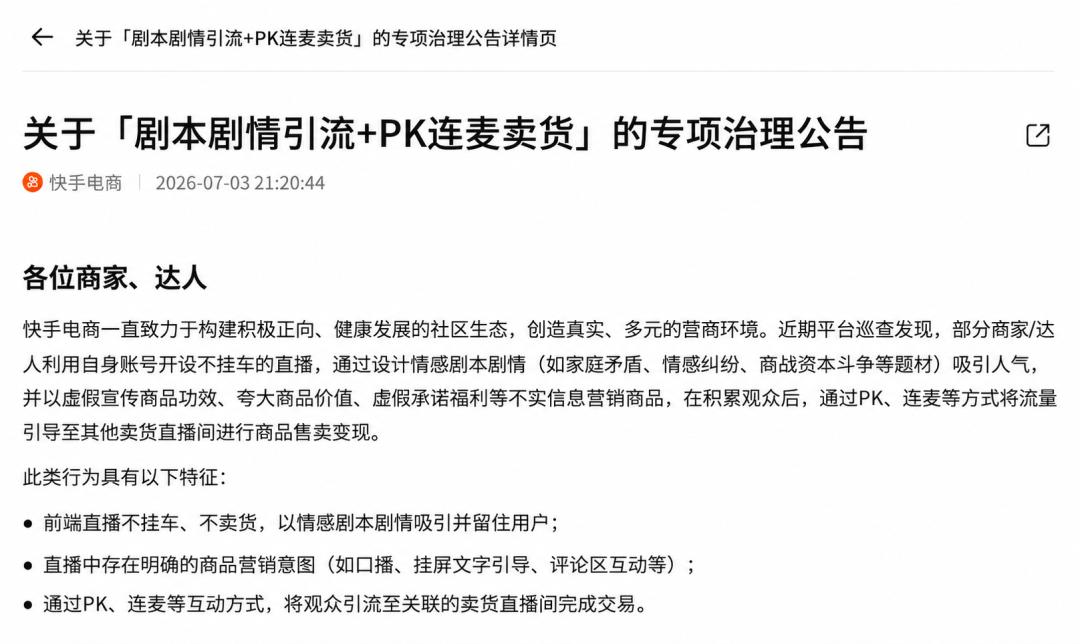
The specific practice is that merchants or creators use their own accounts to host live streams without product links, attract popularity by designing fictional emotional scripts such as family conflicts, emotional disputes, and commercial capital struggles. After accumulating viewers in the live stream, they then guide the traffic to other sales-focused live streams through methods like PK and co-hosting to realize product sales and monetization.
Breaking down this model, its essence is to artificially separate the two links of "traffic diversion" and "product sales" to avoid the regulatory risks of direct product sales. The front-end live stream does not hang product links or sell goods, and only attracts users with sensational plots; the back-end accurately directs viewers to sales-focused live streams through interactions between associated accounts.
Kuaishou clarified in the announcement that as long as there is a clear intention of product marketing in the front-end live stream, such as verbal announcements, on-screen text guidance, and interactions in the comment section, it constitutes a violation. Violators will face multiple penalties including deduction of violation points, payment of liquidated damages, freezing of commissions/payment for goods, restriction of natural e-commerce traffic, suspension of the use of shopping carts, prohibition of posting short videos, and prohibition of live streaming.
The joint liability mechanism ensures targeted enforcement: traffic-diverting accounts and the traffic-receiving sales accounts bear the same responsibilities and penalties. All accounts participating in the "diversion-transition-monetization" chain bear joint and several liability, leaving no room for exemption with the claim that "I only divert traffic and do not sell goods". For particularly serious violations, the platform will take measures such as accelerating account deactivation and increasing risk deposits.
This governance logic has deep-seated intentions.
The harm of the script-based diversion and sales model to the repurchase rate is hidden and far-reaching. On the surface, it completes the transaction: users are attracted by the plot, guided to the sales-focused live stream, and make a purchase.
But the starting point of this transaction is a fictional plot, exaggerated product efficacy, and false welfare promises. After purchasing, users find that the product does not match the promotion, and their trust is consumed. Once trust is eroded, there can be no repurchases.
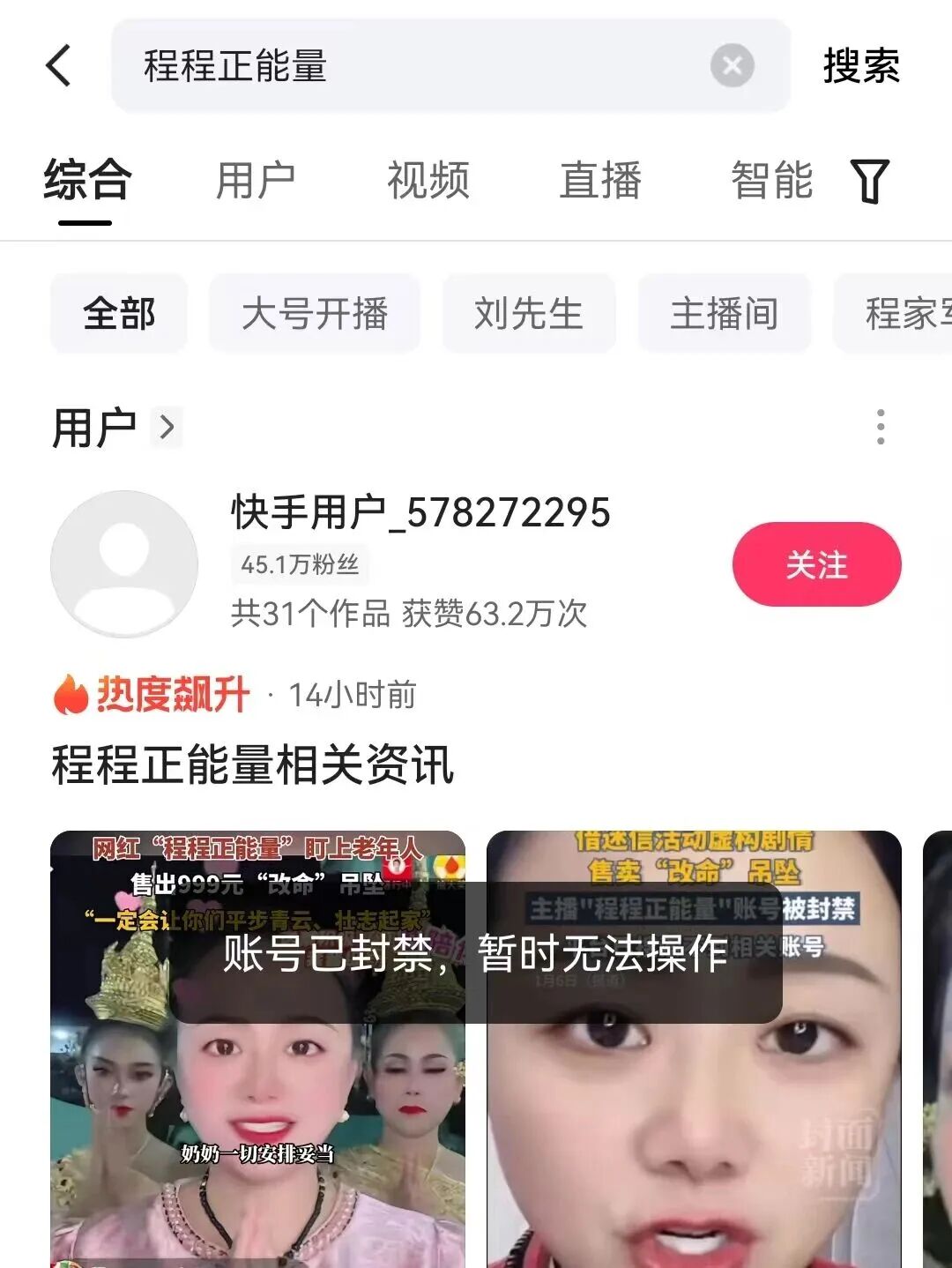
Previously, Kuaishou internet celebrity Jin Shuyi exaggerated the curative effect of seabuckthorn freeze-dried powder in a live stream, claiming that it could "treat skin diseases" and "heal external injuries in three days", which constituted misleading promotion, and her account was once banned; another internet celebrity Cheng Cheng directed and acted as the character "Wuyou Laozu", using 999-yuan amulets as a gimmick to fictionalize the functions of fortune-telling and changing luck, inducing middle-aged and elderly groups to place orders. The relevant accounts have now been permanently banned by the platform.
Kuaishou E-commerce's concept of "trust-based e-commerce" is built on users' trust in the platform, creators, and merchants. The script-based diversion model is precisely eroding this trust. It instrumentalizes Kuaishou's community atmosphere, directs users' real emotional investment to fictional plots, and converts community interactions into traffic arbitrage. In the long run, not only individual users will be lost, but the trust assets of the entire platform will also be eroded.
Rectifying script-based diversion is to protect Kuaishou's core competitive barrier—"community trust". Without trust, there can be no repurchases. Without repurchases, the growth story of e-commerce cannot continue.
It is worth noting that the timing of this governance action echoes the moves of the Central Cyberspace Administration of China.
On July 3, the Central Cyberspace Administration of China issued a notice to launch a two-month nationwide special campaign named "Qinglang · Rectifying Chaos in Online Entertainment Group Live Streaming". Kuaishou's launch of special governance on July 9 is not only an active cleanup of internal problems on the platform but also a positive response to regulatory signals.
From "Who Sells" to "Why Buy"
Examining the organizational restructuring and special governance together, Kuaishou E-commerce's intentions gradually become clear.
The organizational restructuring solves the problem of "who sells, what to sell, and how to sell". The three lines—brands, creators, and white-label merchants—each perform their own duties, allowing different types of merchants and products to find the most suitable operation paths for themselves. The further segmentation of the white-label business even turns "refined operations" from a slogan into organizational guarantee.
The special governance solves the problem of "why users buy and whether they will buy again after purchasing". Eliminating trust-consuming business models such as script-based diversion is to clear the battlefield for the core concept of "trust-based e-commerce". Only when trust is not consumed can repurchases have a foundation.
The common direction of the two measures is the repurchase rate. More accurately, it is the high-quality repurchase rate.
Kuaishou E-commerce does not lack repurchases; what it lacks are repurchases with high customer unit prices, high profits, and sustainability. Low-priced essential goods from white-label merchants can bring frequency but not profits; the settlement of brands can bring higher customer unit prices, but brands are unwilling to enter the platform; creators' content can bring trust, but trust is being consumed by script-based diversion.
The organizational restructuring attempts to solve these three problems simultaneously: making brands see a professional service system, giving creators independent operation space, and enabling white-label merchants to operate refinedly on tracks that suit them. The special governance attempts to provide a clean environment for the efforts in these three directions—an environment where users are willing to trust and make repeated purchases.
However, whether this combination of measures can be effective depends on two prerequisites.
The first is whether brands will buy in. Kuaishou faces far greater difficulties in inviting brands to settle in than Douyin. Brands' considerations for a platform are not only about traffic scale, but also about user portraits, brand tonality, and conversion efficiency.
Kang Le's oversight of both brand and commercialization business means that Kuaishou has bet on the closed-loop capability of "advertising + e-commerce" on the brand side. But whether this closed loop can function smoothly still requires time to verify.
The second is whether the governance can be sustained. Script-based diversion is not unique to Kuaishou, but a common chaos in the entire live streaming e-commerce industry. It is easy to launch a crackdown, but difficult to achieve long-term effective governance.
Illegal models will continue to mutate and evolve, and the platform's governance capabilities need to be continuously iterated. Kuaishou's introduction of strict measures such as "no warning or rectification opportunities given" this time shows its determination, but whether this determination can be translated into long-term effectiveness is another matter.
Kuaishou E-commerce is at a subtle turning point.
In 2025, its annual revenue reached 142.8 billion yuan, a year-on-year increase of 12.5%; its adjusted net profit was 20.6 billion yuan. Its financial fundamentals are not bad, but the signal of slowing growth is clear: the revenue growth rate of online marketing services dropped from 22.97% in 2023 to 12.5%, and the live streaming revenue of 39.1 billion yuan increased by only 5.5% year-on-year. Huatai Securities predicts that the annual revenue growth rate in 2026 will slow down to 4.5%.
At the same time, the organizational level has continued to experience turbulence. The head of commercialization has changed five times, and the head of e-commerce has changed six times. In the past 12 months, Zhang Di, the head of Keling AI, left his position; Xiao Gu stepped down as the head of local life services and became a consultant; Wang Yi, the head of search, was reported to have left his post; Kong Hui, the top leader of the e-commerce business, was transferred back to the commercialization sector after only about three months in her position.
Against the backdrop of slowing growth in its main business and high investment in AI, Kuaishou needs to