Is Swan Home left with no defensible ground as JD and Meituan close in?
In the early spring of 2026, Beijing witnessed an unprecedented "silver land grab".
On January 5, Meituan signed a strategic cooperation agreement with the Beijing Civil Affairs Bureau; on February 28, JD followed suit; on March 27, Alibaba joined the fray shortly after — in less than 90 days, three internet giants were successively drawn into Beijing's "elderly care circle of friends". The tight timeline and high-level coordination were unprecedented in the history of Beijing's elderly care service development.
What these giants are scrambling for is a silver economy market projected to exceed 10 trillion yuan in size by 2026. Yet as Meituan, JD, and Alibaba rolled up their sleeves to enter the arena, a company that once came closest to dominating this track has been lingering outside the table for years.
In July 2021, Swann Home Services (formerly 58 Home Services) stood before the New York Stock Exchange for only 17 days before quietly exiting. Years later, as internet giants rediscover the gold mine of domestic services and elderly care, the real protagonist of this war may have only just stepped onto the stage.
The Failed IPO
On July 3, 2021, Swann Home Services submitted its prospectus for a US listing. As CEO, Chen Xiaohua had intended to use the glory of being "China's first household service stock" to wrap up seven years of rapid expansion.
However, affected by the then-tightening regulatory environment for Chinese concept stocks and new data security review regulations, Swann Home Services announced the suspension of its IPO on July 20. Only 17 days passed from submission to suspension.
While the public lamented the broken dream, Chen Xiaohua pressed the internal pause button for reflection. He realized that even if the bell had rung successfully, Swann Home Services would not have truly built a competitive moat — this is an extremely fragmented trillion-yuan market that heavily relies on people. Capital can buy traffic and scale, but it cannot buy the service quality of domestic workers, nor the trust of employers.
Domestic services have never been a traffic-driven business that can achieve winner-takes-all results through subsidies alone.
That IPO suspension became a watershed for Swann Home Services' strategic shift. Chen Xiaohua decided to shift his focus from "expanding the platform" to "deepening services", concentrating on worker training and service standardization, and making early investments in elderly care that had not yet boomed at the time.
"This industry is not short of people who want to go fast; it lacks those willing to slow down," Chen Xiaohua said internally.
But he did not expect that just as he decided to slow down, a group of internet giants who believed in "only speed is unbreakable" had already reached the city gates.
From "58 Home Services" to "Swann Home Services"
Today, giants are storming into households with massive traffic and algorithms, but few people know that Chen Xiaohua, the helmsman of Swann Home Services, was precisely one of China's earliest internet "traffic believers". In 2014, a year after 58.com went public, Chen Xiaohua, then vice president, was sent by Yao Jinbo to start an independent business and establish "58 Home Services".
Prior to that, he had helped Yao Jinbo win the toughest head-on traffic battles in the brutal "thousand-group war" and the showdown between 58.com and Ganji.com. From its inception, 58 Home Services was used to growing up on the traffic fed by its parent company. However, as the mobile internet entered its second half, 58.com, once the overlord of classified information, gradually fell behind and was privatized and delisted in 2020. With the traffic dividend peaking, 58 Home Services, which relied on blood transfusions from its parent company, also showed signs of fatigue. In September 2020, Chen Xiaohua made a difficult decision: to officially rename 58 Home Services to "Swann Home Services".
This was not only a self-rescue move to "de-58-ize" and break away from the influence of the parent company, but also Chen Xiaohua's active choice to cut off his dependence on "traffic feeding". He realized that a light model that only matches information through buying and selling traffic cannot truly solve the non-standard problem of "people" in domestic services.
"If there is a household life service company listed in China, it must be us," Chen Xiaohua declared publicly. He found a new benchmark for Swann Home Services: Beike Zhaofang — using digital and standardized methods to rework the mixed traditional industry.
From fighting traffic wars to developing industrial internet, Chen Xiaohua tried to complete the leap from a "traffic business" to a "trust business".
Money-Burning Cannot Buy Trust
The prospectus submitted by Swann Home Services was once a mixed-answer sheet that made Chen Xiaohua feel a whirl of emotions.
The revenue on the books was indeed rising: from 399 million yuan in 2018 to 711 million yuan in 2020. But the ugly truth was that losses had not stopped — the total accumulated loss over three years exceeded 1.8 billion yuan. More fatally, the largest expense was sales costs, which always ate up 70% to 87% of revenue.
This is exactly the aftermath of the "traffic business": orders bought at high marketing costs cannot retain profits.
What was even more disheartening was the market share. According to the latest estimates by industry institutions, the size of China's domestic service market has approached 1.5 trillion yuan by 2024. But as the industry leader, Swann Home Services' total platform transaction volume has never achieved remarkable results in this trillion-yuan market.
Traffic can buy temporary scale, but it cannot buy absolute market dominance. In this industry that heavily relies on "people", money-burning subsidies cannot buy user loyalty, let alone the trust of employers in domestic workers.
Chen Xiaohua once admitted: "More than 6,000 people have fought for 6 years, but our market share is only a few percentage points. The transformation of the household service industry has only just begun, and what we are challenging is patience."

The photo shows Chen Xiaohua, founder of Swann Home Services
Chen Xiaohua gave up the fast-paced traffic strategy and turned to tackling the hard task of building trust at a slow pace, which can be described as doing "difficult but right things".
But this hard bone is really not easy to gnaw.
Scale Does Not Equal Trust
When Chen Xiaohua decided to abandon the "only speed is unbreakable" traffic strategy and tried to use "slow efforts" to build a moat of trust, he found himself stuck in a quagmire.
The core asset of the domestic service industry is "people", but this is precisely the most difficult variable to standardize. During the prospectus period, Swann Home Services had 1.5 million registered workers, and now this number has climbed to more than 2 million. But in an industry where strangers are brought into homes, and even the elderly and children are entrusted to them, scale never directly translates into a barrier. Without in-depth quality control, the huge supply side has instead become a hotbed of customer complaints. Issues like "unrefunded payments on time" and "poor service quality" have long dominated major complaint platforms. In October 2024, a malicious public opinion incident where a maternity nurse secretly took sleeping pills to work put the brand under instant pressure. In the domestic service market where trust is extremely fragile, a serious performance failure is enough to offset marketing investments worth tens of millions.
The renaming to "de-58-ize" that was originally carried out to deepen services, while cutting off traffic dependence, also brought a hidden side effect: Swann Home Services lost the "trust endorsement" of its parent company as a veteran internet giant. In the scenario of inviting strangers into their homes, consumers naturally prefer platforms backed by large corporations. Rebuilding a new independent brand that people can trust to entrust their affairs to has far higher trust costs than imagined.
Since "people and brands" are both difficult to build, we can rely on systems instead. During the pandemic, Swann Home Services took the lead in realizing the onlineization of interviews, training, and contracts, and once led the industry. Chen Xiaohua has always wanted to tell a story about "digital infrastructure for household services".
But now, competitors are no longer traditional mom-and-pop shops. When JD and Meituan entered the market with extremely mature fulfillment systems, algorithm scheduling, and strong supply chain capabilities, Swann Home Services' once "digital leading advantage" instantly became the infrastructure of large corporations, and it is difficult to become an insurmountable wall on its own.
People are hard to manage, brands are hard to build, and systems have been leveled by large corporations. Chen Xiaohua tried to use digitalization to standardize non-standard people and use slow efforts to build trust, but the cruelty of the business world lies in: the giants do not plan to give him time to slowly make up for his shortcomings.
Crossing the Mire: Elderly Care, Robots, and New Narratives
If Swann Home Services only stays stuck in the quagmire of "managing domestic workers well" and "rebuilding the brand", it will be difficult to tell an attractive new story. Chen Xiaohua must find a higher mountain to completely cross the mire of trust.
In July 2024, at Swann Home Services' 10th anniversary celebration, Chen Xiaohua choked up several times. He gave the answer for the next decade: elderly care. He hopes to lead millions of workers on the platform to "provide affordable elderly care solutions for ordinary Chinese consumers".
This is by no means an empty slogan. In early 2024, the silver economy was officially elevated to a national strategy, and elderly care is precisely the most rigid-demand scenario in the silver economy that most requires the support of "trust". To stabilize its position in this trust-heavy track, Swann Home Services has put in slow efforts on the supply side: not only has it increased the number of certified workers to over 2.4 million, but it has also funded workers' children through public welfare funds such as the "Goose Baby Plan". This is not just corporate social responsibility, but also a way to retain the highest-quality supply in the highly mobile domestic service industry by fostering a sense of belonging.
But what really shocked the industry was another hidden card Chen Xiaohua played: robots.
At the end of 2025, Swann Home Services reached a strategic cooperation with UBTech and announced that it would promote humanoid robots to enter domestic services. A few months later, during the 2026 Boao Forum, Chen Xiaohua revealed to the public: intelligent robots for window cleaning, floor sweeping, and other tasks have taken the lead in landing for testing in some household scenarios in Beijing.
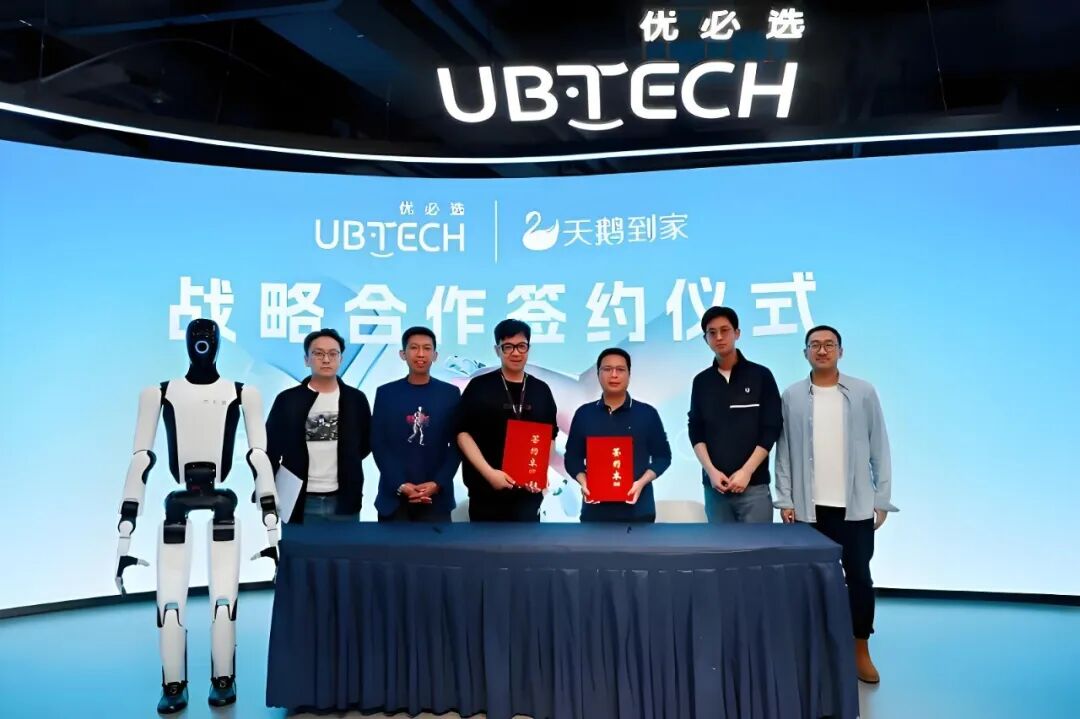
The photo shows UBTech and Swann Home Services officially signing a strategic cooperation agreement in Shenzhen
The core narrative he put forward is "human-robot collaboration". Chen Xiaohua clearly recognizes that limited by the bottleneck of the "physical space large model" that dynamically changes in real households, robots will hardly completely replace domestic workers in the next 10 years. But business implementation does not need to wait for perfection: "As long as a robot can stably replace a certain action, it is enough to create huge value." For example, window cleaning — once it can work stably on different glass surfaces, its application space will extend directly from households to the facades of high-rise buildings.
In his speech at Boao, he left a widely quoted sentence: "It is not AI that will eliminate you in the future, but people who master AI tools that will eliminate you."
Connecting these two moves, you will find that Chen Xiaohua is reconstructing the underlying logic of Swann Home Services: using AI and robots to make up for the non-standard and uncontrollable nature of people, and using the collaborative model of "domestic worker + robot" to tackle the elderly care scenario, a silver economy sector with extremely high trust requirements.
By the end of 2025, Swann Home Services had accumulated over 25.36 million registered users, serving 400,000 households monthly on average. If this path works, competitors may be able to poach hundreds of thousands of domestic workers through subsidies, but it will be extremely difficult to replicate a heavy-asset trust system of "human-robot collaboration + elderly care supply chain" in a short period of time.
This is a new story with perfect logic and extremely high barriers.
But the problem is that building this system requires a long time. And time is precisely the thing that those giants holding massive traffic and resources are most unwilling to give him.
Strong Enemies Approach: How JD and Meituan Attack
While Swann Home Services is still enduring the pain of "non-standard" and trying to build a wall of trust little by little with slow efforts, the rules of the battlefield have been quietly rewritten.
For Chen Xiaohua, domestic services are a painstaking business that requires meticulous polishing and is related to people's lives; but for JD and Meituan, this is just a strategic puzzle piece that must be captured in the map of their huge business empires. When these two giants, who hold hundreds of billions of infrastructure resources, truly enter the arena, what they bring is no longer homogeneous poaching of people and orders, but ecological dimensionality reduction suppression.
JD's strategy is extremely "heavy". Since incubating self-operated domestic services in Beijing in 2021, JD has never intended to do a lightweight traffic matching business. Its killer feature is its deep-rooted supply chain capabilities and strong brand endorsement. When children in first- and second-tier cities need to find nannies for their elderly parents living alone, they naturally trust the guarantee ability of "JD Self-Operated" more than a traditional agency that might disappear at any time.
To solidify this trust, JD's actions can be described as cost-no-object. At the end of 2025, JD Domestic Services launched a 20,000-square-meter training base in Wanzhou, Chongqing, and announced that it would invest 1 billion yuan in the next three years to build its training system. This 1 billion yuan is not used to buy traffic, but to build more than 150 standardized bases, introduce AI teaching assistants and VR training, and even focus on developing high-standard elderly care courses.
JD has broken down non-standard domestic services into 144 standard actions, with unified national service standards. This method of "standardizing domestic workers" using the strict quality control used for 3C digital products and fresh cold chains has directly broken through the trust pain point of "blind box opening" in traditional domestic services.
If JD is building solid fortresses with heavy troops, then Meituan is using its ubiquitous "network" to fight steady battles.
As a super entry point for local life services, Meituan does not need to painstakingly rebuild brand awareness like Swann Home Services. In 2025, Meituan's "Meituan Worry-Free Cleaning" accelerated the recruitment of professional personnel in multiple regions, directly using the platform's traffic siphon effect to seize high-quality supply.
What makes the industry feel even more pressured is the combination of punches Meituan has played in the silver economy.
Recently, Meituan has quietly launched high-frequency silver services such as accompanying patients to medical appointments, picking up medicine on behalf of others, and door-to-door bathing assistance in multiple cities, and has cooperated with community elderly care centers in many places. It did not cut in at a single point, but built a closed-loop ecosystem around "food delivery to home — medical accompaniment — domestic care".
By April 2026, Meituan even conducted gray-scale tests on the "Miaowa Side Hustle" section in some cities, bringing scattered tasks such as errand running, agency services, maintenance, and domestic services all into the platform's C2C track. This means that Meit