Baily Food, which has been "carried to success" by Wallace, Tastien, and Baoshu Master, has reaped 2 billion yuan in the Chinese-style hamburger market
In recent years, the rapid rise of Chinese-style hamburger brands has created a rare industry opportunity for the development of local condiment manufacturers. Baili Food is a typical example of a player that seized this favorable momentum.
For many consumers, they may have never purchased Baili Food's sauces on supermarket shelves or e-commerce platforms.
But if you have eaten hamburgers, fries, or chicken nuggets from Tastien or Wallace, the packet of ketchup you used was very likely produced by Baili Food. Even the sauces applied on the popular Baosifu pastries that people queue up to buy might also come from Baili Food.
Recently, Guangdong Baili Food Co., Ltd. (referred to as "Baili Food") successfully got its IPO approved at the Beijing Stock Exchange. The company is mainly engaged in the R&D, production, and sales of Western-style compound condiments. Its main products include various Western-style compound condiments such as salad dressings, flavored sauces, bread crumbs, and seasoned powders, as well as ready-to-eat ingredients for Western-style consumption scenarios like red kidney beans.
Over the past three years, as chain catering brands such as Wallace and Tastien have expanded to the scale of 10,000 stores each, Baili Food's revenue has increased from 1.605 billion yuan to 2.149 billion yuan.
However, Baili Food, which has been affected by the intense "involution" in the hamburger business, is now working hard to move from the back kitchen to retail shelves.
Hamburger Stores Expand Wildly, Baili Rakes in Profits Behind the Scenes
In China, KFC and McDonald's are widely recognized as the leaders in the hamburger category, gradually shaping the market landscape and becoming the core driving force promoting the large-scale and standardized development of this category.
The catering industry has extremely high upstream-downstream correlation, and the expansion of downstream terminal formats often drives the rise of upstream supporting enterprises. Heinz and McCormick, which have established deep partnerships with KFC and McDonald's respectively, have accordingly occupied the leading positions in China's Western-style compound condiment market.
In recent years, the sudden rise of Chinese-style hamburger brands has created a rare industry window for the development of local condiment enterprises. Baili Food is a typical "momentum-seizing" player in this trend.
Public information shows that in 1998, Liaobu Hongxing Food Company was founded, mainly producing bread crumbs. Its brand "Baili" carries the meaning of "hundred percent delicious, benefiting the country and the people", and was even selected as a designated food supplier brand for the 2008 Beijing Olympic Games. This demonstrates that the company has laid a solid foundation in the food manufacturing sector.
At that time, Baili was just a brand name, not an independent corporate entity. During the process of Baili evolving from a "brand" to a formal "company", China's Western-style fast food market was also undergoing a profound transformation from "imported goods" to products adapted to Chinese consumers' tastes.
According to the "Western-Style Fast Food Development Report 2024" released by the Red Catering Research Institute, the development of Western-style fast food in China can be roughly divided into two key stages.
From the early 2000s to the mid-2010s, Western-style fast food entered a steady expansion phase, during which local challengers such as Ronghua Chicken, Dicos, and Wallace emerged in China, each finding its own development path. Foreign brands focused on provincial capitals and first-tier cities, while local brands targeted the lower-tier market.
From the mid-2010s to the present, Western-style fast food has further integrated with the Chinese market, with various brands accelerating their localization efforts and new local players emerging continuously. Among them, the "Chinese-style hamburger" represented by Tastien has shown the most vigorous development momentum.
Baili Food was registered and established during this period. In 2012, Xu Weihong and Lu Lianfu founded Baili Food in Chashan, Dongguan, and started to develop their salad dressing business. Coincidentally, Tastien was officially established in Jiangxi the same year. Perhaps Baili Food never imagined that Tastien would become its largest "big-spending client".
The prospectus shows that Baili Food's revenue from Tastien was only 17.9769 million yuan in 2023, which rose to 126 million yuan in 2024, and further increased to 233 million yuan in 2025, accounting for 10.83% of Baili Food's annual sales revenue. This figure exceeded the total revenue contributed by the last four major customers that year, while the top five customers collectively generated 369 million yuan in sales for the company.
Every new store Tastien opens and every additional hamburger it sells means an extra packet of flavored sauce is needed. Baili Food also pointed out that the rapid expansion of Tastien's scale has led to a significant increase in demand for the company's products.
The same logic applies to Wallace. As Baili Food's second-largest customer, Wallace has contributed more than 50 million yuan in revenue to the company each year over the past three years.
According to the latest data from Canyin Eye as of June 15, 2026, Wallace has 19,442 stores, Tastien has 12,518 stores, while KFC has 13,698 stores, McDonald's has 8,680 stores, Pizza Hut has 4,733 stores, and Dicos has 2,704 stores during the same period.
It is precisely because Baili Food has firmly partnered with local hamburger brands that as these brands transformed China's hamburger market in the foreground, the domestic compound condiment market has also undergone corresponding changes.
After years of development, the company has become one of the few domestic enterprises capable of competing with foreign brands. According to statistics from the China National Food Industry Association, Baili Food surpassed Kewpie in the Chinese market in 2023, becoming China's largest Western-style condiment company.
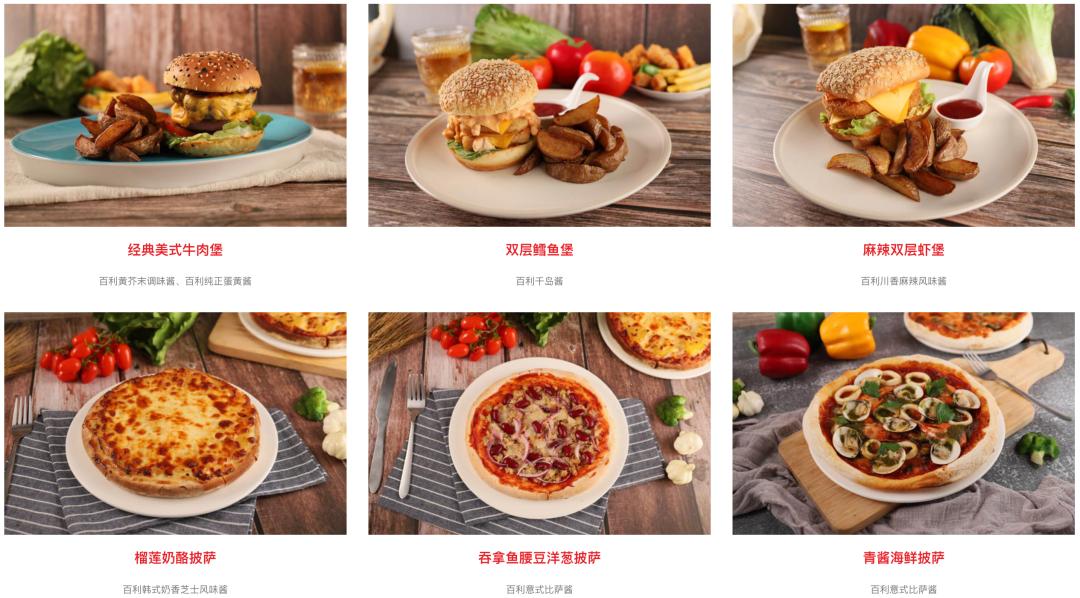
Baili's sauce products; Image source: Baili Food official website
In terms of segmented products, sauce condiments are the company's core product line, and salad dressings and ketchup are also the most consumed categories in hamburger restaurant kitchens.
During the reporting period, the revenue from sauce condiments increased significantly year by year, rising from 1.238 billion yuan to 1.729 billion yuan, with its revenue proportion increasing from 77.21% to 80.59%.
The development of other businesses is relatively unstable. The revenue from powder condiments has increased slightly year by year, growing from 234 million yuan to 283 million yuan, but its revenue proportion has declined slightly from 14.60% to 13.20%. The revenue from ready-to-eat ingredients first rose and then fell, reaching 131 million yuan, 147 million yuan, and 133 million yuan respectively from 2023 to 2025. Its revenue proportion has declined for three consecutive years to 6.21%, with its contribution to overall revenue continuously weakening.
Hamburger Market Involution, Is Baili Affected?
Of course, Baili Food was able to capture the growth opportunities brought by the rise of local hamburger brands not only relying on the dividends of the times. Local hamburger brands are better at catering to Chinese consumers' tastes, and as an upstream supplier, Baili Food is also highly experienced in adjusting its flavor formulations accordingly.
Facing the leading advantages of international giants, Tastien has built a differentiated positioning closely centered on Chinese characteristics in both brand image and product offerings. For example, at the product level, Tastien emphasizes that its hamburger buns are handmade, freshly rolled and baked, and combines Chinese characteristic flavors and food culture with Western-style fast food, developing flavors such as Sichuan pepper, Peking duck, and bacon with fried egg.
As customer demands change, the logic of condiment production must also evolve. To match Tastien's product structure of "Western-style shell with Chinese-style filling", Baili Food carried out localized improvements, launching products such as "special salad dressing for Chinese pastries" and "lactic acid bacteria flavored sandwich sauce" tailored to Chinese consumers' tastes. This path of "you focus on standardization, I focus on localization" has allowed Baili Food to avoid price wars with industry giants in the mainstream product categories.
At the same time, the accelerated expansion of local hamburger brands, which have high requirements for supply chain response speed and customization capabilities, naturally benefits domestic condiment enterprises. This "geographical proximity" advantage has given Baili Food an edge in service efficiency.
More importantly, Baili Food's localized production advantages make its pricing more competitive than imported brands. The increasingly fierce involution in the catering industry has pushed cost reduction and efficiency improvement to the "survival line" of every brand, and Baili Food's cost-performance ratio precisely addresses this pain point.
Industry changes have prompted international giants to adjust their strategies. In 2025, in response to the trend of intensified involution in the catering market and rising cost sensitivity, McCormick launched its "Premium Selection Series", which includes mild sweet salad dressing, tomato ketchup, and batter coating mixes, offering higher overall cost-performance. In the same year, Heinz China welcomed its new leader Xiao Gaoqiu, marking the first time in 9 years that the company has appointed a local executive to head its Chinese operations.
From product pricing to localized management, these changes indicate that international giants can no longer succeed in selling condiments in China solely relying on their old path of global standardization.
However, it is obviously not a long-term strategy for Baili Food to fully tie its fate to domestic hamburger brands.
Local chain catering brands are Baili Food's core customers. If their stores continue to expand, Baili Food can easily reap the benefits, but if they slow down store opening and cut costs, Baili Food will also suffer losses. The two sides are in a relationship of "prosper together, suffer together".
This double-edged sword effect of deep partnership has already been reflected in Baili Food's performance.
Baili Food's revenue from 2023 to 2025 was 1.605 billion yuan, 1.912 billion yuan, and 2.149 billion yuan respectively, with year-on-year growth rates of approximately 19.1% and 12.39%. During the same period, its attributable net profit was 222 million yuan, 276 million yuan, and 322 million yuan respectively, with year-on-year growth rates of approximately 24.1% and 16.65%.
In the first quarter of 2026, the company's revenue reached 564 million yuan, a year-on-year increase of 13.55%; during the same period, its attributable net profit was 80.0051 million yuan, a year-on-year increase of 16.47%.
Whether in terms of revenue or net profit, Baili Food's growth rate has been slowing down year by year in recent years, which is a chain reaction caused by the fluctuations in the operating conditions of its core customers being transmitted upstream.
Take Wallace as an example. In 2022, the number of Wallace's stores exceeded 20,000, more than the total number of stores of KFC, McDonald's, and Dicos combined during the same period. According to the prospectus, Wallace was still Baili Food's largest customer in 2023, while Tastien ranked third.
However, in March 2026, Wallace officially delisted from the New Third Board, and the number of its stores fell below 20,000. This scale contraction has directly affected its procurement demand for Baili Food's products.
In 2024, Wallace contributed 55.9 million yuan in revenue to Baili Food, and this figure dropped to 52.76 million yuan in 2025. During this period, Tastien replaced Wallace and became Baili Food's largest customer.
The alternating changes in the operating conditions of major customers are only one side of the problem. The nature of B2B business determines that Baili Food is highly dependent on the distribution model to reach these large customers.
From 2023 to 2025, its revenue contribution from distributors was 1.09 billion yuan, 1.218 billion yuan, and 1.23 billion yuan respectively, accounting for as high as 68%, 63.8%, and 57.32% of the total revenue. Although the proportion of distribution revenue has decreased, its absolute scale is still rising, which means that Baili's performance growth still relies on multi-level distribution channel deployment.
However, its growth model relying on channel stocking is hitting a "ceiling".
At the end of each reporting period, the proportion of ending inventory held by Baili Food's top five distributor customers was 4.89%, 8.73%, and 7.04% respectively, with the figures at the end of 2024 and 2025 significantly higher than that at the end of 2023. The products have been distributed to the channels, but the terminal consumption speed has not kept up, sounding the alarm of inventory backlog.
This contradiction of "fast stocking, slow sales" will be further amplified when the overall industry environment cools down. In 2026, the market trend shifted from incremental competition to stock game intensified. KFC and McDonald's maintained rapid expansion in China, while Chinese hamburger brands such as Tastien entered an optimization phase of "high store opening rate accompanied by high store closure rate".
Under the pressure of growth, Baili Food is moving from the back kitchen to retail shelves.
A "Unbalanced" Business
By transitioning from the B2B sector to the C2C sector, Baili Food has entered a new track, but its competitors have not changed.
In China, Heinz ketchup is a household name, with its C-end business accounting for about 70% of its total revenue, and the B-end market serving as a growth point. Kewpie performs strongly in both China's C-end and B-end markets, with an estimated market share of over 60% in the salad dressing market, and its B-end products have penetrated into local Chinese chain catering brands, sandwiches in convenience stores, and more.
The common feature of these two giants is their "dual-drive" model: their C-end brands are deeply rooted in consumers' minds, while their B-end scale continues to expand, with the two lines supporting each other.
However, Baili Food is clearly a "unbalanced student". The prospectus shows that from 2023 to 2025, the proportion of the company's online revenue was 3.28%, 2.65%, and 2.86% respectively, with the revenue scale reaching 52.6271 million yuan, 50.5133 million yuan, and 61.37 million yuan respectively. The overall development is unstable.
Channels are a key factor determining the success of the transformation. At present, Baili Food has cooperated with large chain or high-end supermarkets such as Walmart, Metro, RT-Mart, Hema Fresh, and Costco, as well as new retail platforms such as Dingdong, Pupu, and Xiaoxiang Supermarket, trying to diversify risks by expanding offline and new retail channels. However, judging from its performance structure, Baili Food still highly relies on the distribution model.
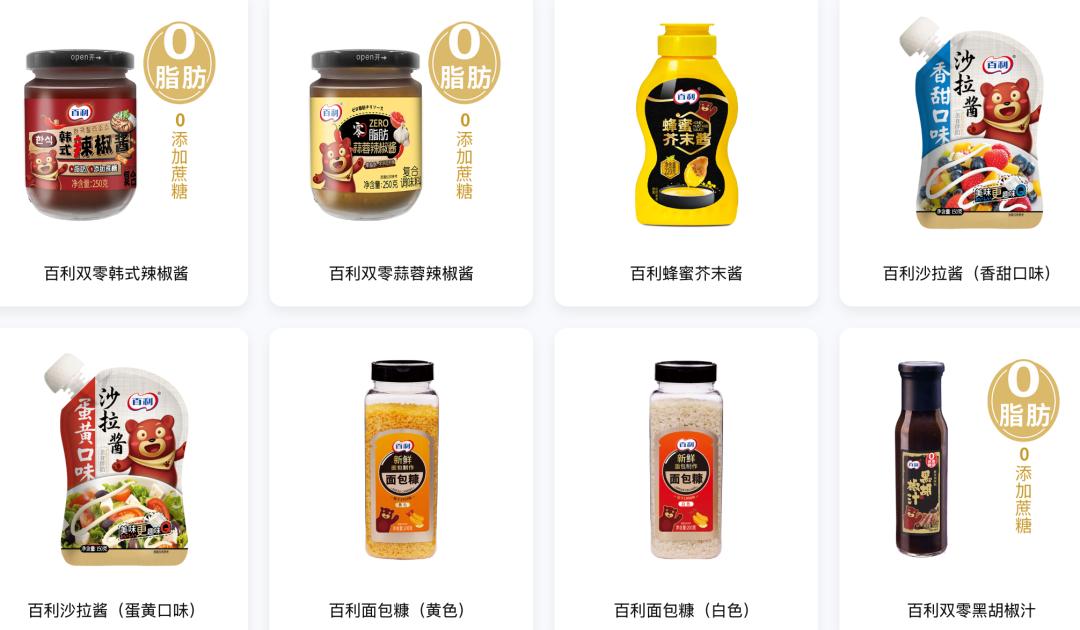
Baili Food's retail packaging products; Image source: Baili Food official website
In addition, the intensity of competition in the C-end market is no less than that in the B-end market. The B-end market focuses on efficiency, with competition centered on cost reduction and efficiency improvement capabilities, stable standardized delivery, etc., and customers usually show high stickiness after establishing cooperation. In contrast, the C-end market emphasizes the ability to create hit products and resonate with consumers' emotional needs, and customer groups are very likely to churn due to a single unsatisfactory experience.
However, Baili Food lacks sufficient confidence in R&D. Data shows that from 2023 to 2025, Baili Food's R&D expenses were 9.6259 million yuan, 14.