When dreams shine into reality, Langjiu is trapped in the "same old place"
Article by | Xiaofeng
Source | Bowang Finance
In early July, Gulin Honghualang Sales Co., Ltd. issued a notice that shipments of the 53% ABV 2024 version Honghualang 15 would be suspended immediately, with the resumption date to be notified separately.
In fact, as early as April 1st of this year, Honghualang 10 had already taken the lead in implementing the shipment suspension policy.
It is worth noting that during this year's 618 shopping festival, the wholesale price of Langjiu's core product Qinghualang fell below 600 yuan, before rebounding back above 600 yuan in early July.
However, these price fluctuations are only short-term issues. Looking at the bigger picture, Langjiu faces greater challenges: five failed attempts to go public, and its 100-billion-yuan revenue target is drifting further out of reach. This brand, which once claimed to be "one of the two leading soy sauce aroma Baijiu in China," is now mired in a high-end stall and capitalization bottleneck under mounting pressure.
This time-honored Sichuan Baijiu brand has spent nearly two decades proving that the narrative of positioning itself against Moutai, while sounding ideal, cannot support a real, large-scale market value. No matter how compelling the capital story is, it must eventually return to the fundamentals of product strength and healthy distribution channels.
The strengths and shortcomings of Langjiu are a microcosm of the entire soy sauce aroma Baijiu industry's transition from fanaticism to rationality.
01 After positioning against Moutai, Langjiu's price stability remains elusive
Moutai is widely recognized as the premium Baijiu leader in China.
During the rapid growth period of the Baijiu industry over the past decade, many enterprises regarded it as a replicable success model.
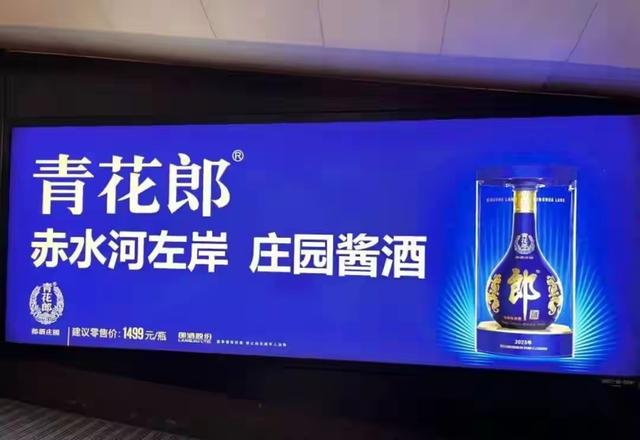
Previously, Wang Junlin, Chairman of Langjiu Group, stated that "the quality of Qinghualang deserves a price point of 1,500 to 1,600 yuan to reflect its true value." But aspirations aside, the core proposition of high-end development lies in whether the price system can gain a firm foothold in the market. As Langjiu's flagship product for high-end market expansion, after years of development, an unbridgeable gap seems to have formed between its official guide price and actual transaction price.
During the industry's scale expansion phase, Langjiu positioned itself as "one of the two leading soy sauce aroma Baijiu in China" to benchmark against Moutai, and then launched successive price hikes for Qinghualang. After multiple prior adjustments, its official suggested retail price climbed from below 1,000 yuan to 1,499 yuan, and its ex-factory price exceeded 1,009 yuan in 2022, with the product's suggested retail price once set at 1,499 yuan.
At that time, Langjiu was full of ambition: the revenue share of Qinghualang rose from 25% in 2017 to over 45% in 2020, and its high-end development narrative appeared to be coming to fruition.
Theoretically, this was related to the Baijiu industry's high growth at the time, as well as Qinghualang's strong product competitiveness. However, as time passed, the ebb tide revealed who had been swimming naked.
Entering the second half of 2023, the dual pressures of overcapacity and shrinking consumption in the soy sauce aroma Baijiu industry converged, and Qinghualang's price system began to loosen. Later, the sub-premium product Honghualang became Langjiu's largest revenue pillar, with its revenue share rising from around 20% to over 40%, making Langjiu's high-end advancement far from easy.
By March 2026, Langjiu voluntarily lowered its ex-factory prices: the planned quota for Qinghualang was reduced to 818 yuan, the unplanned quota to 909 yuan, and the comprehensive payment price was approximately 836 yuan. But this profit concession failed to stop the downward trend. For example, the wholesale price in some core market channels once fell below the originally set price system, and during the 618 shopping festival and early July, the price fluctuated below and above 600 yuan alternately.
While price instability is a widespread industry problem, the underlying cause behind this price collapse is indeed the massive channel inventory backlog across Langjiu's entire distribution network.
02 Why did its repeated IPO attempts end in disappointment?
In fact, a successful listing is not determined by a single event, but by the combined effects of corporate governance, industry cycles, and regulatory environments. Each of Langjiu's failed long-distance IPO sprints had specific triggers, rooted in deep-seated historical legacy issues and policy realities.
Looking back at Langjiu's listing timeline is like reviewing the development history of China's Baijiu capitalization. In 2007, just five years after Wang Junlin acquired Langjiu, the company launched shareholding reform, but its first listing preparation was stranded before even starting due to insufficient performance scale and other factors. Its second sprint in 2009 also ended hastily. In 2012, when its sales revenue exceeded 10 billion yuan, the listing prospect seemed bright, but it was then affected by senior executives being involved in certain disputes.
In 2018, riding the wave of Luzhou's 100-billion-yuan Baijiu industry plan, Langjiu restarted its listing journey and officially submitted its prospectus in 2020. However, it was implicated in the Kangmei scandal involving its sponsor GF Securities. The China Securities Regulatory Commission raised over 50 feedback opinions targeting core issues such as non-compliant information disclosure, performance growth driven by channel stuffing, and the sustainability of its price hike strategy, leading to another quiet end to its years-long IPO effort.
From an industry perspective, Langjiu's IPO setbacks are partly due to industry cycle factors. Baijiu has long been regarded as an industry marked with a "red light" for IPOs. In fact, since Jinhuijiu in 2016, there have been almost no new Baijiu IPOs on the A-share market. The tightening of policy controls has made the listing path extremely difficult for all non-leading Baijiu enterprises.
Langjiu itself also has some complex issues: operational performance, transparency of related-party transactions, and performance inflation caused by channel stuffing — all of these issues have drawn public attention.
For example, Langjiu's inventory pressure has been persistent. While this problem exists across the entire industry, Langjiu's pressure is particularly prominent.
Previously, Langjiu kept imposing pressure on its distributors: in 2024, it even required core distributors to increase their purchase volume by 30% year-on-year. However, not all terminal sales speeds can keep up with the purchasing pace, leading to increasingly accumulated inventory. Multiple public sources, citing a research report released by *Jiu Ye Jia* in October 2025, show that as of the third quarter of 2025, Langjiu's channel inventory turnover days reached 180 days, while the average waiting time for distributors to sell through their products had reached 200 days — far exceeding Moutai's 45 days. As a result, the unsold goods held by distributors in turn put downward pressure on product prices.
Looking ahead, Langjiu's fundamental advantages remain intact, and the reputation and market momentum of Qinghualang have indeed taken root among consumers, but significant challenges still lie ahead.
03 Is there still hope for high-end positioning and a public listing?
In fact, objectively speaking, Langjiu's total shipments in 2025 achieved slight growth based on 2024's figures, which highlights its resilience against the backdrop of a 12% year-on-year decline in the total output of the entire Baijiu industry. Its shipment volume in January 2026 even hit a record high, with overall performance being quite commendable.
Considering that accessing the capital market and pursuing high-end product positioning have been two parallel strategies for Langjiu over the years, in the short term, neither path looks optimistic, but there is still room for maneuver.
Under the current policy environment, the opportunity for Baijiu enterprises to conduct a direct A-share IPO remains uncertain. Alternative paths such as backdoor listings and indirect listings also face strict scrutiny for "circumventing listing restrictions," and regulatory requirements for corporate standardization have not been relaxed in other markets.
Now let's look at its high-end advancement.
As is well known, in the price range above 1,000 yuan, Kweichow Moutai takes up the vast majority of market share, Wuliangye accounts for a portion, and all remaining brands combined cannot compete with these two leading players. It is very difficult for Qinghualang to lead Langjiu in breaking through the high-end market again.
The halving of Qinghualang's price does not mean that its high-end attempt has completely failed; instead, it indicates that the early-stage brand premium is returning to its real value. The price range of 600+ yuan is actually the golden sub-premium zone for soy sauce aroma Baijiu, with a far larger market capacity than the ultra-high-end market above 1,000 yuan. Leveraging its liquor quality and brand heritage, Langjiu may instead unlock broader growth space. The real risk is that it cannot let go of its high-end posture, yet fails to hold its price bottom line, thus missing market opportunities amid strategic wavering.
From a data perspective, Langjiu's annual revenue has remained around 20 billion yuan in recent years, demonstrating its solid foundation. An enterprise of this scale has enough room for trial and error as long as it stabilizes its basic market.
Therefore, the real risk lies in strategic inconsistency: sometimes benchmarking against Moutai to pursue high-end positioning, sometimes sinking to capture the mass market; sometimes fully sprinting for an IPO, sometimes contracting operations to protect channels. With dispersed resources, it is difficult to build absolute advantages in any battlefield.
Grand narratives such as the 100-billion-yuan revenue target, being the second-largest soy sauce aroma Baijiu brand, and benchmarking against Moutai can boost morale, but they must eventually be reflected in the sales of every bottle of Baijiu, the profitability of every distributor, and the repeat purchases of every consumer. Price system restoration takes time, inventory clearance takes time, and brand reshaping takes even longer. Slowing down is not necessarily a bad thing.
Langjiu's story is a microcosm of the 20-year golden era of China's Baijiu industry. Countless Baijiu enterprises rose rapidly by leveraging category dividends and marketing hype, but exposed their weak basic capabilities during the industry adjustment phase.
Stabilizing the price system, clearing inventory, and ensuring profitability will likely be Langjiu's top priorities going forward.