Baidu and Tencent have started competing for the boot screen of office workers.
Every workday, after you turn on your computer, is the first sentence you say addressed to a Chatbot, or to an AI Agent that can get the job done directly? That decision will determine who emerges as the winner of the office productivity revolution in the next decade.
The time of knowledge workers is extremely valuable.
Throughout history, any technology that successfully captured the office productivity gateway by enhancing work efficiency has eventually given rise to great companies.
The first wave came in the 1990s, when Microsoft packaged Excel, Word, and PowerPoint into the Office suite, liberating knowledge workers from the old era of "typewriters and paper forms" and monopolizing the professional lives of generations. The second wave arrived over a decade ago, when Steve Jobs unveiled the iPhone, breaking the constraints of computer screens and ushering in the era of mobile work.
Every time tech giants reposition their foothold on knowledge workers' productivity tools, it means the old productivity order will be completely reshuffled. This time, in the new AI era, major tech firms are setting their sights on the gateway to the 8-hour workday.
On July 10th, Baidu hosted an "AI Day · DuMate Special Session" market event in Chengdu, launching its upgraded core engine-powered DuMate. As a general-purpose AI Agent, DuMate can directly understand complex work intentions, automatically schedule various office software in the background, drastically shorten the originally long and tedious execution steps, and help knowledge workers achieve a true "dual improvement" in efficiency and output.

Behind this launch event lies the latest battle among tech giants to reshape office productivity for knowledge workers in the AI era.
01 Major Tech Firms Are Targeting the "8-Hour Workday"
In the past, when we arrived at work and turned on our computers, the first thing we did was skillfully open the four staples: WeChat, DingTalk, browsers, and the Office suite.
In the future, you may only need to say one sentence to an AI, and it will handle all the remaining tedious tasks by coordinating various software in the background.
For knowledge workers to address high-frequency professional demands such as sourcing materials, creating spreadsheets, writing reports, and generating PPTs, they need AI tools that can deliver tasks across the entire workflow. As a result, the competition among major tech firms has shifted from the past standard of "whose AI is smarter, better at chatting and test-taking" to today's standard of "whose AI can better deliver tangible results."
This essentially reflects the new gateway competition in the AI era. However, every super app carries its own "historical baggage." The more successful a previous generation product is, the more restrained the restructuring of the next generation will be.
Alibaba's Tongyi is naturally built around e-commerce, operations, and transaction workflows; Microsoft's Copilot, backed by Office, is deeply embedded in enterprise workflows, but it easily becomes an Office enhancement layer that only helps with "polishing and summarizing"; as for Apple's AI initiatives, they have to balance hardware experience and privacy boundaries, so their pace is destined to be more cautious.
Under the constraints of this old order, AI can easily be reduced to an "enhanced feature" attached to legacy applications, rather than a new gateway that can completely restructure our work processes.
This creates an opportunity for new species to seize the initiative, and this is exactly the battlefield where Baidu and Tencent are now sparing no effort to compete.
02 How Are Baidu and Tencent Competing?
In this office productivity revolution, Tencent and Baidu have presented two completely different solutions.
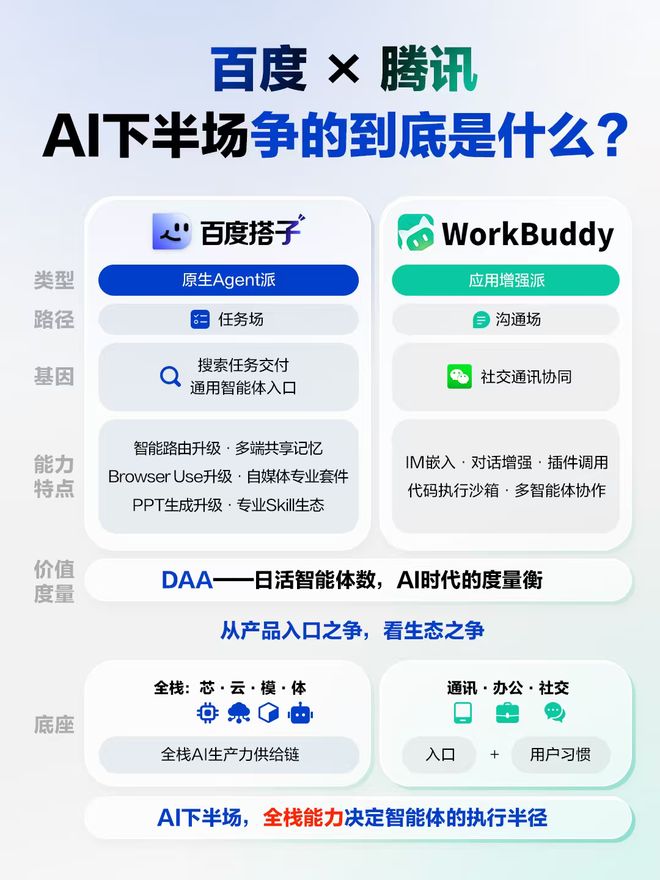
Tencent's approach can be described as "blocking you right in the group chat." Most knowledge workers' work relies on WeChat and WeCom: tasks are assigned in group chats, progress is checked in group chats, files are shared in group chats, and bosses @ their employees in group chats.
Therefore, Tencent WorkBuddy's logic is perfectly logical: since you spend most of your day in group chats, the AI will directly join the chat to take over tasks mentioned in conversations.
This approach is closest to the front line of work, delivering a seamless experience. But it also has its limitations: it is easily "held back" by the old order. Group chats are essentially communication spaces, suitable for assigning tasks, negotiating, and aligning information. But during the actual tough "execution" phase, you still have to leave the group chat and open various files, spreadsheets, and professional software.
If the AI is too proactive in the group chat, spamming nonstop like a loudspeaker, users will feel disturbed; if it is too restrained, it will easily be reduced to an advanced robot that only checks the weather and searches for documents.
Baidu has taken a different path: instead of crowding into your chat box, it designs its AI directly around the task execution workflow.
What is the most frustrating thing for knowledge workers? It's copying and pasting across different software, searching for information everywhere and manually cleaning it up, and repeatedly adjusting that annoying formatting. DuMate inherits Baidu's core gene of "search-answer-result": as soon as users throw it a task with clear requirements, it will cross files and applications in the background, call various capabilities, and finally deliver the finished product.
To put it simply, the core difference between the two lies in the different gateways they target: Tencent is positioned at "where tasks are assigned," while Baidu focuses on "where tasks get completed."
03 Whoever Reduces the Number of Clicks for Knowledge Workers Wins
Free of historical baggage such as socializing, meetings, and casual chats, DuMate is more like a native AI species hatched purely for getting work done. It doesn't waste time on small talk in group chats, but goes straight to the point, aiming to "completely solve the problem and eliminate intermediate steps."
At the DuMate market event in Chengdu today, many freelancers and independent professionals can be seen already using this unburdened tool to drastically reduce their workload. Those "tedious and annoying tasks" that used to drive you crazy every time you turned on your computer now have a more lightweight solution provided by DuMate.
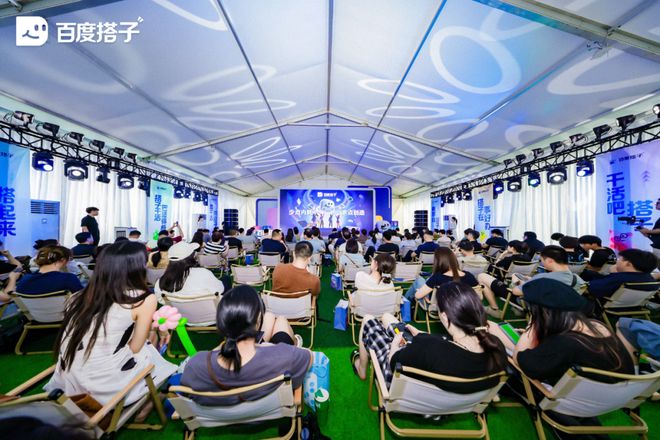
For example, Wan, a photographer who shoots wild animals in the Changbai Mountains, used to struggle the most with organizing massive numbers of photos and writing popular science captions. In the past, he had to open an image viewer to sort through photos one by one, then open a browser to search for encyclopedic information to verify animal habits, and finally polish every word in the document. After DuMate upgraded core capabilities such as web visual execution (Browser Use), Wan only needs to upload a batch of original photos and say "help me look up the families and genera of these birds and generate popular science notes." The AI will automatically identify and clean up information across web pages and applications in the background, and finally hand the finished product directly to Wan.
Another example is content creator Lv Dengdeng, who is full of creative ideas but used to get stuck on tedious administrative tasks such as script storyboarding, editing outlines, and multi-platform operations. Now, she has made DuMate her dedicated long-term assistant—it can permanently remember her video style, fan audience, and common topics. She only needs to say one sentence, and the AI will automatically expand a rough idea into a complete workflow that includes scene storyboards, viral headlines, and operation captions, and even generate a PPT for reporting with one click.
All these features are designed to address the real pain points of knowledge workers, following a pure "knowledge worker mindset"—making things as easy as possible.
04 The Strategic Endgame Behind DAA
This corresponds to a paradigm shift in the industry's measurement standards in the Agent era.
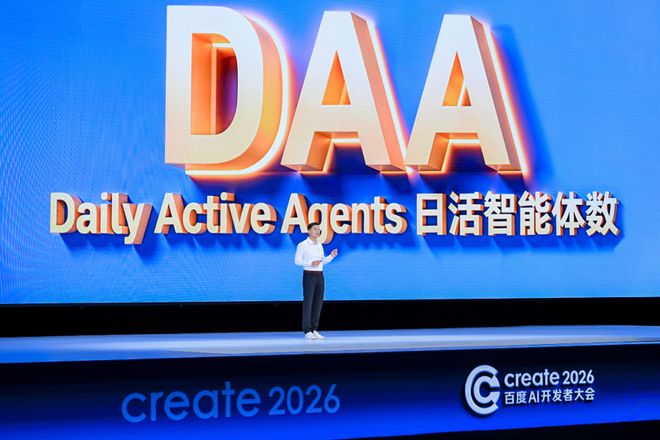
Baidu founder Robin Li proposed at the Create2026 conference: the measurement standard for the AI era should not be the blind pursuit of computing power and excessive Token consumption, but DAA (Daily Active Agents). Simply put, to evaluate whether an AI is good or not, we should look at how many Agents are working diligently for users every day and delivering closed-loop tasks in real scenarios.
The industry's demand for a new measurement standard essentially redefines what a "good" Agent is. But putting forward a standard is only the first step—being able to implement the standard effectively is the real hard power. As a general-purpose Agent gateway, DuMate's fast delivery speed and strong explosive power prove that Baidu has not only created the DAA measurement standard, but also fully validated the underlying logic of "high daily activity and high-quality delivery" with its core flagship product.
Because everyone understands that in this era where standards are being widely applied, knowledge workers judge Agent products very pragmatically—they don't care how grand the product's promises are, but whether it can deliver tasks well. If the delivered report is full of errors, the tool calls are incomplete, and the rework rate is extremely high, knowledge workers would rather do the work themselves.
In this regard, the underlying hard power becomes the watershed. What supports DuMate to bring these "effortless experiences" is Baidu's full-stack ecosystem covering "chips, cloud, models, and Agents." Against this background, looking at DuMate's recent concentrated upgrades of multiple capabilities such as intelligent routing, multi-device shared memory, browser calling, and PPT generation, these capabilities can not only continuously be transformed into perceptible product experiences for users, but also serve as strong proof that Baidu has fully validated its full-stack capabilities.
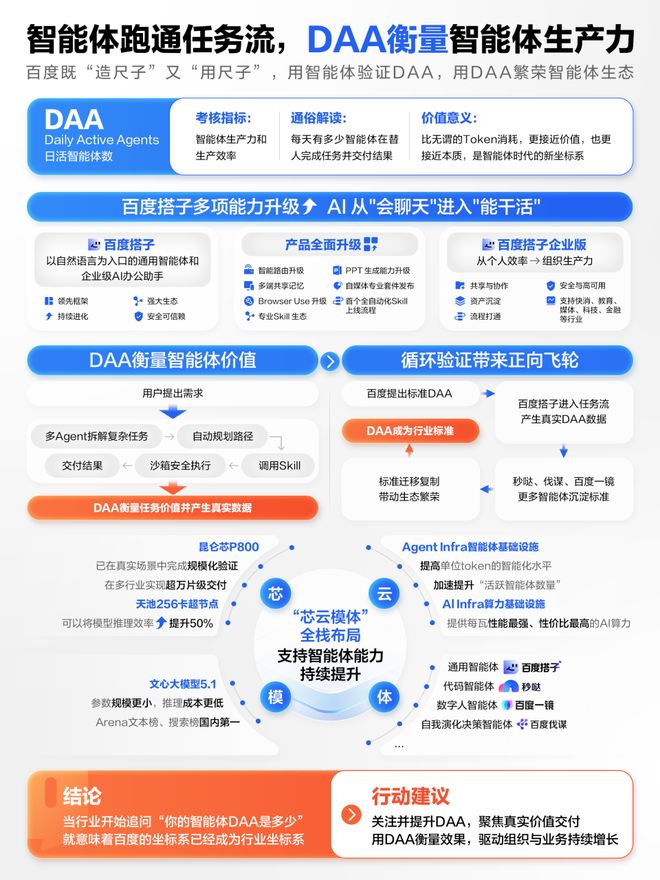
This itself is a typical positive loop: Baidu's self-developed chips, self-operated cloud platform, self-built large models, and self-owned general-purpose Agent gateway reinforce each other across layers, enabling cyclic optimization.
Returning to this efficiency positioning battle around the "boot screen," there will be no clear winner for a long time. Tencent has integrated AI into the highest-frequency collaboration scenarios, serving "how work gets communicated"; while Baidu has embedded AI into a more complete task workflow, attempting to restructure "how work gets completed."
This strategic divergence reflects the different ecological foundations of the two tech giants. Tencent's core gene is "connection": by embedding AI into its social collaboration network, it essentially aims to build a more seamless network to activate various people and services in its social ecosystem. Baidu's foundation is "full-stack delivery": by developing DuMate, it leverages the deep penetration of a full set of technologies, like building a car, to directly drive users to the finish line of their tasks.
The endgame of AI-powered office work will never be a shiny "AI" button added to the top right corner of every software. The real endgame is: when you sit at your workstation every morning, turn on your computer, and utter your first work request, will you send it in Tencent's group chat, or directly assign it to Baidu's DuMate?
Whoever can seamlessly turn a knowledge worker's single sentence into the final finished delivery will truly get the ticket to the next era.