US retail sector faces collective pressure, while Target moves against the trend?
The divergence in U.S. retail stocks since the start of this year has been somewhat unexpected: Walmart has stayed nearly flat, Kroger has fallen roughly 4%, and while Costco still posts gains, it has retreated noticeably from its earlier peak. In contrast, Target, which was repeatedly shunned by the market previously, has risen about 34% year-to-date.
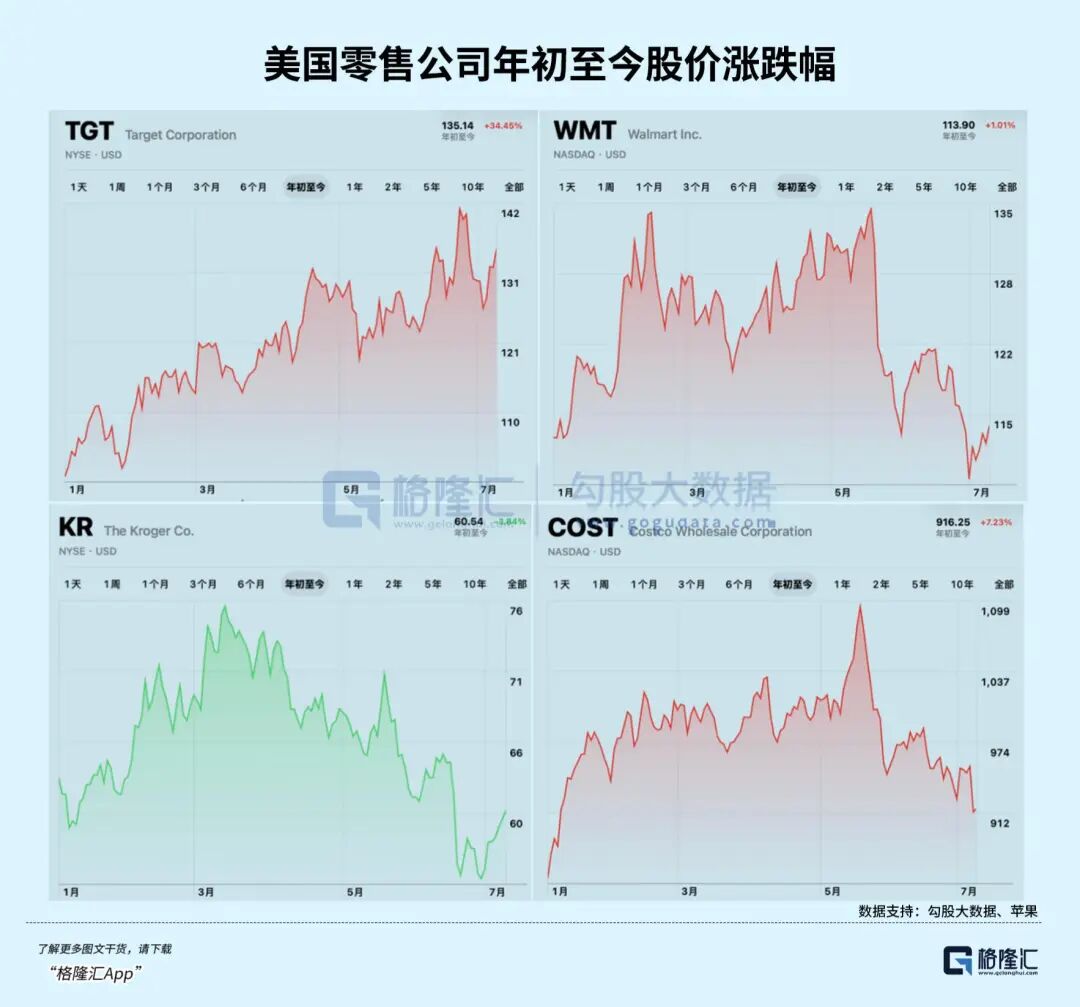
This is a rather counterintuitive scenario: Target is neither the strongest value retailer in the U.S., nor the supermarket with the deepest consumer mindshare for fresh groceries. Last year, it was mired in a typical operational stall: discretionary spending was curtailed, in-store experiences faced criticism, and excess inventory paired with steep discounts dragged down profits. For a time, the market labeled it a "laggard sample" among mid-tier retail chains.
Yet over the past two quarters, Target has begun delivering evidence of a turnaround: its Q4 earnings beat expectations, while Q1 saw synchronized improvements in revenue, same-store sales, gross margin, and EPS.
So why did Target collapse so sharply last year? What concrete steps did its management take? And can this ongoing stock rally be sustained?
01 Why Did Target Struggle So Severely Last Year?
The root of Target's 2024 problems first lay in its category structure.
It is not a defensive retailer like Walmart, whose core offerings revolve around food and daily essentials. Grocery accounts for nearly 60% of Walmart U.S.'s total sales — consumers purchase food regardless of economic conditions, creating inherently stable foot traffic and cash flow. By comparison, Food & Beverage makes up only 24% of Target's revenue. This means food primarily serves as a traffic-driving category for Target, a lever to pull customers into other higher-margin segments. The categories that truly define Target's brand differentiation and deliver greater profit flexibility are more discretionary segments: beauty, apparel, home goods, and toys.
The problem is that in a high-inflation, high-interest-rate environment, U.S. consumers first cut spending on new clothing, home decor, and non-essential purchases. Target's long-standing strengths of "affordable style" and "engaging lifestyle shopping" became sources of pressure as household budgets tightened: it could not match Walmart's mindshare for low-cost groceries, while its signature style-driven merchandise lost novelty, ultimately leading to unstable foot traffic, smaller average transaction sizes, and compressed gross margins.
Second, Target's in-store experience itself deteriorated.
Target's core customer base is not purely chasing the lowest possible prices, but mid-income household shoppers. They visit Target not just to restock essentials, but to seek a pleasant in-store environment, thoughtfully designed products, and a relaxed one-stop shopping journey. When shelves became disorganized, products were hard to locate, in-stock rates fluctuated, and checkout wait times grew longer, Target's most critical competitive edge eroded.
This was the market's biggest concern last year: Target no longer had Walmart's unbeatable low-price perception, while it had lost its own previously superior in-store shopping experience. For a retailer built on "traffic-driving frequent-purchase categories and profit-driving style segments," the simultaneous decline of foot traffic and experience naturally amplified downward pressure on profits.
The operational results were clear: for full fiscal year 2025, Target's net sales fell 1.7% year-over-year, operating profit dropped 8.1%, net income declined 9.4%, and diluted EPS fell 8.2%. The triple pressure of an imbalanced category structure, strained consumer sentiment, and operational missteps exposed concentrated weaknesses in Target's mid-tier retail model that had previously been propped up by strong experiences and fresh product assortments.
02 Where Did Management Implement Aggressive Reforms?
The first step of Target's turnaround was to rebuild consumers' perception of its price value.
Last year, a top consumer complaint was that Target no longer felt like a "good deal." It lacked Walmart's deeply ingrained low-price reputation, and many of its products failed to deliver sufficient novelty or thoughtful design. The result was a retailer that was neither cheap enough nor experience-driven enough, making its value proposition increasingly uncompetitive amid high inflation.
So management started with everyday household items, cutting prices on over 3,000 frequently purchased SKUs, and clearly highlighting accessible price points in the $5 to $20 range. This move re-educated mid-tier household shoppers that they would not overpay for essentials, toys, apparel, and home goods at Target.
Critically, this round of price cuts did not erode gross margins. In Q1, Target's gross margin rose to 29.0%, up roughly 80 basis points year-over-year. Management attributed this improvement to streamlined supply chain efficiency, reduced clearance discounting, and growing revenue from high-margin streams like the Roundel ad platform and Target Plus third-party marketplace. In essence, Target repaired its price perception while eliminating the profit-damaging liquidation promotions it had relied on in the past.
Second, Target revamped its product assortment to play to its strengths and avoid direct competition.
Target chose not to engage in a brutal price war over groceries with Walmart and Kroger. Instead, it expanded its offerings in high-frequency categories including food, essentials, health products, beauty, and baby care to drive more frequent store visits. It then leveraged its existing strengths in style-driven segments like beauty, apparel, home goods, and toys to boost average transaction values and gross margins.
In 2026 Q1, the company added roughly 3,000 new SKUs to its food and beverage portfolio, with new products delivering over 50% higher sales than the prior assortment; it added around 1,500 new SKUs to its health category, with plans to refresh 40% of that assortment within the year; it launched roughly 2,000 new baby products priced as low as $1, alongside premium upgraded options; and it previously added 3,000 new beauty SKUs and 60 new brands to strengthen its appeal to female shoppers.
The core of this strategy was to recapture Target's historic merchandising prowess: everyday essentials bring customers through the door, while style-driven categories encourage shoppers to add more items to their carts.
Third, Target restored its in-store experience and fulfillment efficiency.
Target's physical locations are not mere sales outlets — they are the brand's most valuable asset. Management rolled out customer experience training for over 300,000 employees and team leaders, and allocated more staffing hours to peak shopping windows like evenings and weekends. By Q1, the company reported that multiple in-store experience metrics had hit three-year highs, including checkout wait times, product availability, store cleanliness, and quality of employee interactions.
This initiative was transformative for Target, because its stores serve dual purposes as both "shopping destinations" and "fulfillment hubs." Over 95% of Target's total sales are supported by its store network, with same-day services generating more than $14 billion in 2025, accounting for roughly two-thirds of all digital sales; in 2026 Q1, same-day delivery continued to grow by over 27%. Improvements to the in-store experience not only make shopping more enjoyable for customers, but also boost operational efficiency for order pickup, Drive Up, and same-day delivery fulfillment.
03 By Prioritizing Strengths Over Head-On Competition, Target Pulled Ahead
The pressures facing U.S. retail in 2026 are distinct from those of last year.
2025 was largely defined by consumer downgrades amid high interest rates and persistent inflation. The strain hit discretionary segments like apparel, home goods, and toys the hardest — exactly the categories that drive the majority of Target's profit flexibility, which explains why it suffered more acutely than peers. This year, new disruptions from Middle East conflicts have pushed energy prices higher, raising costs for transportation, cold chain logistics, fulfillment, and inventory restocking, creating more direct pressure for grocery-focused retailers.
Fresh food is the most obvious example of this dynamic. It relies on cold chain infrastructure, frequent transportation, and constant restocking, so rising fuel and labor costs quickly squeeze profit margins. Grocery-heavy retailers like Kroger and Walmart, while benefiting from stronger essential-demand characteristics, are directly exposed to mounting pressures from fresh food operations, logistics costs, and price competition.
Target's category structure, by contrast, partially buffers it from these strains. Food & Beverage still makes up only 24% of its total revenue, compared to nearly 60% at Walmart U.S. This means Target does not depend on fresh groceries as an impenetrable defensive moat, so the direct drag from rising fresh food costs is relatively limited.
At the same time, Target has not merely passively avoided industry pressures. Management has expanded offerings in food, essentials, and health categories to drive more frequent store visits, while overhauling its once-strong but previously stale assortments in beauty, baby care, home goods, and toys. The former draws shoppers back to stores, while the latter grows average basket sizes and restores gross margins.
Target's strong first-half performance essentially stems from "dodging the heaviest blow of external industry pressures while internal operational reforms begin to pay off." All retailers face headwinds amid persistent inflation and volatile energy prices, but Target has far less exposure to fresh food cost shocks than its peers. Whether this momentum can continue will depend on sustained recovery in discretionary categories like home goods and apparel, as well as Target's ability to maintain its recent improvements to the in-store shopping experience.
This article originates from the WeChat public account "Gelonghui Financial Spotlight" (ID: glh_finance), authored by Gelonghui Editorial Team, and published here with authorization from 36Kr.