In just 11 days, Claude rewrote millions of lines of code, yet this epic AI project sparked widespread outrage
These past few days, the tech industry has been buzzing with a dramatic story: Andrew Kelley, the creator of the programming language Zig, has publicly lost his temper.
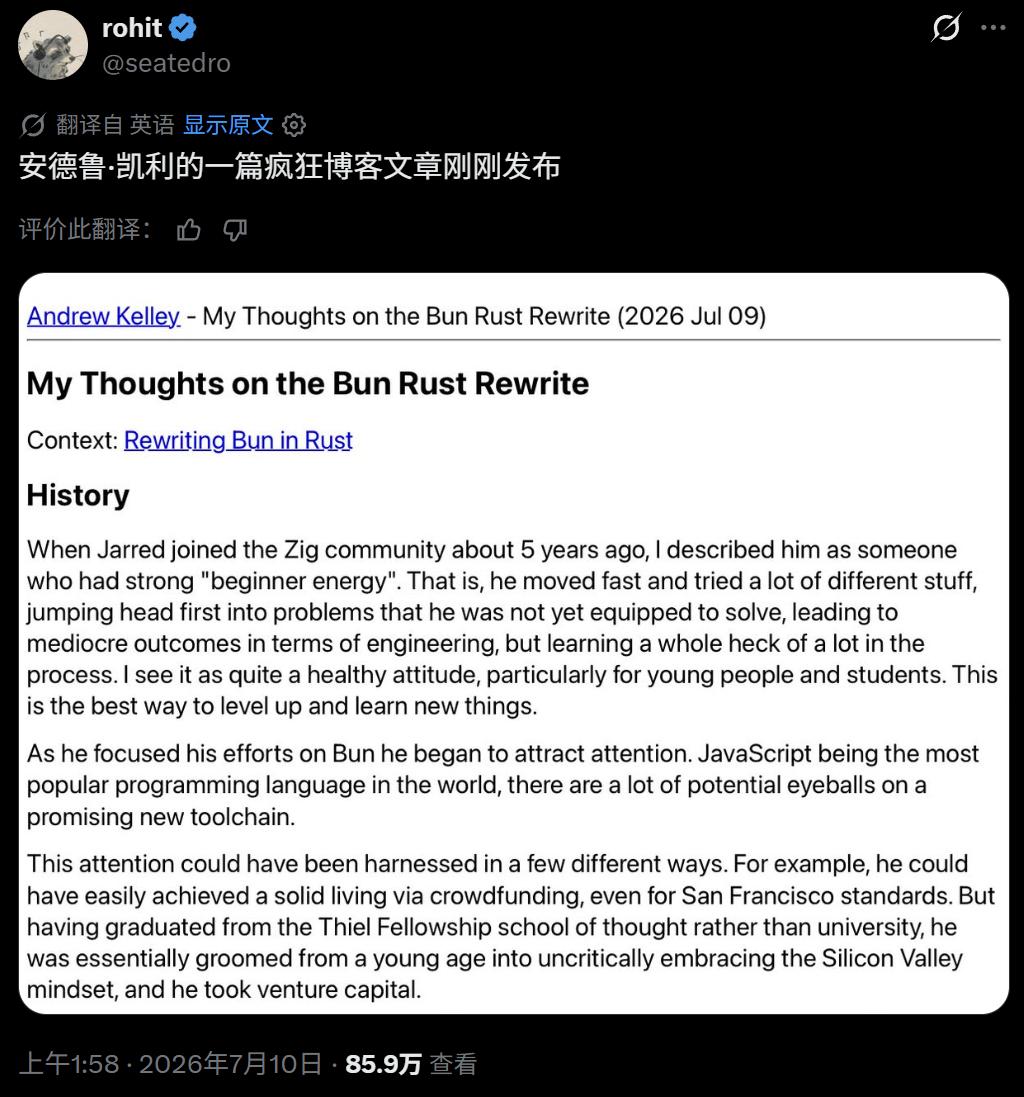
The trigger is that Bun, the runtime that once fully committed to the Zig language, has been completely rewritten in Rust by its founder Jarred Sumner.

Andrew Kelley made his anger completely public without any restraint. Instead of making polite remarks about this viral tech event, he directly targeted Jarred Sumner's personal engineering habits, management capabilities, and the underlying business logic behind this incident.
Bun is a high-performance JavaScript/TypeScript runtime designed to be a faster, more modern direct alternative to Node.js. In recent years, it has grown into a major contender challenging Node.js's dominance in the frontend ecosystem.
Bun's core selling point is its extreme speed: it outperforms competitors drastically in startup time, dependency installation, and test execution, partly because it was originally written in Zig.
Last December, Anthropic announced its acquisition of Bun, positioning it as core infrastructure to power its AI programming tools Claude Code and the Claude Agent SDK. Jarred Sumner and the rest of the Bun team are now employed at Anthropic.
After large-scale deployment, especially as the underlying runtime for Claude Code, the Bun team reported encountering persistent stability issues that were nearly impossible to fully resolve.
Specifically, the Zig-based version of Bun suffered from a large number of memory safety bugs — including use-after-free, double-free, and forgotten memory deallocations on error paths. These issues can only be mitigated by strict coding conventions in Zig, while in Rust they are directly caught as compilation errors by the borrow checker and Drop mechanism.
On the other hand, the upstream Zig community maintains a zero-tolerance policy for code generated by large language models (LLMs), meaning even non-AI-related optimization changes could not be merged into the upstream repository. As the Bun team heavily relies on AI-assisted development, continuing to use Zig would require them to maintain their own long-term fork of the Zig compiler, incurring extremely high operational costs.
As a result, this May, the tech world witnessed a massive engineering feat: Jarred Sumner, founder of Bun, announced that the team had completely rewritten Bun's millions of lines of code from scratch in Rust in just 11 days. They leveraged Anthropic's then-unreleased Claude Fable 5 (Mythos-class model) and the dynamic workflow capabilities of Claude Code.
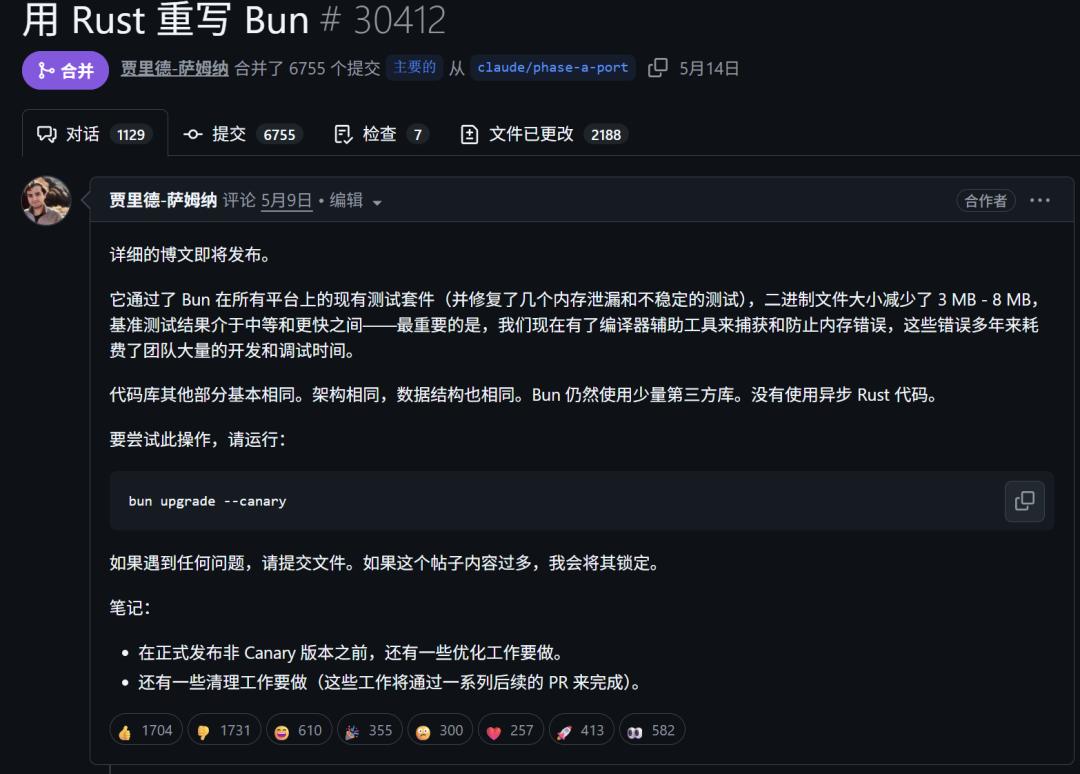
This was an epic large-scale test of Agentic Workflows, which Anthropic later promoted as a flagship case for its Dynamic Workflows feature. However, the move also sparked widespread controversy over claims it represented a "betrayal of core principles".
In a recent blog post, Zig creator Andrew Kelley argued that the root cause of Bun's frequent bugs before the rewrite was Jarred Sumner's poor engineering practices.
First of all, Jarred had been writing low-quality code long before the rise of AI. Kelley noted that the Zig team regularly reviews user codebases, and they found Bun's codebase "extremely alarming": it was filled with layers of hacky workarounds, misused assertions, and almost no effort was spent on eliminating bugs and paying down technical debt in pursuit of rapid feature launches.
Then there is the million lines of code generated by Claude. Kelley posed a pointed question: "Bun's official team claims that 1 million lines of unaudited AI-written Rust code is safe because it has test cases. If the test coverage was truly that comprehensive, why didn't it catch all those annoying bugs when Bun was written in Zig?"
Kelley now expresses deep disappointment that Jarred has transformed from an energetic, promising open-source developer to a "stinky manager" with poor leadership.
Kelley stated bluntly that when he learned Bun was abandoning Zig, he did not feel betrayed — he felt relieved. He feared that Bun, which had long been associated with the Zig brand, would create public misconceptions, and even worse, attract a user base that only copy-pastes AI-generated code. He even sarcastically remarked that he was sitting back with a cup of tea, glad that "this is no longer my problem".
Such unreserved public criticism quickly drew other voices from the tech industry into the debate.
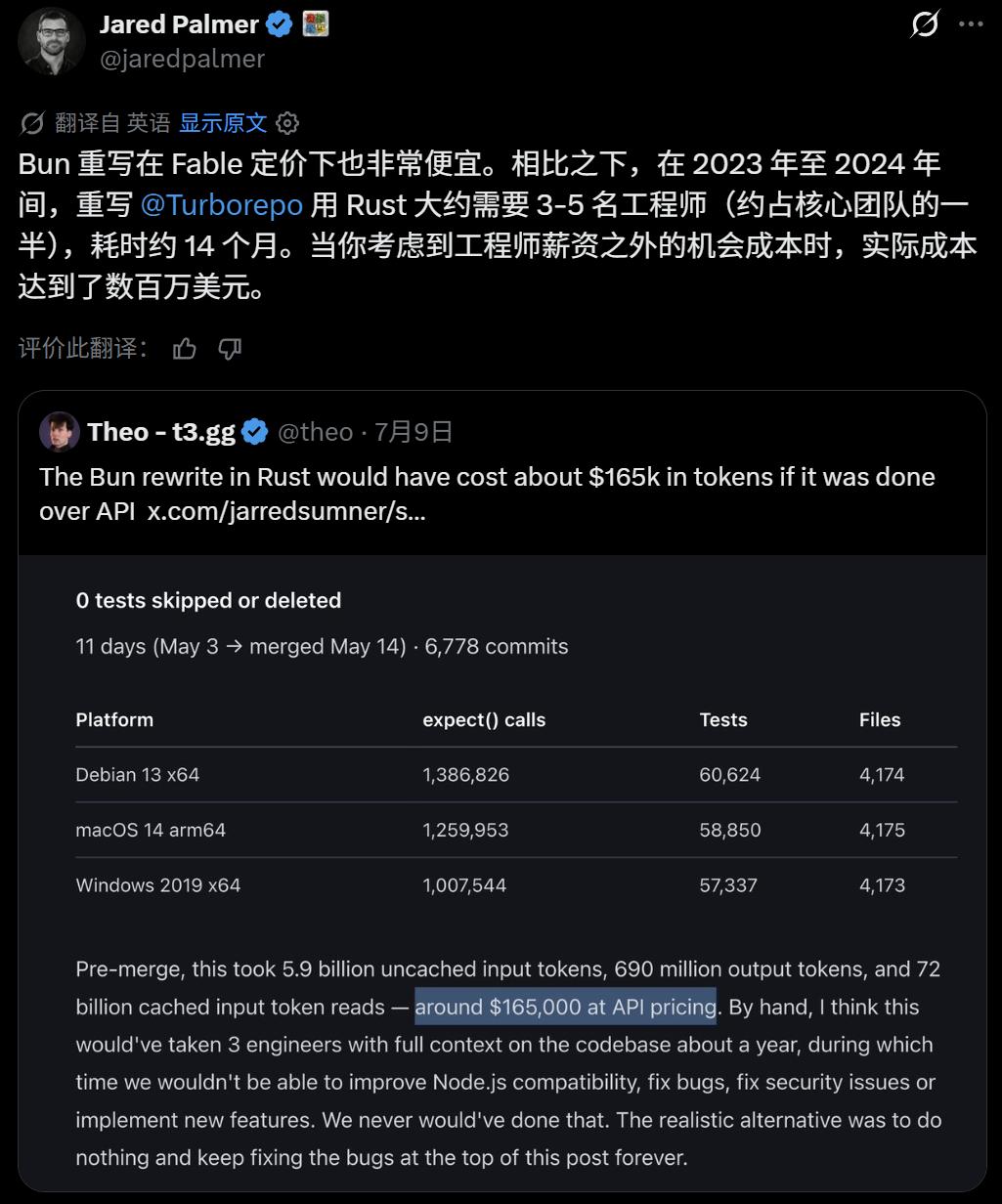
Many first calculated the costs: while Claude's token pricing is widely considered expensive, data released by Jarred Sumner and the official Bun team shows that the Rust rewrite of Bun consumed an estimated $165,000 in API costs. For the tech and engineering community, this price and development timeline are shockingly low.
On paper, AI has compressed development costs to roughly one-tenth of the traditional estimate, cutting the projected timeline from about a year to less than two weeks.
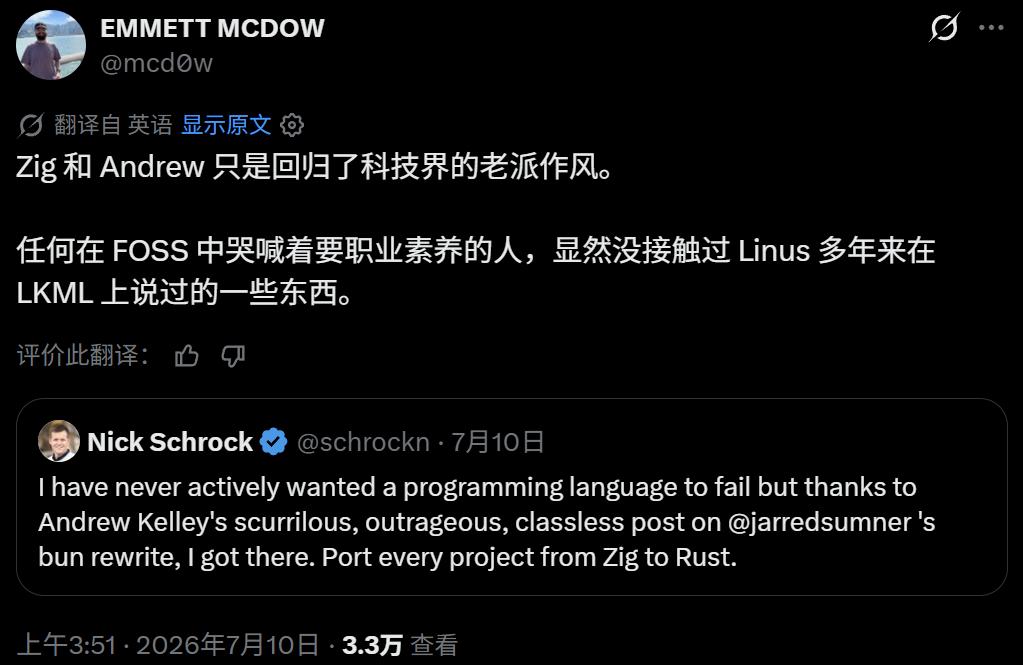
Discussions also focused on the collision between traditional open-source community culture and the AI era. Some readers felt deeply uncomfortable after reading Andrew Kelley's blog post, arguing that his public attacks on a former major user and long-time sponsor (Bun funded the Zig project for years) were unprofessional. A few even went as far as to say they "have never actively rooted for a programming language to fail this hard".
However, many veteran developers came out in support of Kelley, noting that in an era swept up by capital hype and the AI bubble, Andrew was simply defending uncompromising engineering quality, embodying the no-nonsense attitude once demonstrated by Linus Torvalds.
Naturally, the most widely discussed question is whether the project still works well after such a massive overhaul.
The biggest point of contention right now is that these 1 million lines of code were mechanically translated by AI directly from the original Zig code, without any architectural refactoring by human engineers. The new Rust codebase retains an astonishing 27,000 lines of unsafe code blocks. Many worry that the cognitive overhead and debugging costs for human developers to maintain, read, and modify this massive "AI-generated artifact" will eventually exceed the upfront development costs saved today.
It remains to be seen whether this project, which defies all traditional software engineering norms, will become a landmark milestone that redefines programming paradigms with AI — or turn into an unmaintainable volcano of technical debt waiting to erupt. Only time will tell.
References:
https://bun.com/blog/bun-in-rust
https://andrewkelley.me/post/my-thoughts-bun-rust-rewrite.html
This article originates from WeChat Official Account "Machine Heart" (ID: almosthuman2014), authored by AI-focused contributors, and republished with authorization from 36Kr.