Alibaba and ByteDance are scaling back, while Tencent is pressing forward, leading to a divergence in the AI application generation track
Since June, the landscape of China's domestic AI application generation track has undergone clear differentiation.
On one side, Alibaba and ByteDance have successively sent out signals of contraction: Hano, the top leader of Ant Group's Lingguang, was transferred to take over part of the responsibilities of A-Fu, and resource investment has begun to shrink noticeably; Doubao has completely taken its application generation function offline, with related capabilities fully migrated to the independent product Trae. AI application generation, which is characterized by narrow demand, high computing power consumption, and unclear commercialization prospects, is being gradually stripped away from the main track by tech giants.
On the other side, Tencent has opted for a two-pronged approach: "Xiaowei", WeChat's native AI assistant that launched gray-scale testing in June, has rolled out the capability to generate personal-use mini-programs with a single sentence, deeply embedding AI development capabilities into the mini-program ecosystem; Toast, which focuses on native app generation, launched its Android version in May and released its iOS version in early July, achieving full coverage of both major mobile platforms.
Between this retreat and advance, the three tech giants have formed distinctly different judgments on the AI application generation track. Behind this divergence of paths lies their differing answers to the commercial value, product positioning, and ecosystem boundaries of Vibe Coding.
Alibaba and ByteDance Narrow Their Focus, Application Generation Exits AI's Main Battlefield
At the end of June, an organizational restructuring announcement confirmed Ant Lingguang's strategic contraction.
According to disclosures from multiple media outlets, Hano, the top leader of Ant Lingguang, will be transferred to take charge of part of A-Fu's functions, and core team members of Lingguang will later be reassigned to support A-Fu's feature development. The reassignment of core leadership and technical backbones means that this once highly anticipated product is no longer a key investment priority in Ant Group's AI landscape.
Looking back to the end of 2025, when Lingguang was first launched, it was a star product in the track, carrying Ant Group's expectations of making a breakthrough in the general-purpose AI field.
Featuring the differentiated combination of "full-modal general AI assistant + flash app", Lingguang exceeded 1 million downloads just 4 days after its launch, successfully ranking 6th on App Store's China Free App chart and 1st on the Free Tools chart. Back then, within the Alibaba ecosystem, Ant Lingguang aimed to carve out a niche in the red ocean of general AI assistants with its extremely low-threshold application generation capabilities.

Entering 2026, Lingguang continued to enhance its related capabilities: it launched the no-code app sharing community "Lingguang Circle", and simultaneously initiated a 100 million-yuan special incentive program for creators, positioning the community as "app creation equals content consumption"; later, it deeply integrated into Alipay's financial ecosystem, supporting flash apps to access commercial capabilities such as payment, membership, and verification with one click, attempting to connect the entire chain from creation to monetization. By the first half of 2026, the number of flash apps created by users on Lingguang had exceeded 30 million.
However, behind these impressive creation figures, this differentiated path has not been successfully validated.
As Qwen continued to iterate and Alipay's A-Bao became the AI entry point for financial scenarios, Lingguang's positioning became increasingly awkward: its general conversation and AI generation capabilities highly overlapped with Qwen's, and the "one-off tool" nature of flash apps failed to build user stickiness, so its monthly active users never made it to the industry's first tier.
For Alibaba, on the premise that Qwen has firmly occupied the main battlefield of general AI, retaining a flanking product with overlapping positioning and uncertain success prospects has significantly reduced its strategic value. Reassigning the core team to vertical businesses closer to commercialization, such as A-Fu, is a rational choice after the giant's strategic patience has been exhausted.
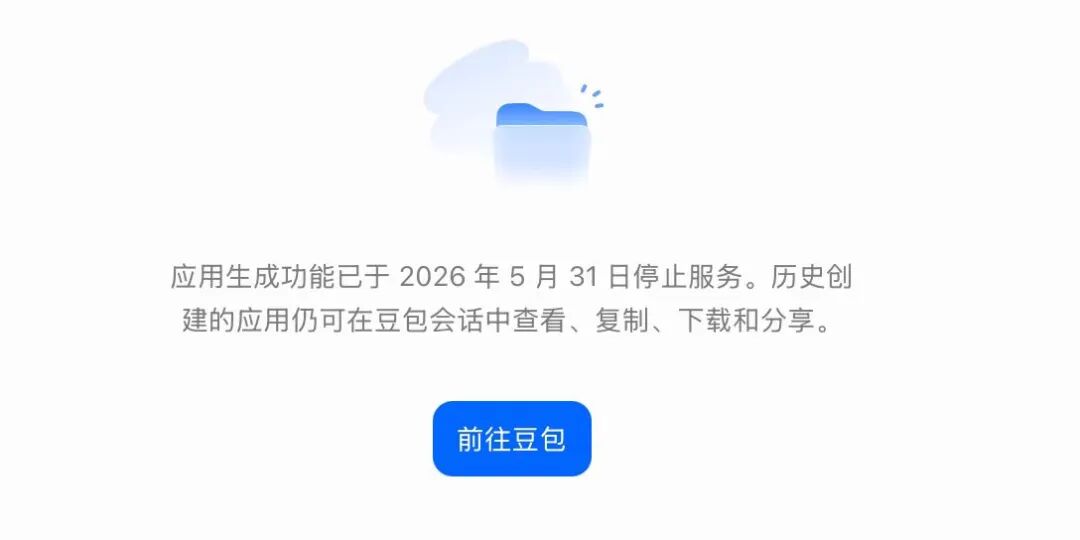
Almost simultaneously with Ant's restructuring, ByteDance has also completed the separation of its application generation capabilities. Recently, some user-focused media outlets discovered that Doubao's application generation function officially ceased service on May 31, with related capabilities fully migrated to its independent AI development platform Trae-SOLO. Just half a year ago, Doubao partnered with Intel to launch the "Not Tech-Savvy at All" creation challenge, promoting no-code application generation as a core feature to all users, directly competing with Ant Lingguang's mass creation strategy.
ByteDance's contraction is the result of the combined effects of three factors: content security, cost, and product positioning.
In terms of content security, according to the general regulatory requirements for generative AI services, platforms must bear primary responsibility for user-generated application content. As a national-level AI assistant with hundreds of millions of daily active users, opening up application generation means enormous review pressure for massive UGC content, with risks such as fake forms, privacy theft, and traffic-drawing scams being difficult to control. Once non-compliant content appears, the platform will face regulatory penalties.
Stripping the externally distributable application generation capabilities into an independent product and implementing tiered management through real-name verification and age restrictions is an inevitable choice for risk isolation.
In terms of cost and commercialization, application generation requires extensive calls to code models, with token consumption far higher than ordinary conversations. However, the vast majority of ordinary users only generate demos out of curiosity, with neither willingness to pay nor demand for continuous use, leading to unsatisfactory retention rates and return on investment.
At the same time, ByteDance is sorting out a clear AI product matrix: Doubao focuses on a lightweight mass assistant, targeting high-frequency general scenarios such as daily Q&A, copywriting creation, and office assistance; Maoxiang undertakes character-based agents and interactive companionship functions, targeting vertical entertainment scenarios; the Trae series takes on development-related functions such as AI programming and no-code application generation, targeting professional and semi-professional users with development needs.
Function separation not only prevents the main site product from having a bloated positioning, but also allows computing power resources to tilt toward businesses that are easier to monetize, essentially representing a choice to optimize resource efficiency.
Tencent Advances on Two Fronts, Xiaowei and Toast Cover Scenarios Inside and Outside WeChat
While Alibaba and ByteDance are proactively narrowing their focus and concentrating their businesses, Tencent is completing its two-pronged deployment at its own pace.
In June, WeChat's native AI assistant "Xiaowei" launched a small-scale gray-scale test, where users can call up the assistant through the upper-left entrance to generate lightweight personal mini-program tools with a single sentence; on May 15, the Android version of AI application generation platform Toast was officially launched, focusing on native app generation and idea co-creation. Just over a month later, in early July, the iOS version of Toast landed on the App Store.
Tencent's two-pronged advancement is not going against the trend, but a differentiated path based on its own ecosystem endowment. The two products have clear positioning and complementary scenarios, covering two core demands of AI application generation respectively.
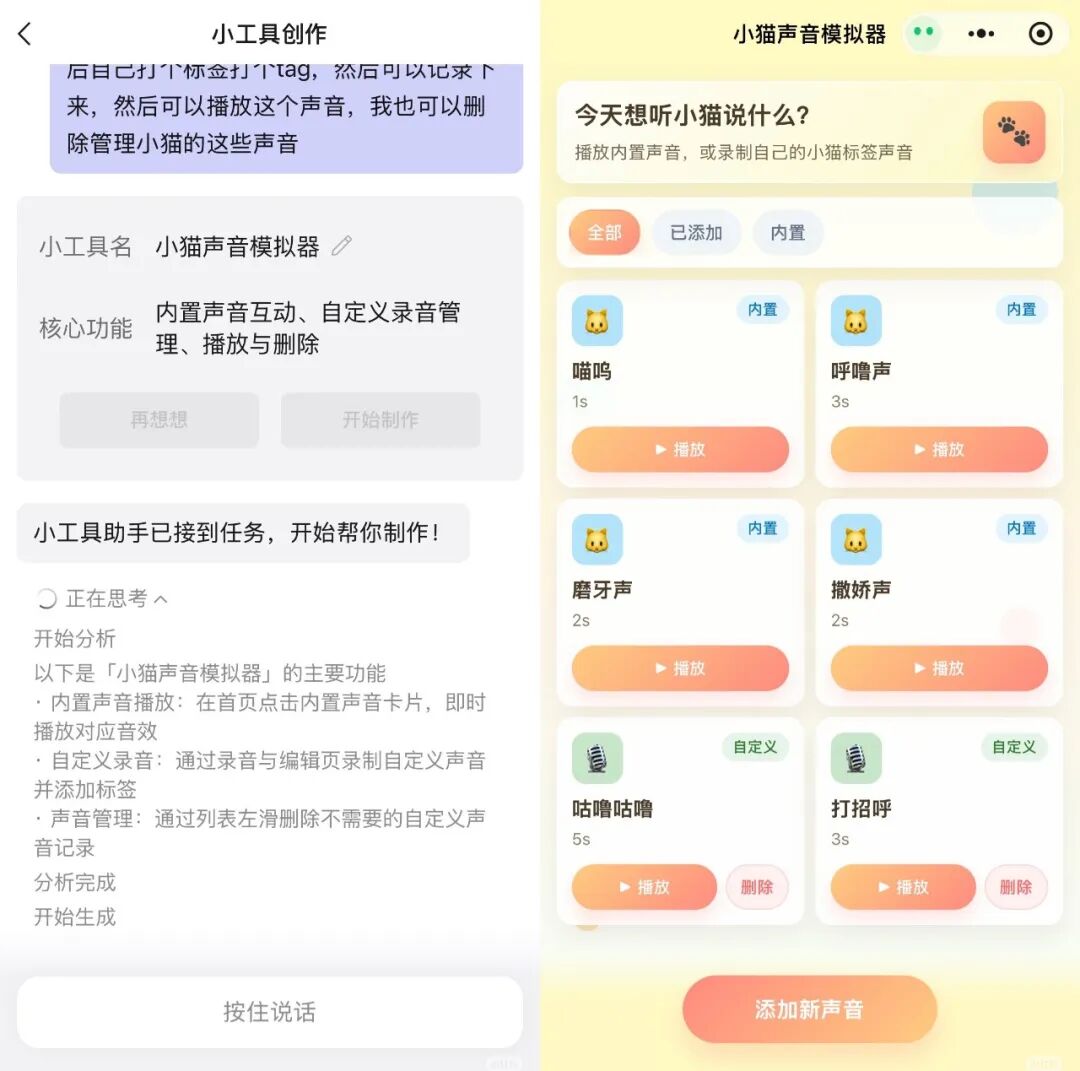
Xiaowei's application generation capability in WeChat is essentially a natural extension of the mini-program ecosystem. After more than a decade of cultivation, WeChat users have formed the habit of "using mini-programs to solve lightweight needs", with extremely strong long-tail demands ranging from form statistics to daily life tools.
Xiaowei's one-sentence tool generation is not intended to build an independent app ecosystem, but to turn the process where users originally searched and filtered mini-programs into direct customization of personalized tools, with the entire process enclosed within the WeChat ecosystem — the generated tools are only for personal use, sharing and forwarding are not supported for the time being, and high-risk permissions such as payment and address book access cannot be invoked.
This model not only meets users' individual needs, but also highly aligns with WeChat's "use it and leave" mini-program logic, serving as a functional supplement to the super app's AI capabilities.
The launch of Toast, on the other hand, represents Tencent's precise complementary move and track experiment outside the WeChat ecosystem.
Unlike Lingguang, which shoulders the strategic responsibility of being Ant Group's general AI entry point, Toast has an extremely pure positioning — a vertical AI application generation and idea co-creation platform, with all features centered around "building apps", without redundant AI assistant capabilities such as general conversation, image recognition, or painting.
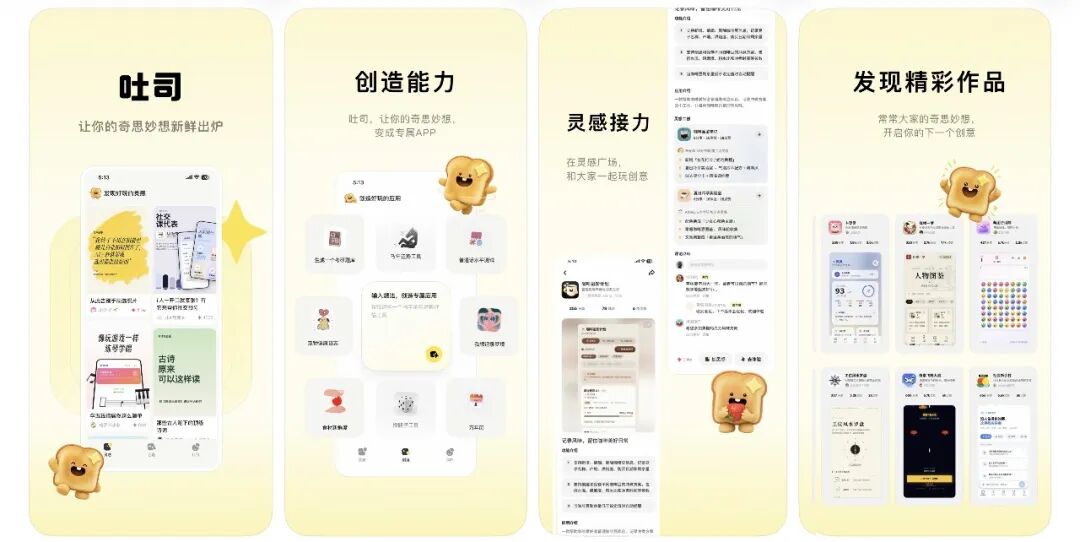
It does not need to undertake the group's general AI strategic KPIs, and is more like Tencent's exploration in the Vibe Coding track: given that utility and lifestyle apps have a large user base, and AI generation is lowering the threshold for app development, early deployment in app creation and distribution platforms may allow it to seize the opportunity for the next-generation app entry point, expanding another UGC creation ecosystem beyond mini-programs.
In terms of product division, Tencent's two lines of development precisely cover different user scenarios: Xiaowei serves immediate personal-use demands within the WeChat ecosystem, focusing on lightweight, fast, and in-scenario embedding; Toast targets users with complete creative ideas who want to generate independent and distributable apps, focusing on completeness, co-creation community, and subsequent commercialization possibilities.
The two lines operate independently, corresponding to two directions: efficiency tools within the ecosystem and creation platforms outside the ecosystem. They will not interfere with each other's positioning, and can simultaneously test two feasible implementation paths for AI application generation.
Overseas Popularity Continues to Rise, Startups Become the Main Players in the Track
Alibaba and ByteDance are contracting, while Tencent has chosen a two-pronged trial-and-error approach — but this does not mean that AI application generation itself is a false proposition. There are still domestic players who have not followed the trend of contraction, and overseas capital markets have given far more optimistic judgments than domestic ones.
A representative of domestic players still persisting is Baidu's Miaoda. In May this year, Miaoda released its 3.0 version, complementing capabilities such as native app generation and enterprise-level collaboration, with its user scale reaching tens of millions. Against the backdrop of falling behind in the general AI assistant track, Miaoda is perhaps one of the few remaining differentiated products that Baidu can showcase, which explains why it has not been marginalized like Lingguang.
However, Miaoda still cannot avoid the unresolved problems of user retention and commercialization: most ordinary users generate an app once and then leave, while enterprise customers have concerns about the stability and scalability of no-code platforms. Whether it can embark on a more sustainable path than Lingguang remains a question mark for now.
The overseas market presents a completely different scene, with capital showing significantly greater confidence in this track. Take Lovable as an example: this Swedish company secured a $6.6 billion valuation with a $330 million Series B financing at the end of 2025, and its revenue surged rapidly in the first half of 2026, with annual recurring revenue jumping from $400 million at the beginning of the year to $500 million in June. According to recent media reports, Lovable is negotiating a new round of financing of about $300 million, corresponding to a valuation of $13.2 billion, doubling from half a year ago, and its investor lineup has expanded from early-stage venture capital firms to larger institutional funds.
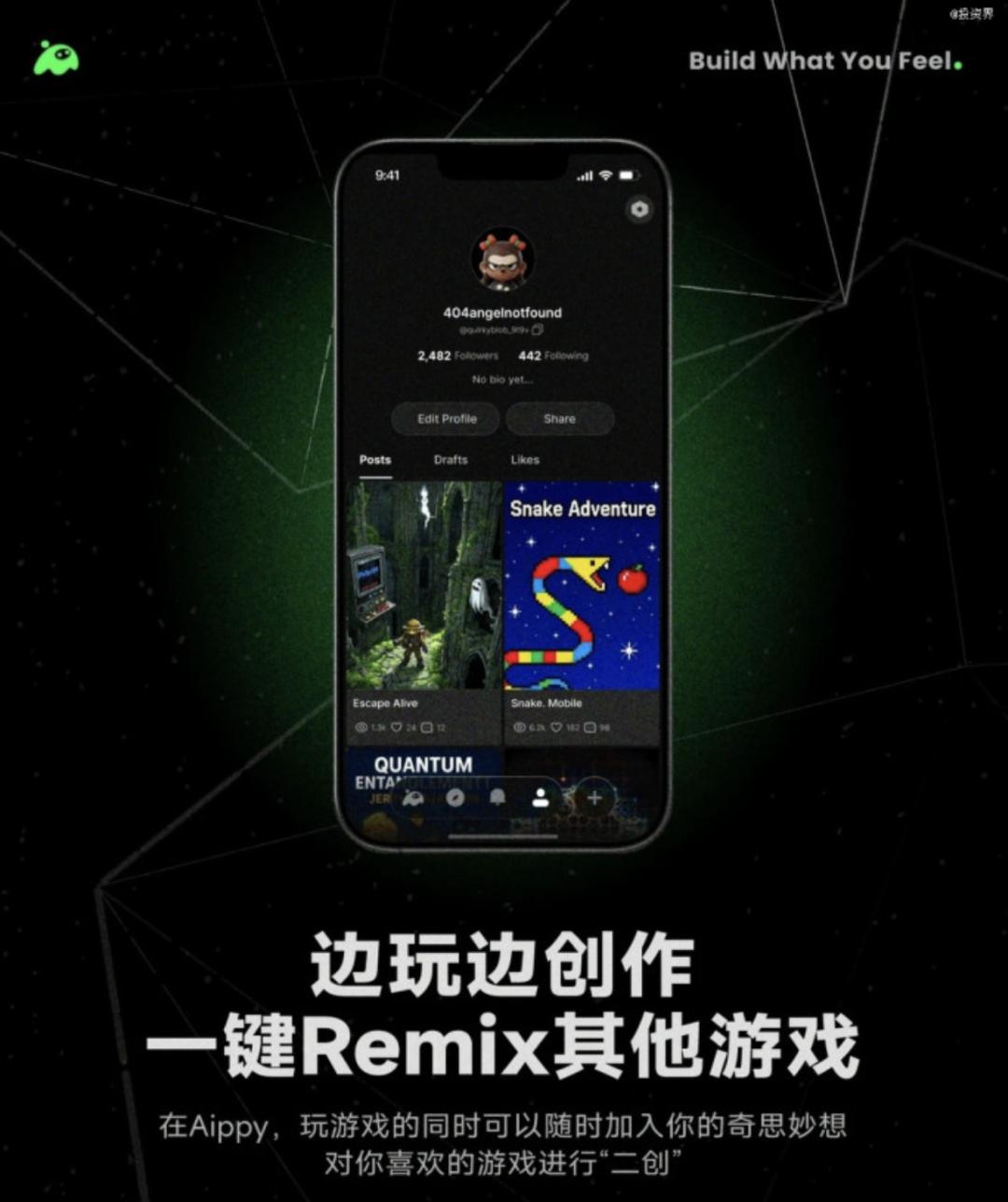
Another track that has also seen accelerated development is the AI mini-game sector: Playabl.ai, incubated by Y Combinator, accumulated tens of thousands of user-generated games and millions of independent plays just three weeks after its re-launch this year, with daily active users and weekly active users climbing rapidly; Aippy, incubated by Hong Kong-listed poolin Technology, completed tens of millions of dollars in Series A financing in June, with a post-investment valuation of $250 million, global downloads exceeding 3 million, and monthly active users approaching 2 million.
Capital's real-money voting shows that in overseas environments with relatively more lenient entrepreneurship conditions and stronger user willingness to pay, no-code application generation is still regarded as a business worth betting on, rather than a trivial feature considered a "chicken rib" (something seemingly useless but hard to discard) by domestic tech giants.
Behind this contrast between domestic and overseas markets lie differences in regulatory environments, user habits, and business ecosystems: domestic content compliance requirements are stricter, and large tech giants naturally tend to bring capabilities into their own ecosystems for unified control, making it difficult for independent startups to compete with giants in computing power and traffic; overseas markets offer startups more room for trial and error and clearer commercialization paths.
However, both domestic and overseas markets have yet to answer the same core proposition: how to turn the "one-time generation surprise" into sustainable user value.
At present, all AI application generation tools are still in the "can make a demo" stage, and there is still a huge gap before they can "make a high-quality product" — simple demands can be generated quickly and well, but complex businesses still suffer from frequent bugs; ordinary users lack debugging capabilities, while professional developers complain about insufficient depth, leading to the awkward situation of failing to satisfy either group. As underlying large model manufacturers begin to build in app-building capabilities one after another, there is still no standard answer as to whether the moat of vertical tools lies in the ecosystem, user experience, or technology.
The divergence among tech giants is just the beginning. This race for the right to app development in the AI era is far from reaching its final outcome.
This article is from WeChat Official Account "AI Value Officer", written by Xing Ye, and published with authorization from 36Kr.