Tashan Technology Teams Up with Turing Award Winner Sutton to Build "Robot Kindergarten", Propelling Embodied Intelligence from the "Imitation Era" to the "Experience Era"
This conference was co-initiated by Tashan Technology and OpenMind Global Research, and co-hosted by Beijing Embodied Intelligence Research Institute. At the event, the "Robot Kindergarten", jointly built by Tashan Technology and the team of Professor Richard Sutton, 2024 Turing Award Winner and Chief Scientist of OpenMind Global Research Institute, was officially inaugurated.
This marks the first physical implementation of reinforcement learning theory in the field of embodied intelligence, signifying that robots have formally moved from the "data era" of passive imitation to the "experience era" of interactive trial and error.
I. A Kindergarten Where Robots Are Curious and Can Safely Make Mistakes
In his welcome address, Sun Tengchen, Chairman of Tashan Technology, pointed out that the global artificial intelligence industry is transforming toward "physical productivity", and the industry urgently needs a brand-new technical paradigm. The "Robot Kindergarten" innovatively takes tactile perception as its core breakthrough, aiming to close the full-process capability loop of reinforcement learning practice, allowing robots to accumulate experience and iterate evolution through autonomous touching and continuous trial and error.
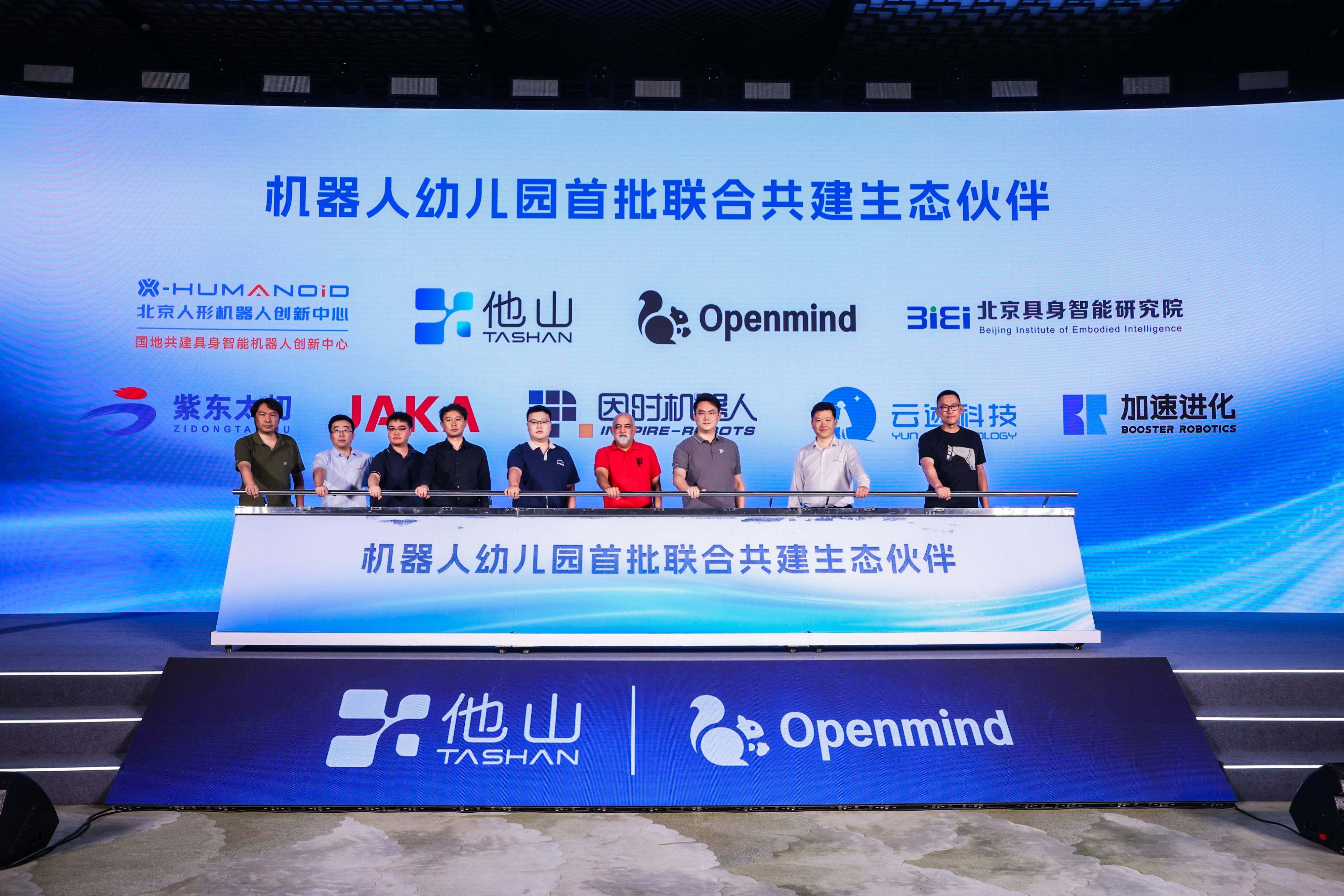
Shortly afterward, the conference welcomed a legendary figure who truly defined the development direction of artificial intelligence — Professor Sutton, known as the "Father of Reinforcement Learning". Professor Sutton systematically elaborated on the core concept of the Robot Kindergarten.
"Over the past 70 years, AI has always existed, and the development of AI has long been exploring ways to let robots learn continuously through trial and error." Professor Sutton cited the insight from Alan Turing's 1950 paper: "Instead of developing a program that thinks like a human to simulate adult thinking, we might as well try to develop a program that simulates children's thinking, letting it grow continuously and learn to think." He pointed out that although there have been attempts in the past few decades, limited by fragile hardware, it was difficult for robots to gain extensive experience rooted in the real world.
Nowadays, hardware has made tremendous progress with lower costs, and the traditional robot behaviors trained from human demonstrations are "not powerful enough". Professor Sutton believes that the real answer is: robots must learn through interaction, achieve continuous learning throughout the entire deployment lifecycle via trial and error, just like babies, who learn step by step gradually from the accumulation and growth of experience. He emphasized that the Robot Kindergarten co-built with Tashan Technology is actually based on this powerful concept, enabling robots to learn online without human demonstrations. "This is also a dream of artificial intelligence."
Right after that, as the co-initiator of the Robot Kindergarten, Ma Yang, CEO of Tashan Technology, analyzed "why we need to build this kindergarten" from an industrial perspective. He pointed out that what robots need is not isolated data, but experience that is continuously generated and updated in interactions. Tactile sensation is the only channel for humans and robots to interact with the objective world. Only through touch can they truly contact objects and change targets. Tashan Technology has focused on this field since its establishment in 2017. At present, hundreds of thousands of tactile fingertips produced by Tashan Technology have been applied to different humanoid robots around the world.
The "Kindergarten" stage is where autonomous exploration truly sprouts, and it is also the stage where children begin to gradually break away from protection and directly interact with the physical world. To this end, Tashan Technology will provide four core conditions for the Robot Kindergarten: opportunities to make mistakes, a safe exploration environment, continuous real interactions, and timely and clear feedback. Finally, Ma Yang issued an initiative, welcoming all practitioners in the embodied intelligence field to become enlighteners for robots. "We are patient enough and humble enough, because we think this is not only the enlightenment era for embodied intelligence, but also the enlightenment era when humans and embodied intelligence jointly embrace the coexistence of carbon-based and silicon-based life."
II. A Robust Foundation for an Open Ecosystem
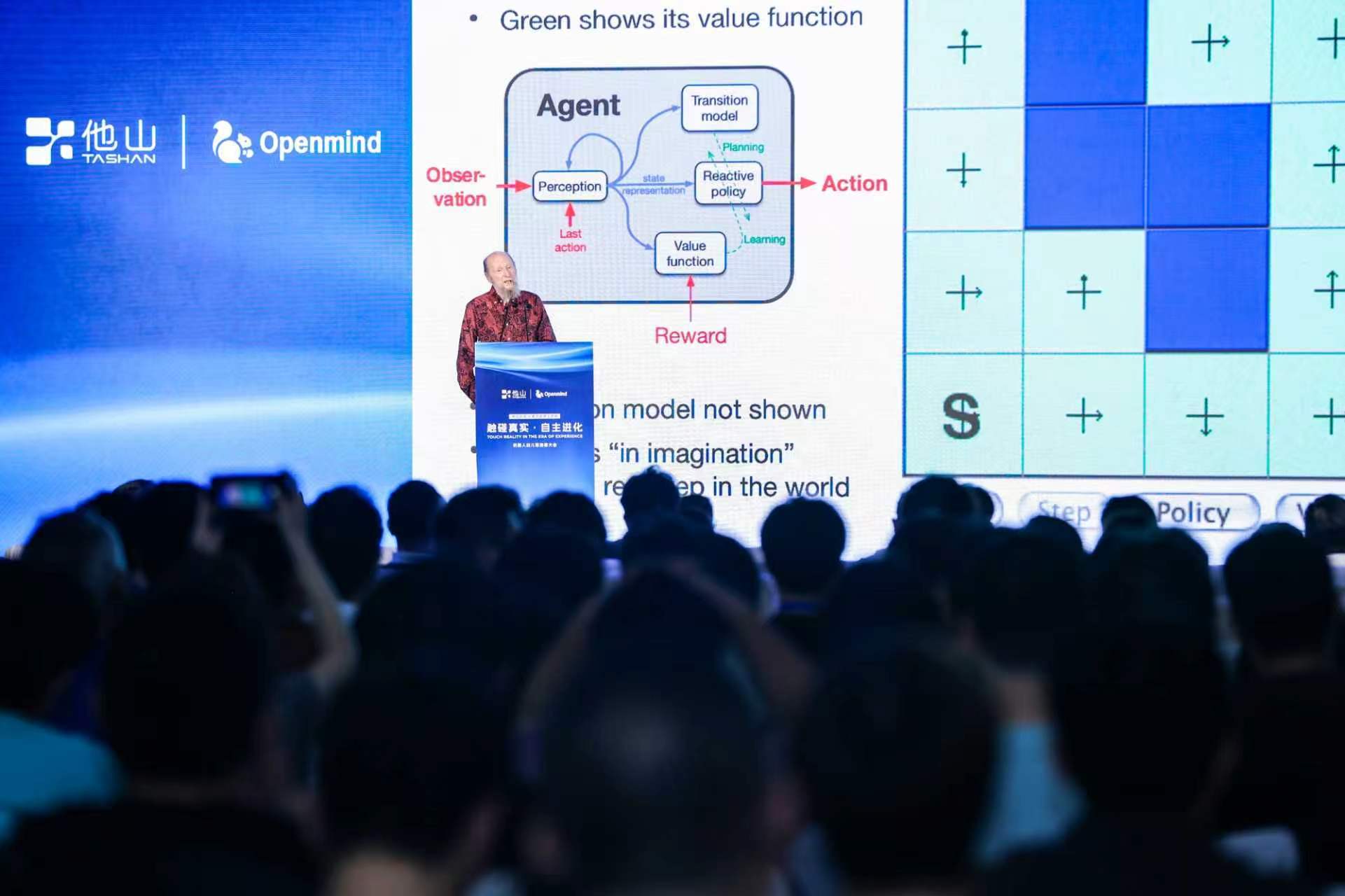
After the climax of the keynote speeches, the conference entered its iconic session. Amid the countdown from the entire audience, the guests jointly pressed the activation light pillar, and the "Robot Kindergarten" was officially inaugurated, marking that embodied intelligence has officially entered a new milestone from passive imitation to active exploration.
The inauguration is just the beginning. To truly turn this platform into an engine driving industrial evolution, more peers need to join hands to participate. Subsequently, the launch ceremony of the "First Batch of Ecological Partners for Joint Construction of the Robot Kindergarten" was held. Representatives from enterprises and institutions including Accelerated Evolution, CloudMinds, Inch Robotics, Tashan Technology, OpenMind Global Research Institute, Beijing Weishi Embodied Intelligence Research Institute, Beijing Humanoid Robot Innovation Center, JAKA Robotics, and Zidong Taichu took the stage together to launch the ecological co-construction plan. Tashan Technology has gathered diverse forces ranging from core components to complete machines, from algorithm frameworks to scenario applications, to jointly create an open, safe innovation ecosystem for robots that encourages trial and error and autonomous evolution.
At the in-depth technical level, Hou Guangdong, Vice President of R&D at Tashan Technology, and Dr. Kris De Asis, a researcher at OpenMind, provided solid technical explanations. Hou Guangdong pointed out that Tashan Technology and Professor Sutton are exploring a new paradigm of "long-term continuous learning on real systems". In the enlightenment stage of robots, "the most important first perception for a baby is likely to be touch", which will become the "cornerstone of active exploration". Tashan Technology plans to use tactile sensation to define the "pain" mechanism of robots and drive their internal exploration motivation.
Dr. Kris De Asis put forward a breakthrough concept of "designing for learning". He shared: "Whenever I mention that we should learn directly on robots, I often hear an objection that robots will wear out and malfunction." Dr. Kris believes that this is a problem with real-time learning, but it is also the highlight of real-time learning. Because robots will regard this situation as a new reality, an environment that they must experience. Moreover, robots will learn to perform tasks based on all these wear and damage situations.
III. A Dialogue About Growth and Value
Two high-quality roundtable discussions became the concentrated outbreak point of viewpoints on that day.
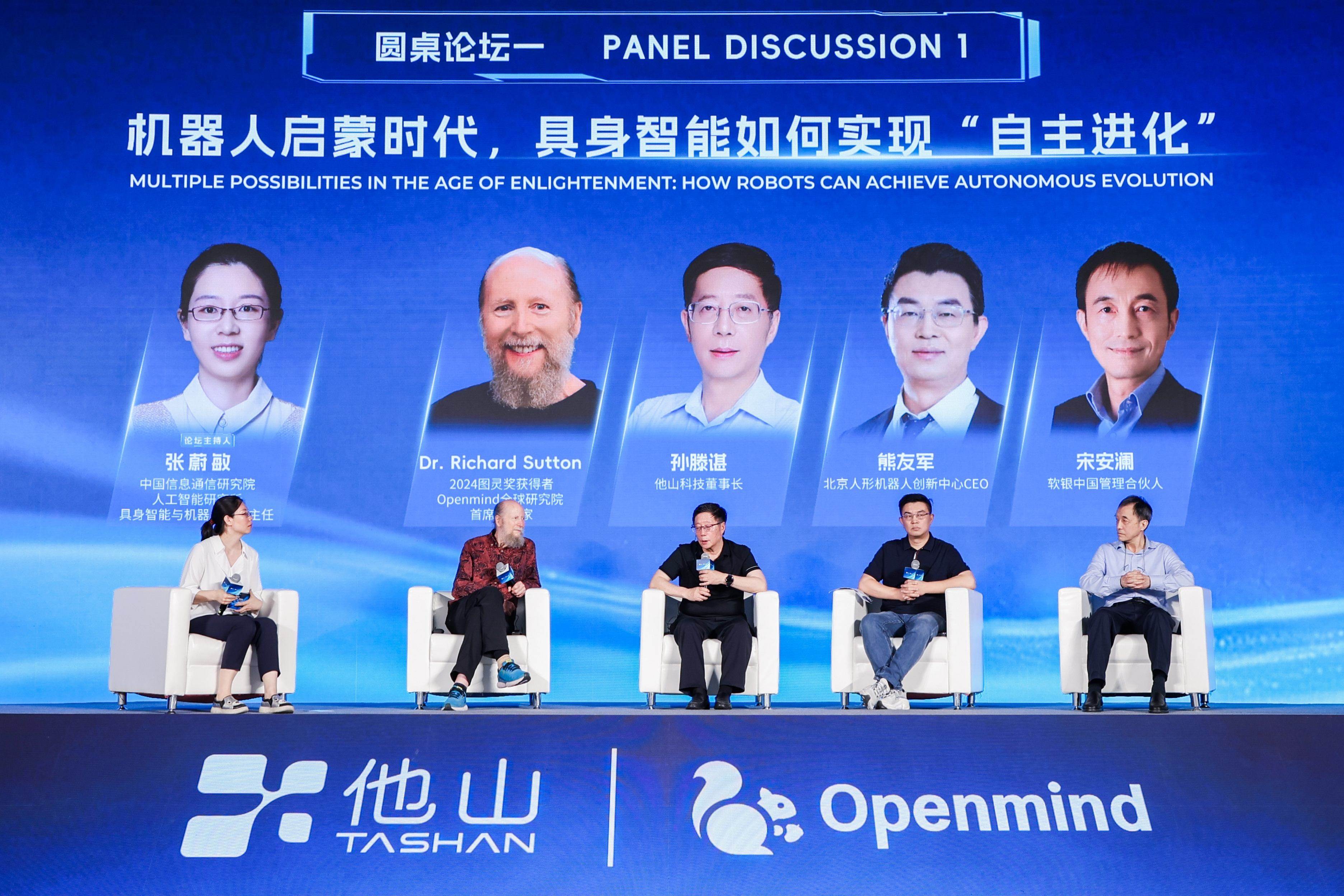
In the roundtable discussion themed "In the Robot Enlightenment Era, How Embodied Intelligence Achieves 'Autonomous Evolution'", Tashan Technology, as the core promoter of the "Robot Kindergarten", received high recognition from the academic, industrial and capital circles. As a leading force deeply engaged in core components and key technologies, Tashan Technology's technical leadership, large-scale implementation capabilities, combined with top reinforcement learning algorithms, have made the innovative paradigm of "Robot Kindergarten" highly anticipated.
The host Zhang Weimin, Deputy Director of the Embodied Intelligence and Robot Department of the Artificial Intelligence Research Institute of China Academy of Information and Communications Technology, made it clear at the beginning that the shift of AI proposed by Professor Sutton from the "data era" to the "experience era" is essentially redefining "how intelligence grows".
Professor Sutton shared the origin of the cooperation on the Robot Kindergarten: "We chose Tashan because of their focus on tactile sensation, and their shared belief with us in the power of experiential learning." He frankly stated that Tashan Technology's deep engagement in tactile perception, especially its resonance and rapid action on the concept of trial-and-error learning, is the core reason why the two sides jointly built the Robot Kindergarten.
Sun Tengchen, Chairman of Tashan Technology, explained the deep integration of tactile sensation and reinforcement learning: "Tactile sensation provides a safe barrier for trial and error and temporal perception accuracy for reinforcement learning." The proximity sensing capability of capacitive tactile sensation allows robots to give early warning and avoid collisions before they happen, greatly reducing the cost of trial and error; dynamic tactile technology improves the time resolution to the microsecond level, and the natural support of brain-inspired chips for the "spike-temporal difference" algorithm has built a solid hardware foundation for the autonomous learning of robots.
Xiong Youjun, CEO of Beijing Humanoid Robot Innovation Center, started from ecological construction: "An open ecosystem is more important than a single-point breakthrough, and we need layered collaboration among industry, academia, research and application." He proposed that the embodied intelligence industry urgently needs three types of partners: academic R&D institutions, core component enterprises represented by Tashan Technology, and scenario application enterprises, to accelerate intelligent evolution and industrial implementation through an open and shared layered collaboration mechanism.
Song Anlan, Managing Partner of SoftBank China, judged from an investment perspective: "There used to be education and training, and technical training. In the AI era, it is robot experience training." He believes that the Robot Kindergarten, a globally pioneering learning paradigm, will produce significant economic effects within a few years.
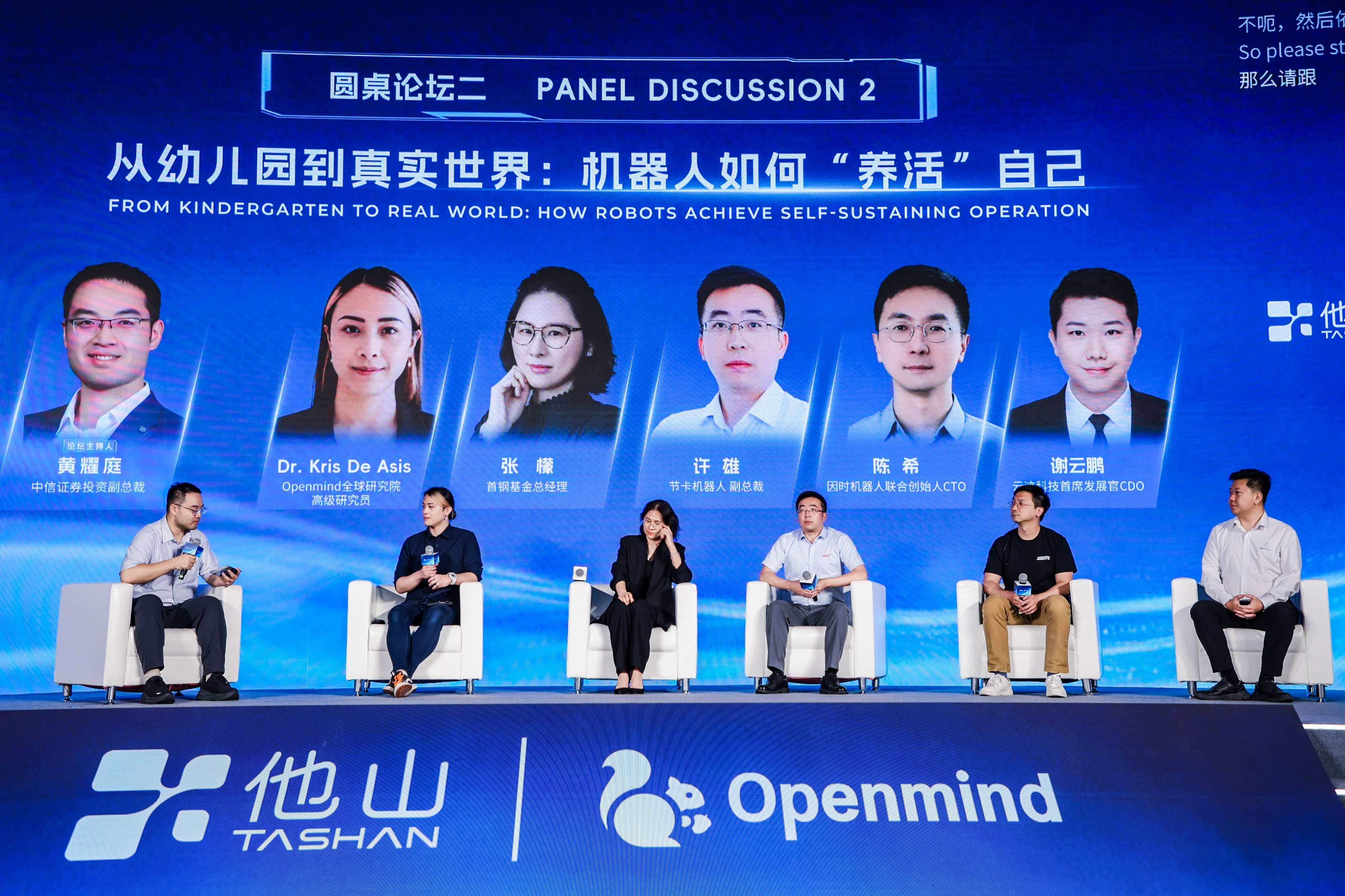
The second roundtable revolved around the theme of "From Kindergarten to the Real World: How Robots Can 'Support Themselves'". Huang Yaoting, an investor from CITIC Securities, took the number "1 million" as the introduction, and said straightforwardly: "What I value more is not the shipment of 1 million units, but whether robots can really work", emphasizing that the focus of the industry should return to the continuous evolution of learning methods and capabilities.
Dr. Kris De Asis, Senior Researcher at OpenMind Global Research Institute, responded to the problem of data silos: "Open source projects should not only cover algorithms and datasets, but also include open mechatronic designs", advocating the simultaneous open sourcing of hardware and models to accelerate innovation and sharing.
Zhang Meng, General Manager of Shougang Fund, pointed out the key bottleneck of implementation: Robot enterprises need to "start by solving small problems, so as to understand the connection of the entire industrial process". Only by truly rooting in scenarios and being willing to do tedious work can they cross the gap from laboratories to orders.
Xu Xiong, Vice President of JAKA Robotics, condensed the deployment experience of tens of thousands of robots into one sentence: "Safety and interactivity are the key to letting robots break out of physical fences". Only by breaking through the reliability threshold can human-robot collaboration enter the open real world.
Chen Xi, Co-founder and CTO of Inch Robotics, depicted the future driven by the symbiosis of hands and algorithms: "Dexterous hands are not just actuators, but also data collectors for multi-modal perception". Durability and multi-dimensional perception capabilities are the core of the next iteration.
Xie Yunpeng, Chief Development Officer (CDO) of CloudMinds, responded to the commercial balance problem, and put forward the methodology: "Aim at a small point, launch a saturated attack, and finally make it a rigid demand". By deeply engaging in the delivery scenario, non-rigid demands will become standard configurations that customers cannot do without while robots are learning in use.
In the process of moving from laboratories to real scenarios, Tashan Technology, with its pragmatic style rooted in solving real problems, has received unanimous recognition from guests from the industry, scenario side and capital side, and is regarded as the key to enabling robots to truly understand industrial processes and break through implementation bottlenecks.
IV. A Rare Master Class
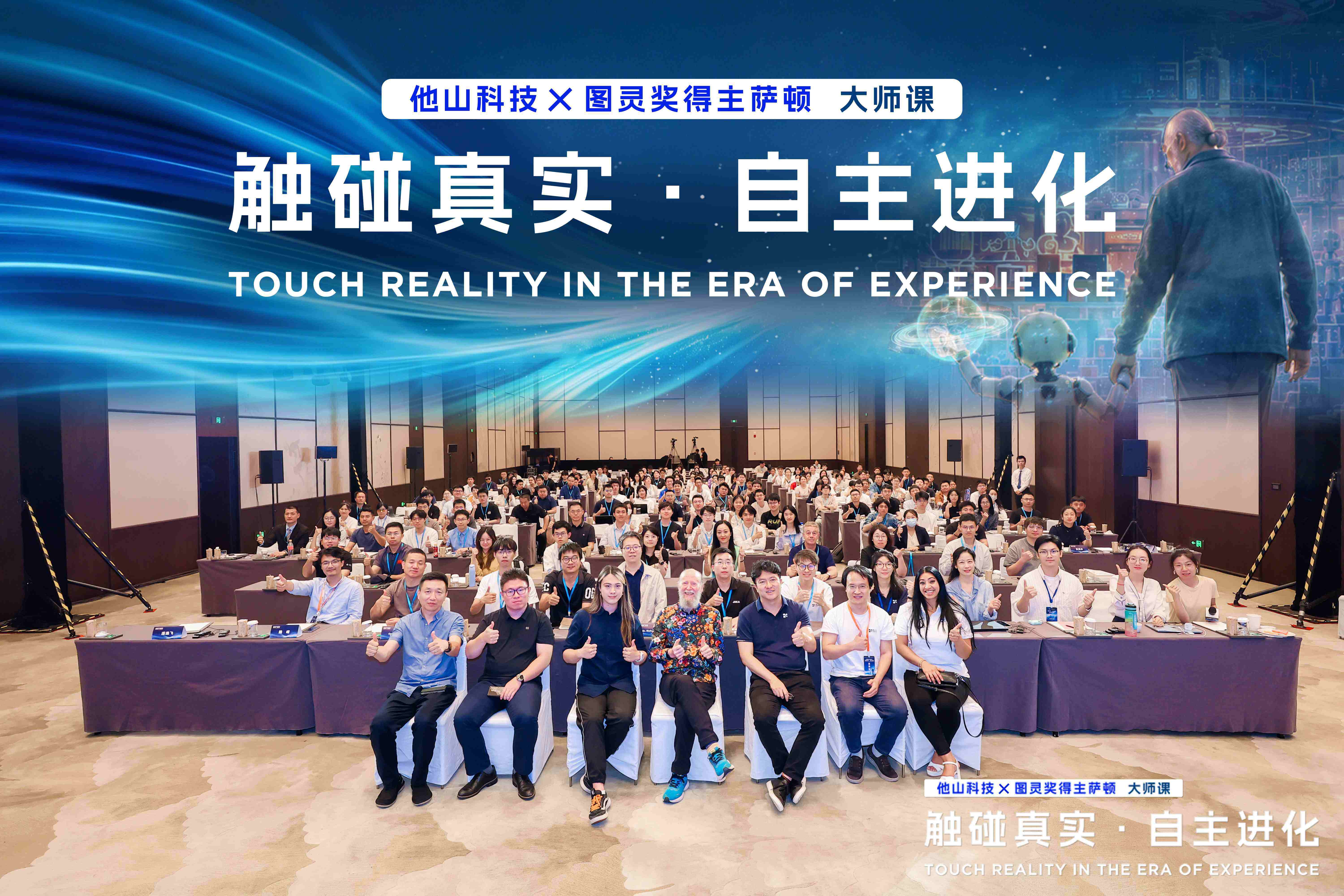
Invited by Tashan Technology, Professor Sutton specially conducted a full-day closed-door training course for the domestic embodied intelligence industry. Focusing on the fundamental proposition of "how intelligence evolves autonomously", he systematically expounded the reinforcement learning ideological system that shifts from data-driven to experience-driven, progressing step by step from conceptual frameworks, engineering paradigms, core challenges, algorithm engines to the latest evolution paths.
Different from common academic reports, the full-day course not only had rigorous theoretical derivations, but also interspersed with multiple rounds of on-site interactive demonstrations. Professor Sutton demonstrated how agents can autonomously learn simple operation tasks through trial and error. During the Q&A session, researchers from universities, enterprise laboratories and the front line of the industry raised their hands to ask questions, and Professor Sutton answered them all patiently. This master class is not only a transfer of knowledge, but also regarded by many people present as a rare enlightenment of research paradigms. Driven by Tashan Technology, such high-density and communication-focused academic activities will become an important ideological source for the enlightenment of embodied intelligence.
In Professor Sutton's sharing, he particularly emphasized three key points. In addition to the technical concepts and the Robot Kindergarten, another important key point is "resilience" — to stay humble, kind and optimistic. This value coincides with the long-standing corporate spirit that Tashan Technology adheres to.
Professor Sutton once asked Ma Yang: "What is the most important thing for you?" Ma Yang's answer is that for embodied intelligence, continuous learning and having fun in the process is the most important thing in itself. This may also be the common aspiration on the exploration path of the entire industry — keep learning, and learn together.
There is still a long way to go for the growth of robots, and all peers need to keep this resilience in mind and work hard in the long run.