The era of organoids is dawning silently.
On July 7, the Center for Drug Evaluation (CDE) of the National Medical Products Administration released a notice, publicly soliciting opinions on the application guidelines, application forms, and implementation framework of the "Pilot Program to Promote Research and Application of New Methodologies" (referred to as the "Pioneer Program"). The core of this notice is to incorporate novel alternative methods such as organoids and organ-on-a-chips into the regulatory considerations for non-clinical drug evaluation.
In more straightforward terms, for the first time, China's drug regulatory system is attempting to answer a question through a systematic pilot: can the models used for safety and efficacy testing in drug development be shifted from animals to human-derived models?
This is not an isolated policy move. Shortly before this, the U.S. FDA had abolished the mandatory animal testing requirement for new drugs through the Modernization Act 2.0, and released a draft guideline explicitly allowing companies to submit organoid and organ-on-a-chip data for non-clinical safety evaluation. The UK's MHRA and Europe's EMA are also advancing their respective acceptance pathways in parallel.
The introduction of the Pioneer Program signifies that China has officially joined this global iteration of R&D tools.
01
Regulatory Shift
NAMs, namely New Approach Methodologies, is a concept jointly promoted by the U.S. FDA, EPA, and OECD. Its objective is clear: to obtain safety and efficacy information for drugs and chemicals without relying on traditional animal experiments. This system is primarily supported by three pillars: human-derived 3D models, including organoids and organ-on-a-chips; computational toxicology and AI prediction models; and the integration of high-throughput in vitro screening and omics data.
In 2022, the U.S. Congress passed the FDA Modernization Act 2.0, legally allowing pharmaceutical companies to use NAMs data to replace mandatory animal experiment data in Investigational New Drug applications. In April 2025, the FDA announced that it would gradually phase out mandatory animal testing requirements for monoclonal antibodies and other drugs.
In March 2026, the FDA's Center for Drug Evaluation and Research released a draft guideline on the use of NAMs in drug development, clarifying that companies can submit organoid and organ-on-a-chip data directly for non-clinical safety evaluation, without requiring prior official certification. Instead, only four principles need to be met: clear usage scenarios, human biological relevance, reproducible and traceable technology, and suitability for specific regulatory purposes.
In the same month, the U.S. National Institutes of Health allocated an additional over $150 million in special funds to support the standardized R&D of NAMs. The previous year, it had established the first standardized organoid modeling center, dedicated to promoting cross-laboratory model consistency validation.
The lifting of legislative restrictions, regulatory acceptance, targeted capital investment, and collaborative standard development—when combined—form a complete institutional shift. China CDE's Pioneer Program is precisely a move made against this global backdrop.
02
Industrial Inflection Point
In simple terms, organoids are the smallest functional units formed by the self-assembly of stem cells under 3D culture conditions, highly mimicking the characteristics of the source organ in structure and function. Since Dutch scientists first established intestinal organoids in 2009, organoids derived from the liver, kidney, heart, brain, lung, pancreas, and tumor patients have been successfully constructed one after another.
Recent technological breakthroughs have focused on two directions.
One is the maturation of vascularized organoids and immune co-culture systems. After introducing endothelial cells and immune cells, the problem of necrosis during long-term culture and the defect of lacking immune interactions have been partially resolved. The other is the multi-organ-on-a-chip interconnection system, which attempts to simulate metabolic crosstalk between the liver, intestine, and kidney to make up for the shortcoming that a single organoid cannot reflect systemic effects.
In 2023, Emulate's liver chip was officially included in the FDA's Innovative Science and Technology New Drug Pathway Pilot Program, an event regarded by the industry as the point where the technology transitioned from the bubble phase to pragmatic development.
Multinational pharmaceutical companies are also accelerating their layouts.
Leading pharmaceutical companies such as Pfizer, Roche, Merck, Sanofi, and AstraZeneca have all established partnerships with organoid and organ-on-a-chip companies. Sanofi's complement C1s-targeted antibody became the first drug to be approved for a new indication clinical trial based on organoid data.
Hengrui Medicine's novel anti-heart failure drug HRS-1893, screened using a human heart organ-on-a-chip, has also obtained clinical approval, marking that Chinese pharmaceutical companies have begun to substantially adopt this technology.
In terms of scientific research output, the number of SCI papers published in the field of organoids in China in the first half of 2025 reached 811, including 592 original research papers, firmly ranking second in the world. In 2026, the National Natural Science Foundation of China set organoids as an independent application code, bringing basic research and funding support into a normalized track.
03
Capital's Tentative Bets
The global organoid and organ-on-a-chip market is in a period of rapid expansion, with multiple institutions predicting that the market size will exceed $10 billion around 2030.
The North American market is the most active, with leading companies such as Emulate, Mimetas, and Hesperos continuously receiving strategic investments from large pharmaceutical companies.
After China's Ministry of Science and Technology included "organoid-based malignant tumor disease models" in the 14th Five-Year National Key R&D Program in 2021, capital has poured in rapidly. In 2026, more than 6 financing events were disclosed in China's organoid and organ-on-a-chip field, with a cumulative financing amount exceeding 1.1 billion RMB.
Representative companies in the track are differentiating their paths: InnoMatrix completed a Series B financing of nearly 100 million yuan, establishing a full-lifecycle technology ecosystem for organoids and drug sensitivity testing services; Big Oak Tech focuses on the commercialization of organ-on-a-chips, with its chip products already serving pharmaceutical companies' IND applications; Danwong Medical built the largest gastrointestinal organoid model library in China; Cigma Biotech follows the "AI + organoids" route, with its first pipeline obtaining FDA Fast Track designation; Youspeed Technology couples organ-on-a-chips with generative AI.
Overall, this track is still in its early stage, but the investment logic is changing: from early concept validation to emphasizing the depth of engagement with pharmaceutical clients, the breadth of model libraries, and the ability to couple and adapt with AI.
The combination of policy catalysis, multinational pharmaceutical validation, and local cost advantages has also made organoids one of the few sub-sectors in biomedical investment and financing that has not cooled down.
04
The Substantial Weight of the Pioneer Program
Chinese drug regulatory authorities' attitudes toward organoids have gone through a gradual process.
In 2021, CDE listed organoids for the first time as a validation tool that can replace animal models in the Technical Guiding Principles for Non-Clinical Research and Evaluation of Gene Therapy Products. In 2024, relevant guiding principles for the R&D of therapeutic tumor vaccines and rare disease drugs further clarified that organoid and organ-on-a-chip data can be used as a source of non-clinical research data.
The Pioneer Program released in July 2026 is the most substantial regulatory action to date. Several of its core designs are worth examining separately:
In terms of application scenarios, pharmaceutical companies that intend to use NAMs data as supporting evidence for registration applications, or NAMs development institutions that apply for joint methodological validation, can apply to join the pilot. Mechanistically, CDE adopts the approach of "early intervention, timely communication, and full-process tracking" for projects included in the pilot, and jointly negotiates the methodological validation plan with applicants. Technically reviewed and approved methods can be directly used in specific application scenarios without repeated validation. The pilot recruitment period is set for five years with no upper limit on the number of participants, encouraging joint applications from industry, academia, research institutions, and regulators.
These arrangements send a clear signal: regulators are beginning to work alongside enterprises to explore validation standards. For a technology that is still in its early stages, this is more valuable than any subsidy.
05
Advantages, Limitations, and Realistic Positioning
Organoids are widely regarded as one of the most promising alternatives to animal experiments. Their core advantage is "human-derived": directly using human cells to answer whether a drug is toxic and effective to humans, fundamentally avoiding the uncertainty of cross-species extrapolation.
Its current limitations are equally clear: it cannot fully simulate the systemic effects of multi-organ crosstalk, nor can it easily cover certain chronic long-term toxicity endpoints.
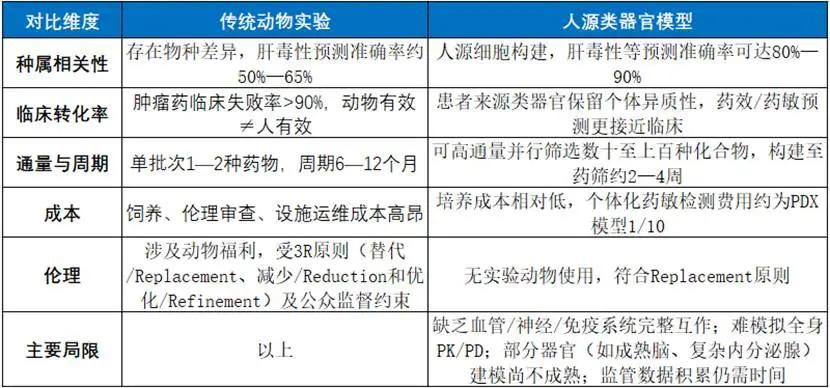
Figure: Organoids vs. Animal Experiments
Therefore, in the short to medium term, its more realistic positioning is as follows: in early hit compound screening, lead optimization, preliminary screening of specific organ toxicity, and individualized drug sensitivity testing for rare diseases and tumors, prioritize replacing animal experiments; in complete toxicological evaluations, serve as supplementary evidence to form a "weight of evidence" system with animal data, gradually expanding the scope of substitution.
06
Conclusion: The Starting Point of a Paradigm
The Pioneer Program's public consultation, the National Science and Technology Ethics Committee's release of the "Ethical Guidelines for Human-Derived Organoid Research," the first appearance of the term "organoid" in the 2025 edition of the Chinese Pharmacopoeia, and the NSFC's establishment of an independent application code—all these signals point in the same direction: organoids in China have been upgraded from a scientific research topic to a strategic technology that affects the drug R&D infrastructure.
For pharmaceutical companies, pre-deploying organoid and organ-on-a-chip platforms is not only a scientific means to reduce the risk of clinical failure but also a compliance preparation to adapt to future regulatory expectations. For clinical practice, patient-derived tumor organoids are gradually entering the practice of precision medication guidance, providing a "drug testing surrogate" for refractory cancers.
For the industry, standardization, automation, and deep integration with AI will be the focus of competition in the next stage. Whoever can establish a reproducible, verifiable, and regulator-recognized human-derived organoid evaluation platform will hold a key to drug development in the post-animal-experiment era.
China's launch of the organoid era does not mean that animal experiments will disappear tomorrow. Its real implication is that the "human-centered R&D paradigm" has been formally written into China's pharmaceutical innovation agenda for the first time.
Change will not happen overnight, but the confirmation of the tide's direction is often more memorable than its speed.
This article is from the WeChat official account "YiYao", written by Yan Song, and authorized for release by 36Kr.