Understanding Momenta means grasping how profits in Physical AI will flow.
Over 600 new vehicle models were launched within half a year, yet the industry's profit margin plummeted to a freezing low of 3.2%. While automakers are trapped in a homogeneous low-price melee, the capital market is frantically chasing a smart driving company that does not manufacture cars. In the upcoming era of Physical AI, exactly how will profits flow?
Back in 2003, a young man named Andy Rubin wandered around Silicon Valley seeking investments for his new project, only to face repeated rejections. He could barely afford the office rent, and it was a $10,000 cash handout from a friend that kept the operation barely afloat.
This project was what later became known as Android.
In 2005, Google, having foreseen the future trend, stepped in to acquire the project and poured massive capital and resources into sustaining its development. Just a few years later, Android, which produced no hardware of its own and was backed by a top-tier capital ecosystem, became the shared "brain" for most mobile phone manufacturers worldwide, capturing the most lucrative and long-lasting profit pool of the entire mobile internet era.
Today, history is repeating itself in the automotive industry and the broader field of intelligent agents.
On July 8, 2026, Momenta, hailed as the "first stock of Physical AI," officially listed on the Main Board of the Hong Kong Stock Exchange.

Why has a software company that does not build cars drawn frenzied subscriptions from 14 top-tier long-term cornerstone investors including the Government of Singapore Investment Corporation (GIC), Fidelity International, BlackRock, Oaktree Capital, and Franklin Templeton? Why even Mercedes-Benz, which has extremely strict safety requirements, and domestic new energy giant BYD, have rarely joined forces to become its cornerstone investors?
To understand these questions, we need to break down the new pricing dimensions of the Physical AI era and the hidden profit transfer laws underlying algorithms.
01
The Pricing Power in the Physical World Is Shifting
Over the past century, the profit secret of industrial products was hidden in hardware assemblies such as engines, transmissions, and chassis.
Traditional fuel vehicles competed on horsepower and mechanical craftsmanship, representing the hardware premium of the industrial age.
But now, this logic is being completely rewritten by Physical AI.
As the three core electric vehicle technologies mature, the "hardware body" of automobiles is evolving into a standardized physical actuator. What truly defines the value of a machine is how intelligent its "brain" is — that is, whether it can understand the complex real world and perceive, make decisions, and act like a human.
This is not just a transformation in the automotive industry. Every hardware that requires "autonomous action in the physical world," such as cars, robots, and drones, is undergoing the same value shift: moving from physical components to intelligent models.
Therefore, when discussing Momenta's valuation, the anchor point should not be "a supplier to automakers," but a platform company that is providing a "universal brain" for all physical intelligent agents.
There is a striking set of data. In the first half of this year, over 600 new vehicle models were launched in the domestic market, but the profit margin of the automotive manufacturing industry was only 3.2% (data from the National Bureau of Statistics for the first quarter of this year). This figure not only hit a record low, but was also 2 percentage points lower than the average profit margin of industrial enterprises above designated size nationwide.
The root cause is that the current automotive market is experiencing a severe homogeneous price war, which has drastically squeezed the profit margins for automakers. Because simply manufacturing the hardware shell and base of a vehicle no longer carries high technical barriers.
Whoever masters the most intelligent "brain" will control the core premium power of future physical intelligent agents.
02
Who Will Become the "Android" of the New Era?
Since everyone knows that the "brain" is the most valuable part, why don't automakers develop it themselves, instead leaving this opportunity to companies like Momenta?
Because Physical AI is not mechanical industry — it is AI, it is software. And the software industry has a ruthless underlying logic called "zero marginal cost." Autonomous driving is the first large-scale real-world application of Physical AI, featuring extremely strong economies of scale and first-mover advantages, which are even more pronounced than in the semiconductor industry. As Momenta CEO Cao Xudong stated, the marginal cost of software is zero, and scale is not just about cost reduction — it can also bring exponential improvements in user experience.
For Momenta, this advantage is supported by a core trump card: the R7 World Model.
The common practice in the industry is to treat world models as simulation tools for "mock exams before the real test," generating a small amount of data to test the main model. But Momenta is one of the very few companies in the market that has the capability to directly use world models to reshape the underlying cognitive structure of the entire system.
With this foundation, Momenta has achieved a dual large-scale closed loop for both data and business. According to data from CIC, an authoritative industry research institution, Momenta holds a dominant 65% market share in terms of sales in China's third-party urban NOA (Navigate on Autopilot) supplier market, ranking first in the industry. Among the world's top 10 automakers, 9 have already launched partnerships with it.
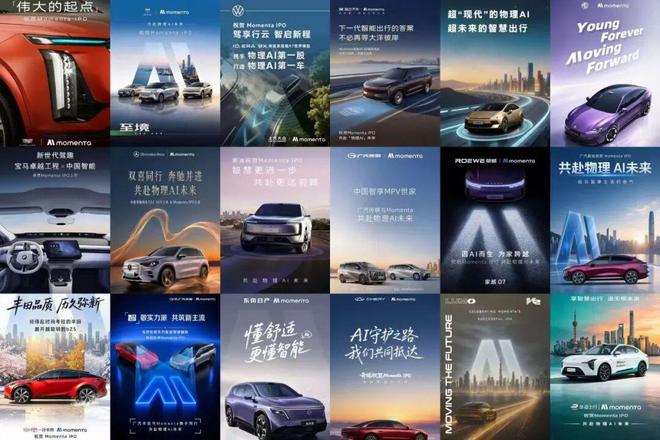
On the day of Momenta's listing, automakers sent their congratulations one after another
Once such a platform-level system is deployed in vehicles, automakers will develop extremely high technical and engineering stickiness with it. Take Mercedes-Benz as an example: the two parties spent 8 years of collaboration from the initial investment in 2017 to mass production at the end of 2025. Once the technical barrier was broken through, Momenta immediately rolled out its solutions across Mercedes-Benz's entire product line, covering both electric and fuel vehicles.
This is an unbreakable moat — once an automaker adopts the system, it will be extremely difficult for them to "switch brains" later.
This is also the confidence that allows Momenta to strive to become the "Android" of the new era. It does not compete with contract manufacturers for hardware profits, but focuses solely on developing the core brain component.
03
How Should We Value Momenta?
Therefore, if you flip through Momenta's prospectus and evaluate it using traditional valuation metrics for automakers such as the price-to-earnings (P/E) ratio or price-to-sales (P/S) ratio, you will most likely misjudge its true value.
So, how should we properly value Momenta?
The best comparable reference might be CATL, the leading battery manufacturer in the electrification era.
Their positions in the industrial chain are perfectly parallel: in the early days of the electrification boom, the most critical "heart" of a vehicle was its battery. Relying on absolute technological and scale barriers, CATL became an unavoidable infrastructure for the entire industry. It achieved a market value of trillions, with profits and valuation premiums that far outpaced most automakers.
In the Physical AI era, "intelligent model + safety" is the equivalent of the new battery.
Today, the core profits of the hardware industry are shifting from the energy source (batteries) to the control source (models). Momenta is precisely the core "heart" of this new intelligent era.
Through its minimalist architecture of "one model, multi-dimensional symbiosis," Momenta uses a single underlying system to empower all scenarios including passenger vehicles, Robotaxis, and Robovans, and can further expand into embodied intelligence in the future. The cross-scenario reuse of its core underlying technology has drastically amortized R&D costs.
The capital market always has the sharpest sense of opportunity. The 14 super-premium cornerstone investors introduced by Momenta this time have a total subscription amount of approximately HK$3 billion, a scene comparable to the public listing of CATL back then.
The climbing phase of Physical AI may take 10 or 20 years, but the breakthrough that surpasses human capabilities and triggers a massive commercial explosion could happen within the next few years.
Just as Andy Rubin, who did not manufacture mobile hardware, ended up dominating the smartphone era, Momenta, which does not produce hardware bodies, is capturing the most core, long-lasting, and certain premium in the intelligent agent industry driven by its data flywheel.
By understanding Momenta, you will see exactly how profits will flow in the future Physical AI era.
This article is from the WeChat Official Account "Yangtze River Delta Momo", authored by Sanhuo, and published by 36Kr with authorization.