In the coming year, the supply of new homes in some cities will fall short of demand.
Against the national general trend of "destocking", different cities have shown varying paces of inventory digestion.
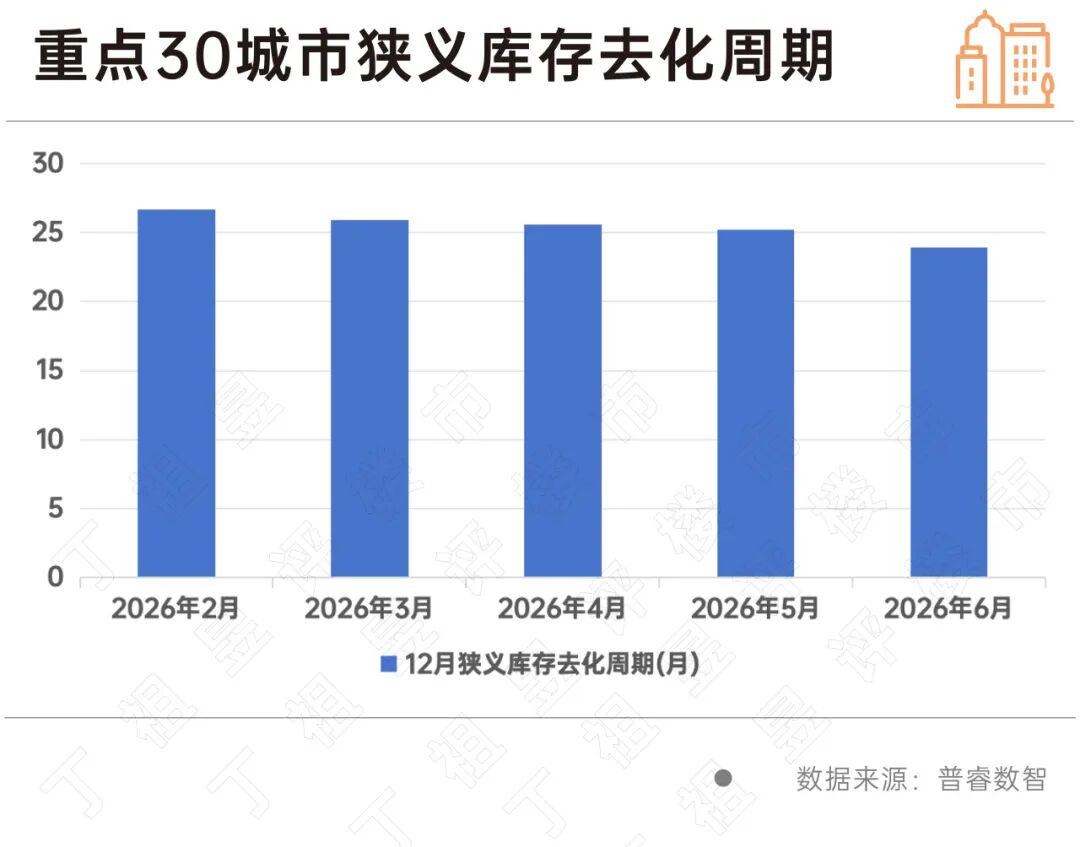
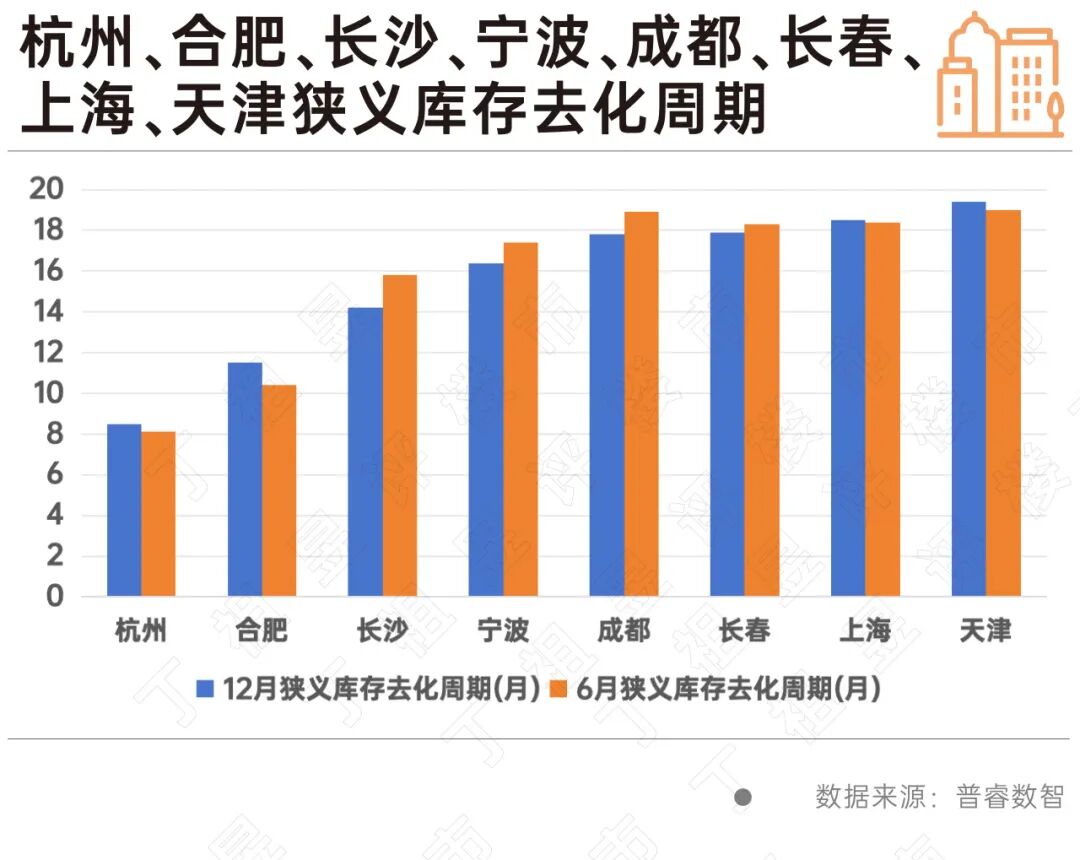
Calculated by dividing "the area of unsold commodity residential properties with pre-sale approval" by "the average monthly digestion area over the past 12 months", the average inventory digestion cycle for 30 key cities stands at 23.9 months. Among them: Hangzhou and Hefei have a cycle of less than 12 months, while Changsha, Ningbo, Chengdu, Changchun, Shanghai, and Tianjin have a cycle under 20 months; in other words, on the premise of no new supply, the two cities of Hangzhou and Hefei will face a situation where "there are no new properties available for sale" in one year.
In reality, of course, new supply will emerge in all cities, and there will never be a complete absence of properties for sale, yet the supply-demand relationship in different cities will still influence the overall market dynamics.
Looking at the trend, if the inventory digestion cycle of some cities is calculated by dividing "the area of unsold commodity residential properties with pre-sale approval" by "the average monthly digestion area over the past 6 months", their cycles will be further shortened, which indicates that the digestion speed in these cities has been accelerating in the past half year.
Further analysis of inventory digestion across different floor area segments in various cities shows that although the mainstream floor area segment varies from city to city, the 120-130 square meter segment generally performs well in digestion, which aligns with the trend that improved and first-time upgraded housing demands have become the mainstream for new properties in recent years.
01
According to data from Prism Data Intelligence, as of June 30, 2026, the narrow-sense inventory digestion cycle for 30 key cities is 23.9 months (calculated based on the 12-month average).
The "narrow-sense inventory" here refers to "the area of unsold commodity residential properties with pre-sale approval", which means that without additional new properties entering the market, all currently unsold new properties on the market will be sold out within 2 years.
And from a trend perspective, this digestion speed is accelerating.
Among them, Hangzhou and Hefei have a cycle of less than 1 year, while Changsha, Ningbo, Chengdu, Changchun, Shanghai, and Tianjin have a cycle under 20 months.
Moreover, if calculated using "the average monthly digestion area over the past 6 months", the inventory digestion cycles of Hangzhou, Hefei, Shanghai, and Tianjin will be further reduced from the 12-month average baseline.
In simple terms, these four cities have performed better in the past half year than they did over the past full year.
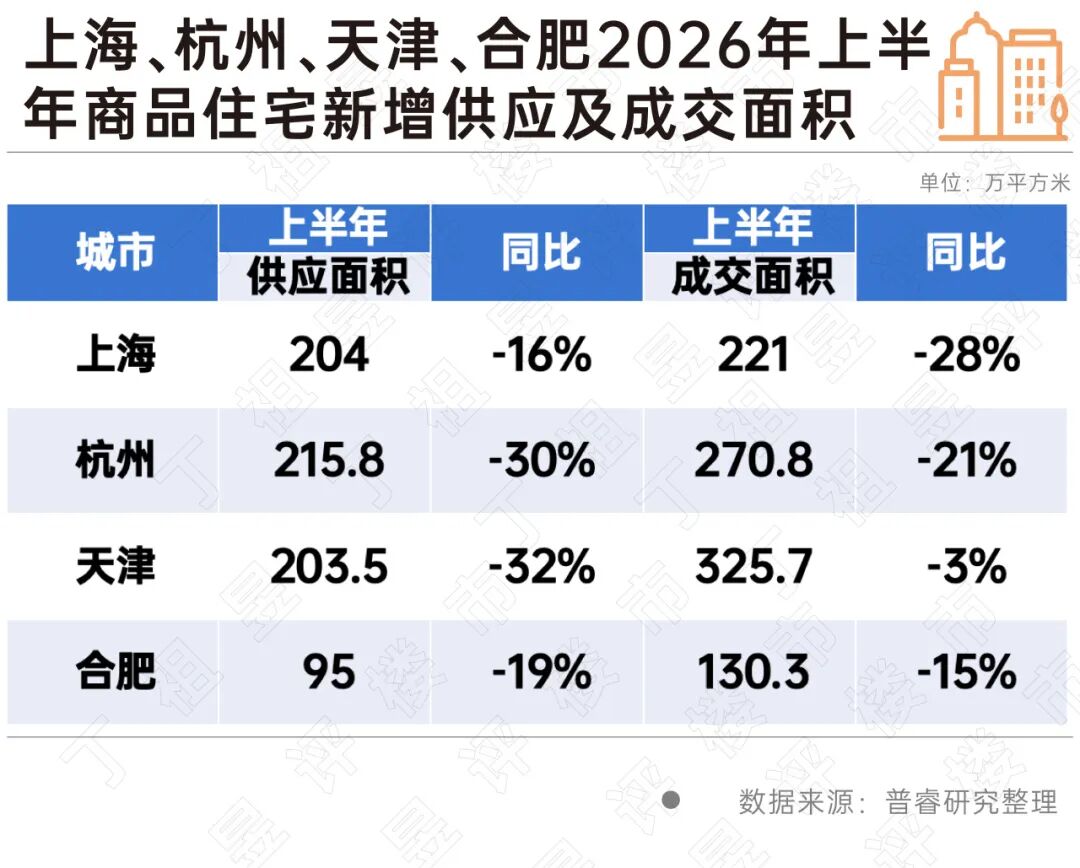
By comparing the supply and transaction areas of these four cities in the first half of 2026, it can be found that the transaction area in all four cities exceeds the supply area, and the supply area has seen a noticeable decline compared to the same period last year.
Among them, the supply area in Hangzhou and Tianjin has decreased by 30%, significantly higher than the national average.
With new supply being controlled on one hand and market demand being stimulated on the other, the overall inventory digestion speed in these cities is accelerating.
02
Further analysis of inventory digestion across different floor area segments in various cities shows that for the 30 key cities, the segments with the fastest overall digestion cycles are 100-110 square meters and 130-144 square meters, both at 16.5 months, while the 120-130 square meter segment ranks third with a cycle of only 16.9 months.
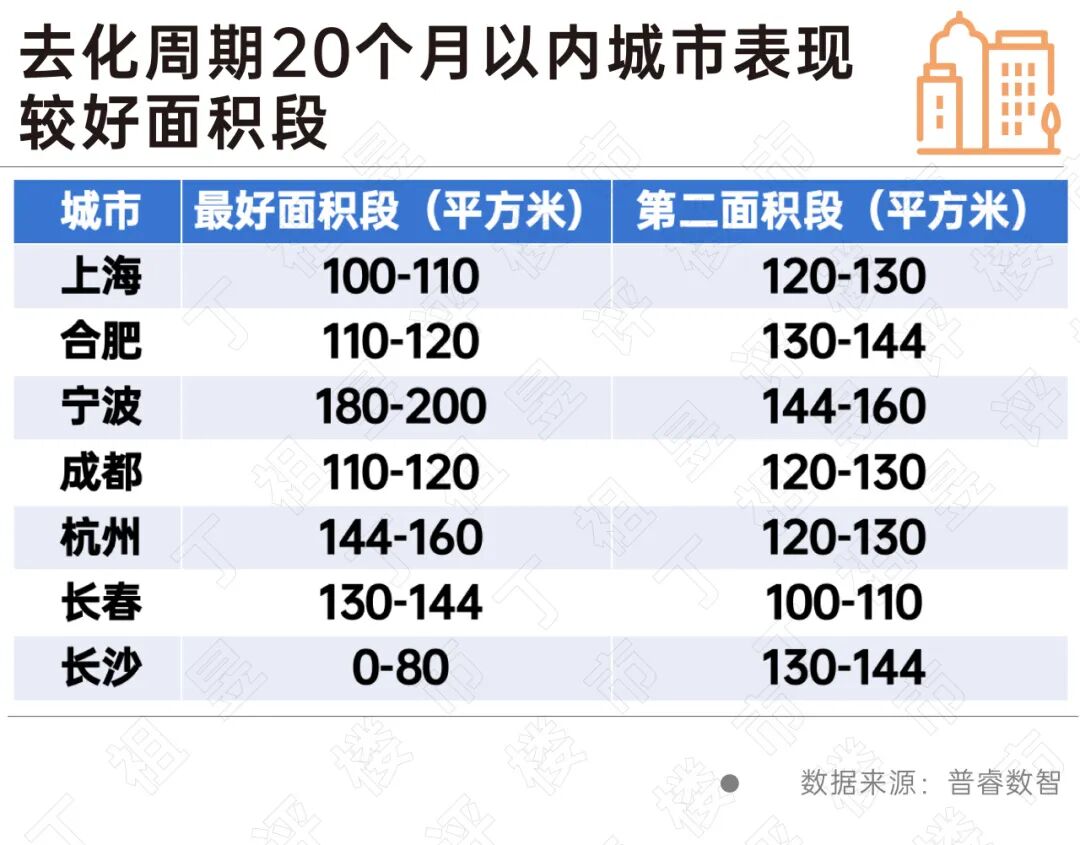
Focusing on the 8 cities with inventory digestion cycles under 20 months, namely Hangzhou, Hefei, Changsha, Ningbo, Chengdu, Changchun, Shanghai, and Tianjin,
the floor area segments with the fastest digestion cycles are relatively scattered, among which Ningbo and Hangzhou show notably rapid digestion for improved housing products, while Changsha and Changchun exhibit a "bimodal" feature with strong performance at both ends of the floor area spectrum.
At the same time, by comparing cities with inventory digestion cycles over 30 months, we can find that 8 of the key cities have cycles exceeding 30 months, yet 5 of these 8 cities have a digestion cycle of under 30 months for the 120-130 square meter segment, and one city even has a cycle of only 21 months for this segment.
A comprehensive comparison between cities with favorable digestion cycles and those with significantly poor cycles reveals that although across all 30 cities, the 120-130 square meter segment ranks third with a digestion cycle of 16.9 months, both cities with strong digestion performance and those with weak performance show relatively good digestion results for the 120-130 square meter segment.
Thus it can be seen that for different cities, despite the varying characteristics of their top-performing floor area segments, the 120-130 square meter segment is a relatively safe, low-risk choice across key cities.
Meanwhile, for small-sized properties under 90 square meters and luxury properties over 144 square meters, although some cities among the 30 key cities have strong performance in these segments, the overall gap between cities is remarkably wide: some cities may perform very well, while others may have digestion cycles exceeding 50 months. Prudent selection based on the specific conditions of each individual city is still required.
Overall, the 30 key cities have recorded 4 consecutive years where the supply area is smaller than the transaction area since 2022, with the ratio of supply area to transaction area in the first half of 2026 reaching only 0.69.
Cities with relatively low inventory digestion cycles and strong remaining purchasing power will take the lead in market recovery in the future.
This article originates from the WeChat Official Account "Ding Zuyi Comments on the Real Estate Market", authored by the Editorial Department, and published by 36Kr with authorization.