Zhang Xiaolong, I quit
Zhang Long, CEO of Fenbi, is stepping down.
On July 8, Fenbi (Fenbi Limited), the "first public exam training stock" listed on the Hong Kong Stock Exchange, announced in an announcement that Zhang Long had resigned from five core positions including Executive Director, Chief Executive Officer, and Chairman of the Board "to handle other personal affairs", effective from the date of the announcement. The baton of Fenbi has officially been passed to the former Vice President Sheng Haiyan.
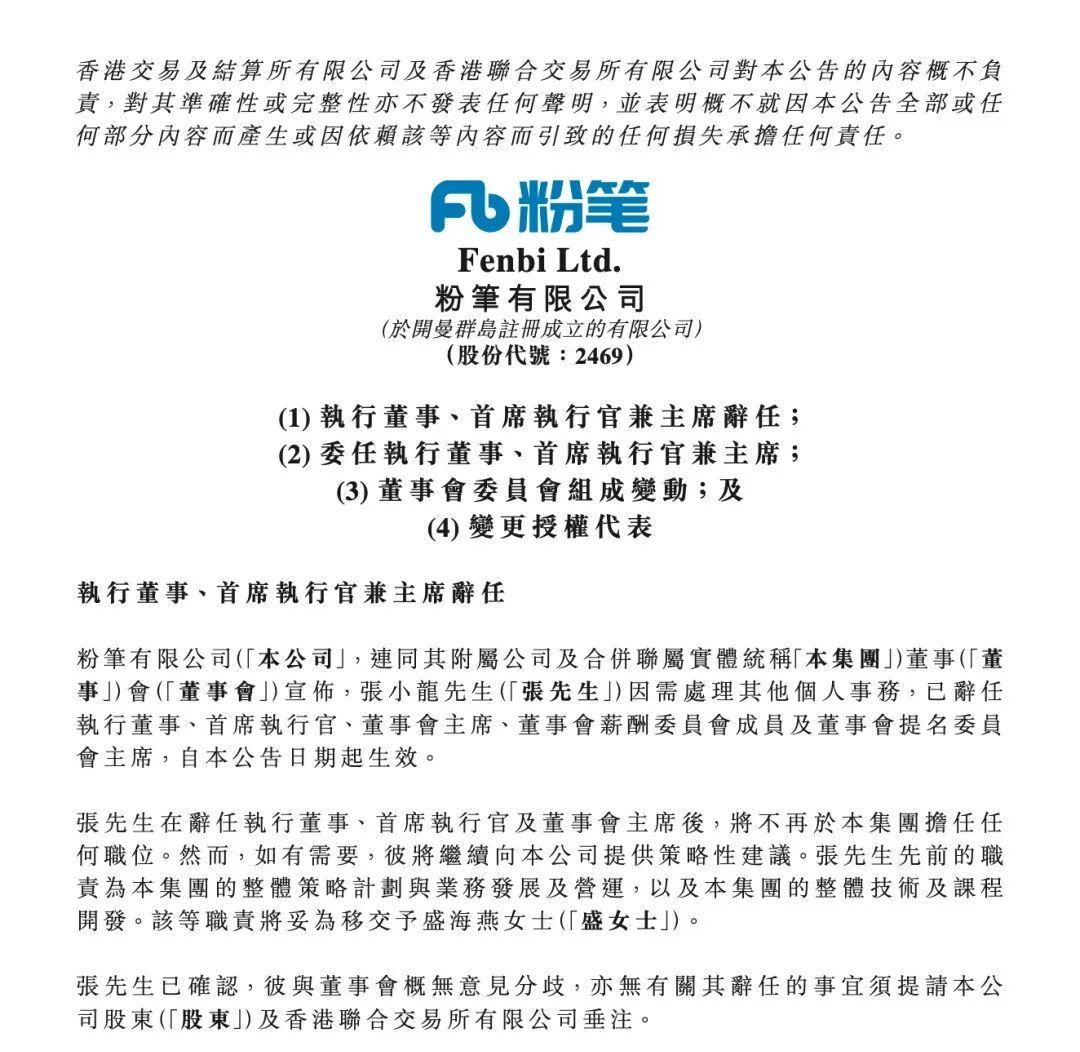
Figure / Part of Fenbi's Announcement
This is just over a month after Zhang Long lost control during a lecture at the School of Philosophy, Renmin University of China. At that time, he talked extensively about "AI stock trading" and even lashed out at the public exam-taking group, calling them "living for nothing and waiting for death". These remarks not only sparked huge public controversy, but also caused Fenbi's already low stock price to plummet again.
Zhang Long, who suddenly resigned completely without any transitional arrangement, left Fenbi in a state of utter chaos. Compared with when the company rang the listing bell on the Hong Kong Stock Exchange in 2023, Fenbi's stock price has fallen by more than 90%, and its market value has shrunk to around 1 billion Hong Kong dollars.
Zhang Long Can No Longer Stay Put
More than a decade ago, several entrepreneurs with backgrounds from NetEase created an online education platform, initially operating the Fenbi website. Later, the public exam training division of Fenbi was spun off for independent operation, and Zhang Long took on the role of CEO. Leveraging the asset-light strategy of "renowned teachers paired with question banks", he led Fenbi to carve out a prominent position in the public exam training track.
Zhang Long's unrestrained speech as a famous training teacher was also deeply memorable, but for a long time, fans and internet users regarded it as "uninhibited authenticity". However, during the lecture at Renmin University, this "uninhibited authenticity" outraged the public, and Zhang Long was completely backlashed by public opinion.
In the capital market, a founder resigning from almost all core positions in one go is an extremely strong signal.
Bai Wenxi, Vice Chairman of the China Enterprise Capital Alliance, pointed out straightforwardly that Fenbi's structure on the Hong Kong Stock Exchange inherently had relatively weak checks and balances. It should be noted that in the public exam training industry, the founder's reputation is the company's gold-lettered signboard. Therefore, the board of directors usually turned a blind eye to Zhang Long's previous bold remarks.
However, Zhang Long's phrase "living for nothing and waiting for death" caused a huge disaster.
Bai Wenxi mentioned that this statement directly hurt Fenbi's source of income — the massive group of exam-takers who paid for its courses — pushing the conflict between the brand and its customers to an immediate peak. Coupled with Fenbi's continuous decline in the Hong Kong stock market, "Zhang Long's complete withdrawal is more like a forced separation under multi-party pressure."
"This extremely unprofessional remark, in the context of the company's already plummeting stock price, was no different from a bomb," investor Wu Xiao said half-jokingly. "With things having escalated to this point, Zhang Long probably didn't want to stay in his position anymore."
Returning to the announcement itself, which cited "handling other personal affairs" as the reason for Zhang Long's resignation, Bai Wenxi stated that this is a standard public relations euphemism in the Hong Kong stock market, a similar expression that has appeared in many corporate executive resignation announcements.
"If it were truly just 'handling personal affairs', there would be no need to step down from all five positions at once," Bai Wenxi explained. The board of directors packaged the situation with "personal affairs", beautifying the "forced dismissal" as a "voluntary resignation" to leave a decent way out for everyone.
However, this announcement also left a loophole.
Zhang Long still retains his identity as a "person acting in concert" and holds a nominal role to provide "strategic advice". Essentially, this is to appease the capital market, reassuring everyone that the company's actual control remains stable, preventing the stock price from suffering another further collapse.
From the perspective of enterprise development, parting ways with Zhang Long may be a necessary step for Fenbi to mature.
Industry analyst Zhang Shule pointed out that startups in their early stages do need a charismatic founder as an IP and a signature to attract traffic. But for exam training products, the aura of renowned teachers is not actually that reliable.
Fenbi has moved past the era where growth was driven by the founder, and now must rely on high-quality products to fuel its development. Zhang Long's radical remarks, which on the surface seemed to help Fenbi gain widespread attention, were actually gradually eroding the brand's reputation. Only by slowly reducing its reliance on internet-famous teachers and truly taking "score improvement results" as the sole standard can Fenbi avoid the fate of being abandoned once the key figure leaves.
"His departure can be regarded as the final contribution to restoring the brand image," Zhang Shule said.
Fenbi Is Struggling to Cope
Zhang Long's departure did temporarily quell public outrage. The day after the announcement was released (July 9), Fenbi's stock price surged to a high of 0.52 Hong Kong dollars in morning trading, with an increase exceeding 12% at one point.
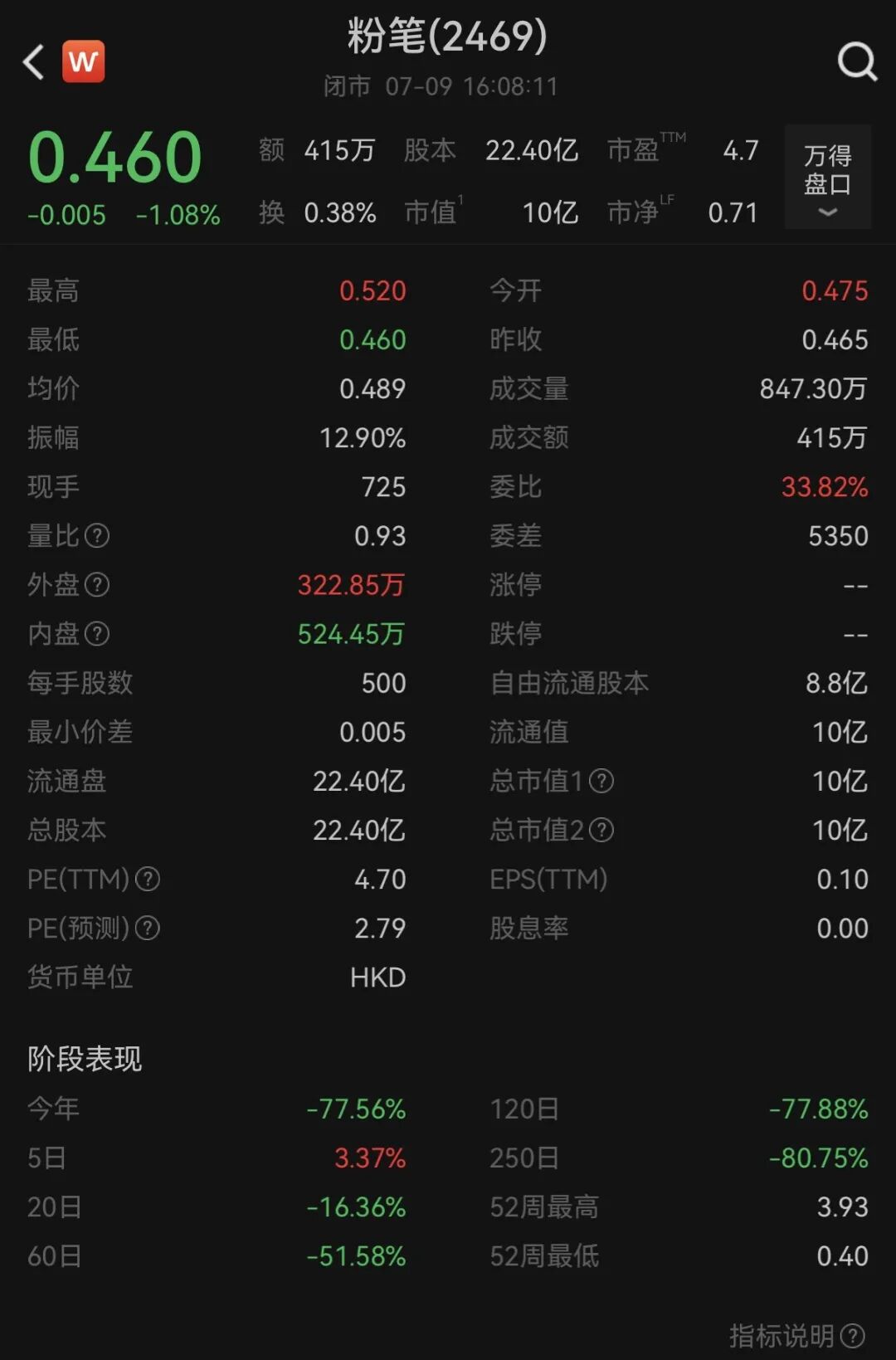
Fenbi's performance at the close on July 9. Figure / Wind Financial Terminal
However, the impact of this incident pales in comparison to the troubles Fenbi itself is facing. By the close of trading, Fenbi's stock price had fallen back to 0.46 Hong Kong dollars, with a full-day trading volume of only 4.15 million Hong Kong dollars. For a once-prominent listed company, this level of trading volume essentially means it has lost the core attention of the capital market.
The fundamental reason for the capital market's indifferent attitude is that Fenbi's performance report is far from satisfactory.
Shortly after its listing in 2023, Fenbi successfully turned a profit by drastically cutting costs. But financial reports do not lie — the side effects of profits gained through such strict cost control have already emerged.
In 2025, Fenbi's revenue was approximately 2.677 billion yuan, a decrease from the previous year; its annual profit was less than 200 million yuan, also showing a decline. This basically brought the company back to the level it was at when it first achieved profitability.
At the same time, Fenbi's workforce has also shrunk. By the end of 2025, the company had only 7,005 full-time employees, far fewer than during its peak period.
In addition to sluggish performance growth, another harsh reality that has made Fenbi unpopular in the capital market is its "price-to-book ratio below 1". Simply put, this means the company's stock price has fallen below its net asset value per share, failing to even maintain its underlying value.
Currently, Fenbi's price-to-book ratio is only 0.72 times. Meanwhile, its price-to-earnings (PE) ratio is a mere 4.75 times. In other words, based on Fenbi's current profitability, investors would need to wait approximately 5 years to recoup their investment in the company's stock.
These two indicators both show that the market's expectations for its future growth have dropped to a freezing point. The reasons behind this are not only the accidental backlash against the brand caused by the founder's emotional remarks, but also the inevitable result of the company's fundamentals reaching their peak and its value being reassessed.
For ordinary retail investors who have been holding Fenbi's stocks, this has been a long and painful ordeal. Individual investor Fang Sheng (pseudonym) said helplessly that he has lost more than 80% of his principal.
Wu Xiao pointed out that Fenbi's biggest problem is definitely not Zhang Long's unrestrained speech, but the sluggish performance growth of the company under Zhang Long's leadership. This has led to a continuous decline in the company's stock price, which in turn caused it to lose eligibility for the Stock Connect program, preventing mainland funds from purchasing its shares and reducing the stock's liquidity to a certain extent.
Based on this, Wu Xiao emphasized that Fenbi no longer needs to paint unrealistic prospects. Only by genuinely improving its performance can the company gradually regain everyone's trust. However, there are still many obstacles ahead for Fenbi to deliver a performance that boosts morale.
Even Greater Challenges Lie Ahead
After Zhang Long's rapid complete resignation, the new leader Sheng Haiyan and her management team who have taken over the heavy responsibility are facing problems that could not be fully listed even with a box of chalk.
The top priority is to streamline the internal management relationships within the company. According to the announcement, Sheng Haiyan will fully take charge of strategic planning, business development, as well as technology and course development, while Zhang Long, despite stepping back from the front line, still retains the right to provide strategic advice.
Therefore, Bai Wenxi warned that how the new team clearly delineates the boundaries of power to avoid public speculation that Zhang Long is still "controlling behind the scenes" is a necessary growing pain for Fenbi to transition to a modern corporate governance system.
After that comes Fenbi's most arduous survival battle.
The current public exam training market is no longer the incremental era where profits could be easily earned; all players are competing for a share of a limited market. Large internet education enterprises have entered the track with abundant capital and technology, while established traditional institutions are firmly holding their ground in offline operations.
Fenbi, which has long focused on this vertical sector, is caught in the middle. Relying solely on its old strategies of online question banks and cost-effective courses can no longer attract and retain increasingly rational learners.
The final and most critical challenge is that Fenbi still needs to find a way to effectively articulate its AI story, which cannot be ignored in the current market.
After layoffs and salary cuts, AI has become the company's hope for a breakthrough.

Figure / Prominent "AI System Course" advertisement on Fenbi's official website homepage
Fenbi has indeed invested heavily in this area, launching new products such as the "AI Question Practice System Course". According to financial report disclosures, within just 8 months of 2025, this AI product had nearly 300,000 paying learners, generating 38.1 million yuan in revenue. Although this growth rate is impressive, this amount of revenue is still a drop in the bucket compared to Fenbi's total annual revenue of nearly 2.7 billion yuan.
Whether AI can truly help Fenbi recapture lost market share and reverse the decline of its valuation remains a huge question mark. As the founder who was fond of confronting others in public leaves the company, the real survival test for Fenbi, the "first public exam training stock", has only just begun.
This article is from the WeChat Official Account "Interesting Report", written by Liang Tingting, edited by Tian Naxi, and published with authorization from 36Kr.