Sorry, even AI can't save the smartphone
As Tim Cook, a world-class supply chain master, entered his final summer before stepping down from Apple's CEO position, he left the market and consumers with an unvarnished warning about supply chain price hikes:
"Price increases are inevitable."
On June 18, during an interview with The Wall Street Journal, Tim Cook described the current frenzied surge in storage chip prices as a "once-in-a-century flood." He stated that in his more than 40-year career, he had never seen the price of any component rise so much and so quickly.
However, this anxiety is not exclusive to Cook. Over the past six months, nearly all major smartphone manufacturers, from OPPO and vivo to Xiaomi and Huawei, have raised the selling prices of their products under the pressure of rising memory costs.
iPhone was the only smartphone brand still holding out. But a few days later, on June 25, without any prior announcement, Apple raised the prices of multiple product lines including Mac, iPad, and even HomePod.
Although this price adjustment has not yet spread to the iPhone, the market has formed a widespread expectation: the iPhone 18 series will officially follow suit when it is released in the fall of 2026.
The surge in memory prices is becoming the first "super flood" weighing on the entire smartphone industry — and in the face of this flood, AI, which had been highly sought after by smartphone manufacturers before, can do nothing at all.
Is Apple About to Lose Its Grip?
This round of price hikes in the smartphone industry actually began in the fourth quarter of 2025.
At that time, new models launched by various brands, including Xiaomi, OPPO, vivo, Honor, and others, saw price increases ranging from 100 yuan to 600 yuan across different configurations compared to their predecessors.
Among them, the Honor Power 2 released on January 5, 2026, had its 12GB + 256GB version priced 500 yuan higher than the previous generation. In February 2026, the Samsung Galaxy S26 series was launched, with its starting price generally 1000 yuan higher than the prior generation.
However, by March, the situation changed further — not only new models were getting more expensive, but even already-released older models began to implement price adjustments.
OPPO and OnePlus fired the first shot of the price hike. The entire OnePlus 15 and Ace 6 lines saw a 500-yuan increase, while the OPPO K series rose by between 200 yuan and 500 yuan. Subsequently, vivo, iQOO, Honor, and Xiaomi quickly followed suit, making this the largest-scale and most significant collective price adjustment in nearly five years.
In this wave of price increases for existing models, two players did not join — Huawei and Apple.
While their competitors raised prices one after another, Huawei and Apple chose to stay put, attempting to leverage their stronger bargaining power to withstand cost pressures and grab market share by keeping prices unchanged.
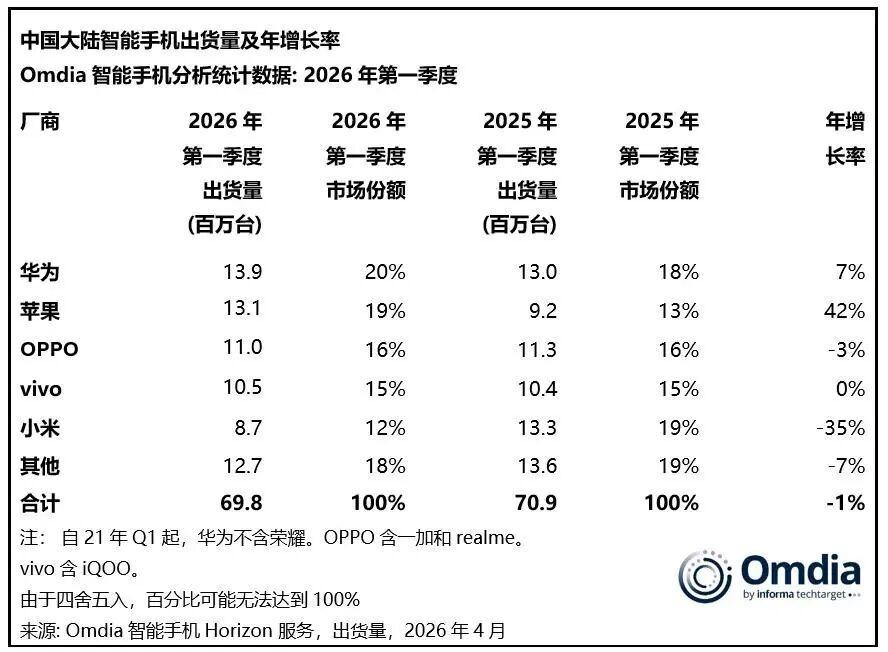
The two also became the only two brands with positive shipment growth in Q1 of this year. Data from well-known research firm Omdia shows that in the first quarter of 2026, Huawei reclaimed the top spot in the Chinese market with a 20% share, representing a 7% year-on-year increase; Apple ranked second with a 19% share, surging 42% year-on-year.
Other brands, meanwhile, fell into the predicament of declining shipments.
Among them, the OPPO system (including realme and OnePlus) held a 16% share, down 3% year-on-year; vivo had a 15% share, with shipments remaining flat compared to the same period last year; Xiaomi accounted for 12% of the market, a 35% year-on-year decline, the largest drop among the top five brands.
But for Huawei and Apple, this window of trading price for volume is closing rapidly.
The second wave of impact arrived in June. iQOO launched its second round of price adjustments on June 24, with the top-tier 15 Ultra model increasing by 500 yuan. Mid-range models from OPPO, Xiaomi, and Honor generally rose by another 300 to 1000 yuan.
Huawei, which had been holding firm, finally relented — on June 1, Huawei unveiled the new nova 16 series, whose final selling prices were slightly raised by 300 to 500 yuan compared to the previous generation.
At this point, all five major domestic smartphone brands had fallen in line with the price hikes.
Against this backdrop, Apple's movements attracted even more attention. In Apple's official price adjustments at the end of June, product lines such as Mac, iPad, and HomePod saw price increases of varying degrees, while the current iPhone models were temporarily excluded — but looking ahead to the next-generation iPhone, the outlook is not optimistic.
According to TechInsights' forecasts, to maintain its profit margins, the iPhone 18 Pro would need a $270 price increase. JPMorgan Chase estimates that the iPhone 18 Pro series will see a price hike of between $50 and $100, representing a 4.55% to 9.1% increase.
In a sense, Cook's remark that "price increases are inevitable" may have already set the tone for the iPhone 18 series pricing this fall.
This means that if Apple's iPhones join the price hike trend, no major smartphone manufacturer worldwide will be spared. The era of across-the-board price increases in the smartphone market will officially begin.
Memory Inflation Is Siphoning Off the Smartphone Industry's Lifeline
The root cause of this price surge does not lie with smartphone manufacturers, but in the massive shift in upstream storage chip production capacity.
In recent years, the continuous explosion of generative AI has spawned enormous demand for HBM (High Bandwidth Memory). The three storage giants — Samsung, SK Hynix, and Micron — have all redirected a large portion of their advanced process production capacity toward higher-margin AI server memory.
Against this backdrop, consumer-grade memory for smartphones has become the sacrificial segment in this production capacity squeeze.
Low-end memory has been directly cut off. This April, Samsung officially stopped accepting new orders for LPDDR4 products. Micron and SK Hynix stopped taking orders at the end of 2025, with shipments expected to be suspended starting in the third quarter of 2026.
What does this mean? The "low-cost memory" that forms the core of budget smartphones is disappearing from the market.
This further narrows the survival space for low-end devices.
IDC predicts that in 2026, the market share of the sub-$200 low-end segment will shrink by 4.3 percentage points to 20%. Omdia forecasts that shipments of ultra-low-end smartphones priced under $100 will drop nearly 31% year-on-year.
In addition, a digital content creator stated in early July that Xiaomi has lowered its shipment target by 20% to 30%, while OPPO, vivo, and Honor have also reduced their targets by roughly 15% to 30% — including Apple, all major global smartphone manufacturers have cut their shipment expectations.
Smartphone manufacturers are forced to collectively shift to LPDDR5X — a more advanced, yet more expensive type of memory, whose prices are currently skyrocketing. SigmaIntel's Q2 2026 report shows that LPDDR5X modules saw a staggering 89% quarter-on-quarter increase, the highest growth rate among all DRAM categories.
Premium brands will also find it harder to withstand memory price pressures, and they must accept suppliers' higher price quotes together.
This February, South Korean media outlet Dealsite broke the news: to secure LPDDR5X memory supply for the iPhone 17 series, Apple accepted Samsung Semiconductor's 100% price increase offer with almost no negotiation. Samsung's internal original target was a 60% hike, and they tentatively proposed 100%.
Apple accepted the offer on the spot.
This, on one hand, reflects the urgency of Apple's supply chain situation, and on the other hand, shows that even a giant like Apple, with strong bargaining power, has no negotiating leverage in the face of memory shortages.
Under the dual pressures of soaring memory prices and persistently sluggish replacement demand across the smartphone market, no brand can stay unaffected. Even if they can maintain their top-tier positions, their operating conditions will undoubtedly become far more challenging.
AI Is a Bubble for the Smartphone Industry
Price hikes are not creating a stock game, but rather pushing the years-long existing competition into a more brutal, deep-seated battle.
Omdia data shows that in the first quarter of 2026, the market share of small and medium-sized smartphone brands categorized in the "others" camp plummeted from 24.6% a year ago to 17.3%, representing a 31.7% year-on-year decline. Meizu announced in February that it would suspend its domestic in-house new smartphone development projects, effectively halting its mobile phone business. ASUS also suspended the launch of new devices under its ROG brand.
The sharp increase in brand concentration means the trend of big fish eating small fish is accelerating.
From a domestic market perspective alone, the combined share of Huawei, Apple, Xiaomi, OPPO, vivo, and Honor has reached 94%.
Yet these top players also face their own survival crises. The core problem they face is: in the coming years, the smartphone, this cash cow, will irreversibly shrink, and can new businesses of equivalent scale be successfully developed?
Their response strategies have become highly differentiated.
For tech giants like Huawei, beyond the smartphone business, there are many other segments where growth can be found.
Among them, Harmony Intelligent Mobility is the segment that currently receives the most institutional expectations and public attention. In 2026, Harmony Intelligent Mobility plans to launch 12 new vehicles, aiming to shift from the AITO brand dominating alone to coordinated development across five brands — AITO consolidating its foundation, LUXO expanding into the youth market, and XANGO pursuing differentiated breakthroughs, among others.
Similar to Huawei, Xiaomi has long positioned automobiles as its second growth curve.
In terms of market performance, both the SU7 and YU7 models under Xiaomi have achieved strong results in 2026; in terms of revenue scale, its automotive business generated 19.9 billion yuan in revenue in Q1 2026. Together with its IoT and internet service revenues, Xiaomi's non-smartphone business revenue has become comparable to its smartphone business revenue.
It is worth noting that in July, Xiaomi also announced its second product line, the SkyNomad series — marking Xiaomi's first entry into the extended-range electric vehicle segment in its automotive business.
In comparison, OPPO's second growth curve appears relatively ambiguous.
IoT, car-machine interconnectivity, and other areas were once clear directions, but none achieved major breakthroughs later. Within the IoT business, large home appliances such as TVs have been effectively abandoned; while wearables like watches and headphones are still maintained, they have refocused on niche areas such as health, with the overall scope retreating from broad expansion to targeted contraction.
However, OPPO still has a follow-up plan — it has launched a project to develop handheld smart imaging devices, targeting the GoPro and DJI action camera market. But whether this can become a new growth point remains uncertain.
vivo has bet on the next-generation computing platform (MR/AR) and embodied intelligence (robots). On the MR front, it has launched the vivo Vision headset, yet the market's acceptance of this segment remains highly uncertain — Apple Vision Pro's setback serves as a cautionary tale, and vivo Vision is currently only available for limited-time trial experiences.
In addition to the vivo Vision, vivo has confirmed that it will enter the handheld gimbal camera market, with new products expected to be unveiled within 2026 — meaning that, like OPPO, vivo will step into a market that is already becoming fully competitive.
Also in the humanoid robot business, vivo established the vivo Robot Lab last March, focusing on incubating robot products for home and personal scenarios — but this is an even longer track that will take more than a decade to see commercialization prospects.
In contrast, Honor is currently the smartphone manufacturer with the most advanced robot progress — it released two humanoid robots at MWC in March, and the following month won the Beijing Yizhuang Robot Half Marathon championship.
Technically, Honor has demonstrated the motion control capabilities of its humanoid robots and unveiled their product forms, but commercialization — actually selling to consumers — has not yet been carried out on a large scale.
Overall, by 2026, although smartphones remain one of the most important consumer electronics products, their "sunset industry" characteristics are becoming increasingly obvious, and these traits are further amplified by the pressure of rising memory prices.
As a result, the landscape of smartphone manufacturers' second growth curves has become highly fragmented.
Even Apple, with its high profit margins, is actively seeking changes, leveraging its smartphone hardware and service businesses as a buffer to delay the decline of the iPhone. Domestic manufacturers are making even greater efforts to break out into new areas, as survival pressure looms over every player whose core business revolves around smartphones.
Against this backdrop, the rapid development of AI itself and the frenzy of capital seem like stories from a separate world.
Of course, in the wave of large language models, smartphone players are also actively embracing and deploying AI. But for now, the integration of smartphones and AI appears more like a beautiful bubble.
After all, even the most flashy AI label will not make people pay a premium for smartphones, while the memory-driven price surge will genuinely prompt consumers to tighten their already shrinking wallets — this is a story about enduring hardships to get through the cycle, and this story has only just begun.
This article is from the WeChat official account "Timelines", written by Yu Yue, and published with authorization from 36Kr.