Self-developed welding embodied AI brain model, entering the industrial manufacturing embodied intelligent track with "intelligent welder", "Shengshi Weisheng" completes hundreds of millions of yuan in Series B financing | 36Kr Exclusive
36Kr learned that 3Srobotics, an embodied AI robotics enterprise focused on the industrial manufacturing sector, has officially announced the completion of a Series B financing round worth hundreds of millions of yuan. This round was led by Shanghai Semiconductor Industry Investment and Jinqiao Fund, with continued follow-on investments from Zero2IPO Ventures, NewDing Capital, Zhongguan Dinghua, and existing shareholder Lightseed Ventures. The funds will be primarily allocated to the iterative upgrade of the welding embodied AI brain and autonomous cerebellar motion control system, expanding production capacity at its in-house smart manufacturing factory, scaling up the R&D and market service teams, and accelerating the large-scale deployment of products across multiple industries nationwide.
Founded in 2020, 3Srobotics obtained the National High-Tech Enterprise certification in 2023, and was recognized as a Shanghai Specialized, Refined, Differential, Innovative (SRDI) SME and a Shanghai Intelligent Robotics Benchmark Enterprise in 2024. The completion of this financing round marks that 3Srobotics has entered a new stage of large-scale high-speed development relying on its three-tier full-stack self-developed system of "Autonomous Brain + Autonomous Cerebellum + Self-Developed Hardware Mass Production", targeting the domestic industrial manufacturing embodied AI deployment track with mass-producible, self-evolvable industrial-grade intelligent robot products.
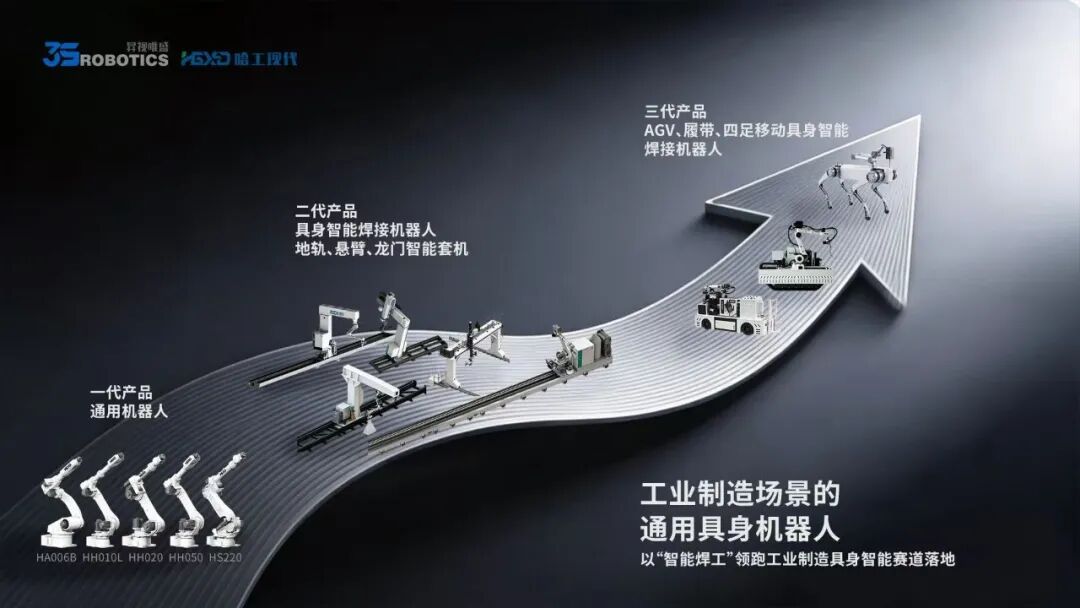
3Srobotics' 3-generation product upgrade roadmap
1. Targeting high-demand welding scenarios to build "intelligent welding workers"
In its early days, 3Srobotics primarily engaged in the R&D, production, and sales of general-purpose industrial robots. As the business grew, founder Wang Dezhao gradually formed a judgment that robots will evolve from general-purpose applications to deep intelligence in vertical scenarios in the future. "That's why we positioned ourselves to deeply integrate AI algorithms with robot hardware, giving full play to the value of intelligent robots in vertical scenarios."
Among numerous industrial scenarios, 3Srobotics chose welding. Welding is a process involved in almost all industrial production, yet the labor shortage problem is worsening due to high work risks, intense labor demands, and steep technical barriers. According to Wang Dezhao, there are approximately 10 million registered welders in China at present, with an average age over 45. Since young people are generally reluctant to take up welding jobs, the welder gap will reach millions in 2025. Meanwhile, manufacturing enterprises are continuously raising their requirements for welding quality, efficiency, and stability.
The convergence of these two major pain points has created enormous market space for welding robots. According to estimates, the market size of intelligent welding robots will reach hundreds of billions of yuan in the next decade. "Based on confidence in the prospects of the welding market, as well as the customer resources and scenario data we have accumulated in the welding field, we finally decided to focus on this vertical scenario first," Wang Dezhao stated.
The welding automation solutions used by most traditional system integrators require pre-programming, drag-and-drop teaching, or manual intervention. They cannot automatically adjust processes based on operational errors, only solve standardized problems within a limited scope, and fail to deeply understand industrial physical conditions or independently handle non-standard complex scenarios. These inherent shortcomings, including poor adaptability, high replaceability, and lack of continuous evolution capabilities, make it difficult to truly address the core pain points of the manufacturing industry.
In contrast, 3Srobotics' robots can learn from the operational data of experienced welders through AI algorithms, independently perceive and understand the physical world via real-time 3D reconstruction and robot path planning, thus making real-time decisions and dynamically adjusting processes. This allows them to better adapt to various complex working conditions and non-standard workpieces, while shortening product delivery cycles and enterprise payback periods. Wang Dezhao mentioned that currently, one 3Srobotics welding robot can replace 1.5 to 2 welders on average per unit of time, with an investment return cycle of approximately 1 to 1.5 years.
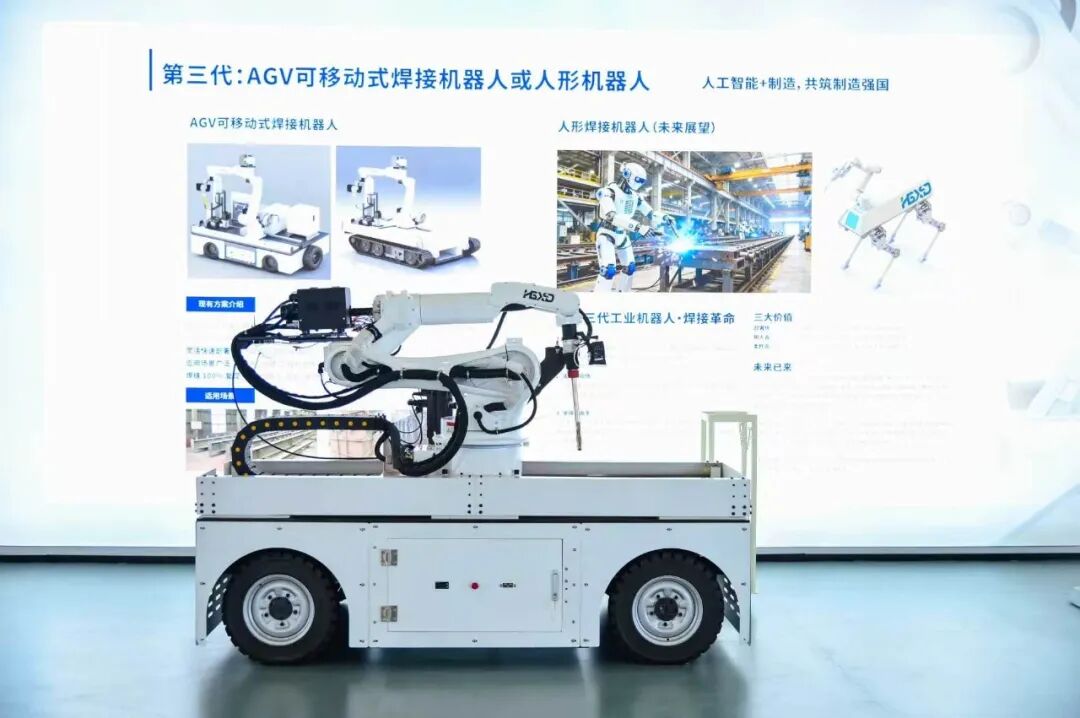
3Srobotics' 3rd-generation welding robot
2. Self-developed embodied autonomous "brain" and "cerebellum" for welding
3Srobotics has developed a proprietary embodied AI brain model exclusively for welding, trained entirely on real industrial working conditions. The "brain" is an AI algorithm trained based on a multimodal large model architecture. By feeding millions of pieces of frontline production line welding data, a full-category material and process knowledge base, and a dataset of complex special-shaped weld seams, the technical team enables the AI algorithm to act like an experienced welder: identifying the 3D structure, material, and texture of workpieces, independently reasoning to generate process plans defining "where to weld" and "how exactly to weld", and adapting to non-standard, high-variety, small-batch core production scenarios in industries such as steel structures, engineering machinery, shipbuilding, rail transit, and automotive components.
This autonomous brain possesses genuine industrial process cognition and independent decision-making capabilities: relying on a self-developed high-precision 3D vision system, 3Srobotics' "brain" model can dynamically match and adjust all core process parameters in real time, including current, voltage, travel speed, and swing amplitude, based on the plate material, thickness, groove shape, and on-site working environment. Meanwhile, the model supports closed-loop self-learning of production line operational data, continuously optimizing process logic and breaking the industry bottlenecks of traditional equipment such as fixed processes, heavy reliance on manual experience, and limited scenario adaptability.
The "cerebellum" capability independently developed by 3Srobotics — a self-developed real-time motion control system — originates from the years of accumulated expertise in industrial robot bodies by its controlling subsidiary Harbin Modern, serving as a critical technical barrier that ensures robots accurately execute decisions and perform stably at high standards.
Unlike the outsourced general-purpose motion control solutions adopted by most current manufacturers, which commonly suffer from issues such as response latency, insufficient trajectory tracking accuracy, and poor multi-axis coordination, 3Srobotics' autonomous "cerebellum" can independently receive the full set of process decision instructions from the "brain". When facing extremely complex working conditions such as special-shaped curved surfaces, super-large components, narrow spaces, and workpiece deformation, it can complete trajectory correction and dynamic error compensation in real time, ensuring uniform and stable weld seam formation while eliminating quality problems like incomplete welding, missed welding, and burn-through. It can also adapt to the full range of welding robots, including fixed and tracked mobile models, realizing the vision of "a single brain driving multiple devices for flexible autonomous operations across all scenarios".
The massive volume of process data accumulated by 3Srobotics acts as a bridge and learning fuel for the "brain" and "cerebellum". As the actual deployment scale of robots continues to expand, the iteration of robot products forms a positive flywheel effect: the more they are used, the more data is generated, and the smarter the model becomes.
3. From deep focus on welding to continuously expanding the boundaries of industrial embodied AI products
Traditional welding automation solution providers mostly adopt a direct sales model with end customers, as they need to conduct customized development and on-site adaptation for each specific project. In contrast, 3Srobotics' welding robot products feature a higher level of standardization and intelligence, enabling customers to deploy them in a "plug-and-play" manner.
On this basis, 3Srobotics' sales model primarily relies on channel distributors and integration agents. Revenue from direct end-customer contracts only accounts for 10%-20% of total revenue, which is mainly used to build benchmark cases for newly expanded application scenarios. Additionally, 3Srobotics is exploring a "robot labor service" business model that charges by the meter of welding completed. Compared with manual welding, this model boosts daily welding efficiency by 2.88 times while reducing the average cost by 32.5%.
Currently, 3Srobotics' customers mainly cover industrial manufacturing scenarios such as steel structures, bridges, shipbuilding, rail transit, power equipment, and engineering machinery, with presence in high-end manufacturing fields including aerospace and new energy. According to Wang Dezhao, customers prioritize welding stability, coverage of weldable workpieces, and per-unit-time efficiency when using welding robots, and the company targets revenue of hundreds of millions of yuan in 2026.
Moving forward, 3Srobotics plans to leverage welding robots as its core product anchor, continuously launching a full range of industrial intelligent robots for applications such as grinding, cutting, assembly, and handling, gradually penetrating the entire production process of manufacturing enterprises to achieve an upgrade from a "hit product for a single scenario" to an "ecosystem of embodied AI products covering all processes".
Investor Perspectives
The investment team of Shanghai Semiconductor Industry Investment stated: In industrial scenarios, the welding sector has long faced the problem of extremely high non-standard rates, which has led to a persistently low automation level, forcing continued reliance on manual labor. However, the working environment for welding is inherently harsh, which means millions of welder positions will face severe labor shortages in the future. AI essentially solves the problems of judgment and execution in various non-standard scenarios across different industries, whose inherent properties naturally align with welding operations.
After navigating and overcoming multiple complex, interconnected challenges that require extensive time investment to resolve — including immature AI models, insufficient data, and inadequate precision in robot bodies — 3Srobotics has finally taken the lead in enabling AI welding robots to match the capabilities of experienced welders and achieve mass production shipments. The welding industry is large enough and has sufficiently rigid demand, and we are optimistic that 3Srobotics has the potential to grow into a much larger enterprise with its rare, industry-leading products.
Ma Wanli, General Manager of Jinqiao Fund, stated: 3Srobotics holds rare value in the field of industrial embodied AI welding robots. The company possesses the domestically uncommon integrated core capability of "robot body + AI + welding process". In particular, its in-house robot body manufacturing facility brings mass production capacity and independent, controllable supply chain advantages, building a solid barrier that differentiates it from pure software solution providers.
The welding scenario is a high-demand market in industrial manufacturing with the largest labor shortage and the most urgent need for intelligent replacement. 3Srobotics' productization path of "autonomous brain + self-developed hardware" precisely aligns with the industrial trend of the manufacturing sector transforming from "solution empowerment" to "intelligent hardware deployment". Leveraging its long-term layout and industrial ecosystem resources in hard technology and intelligent manufacturing, Jinqiao Fund will continuously support the company's large-scale development and accelerate the in-depth deployment of welding robots in sectors such as steel structures, shipbuilding, and engineering machinery.
Yu Lu, Managing Partner of Zero2IPO Ventures, stated: The trend of "replacing human labor with robots" is prominent in non-standard manufacturing sectors such as steel structures and shipbuilding, and 3Srobotics has precisely targeted this market gap. 3Srobotics boasts a complete technical capability system, and in terms of software algorithms, it has overcome the industry challenge of drawing-free welding, enabling robots to understand working conditions and make independent decisions like senior veteran technicians.
We believe 3Srobotics demonstrates the technical depth, product mindset, and global vision that define a unicorn enterprise, and we are willing to accompany such outstanding teams to jointly embrace the wave of industrial intelligence.
Zhang Chi, Head of NewDing Capital, stated: As core equipment in the industrial automation field, welding robots feature remarkable advantages such as high precision and high efficiency. Through precise program control and multi-axis coordinated motion, they ensure consistent welding parameters and stable, uniform weld seam quality, effectively solving the problem of quality fluctuations in manual welding caused by fatigue or skill disparities. In terms of efficiency, welding robots can operate continuously 24 hours a day, significantly shortening production cycles and boosting production capacity, making them particularly suitable for large-batch standardized production. Meanwhile, relying on flexible programming capabilities and intelligent technologies such as visual recognition, they can quickly adapt to the welding requirements of small-batch, high-variety workpieces with complex shapes, drastically reducing the preparation cycle for product upgrades and iterations. Furthermore, welding robots can operate stably for long periods in harsh environments such as high temperatures and toxic dust, reducing workers' labor intensity and safety risks.