DeepDark vs Unitree Robotics: Two Distinct Paths in the Quadruped Robot Track
In 2026, as the AI narrative shifts rapidly from infrastructure to the application layer, embodied intelligence is entering a "super financing cycle". This year, robotics enterprises are flocking to the capital market: Unitree Robotics secured its IPO approval in just 73 days, breaking the fastest listing record on the STAR Market; Deep Robotics followed closely by submitting its STAR Market application, with its IPO review status updated to "Inquired" on May 27.
These two prospectuses reveal for the first time the full commercial reality of the quadruped robot industry: against the backdrop of widespread high investment and sustained losses in embodied intelligence, the first to achieve scalable revenue and profitability are not humanoid robots closest to humans, but robotic dogs that have pioneered a viable path to revenue.
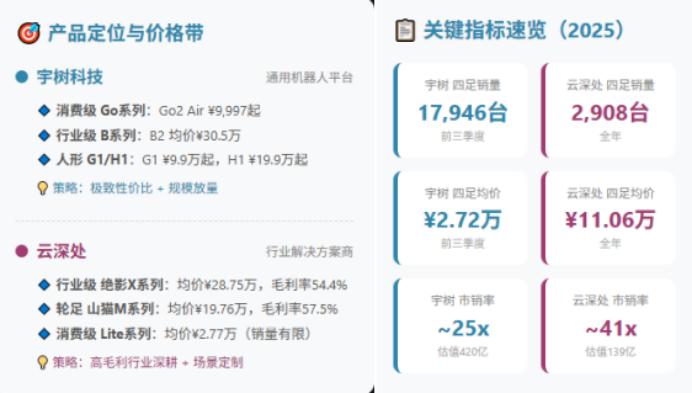
According to IT Juzi data, in the first half of 2026, total financing in China's domestic embodied intelligence sector exceeded 900 billion yuan, with 322 financing events. However, large-scale financing is highly concentrated: 27 companies have captured almost all funding of 1 billion yuan and above. Amid this capital boom, Deep Robotics has supported a 139 billion yuan valuation (41x price-to-sales ratio) with 337 million yuan in revenue, prompting the market to re-evaluate the commercial value of quadruped robots.
Yet, even as both focus on the robotic dog track, Unitree Robotics and Deep Robotics have taken distinctly different paths: one is targeting the mass consumer market for large-scale adoption, while the other delves deep into vertical industry applications. This is not just competition between two companies, but two distinct answers to the commercialization of quadruped robots.
Fundamental Breakdown: Two Completely Different Financial Logics
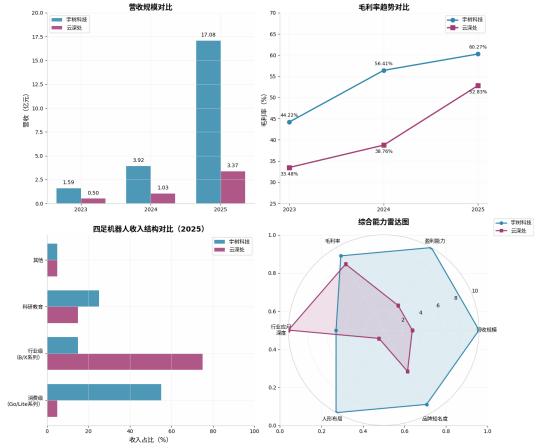
1. Revenue Scale: Strategic Divide Behind the 5x Gap
Deep Robotics' operating revenue grew from 50.1126 million yuan in 2023 to 337 million yuan in 2025, with a compound annual growth rate of 159.51%. Its attributable net profit turned from a loss of 25.8501 million yuan in 2023 and a loss of 13.2899 million yuan in 2024 to a profit of 28.684 million yuan in 2025, while net cash flow from operating activities also turned positive to 63.75 million yuan.
Unitree Robotics' growth is even more aggressive. Over the same period, its revenue surged from 159 million yuan to 1.699 billion yuan, with a three-year compound growth rate of 226.78%. Its non-recurring attributable net profit went from a loss of 18.0191 million yuan in 2023 to a profit of 78.4765 million yuan in 2024, and further jumped to 590 million yuan in 2025. Its gross margin on core business also rose from 44.22% to 60.13%.
In 2025, Deep Robotics' revenue was only one-fifth of Unitree Robotics', and its net profit just one-tenth. Yet the capital market has granted Deep Robotics a higher valuation premium — 41x P/S versus 25x, making Deep Robotics' valuation roughly 60% higher than Unitree's.
This "anomaly" essentially reflects the capital market's differentiated pricing for revenue quality. Of Unitree's 1.7 billion yuan revenue, consumer-grade robotic dogs and scientific research & education account for the majority; of Deep Robotics' 337 million yuan revenue, 79% comes from industry applications such as power inspection and emergency firefighting. Its clients are mostly state-owned enterprises like State Grid, with long order cycles, high repurchase rates, and stronger certainty. Against the backdrop of significantly tightened capital risk appetite in 2026, "certainty" itself has become a scarce asset.
2. Gross Margin: Profit Inflection Points Reached by Different Routes
Both companies saw their gross margins leap forward in 2025. Unitree's rose from 44.22% in 2023 to 60.13%, while Deep Robotics' jumped from 33.48% to 52.83%.
But their driving logics are completely different. Unitree relies on full-stack in-house R&D plus scale effects. The unit cost of its robots was cut in half from 22,300 yuan in 2022 to 12,100 yuan in the first three quarters of 2025. It has a very high self-development rate for core components such as motors, reducers, and encoders, reducing the cost of imported parts to one-third of the original level.
Deep Robotics relies on high-margin industrial products. Its Jueying X series sells for 287,500 yuan per unit with a gross margin of 54.35%; its wheel-legged Bobcat M series sells for 197,600 yuan per unit with a gross margin of 57.50%. These two products together contribute more than 80% of its revenue. The gross margin of the Jueying X series increased from 35.55% in 2023 to 54.35% in 2025, rising nearly 19 percentage points in three years.
More notably, Deep Robotics' gross margin improvement did not come from price hikes — the unit price of the Jueying X series dropped from 357,300 yuan in 2023 to 287,500 yuan in 2025, a decrease of 19.5%, yet its gross margin improved against the trend. The core reason lies in the falling cost of core raw materials and the gradual release of scale effects.
3. Revenue Structure: Two Approaches for General Platforms and Vertical Solutions
In the competition of the quadruped robot track, the most essential difference between Unitree Robotics and Deep Robotics is not simply product form, but their distinct revenue structures and business models. This difference directly determines their respective growth paths, risk profiles, and capital market pricing logics.
Unitree Robotics follows a "general platform" approach. It is essentially building a widely adaptable standardized hardware platform, leaving scene adaptation and secondary development to downstream integrators and developers. In the first three quarters of 2025, the revenue structure of its quadruped robots clearly reflects this strategy: the consumer-grade Go series contributed about 55% of revenue, with shipments exceeding 17,000 units and an average unit price below 20,000 yuan; the scientific research & education sector accounted for about 25%; the industry-focused B series only accounted for about 15%, with an average unit price of roughly 305,000 yuan.
This structure has allowed Unitree to achieve significant scaling advantages. Low-cost consumer-grade products quickly opened up the market, accumulating a massive user base and developer ecosystem, which in turn drives down supply chain costs and accelerates technological iteration. The high proportion of consumer and scientific research & education revenue means Unitree reaped the benefits of economies of scale earlier, but it also bears the risks of price sensitivity, low repurchase rates, and cutthroat competition in the consumer market.
In contrast, Deep Robotics has firmly adopted a "vertical solution" approach. It focuses on deep engagement in specific industry scenarios, delivering integrated offerings from hardware to complete solutions. For full-year 2025, its quadruped robot revenue structure shows a clear industry skew: the industrial-grade Jueying X series contributed about 58% of revenue (681 units, average price 287,500 yuan), and the wheel-legged Bobcat M series contributed about 22% (377 units, average price 197,600 yuan), together accounting for over 80%; the consumer-grade Lite series only made up about 5% (1850 units, average price 27,700 yuan); scientific research & education accounted for roughly 15%.
This industry-focused revenue structure brings higher unit prices and gross margins, making Deep Robotics' revenue more predictable and sticky. Its main clients are large state-owned enterprises and government agencies such as State Grid and fire brigades, whose orders typically have long cycles and high repurchase potential. In the 2026 environment of tightened capital risk appetite, this "certainty" has become a key support for Deep Robotics' higher P/S valuation.
However, both revenue structures have their hidden risks. Although Unitree has a large scale, the consumer market is fiercely competitive. Once its growth slows or new product iterations fall short of expectations, overall performance can easily fluctuate; Deep Robotics, while gaining first-mover advantages in vertical scenarios, is heavily dependent on a small number of industries and integrator channels, meaning the ceiling of a single scenario and customer concentration risks cannot be ignored.
Why Go All-In on Robotic Dogs?
Deep Robotics was founded in 2017 by Zhu Qiuguo, a professor and doctoral supervisor at the College of Control Science and Engineering, Zhejiang University. Unlike Unitree Robotics' Wang Xingxing, who follows a geek-style path, Zhu Qiuguo is a typical academic entrepreneur.
In 2024, Deep Robotics released the humanoid robot DR01, but Zhu Qiuguo explicitly stated at the time that "developing humanoid robots is only for technical reserves, and we will not consider commercialization in the short term". His logic is that while quadrupeds and humanoids share the same technical foundation — perception, motion control, navigation, planning, and data closed-loop — the mobility capabilities refined on quadrupeds can be transferred to humanoids, but humanoid robots still need to break through precise "operation" capabilities: dual arms, hands, force control, and hand-leg coordination.
Zhu Qiuguo has publicly judged that it will take at least 10 years for humanoid robots to go from technological breakthroughs to mature applications. In his view, today's robots are essentially "semi-autonomous devices" that lack true scene understanding and on-site decision-making capabilities. Reliability is the bottom line for commercialization — "No matter how cool the algorithm is, if it is not reliable enough, it cannot enter a substation".
In June 2026, Deep Robotics released its "1+X+N" strategic development plan. "1" refers to one embodied brain — a generalized "brain"; "X" refers to multiple robot bodies of different forms; "N" refers to standardized solutions covering thousands of industries including manufacturing, logistics, and services.
Zhu Qiuguo further shared Deep Robotics' development path from "technology-driven" to "scene-led" and then to "industrial implementation". Deep Robotics will increase R&D investment, with a focus on the commercial deployment of humanoid robots and large embodied intelligence models.
According to Zhu Qiuguo, the quadruped robot track has crossed the "technological chasm", but every company must find its own application scenario, ensuring products are truly stable and reliable to deliver tangible value to customers.
Deep Robotics' strategy is clear: first run through the commercial closed-loop in the quadruped robot track — which offers higher "certainty" — to accumulate cash flow, supply chain capabilities, and scene data, then gradually extend to humanoid robots. This is exactly what Deep Robotics stated in its prospectus: "The company's revenue scale is relatively small, while the growth rate of operating revenue is relatively fast".
But this also means risk: as peers like Unitree and Fourier Intelligence have written "mass production" into their annual reports, how much longer will Deep Robotics' "exploration" continue?
Why Does Deep Robotics Have a Higher P/S Ratio? How Does It Support Its High Valuation?
1. Certainty Premium
In 2026, the primary market financing pace suddenly accelerated, with monthly financing amounts from February to April reaching approximately 95.8 billion yuan, 145.5 billion yuan, and 172.8 billion yuan respectively. At the same time, secondary market valuations have returned to rationality, with capital shifting from "paying for concepts" to "paying for cash flow".
Although Deep Robotics is small in scale, it has achieved profitability and signed a 5-year 1 billion yuan framework agreement with State Grid to provide inspection robots for more than 1,000 substations. In 2025, Deep Robotics saw strong demand for its robotic dog orders, with over 600 projects launched throughout the year. All these provide visible anchors for future revenue.
Unitree, while larger in scale, saw its Q1 2026 revenue growth rate fall from 332.64% in the previous year to 68.49%, with its non-recurring net profit dropping 52.55% year-on-year. The competitive landscape in the consumer market is rapidly changing, leading to higher uncertainty.
2. The Illusion of a "Moat" in Industrial Applications
Deep Robotics' 2025 revenue from industrial applications reached 258 million yuan, slightly higher than Unitree's 231 million yuan in absolute terms. The customer stickiness, access thresholds, and customization depth of the power inspection scenario theoretically form competitive barriers.
But does this "moat" really exist? The prospectus shows that 63.98% of Deep Robotics' revenue comes from integrators and traders, not end customers. This means it is more like a "hardware supplier" rather than a "platform company". Meanwhile, Shenhao Technology also reached a strategic cooperation with Deep Robotics in March 2025, where Deep Robotics provides quadruped bodies and Shenhao is responsible for system integration and channel sales. The essence of this cooperation is that Deep Robotics voluntarily gives up control over channels and integration links.
3. The Growth Story
Deep Robotics posted a 159.51% compound revenue growth rate from 2023 to 2025, achieving profitability in just three years. Its production volume increased from 529 units in 2023 to 3936 units in 2025, a year-on-year increase of 262%. The capital market favors "steep growth curves" because they herald a profit explosion in the next 3-5 years. While Unitree's growth rate is faster (335%), its revenue base is already close to 2 billion yuan, so its marginal growth rate will most likely slow down.
Yet the high valuation is also built on fragile assumptions:
Humanoid robots are almost absent from its business. It sold only 3 humanoid robots in 2024 with a gross margin of -31.32%; in 2025, it sold 1 unit, generating 823,000 yuan in revenue, accounting for only 0.24% of total revenue. By contrast, Unitree's humanoid robot shipments exceeded 5,500 units in 2025, generating 877 million yuan in revenue. Under the narrative of the "first year of humanoid robot mass production", Deep Robotics' humanoid business looks more like a "long-dated option".
Over-reliance on integrators. 63.98% of revenue comes from integrators and traders, not end customers. This means that although Deep Robotics has sold its products into industries, there are still many intermediaries between it and the actual usage scenarios. The real repurchase behavior of end customers, continuous usage feedback, and the most critical data closed-loop capabilities still need further validation.
The Ceiling of a Single Scenario. While power inspection provides short-term certainty, the total number of substations in China is ultimately limited. Once market penetration peaks, Deep Robotics needs to prove it can replicate its success in the power sector in other scenarios such as emergency firefighting, police security, and industrial inspection.
Competition is Intensifying. Unitree Robotics' 2025 quadruped robot revenue reached 695 million yuan, more than twice that of Deep Robotics; traditional power robot manufacturers such as Shenhao Technology and Yijiahe are accelerating their transition to quadruped robots. The track is quickly becoming crowded, and it remains uncertain whether high gross margins can be maintained.
For Deep Robotics to uphold its 139 billion yuan valuation after going public, it needs to meet three conditions:
First, it must not lose its core power inspection business. In 2025, cumulative sales