Intelligent Driving Says Goodbye to "Market Dream Ratio"
On July 8, two Chinese autonomous driving companies debuted on the Hong Kong Stock Exchange on the same day: Momenta, an intelligent driving solution provider, and Ecarx Mining, a mining-area driverless technology firm.
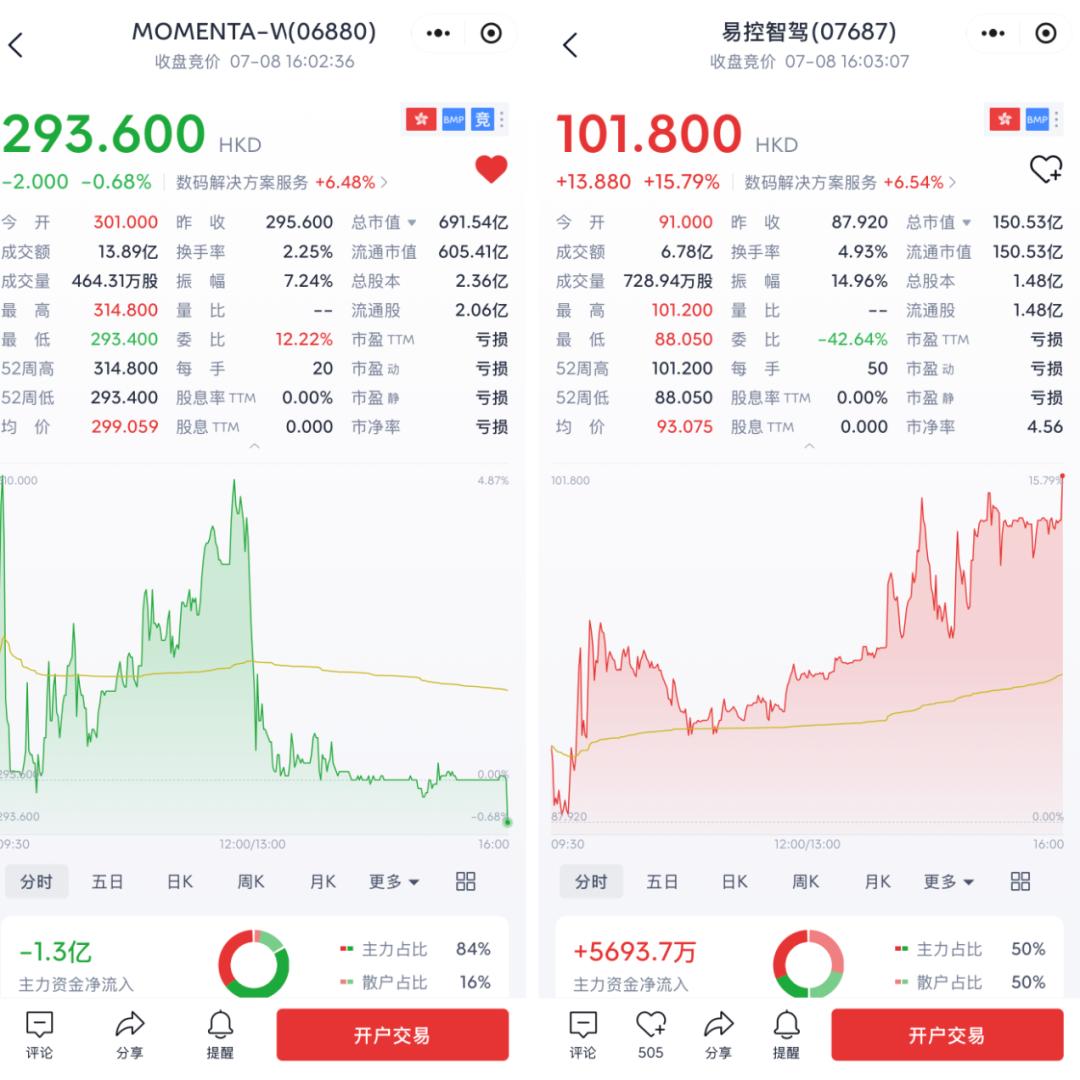
Their stock performances quickly diverged on the first trading day. Momenta opened at HK$301, surged to an intraday high of HK$314.8, at one point rising more than 6% above its issue price. However, it retreated rapidly in the afternoon, closing at HK$295.6, flat with its issue price. The full-day trading volume reached HK$14.2 billion, with a total market capitalization of HK$69.625 billion.
Ecarx Mining posted a stronger performance. The company opened at HK$91, hit an intraday high of HK$101.20, and closed at HK$96.70, up 9.99% from its issue price. Its trading volume stood at HK$6.83 billion, with a total market capitalization of HK$14.299 billion.
Momenta markets a "Physical AI" narrative focused on passenger vehicle intelligent driving and its client roster including Mercedes-Benz, BMW, and Toyota, carrying more ambitious valuation expectations. Ecarx Mining is deeply rooted in the mining scenario, with highly aligned customers and shareholders, making its commercial closed-loop far easier for the market to comprehend.
The first-day market performance fully demonstrates that capital markets are no longer chasing overvaluations solely for grand, vague narratives. The valuation logic for Chinese autonomous driving companies is shifting from "believing in market potential" to "seeing clear financial viability".
01.
414x Over-subscription, Performance Diverges Right After Listing
Momenta set no price range for this offering, directly fixing the price at HK$295.6 per share at a flat rate, which typically indicates the issuer had strong confidence in robust subscription demand. The outcome validated this judgment: Momenta's public offering tranche was over-subscribed by 413.63 times, and its international offering attracted institutional orders exceeding HK$100 billion, covering sovereign wealth funds and long-term institutional investors from 15 countries and regions. Fourteen cornerstone investors collectively subscribed for approximately 9,960,080 shares, accounting for roughly 49.95% of the global offering, with Mercedes-Benz participating as an existing shareholder.
Ecarx Mining is far smaller in scale, with a proposed price range of HK$81.16 to HK$87.92. It ultimately priced at the upper limit, raising approximately HK$2.3 billion. Cornerstone investors including funds under Zijin Mining and XCMG collectively subscribed for around US$146 million. Its start was far from impressive: in the dark pool trading the night before listing, the full-day average transaction price stood at HK$87.07, below the issue price. The stock dipped nearly 20% at one point during the session, closing with a mere 4% gain and an amplitude close to 25%, showing obvious divergence between bulls and bears.
However, the situation reversed after official listing. Momenta surged from its opening price of HK$301 to HK$314.8, then kept retreating, falling back to its issue price by the afternoon and even dipping below it temporarily. Ecarx Mining, by contrast, climbed steadily from its opening price of HK$91, touching HK$101.2 intraday and finishing the session with a 9.99% gain.
Of course, compared to this year's Hong Kong IPO market where new stocks often double in value, even Ecarx Mining's nearly double-digit gain cannot be called a "skyrocketing surge". The core reason is that both companies are still posting massive losses. The market is willing to pay for scale and market share, but it is also sending a clear signal: the next step in valuation will depend on which company can first achieve profitability.
Among similar companies that listed in Hong Kong this year, Horizon Robotics still trades above its issue price but has retreated more than 60% from its peak. WeRide and AutoX have both fallen below their respective issue prices.
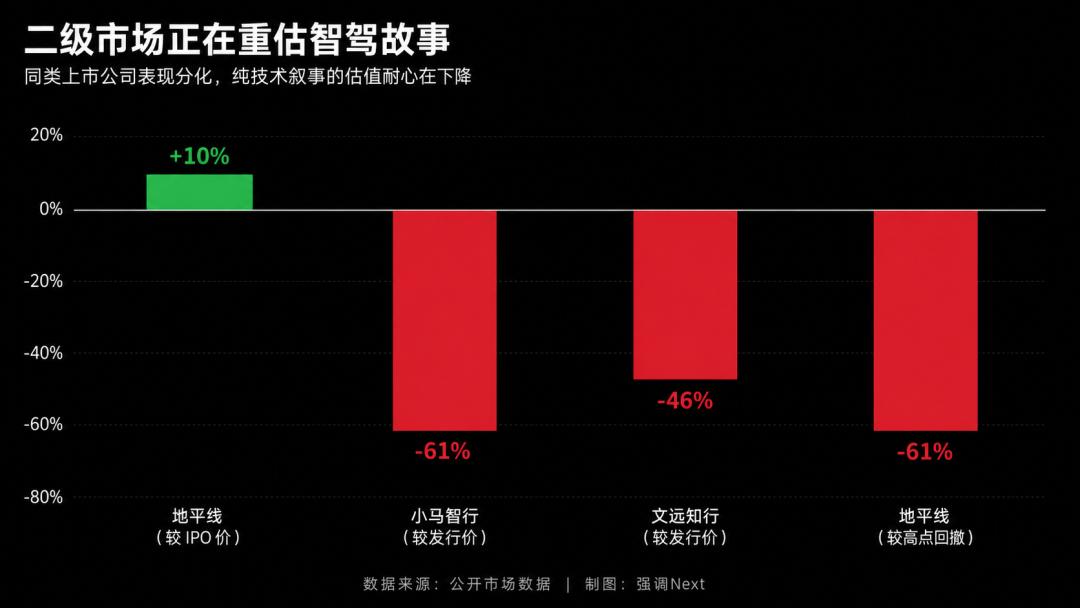
Data as of July 7
The pricing logic of this industry is being recalibrated.
02.
Momenta Is Not Content With Just Intelligent Driving
Founded in 2016 by Cao Xudong alongside Xia Yan, Sun Gang, and Sun Huan, Momenta sums up its strategy as "one flywheel, two legs": one leg is mass-produced intelligent driving solutions, while the other has now been redefined as "Scalable Robo", covering Robovan, Robotruck, and Robotaxi.
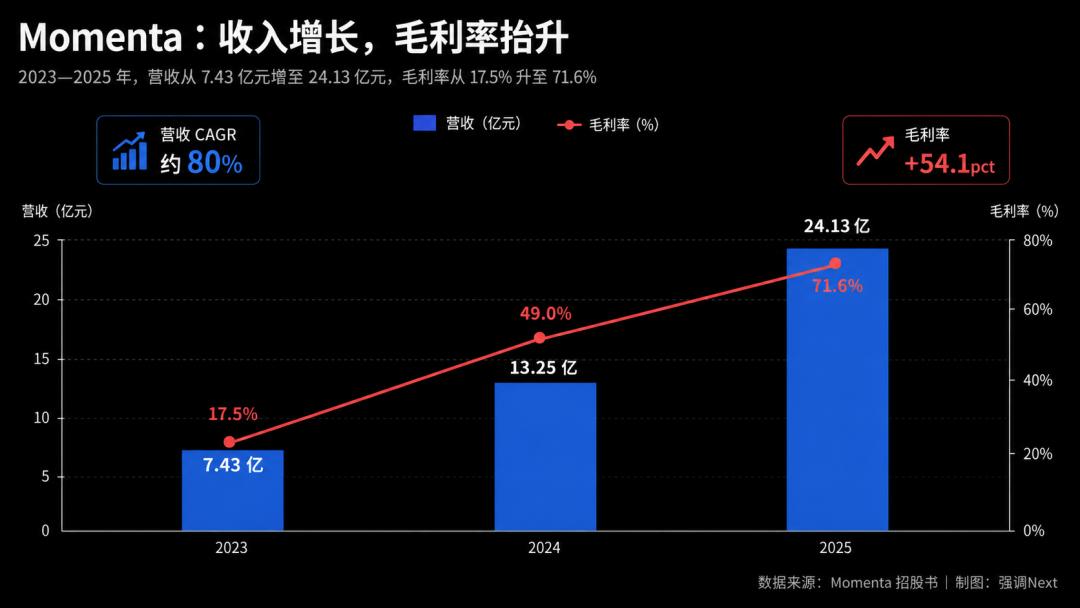
Financially, Momenta's revenue grew from RMB 743 million to RMB 2.413 billion between 2023 and 2025, with a CAGR exceeding 80%. Its gross margin rose from 17.5% to 71.6% over the same period.
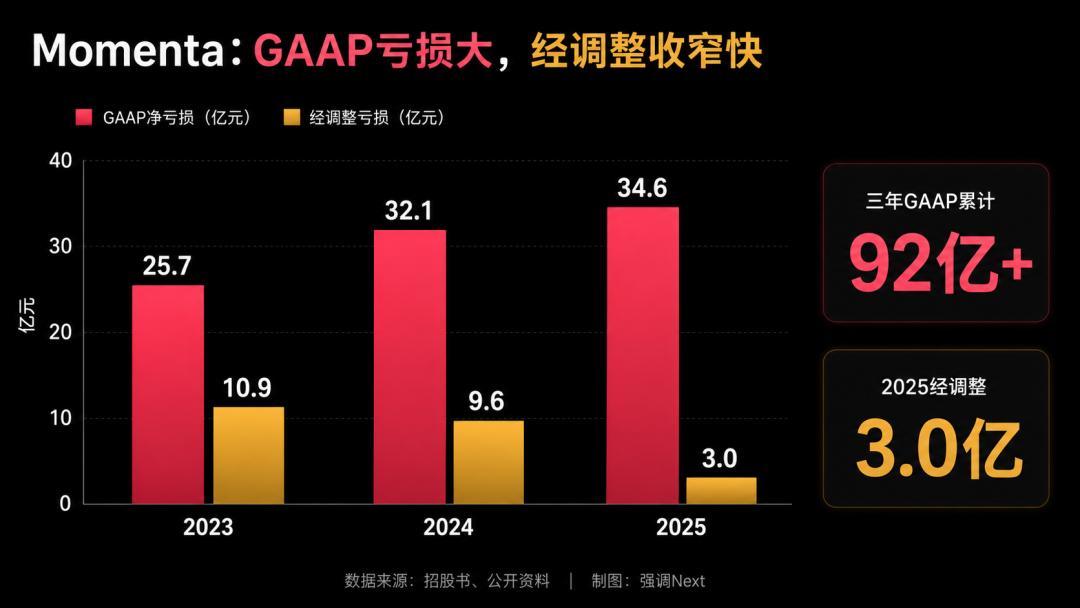
After excluding non-recurring factors such as changes in the fair value of preferred shares, its adjusted net loss has narrowed from RMB 1.09 billion in 2023 to approximately RMB 300 million in 2025. While still loss-making, this performance remains respectable within the industry.
In Cao Xudong's view, this is dictated by inherent industry rules. He predicts that China's third-party high-level assisted driving market will most likely end up with only two or three players, and three to four players globally.
His reasoning is that first-mover advantage and scale advantage will self-reinforce. Leading companies secure product capabilities first, then achieve larger mass production scale, revenue, and gross profit, enabling continuous R&D investment. The second-tier players, with fewer clients, fewer vehicle models, and suppressed quotation prices, will quickly fall into a vicious cycle where R&D lags behind and product gaps widen. He believes the window to reshape the market landscape is closing, and this shift is already underway. Companies in the second and third tiers that are queuing for IPO, including QCraft and DeepRoute, are facing considerable mounting pressure.
This is the underlying logic behind Momenta redefining its positioning this year. At the Beijing Auto Show in April, Momenta launched its R7 world model, rebranding itself as a "Physical AI" company. Cao Xudong revealed that the R7 has verified that a single unified world model can simultaneously support multiple downstream applications including mass-produced passenger vehicles, Robovan, Robotruck, and Robotaxi, taking its generalizability a step higher than the previous paradigm that only transferred capabilities between mass production vehicles and Robotaxi.
However, some industry insiders point out that this so-called "world model" is essentially an autonomous driving technology stack, and whether it can truly extend beyond driving scenarios remains to be verified. Xpeng, NIO, and Zeekr are all betting on similar directions, and this track is by no means exclusive to Momenta. Momenta has only just started developing its in-house chips, while its mainstream mass-produced solutions still use NVIDIA chips, exposing it to non-negligible execution risks in its "hardware-software integrated" strategy.
Notably, Cao Xudong does not place Robotaxi at the top of his priority list. He has ranked Momenta's Robo business for the next five years as: Robovan first, Robotruck second, and Robotaxi third. This is because the demand for urban intra-city logistics and bulk commodity logistics is more rigid, with less competition, making their commercial closed-loops easier to establish than capital-heavy, heavily regulated urban Robotaxi operations.
For its Robotaxi business, Momenta does not plan to build its own mobility platform or operate a self-managed fleet. Instead, it intends to provide "autonomous driving drivers" for platforms such as DiDi and Amap, earning a share of service revenue. Even while promoting the most compelling "Physical AI" narrative, what Momenta truly aims to defend is its position as a technology supplier, rather than attempting to reinvent itself as an automaker or mobility platform.
In an interview with *LatePost*, Cao Xudong also mentioned a rarely discussed consideration: the most important strategic goal of this IPO is not fundraising, but brand building and trust enhancement.
As he put it, Momenta currently "has a decent reputation but lacks widespread public recognition", with far lower public awareness than Huawei and Tesla. Intelligent driving has evolved from a behind-the-scenes capability to a feature that consumers can perceive and are willing to pay for. If third-party suppliers continue to hide behind automakers, they will struggle to secure bargaining power in the next round of competition.
03.
Financial Math Is Far Simpler in the Mining Industry
If Momenta's story unfolds under the spotlight, Ecarx Mining's battlefield is the complete opposite. There are no urban roads, only dust, steep ramps, and fleets of mining trucks operating around the clock.
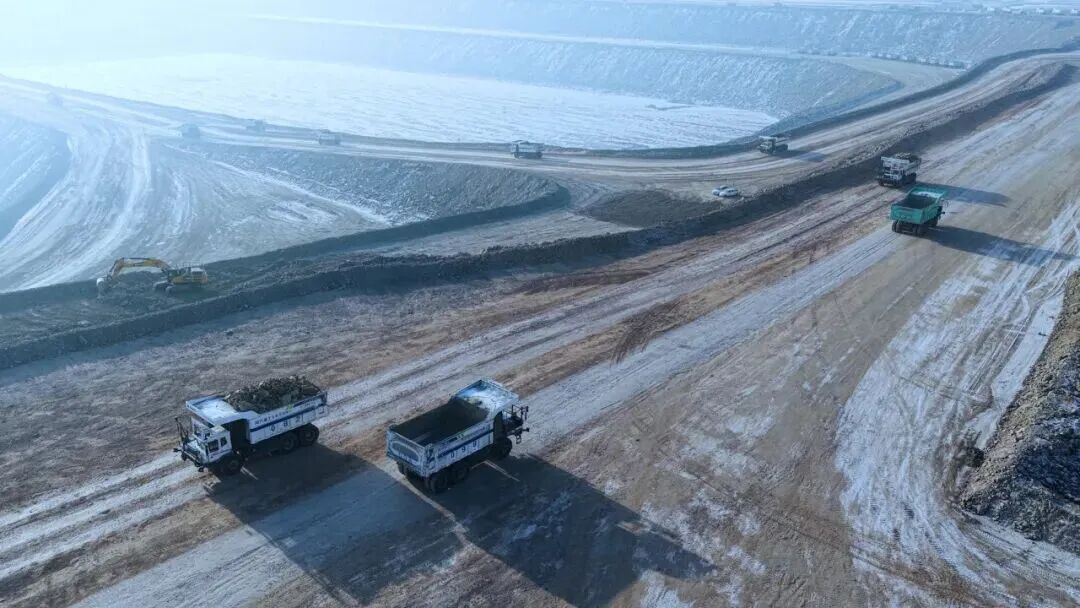
Photo from Ecarx Mining's official WeChat account
Established in 2018 and headquartered in Longyan, Fujian Province, this company integrates driverless systems into mining trucks to replace human drivers in loading, transportation, and unloading operations. Mines have long faced labor shortages and recruitment challenges, and are high-incident zones for safety accidents. After the Alxa coal mine accident in 2023, regulatory oversight tightened significantly, forming a solid demand foundation for this business.
Its advantage lies in not needing to educate consumers, nor waiting for policy approvals to open up urban roads. For mine owners, driverless mining translates to clear, tangible benefits: fewer drivers to hire, fewer safety accidents, and higher operational efficiency. Compared to Robotaxi, which has to simultaneously address passenger experience, urban regulatory compliance, platform revenue sharing, and public safety sentiment, the enclosed, fixed-route, high-demand mining scenario is far more aligned with the commercial logic of industrial software and operational services, making input-output calculations far more straightforward.
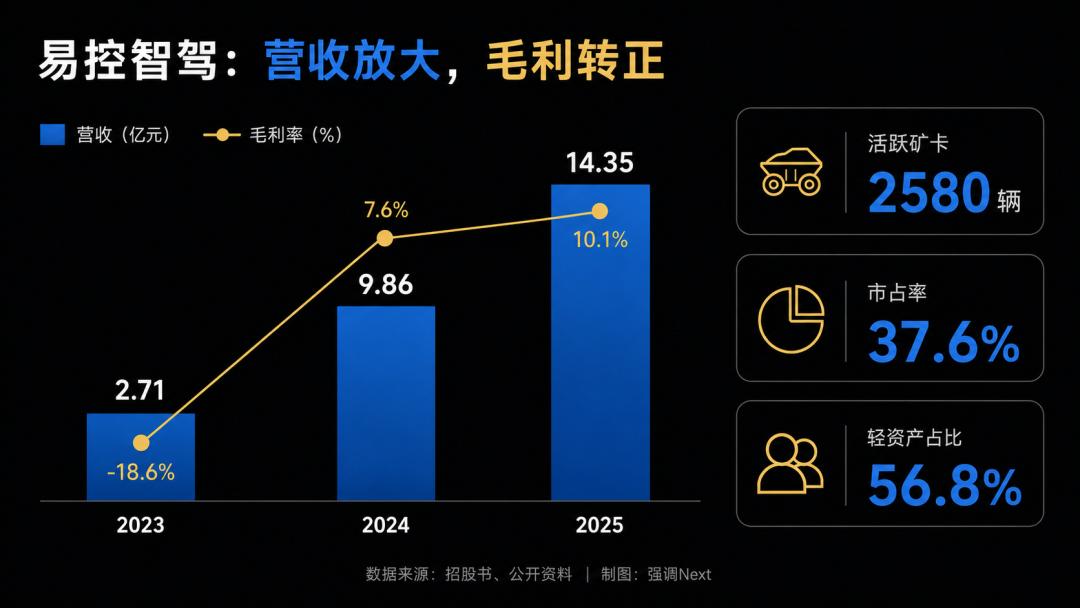
By the end of 2025, Ecarx Mining operated 2,580 active driverless mining trucks, making it the only company in the world with a deployed fleet exceeding 2,500 units. By revenue, it holds a market share of approximately 37.6%, firmly ranking first. The company is also transitioning from a "heavy asset" model where it purchases vehicles itself, to a "light asset" model where it only outputs software technology. The latter's revenue share has risen from 41.7% in 2023 to 56.8% in 2025.
Financially, its revenue grew from RMB 271 million to RMB 1.435 billion over three years, but the more critical turning point lies in improved profitability. Ecarx Mining's gross margin rose from -18.6% in 2023 to 10.1% in 2025. In 2025, the company's EBITDA remained negative at RMB -224 million, its adjusted EBITDA stood at RMB -193 million, while its adjusted net loss expanded from RMB 303 million in 2024 to RMB 484 million.
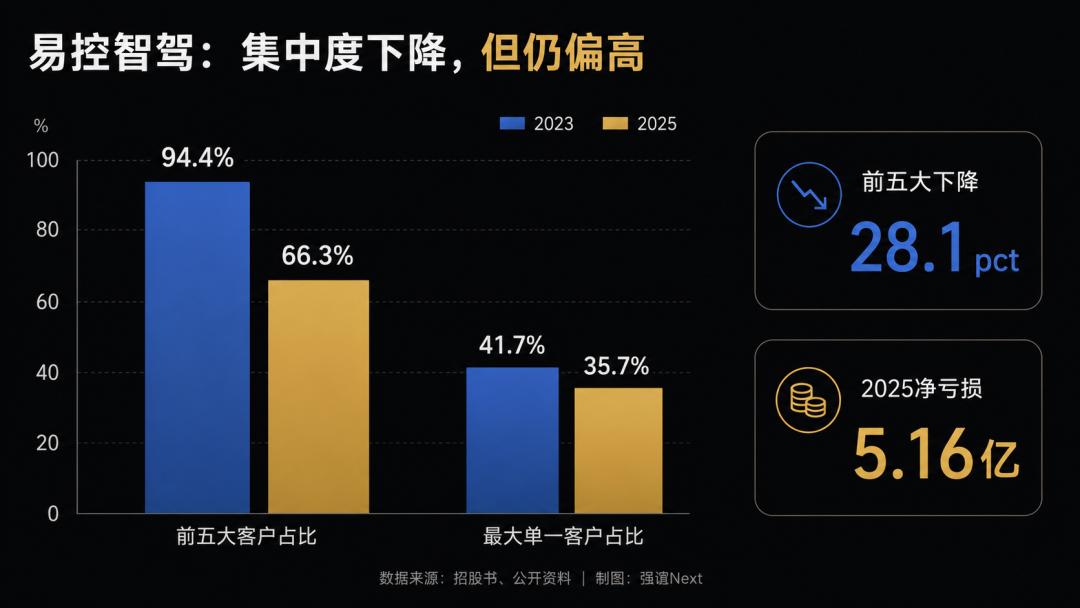
The risks are equally obvious: cumulative losses over three years total approximately RMB 1.24 billion, its top five customers contribute 60% to 90% of its revenue, and its cash reserves at the end of last year stood at only RMB 245 million. Zijin Mining is both its cornerstone investor and downstream client. A large part of its competitive moat comes from scenario data accumulated through deep partnerships with mining giants.
04.
The Ultimate Competition Boils Down to Profit & Loss Statements
In the past, the industry shared a widely accepted understanding: "Huawei captures the high-end market, while Momenta dominates the mid-range". Huawei is tied to mid-to-high-end vehicle brands such as AITO, Luxeed, and Zhijie, while Momenta has secured a broader foothold among automakers. According to data from Zoys Auto Research, as of April 2026, Huawei and Momenta collectively hold approximately 72.8% of China's third-party urban NOA (standard + pre-installed) market. However, the boundaries within this landscape are blurring again, as Huawei, Momenta, and Horizon Robotics all expand downward into lower price segments.
This year, Huawei's ADS system has split its solutions into four tiers: SE, Pro, Max, and Ultra, progressively penetrating lower price ranges.
The entry-level SE tier is a pure vision-based solution, focusing on high-speed NCA and parking assistance, and has already been deployed in vehicles priced as low as RMB 130,000, such as the Deepal L07 (starting from RMB 135,900 after discounts) and the Shangjie H5 Pro (starting from RMB 159,800).
The enhanced Pro tier adds in-cabin lidar vision, extending urban NCA capabilities that were previously exclusive to vehicles above RMB 300,000 into the RMB 150,000–200,000 price bracket. The Wuling Huajing S, which comes fully equipped with the system for free lifetime use, is the most