Tencent, Alibaba and ByteDance redo Office
Tencent, ByteDance, and Alibaba have set their sights on "Work" again.
On July 2, Sina Tech reported that Alibaba is conducting a systematic integration of its Agent product line. Based on QoderWork, it will combine the core capabilities of "Wukong" and "MuleRun" to upgrade into an AI product for enterprise productivity scenarios, under the unified leadership of Chen Yusen, CEO of DingTalk.
Alibaba's response indirectly confirmed this statement. It stated: The existing product services of QoderWork, Wukong, and MuleRun will be seamlessly upgraded in the future, and no user rights will be affected.
Previously, after the discussion sparked by "Immersed in DingTalk", Alibaba carried out personnel and organizational adjustments for DingTalk. On June 11, Chen Yusen took over as CEO of DingTalk. On the 18th, in his first all-staff letter, Chen Yusen announced the merger of Wukong and the AI workspace MuleRun into a new Wukong team.
In the just-concluded June, Tencent and ByteDance advanced their efforts deep into the product layer.
On June 3, Tencent added Teams, project boards, asset libraries, version history, role permissions, task handover, and a message center all at once in the 5.0 update log of WorkBuddy.
Three months ago, the product was publicly positioned as a tool for one person to dispatch a "team of AI experts". Three months later, the expert team gained projects, to-do lists, file cabinets, and handover forms, as well as access controls defining who can edit and who can take over. It no longer looks like a simple assistant, but more like an office that is being furnished.
Six days later, on June 9, ByteDance's TRAE announced the removal of "SOLO" from its product name, officially renaming it TRAE Work.
"This is not just a new name; it reflects TRAE's current positioning: an AI workspace built for all kinds of professionals, not just engineers." The announcement also stated that it initially served independent developers, but later users began to use it to write product requirements, analyze data, formulate marketing plans, organize research reports, and coordinate cross-functional projects.
These events form a clear line: what they are supplementing is not more chat capabilities, but structural capabilities that allow work to continue even after the conversation ends.
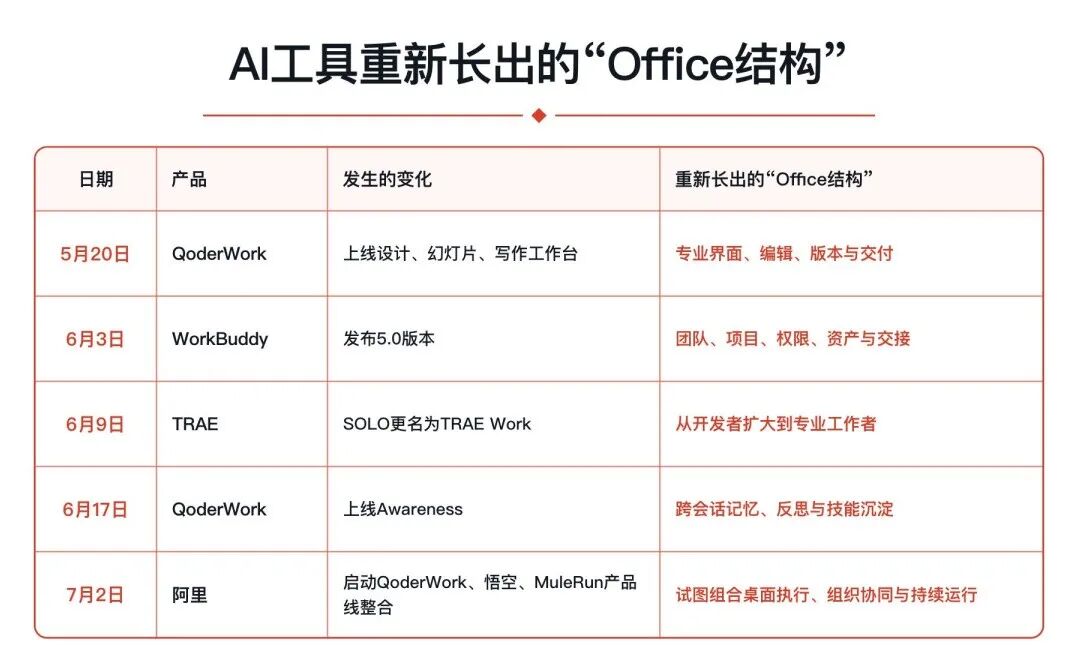
Illustration: HeFen Finance
The "question-and-answer" chatbot products represented by ChatGPT became the model for early consumer-facing large language model products. This also gave rise to a consistent product vision: a person speaks a command, the model understands the intent, the Agent calls tools, and Word, Excel, PPT, and even project management software recede into the background.
But once entering the workflow, people gradually realize that a single "chat box" is far from enough. When Agents enter real work scenarios, documents, canvases, projects, archives, and access controls are all essential elements — features that were once standard in traditional software.
Earlier this year, OpenClaw brought the concept of "letting Agents directly operate computers" into the public view. Users no longer need to open software one by one; as long as they state their goals, the Agent can read files, call browsers, and use other tools.
What truly alerted Wall Street was Anthropic adding a batch of enterprise plugins to Cowork in February. Axios reported that the sell-off triggered by Anthropic's new product caused over $400 billion in market value losses within a week, with the software sector hit the hardest. The market suddenly began to worry: If an Agent can complete an entire workflow across multiple software applications, will enterprises still continue to purchase separate SaaS seats for each individual step?
Yet Agents, which once dealt a heavy blow to traditional software and have long been trying to reduce manual software operations, have eventually grown into another kind of "Office" themselves.
1
The Chat Box Can No Longer Contain Work
The more capable an Agent is of executing tasks, the less its permissions and processes can remain hidden.
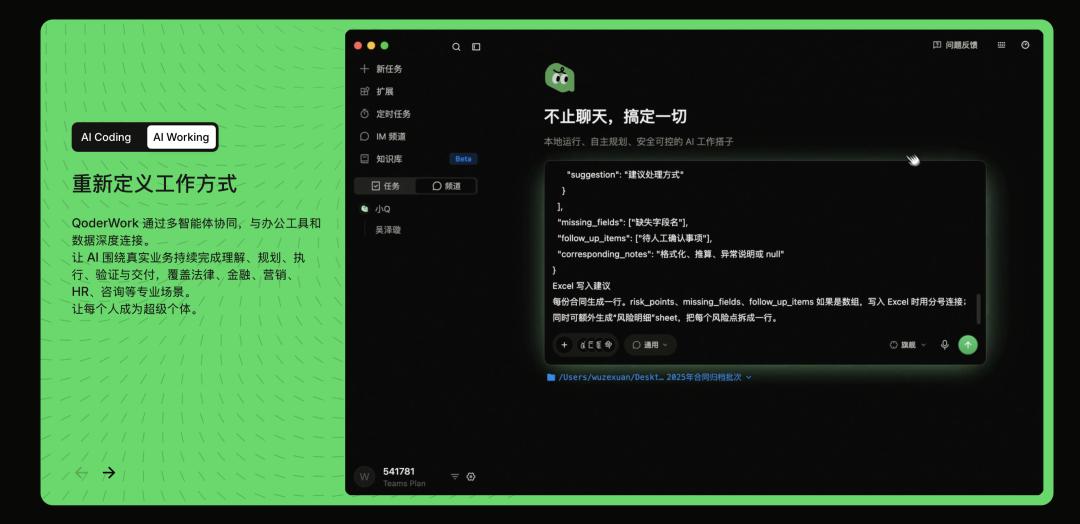
On May 20, QoderWork launched three "custom workbenches" for design, slides, and writing. On its official website, QoderWork directly refers to the chat box as the "1.0 form" of AI products. It argues that while the chat box solved the problem of access, it failed to address the issue of bearing work results: "The fundamental contradiction is that the outputs, processes, and quality requirements of professional work cannot be effectively expressed through a generic dialog box."
Screenshot from QoderWork official website
In real work scenarios, the chat box quickly becomes insufficient.
Design drafts require repeated adjustments, PPTs need page-by-page modifications, and documents must be continuously supplemented. A project often takes weeks to follow up, and brand assets and business knowledge need to accumulate over time — rather than starting over from scratch every time a new conversation is opened.
The end result is that the chat box often only outputs a piece of text. The generated text still needs to be copied into a document, the created spreadsheet needs to be reorganized, and even the PPT has to be produced in separate software. While it can help you brainstorm and write, it can hardly directly deliver a usable final product.
This challenge did not just emerge this year.
In June 2024, Claude placed Artifacts next to the chat box, allowing generated web pages, charts, and documents to be viewed separately and further edited. In September, Microsoft launched Copilot Pages, turning one-time responses into editable, shareable pages. In October, ChatGPT also rolled out Canvas, freeing writing and programming projects from the chat flow.
The answers given by these major tech companies at the time were very clear: chat is for communication, while work outputs need their own dedicated space.
QoderWork's approach is to place workbenches back next to the chat box. For example, when designing, there is a canvas for adjusting details; when creating PPTs, each page can be edited individually and exported as PDF, HTML, or PPTX; when writing articles, there is an independent document area that supports selection, annotation, rewriting, and instant version recovery.
For another example, to create a roadshow PPT, users can first ask the Agent to draft an outline, then select themes and images, and even enter a specific page to modify the title, replace images, or adjust the structure. QoderWork saves each page as an independent HTML file that can be manually edited and compared across versions; after completion, it can be exported as PDF, HTML, or PPTX.
Chat remains the place to initiate tasks, but the real work has shifted to the adjacent area that allows repeated modifications. This is not simply adding three skins to a chat box. It acknowledges a fundamental truth: A single sentence can start a task, but a conversation can hardly become the final deliverable.
On June 17, QoderWork launched Awareness, adding cross-session memory, reflection, and skill accumulation capabilities to the product. The system can remember what users have done and their preferences, and reuse this information in the next task; experiences summarized during execution can also be saved as reusable skills.
It seeks to preserve not just a single file, but the accumulated experience that can be read, modified, and reused in future work.
Tencent's WorkBuddy, on the other hand, focuses on supplementing collaborative relationships.
At the 2026 Tencent Cloud AI Industry Application Conference on June 5, WorkBuddy Enterprise AI Workspace was officially released.

Under this product logic, the Agent no longer only faces a single commander, but a team that requires division of labor, task handover, and traceable records. Three months before the release, the product logic was still that a single user interacts with a group of AI experts.
In Teams, project leaders can first create projects, invite members, and arrange tasks on the kanban; members and Agents share a common project asset library, where file modification history can be viewed in the version timeline, and progress updates are displayed in a dynamic timeline. When someone leaves or the division of labor changes, tasks can be handed over to the next member along with all their context.
What is newly added here is not just a few collaboration buttons, but a complete team workflow that supports division of labor, task handover, and traceability — transforming what was once a conversation between a single person and an Agent.
At the same conference, Tencent disclosed specific results of the synergy between its model and product: after integrating Hy3 Preview, WorkBuddy's first response speed increased by 54%, and the average task completion time was shortened by 47%.
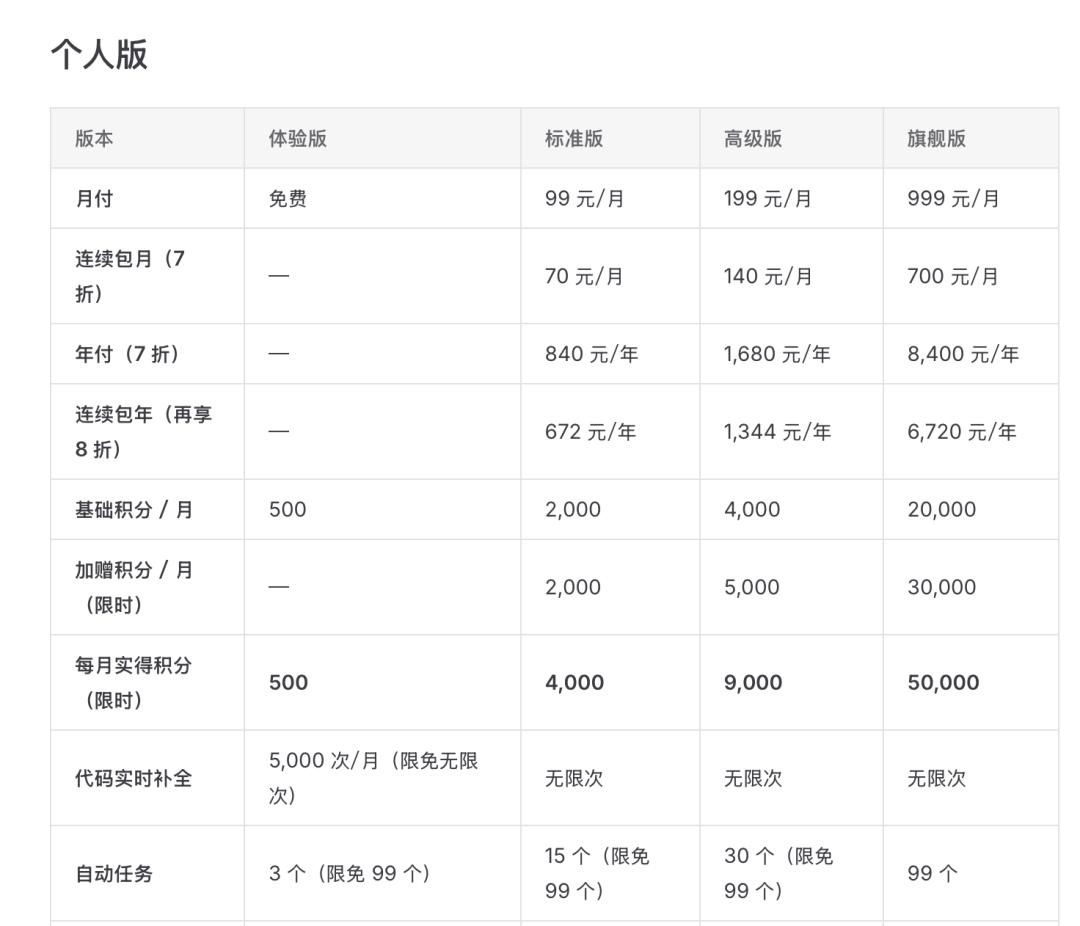
The new pricing effective on July 1 also reveals the product's direction.
WorkBuddy's personal paid plan has expanded from a single tier to three tiers at ¥99, ¥199, and ¥999; different tiers not only distinguish credits and model access, but also limit the number of automated tasks, personal assistants, projects, and members per project. Pricing now measures both model resources and project/team capabilities.
Screenshot of WorkBuddy personal edition pricing from official website
ByteDance's TRAE took a more direct approach by simply changing its name.
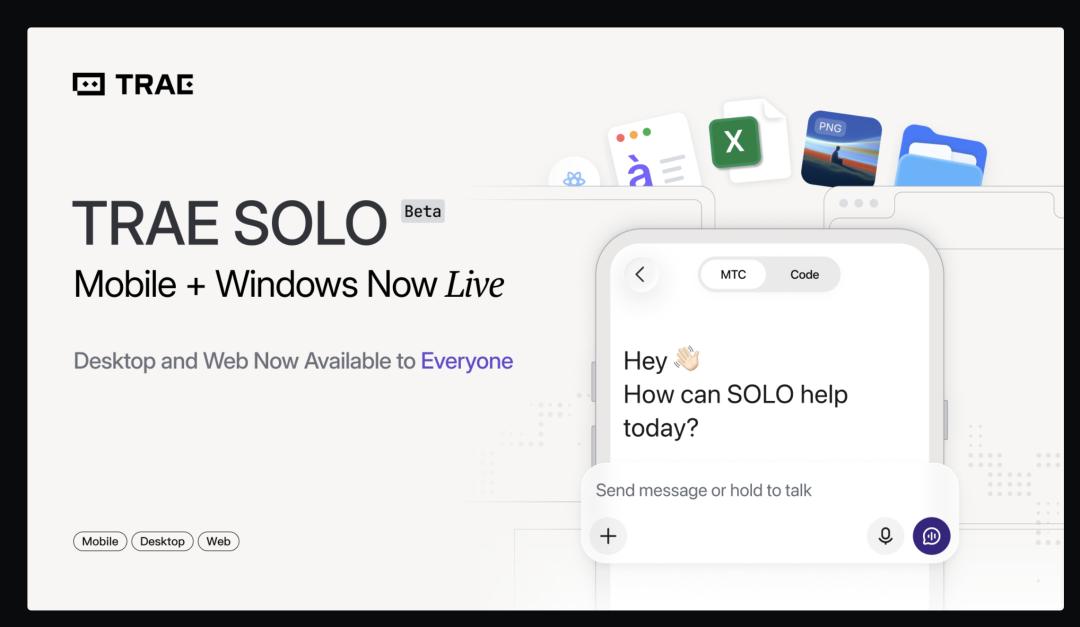
From its independent launch to the name change, only a little over two months passed. On March 31, the new SOLO began invitation-only testing as an independent desktop and web application. On May 6, Windows and mobile versions were launched, removing the invitation code requirement across all three platforms. On June 9, it was officially renamed TRAE Work, while retaining both Work and Code dual modes.
The official page emphasizes global file management, multiple delivery formats, and the division of labor of "user defines tasks, AI executes, and user checks results".
On June 25, TRAE Work added the Design mode. Taking product prototyping as an example, users can first sort out requirements in Work mode, then switch to Design mode to generate design drafts. If there is an existing Figma file, it can directly extract brand colors, fonts, and component specifications. After the design draft is generated, users can select specific elements to continue modifying, and finally switch to Code mode to turn the prototype into a functional product.
From requirements and design to coding, work that was previously scattered across different software applications is now integrated into the same context. The changes to TRAE Work are far more than just a simple name change.
Screenshot from TRAE official website
The three products come from Alibaba, Tencent, and ByteDance respectively, but they all arrive at the same conclusion through different paths: Natural language can unify the task entry point, but it cannot unify work outputs.
Indeed, conversation can be the entry point for work, but it can hardly become the container for work.
Work software like Office and Microsoft 365 have long endured, not just because users are accustomed to Word and Excel; in enterprises, work outputs often need to become organizational objects that can be edited, authorized, rolled back, and audited.
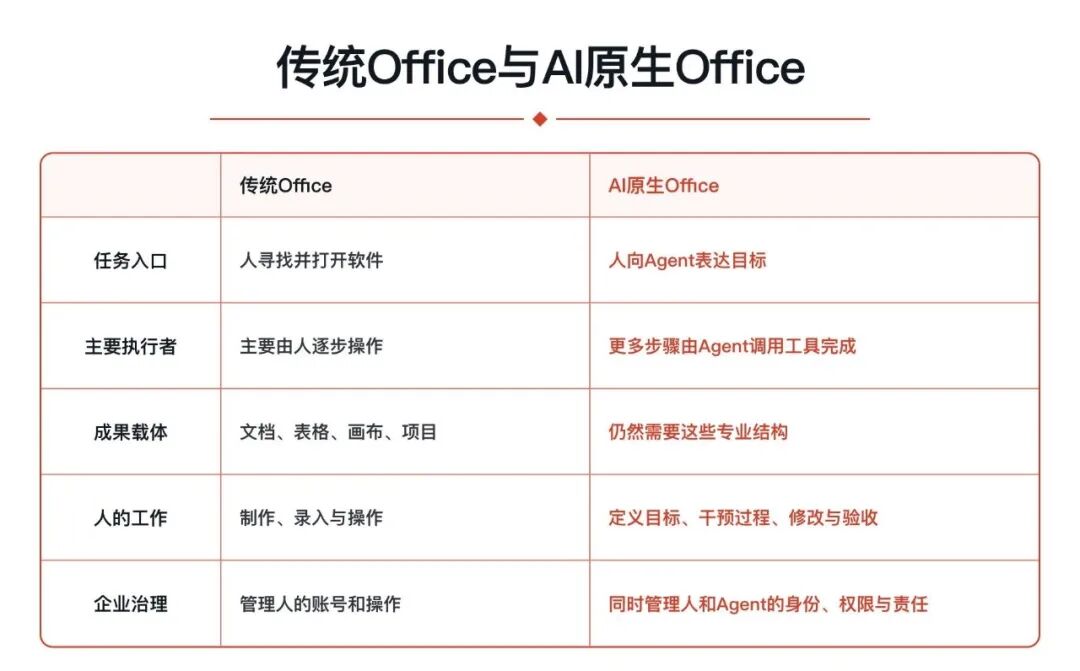
Illustration: HeFen Finance
2
Programming Agents Collectively Shift to Office Scenarios
Interestingly, these products did not naturally evolve from traditional OA or collaborative office teams.
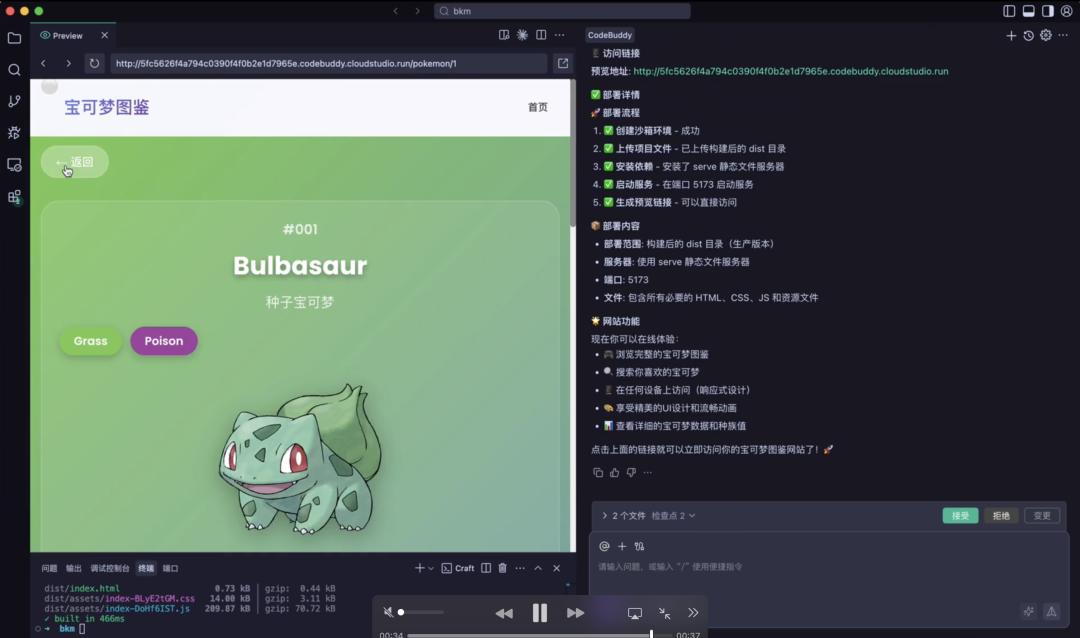
The origin of WorkBuddy can be traced back to January 17, 2026.
On March 13, Wang Shengjie recalled that weekend in an interview. It was a Saturday, and product leader Wang Shengjie and several colleagues worked two consecutive all-nighters to launch the 0.01 version. The team previously developed CodeBuddy, Tencent Cloud's AI code assistant.
Screenshot from WorkBuddy related video
Tencent also disclosed that before the official release of WorkBuddy, over 2000 non-technical employees had participated in its usage. After the public beta on March 9, traffic quickly reached several times the usual volume of CodeBuddy, pushing computing resources to the warning threshold and prompting the team to urgently expand capacity.
From this account, it is not difficult to see that WorkBuddy was not planned under the framework of existing office software. Its development is closer to "AI-native", a product extended by a programming product team to general work scenarios.
This also explains the predicament DingTalk once faced, and Alibaba's subsequent trade-offs.
Compared with WorkBuddy, Alibaba's QoderWork has a more direct origin. According to the review on Qoder's official website, QoderWork completed its first version launch on January 30; on February 12, the team officially released the product to the public through the website.
"No product manager wrote PRDs, no front-end/back-end division of labor, 5 people completed in 7 days what traditionally requires 15-20 people several weeks of work. This is not science fiction, but the real experience of the Qoder team using Quest to develop QoderWork." According to the team's review, the development process extensively leveraged Quest's capabilities for task decomposition, parallel development, and code review.
TRAE has an even larger developer user base.
On December 25, 2025, TRAE released its "2025 Annual Product Report" on its official website. The report defined 2025 as "the year from 0 to 1". Corresponding data showed that as of the report's release, TRAE had 6 million total registered users, covering nearly 200 countries and regions worldwide, with