The "tough-guy version" of lululemon raked in 1.8 billion, winning over hordes of middle-class men
"A no-nonsense middle-class tough guy spends 1.8 billion yuan a year on Dragon Tooth."
The first time many people hear this, they wonder: Even Arc'teryx has never labeled its users as "middle-class tough guys," so how does Dragon Tooth dare to make such a claim?
But once you realize it operates in the "tactical apparel track," that confusion shifts into new curiosity: What exactly is tactical apparel? Why would a seemingly niche category appeal to the middle class?
Tactical apparel can be understood as performance-focused functional clothing. Compared to regular garments, it prioritizes durability, stain resistance, cold protection, storage capacity, and freedom of movement. In other words, it cares less about how a piece of clothing looks, and more about how well it can perform under pressure.
As one of the representative brands in this track, Dragon Tooth was initially seen as serving "a group of middle-class men with hero dreams." That's why on social media, it's nicknamed the "tough-guy version of lululemon."
No one expected this seemingly niche community to produce a dark horse amid the clothing consumption downturn.
According to Dragon Tooth's partner Xin Sheng Strategic Consulting, Dragon Tooth's revenue reached 1.8 billion yuan in 2025. It took only two years for the brand to grow from 800 million yuan to 1.8 billion yuan. During the 618 shopping festival in 2026, Dragon Tooth even ranked sixth on Douyin's men's apparel list, surpassing traditional menswear brands such as BIEM.L.FDLKK, Shanshan, and Septwolves.
Capital has also entered the scene. Media professional Yao Lan revealed that tactical apparel brand Dragon Tooth has completed a financing round totaling over 100 million yuan, with investors including Qichong Capital, Peak Capital, and Black Ant Capital.
While the public widely assumes women are the main force in fashion consumption, and the menswear market is nothing more than a competition between HLA and UNIQLO, Dragon Tooth presents a different answer:
It turns out that "men's hero dreams" can also be monetized into a large-scale business.
"Touched the soft spot of tough guys"
In late autumn 2024, legendary Russian pilot Sergey Bogdan flew a Su-57 fighter jet to perform at the Zhuhai Air Show. On his way back to Russia, he made a stopover in Taiyuan.
After landing, he walked straight into a Dragon Tooth store, shopped for four hours, and left with a full bag of clothes.
The incident quickly spread through the apparel industry. On social media, discussions like "This pilot has seen all kinds of professional gear, yet he specifically came here to buy clothes" gave Dragon Tooth a wave of unexpected viral traffic.
But looking back at Dragon Tooth's origins, you'll find that this professionalism and military heritage were embedded in the brand from its very beginning.
Jiang Lei, founder of Dragon Tooth, was born into a military family. His grandfather was a Korean War veteran. As a child, while his classmates saved money for snacks and comics, Jiang spent all his pocket money on military magazines.
At 16, Jiang Lei was admitted to Tsinghua University's Department of Materials Science through a recommendation. During college, when the military novel he was following stopped updating, he built his own military forum. That forum later became one of China's most influential vertical military communities: Tiexue (Iron Blood) Net.
While running the community, Jiang Lei noticed an overlooked demand: tens of thousands of active users, beyond discussing equipment, repeatedly expressed a latent desire to own a genuine "tactical garment."
It's similar to how fans of ancient Chinese styles want Hanfu, and anime fans want cosplay costumes. The underlying consumption logic is not just buying a piece of clothing, but buying an identity fantasy.
In 2006, Jiang Lei decided to give it a try. He spent over 10,000 yuan of his own money to import 17 M65 jackets from the United States. Originally a U.S. military uniform, this jacket became famous after Schwarzenegger wore it in movies like *The Terminator*.
Back then, the functional apparel trend hadn't taken off in China yet. Jiang Lei wasn't sure if he could sell these not-cheap professional jackets.
But the enthusiasm of military fans exceeded expectations. On the first day the jackets went on sale, 11 were sold. This incident deeply moved Jiang Lei. In 2011, after being recommended for a combined master's and doctoral program at Tsinghua, he decided to drop out to officially found Dragon Tooth, betting everything on tactical apparel.
His background in materials science gave him a unique perspective on clothing. According to Dragon Tooth's early documentaries, the brand had no traditional designers, because Jiang Lei didn't focus on aesthetics. The product appearance reflects this: no special cuts or patterns, colors are mainly black, white, and gray, and logos are almost invisible.
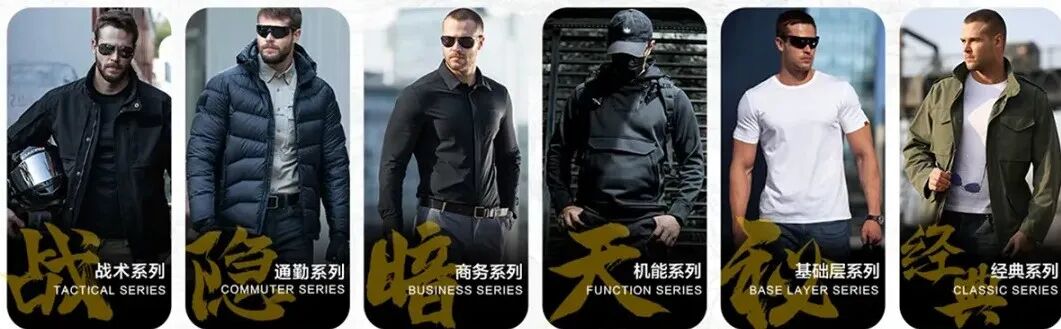
Screenshot from Dragon Tooth's official flagship store
Dragon Tooth's brand narrative mostly revolves around fabrics. For example, the wear-resistant Cordura fabric, the highly breathable 20D Wind Tunnel technology fabric, double-sided woven soft-shell fabric, and long-lasting anti-static conductive silk textile technology. Even on e-commerce product detail pages, Dragon Tooth talks in technical jargon like tear strength and fabric weight.
Over time, even fans began to joke: "If Arc'teryx is the brand that goes outdoors with me, Dragon Tooth seems genuinely worried that I'm heading to a battlefield." After all, it's hard to find a jacket on the market like Dragon Tooth's, made of 218 fabric pieces, with 12 main pockets and 4 inner tactical pockets, "as if designed for me to hide hidden weapons."
Marketing has also continued this tough-guy narrative. In 2025, Dragon Tooth brought on Zhang Yi, who built a tough-guy on-screen image through films like *Soldier Sortie* and *Operation Red Sea*, as its brand ambassador.
In the early years, someone asked on a forum: "Why did you get into Dragon Tooth?" One comment read: Dragon Tooth "fills the imagination space for a life of action."
This line sounds a bit overly dramatic at first, but it fits perfectly with Dragon Tooth's growth trajectory.
Just as adults still yearn for Disney, middle-class tough guys need their own "spiritual uniform."
"Tactical Commute"
However, one question is unavoidable: In today's materially abundant world, is a pair of indestructible pants really a rigid demand for ordinary people?
Since Dragon Tooth's founding, such doubts have persisted. Back in 2012, some media described it as "a niche community on the internet."
If Dragon Tooth's value was only rooted in the emotional projection of military fans, it would probably remain a lonely garment hanging in the closet. But by 2026, the tide had clearly turned.
In Dragon Tooth's Douyin flagship store, multiple products have sold over 400,000 units. The brand revealed that over the past two years, its user base has grown from 9 million to 30 million.
This means Dragon Tooth is no longer just a private gear for military fans, but has entered the mainstream. Its consumer group has expanded from military enthusiasts to a broader audience of trend-conscious people.
Related data shows that around 2022, Dragon Tooth's Douyin consumer profile was over 95% male, with those aged 31-40 accounting for more than 40%, and those aged 41-50 close to 30%.
Thus, some argue that Dragon Tooth's expansion into the mass market is simply catering to middle-aged men's consumption preferences: prioritizing cost-effectiveness over fashion, and sticking to basic styles.
But if it were that simple, Dragon Tooth wouldn't be the only one succeeding.
The more critical change is that in the past two years, the number of new white-collar workers among Dragon Tooth's consumers has increased by over 400%, and the number of high-income middle-class people has risen by 140%. In other words, young urban middle-class people are also starting to wear tactical apparel.
They may not have a military complex, nor do they need to climb mountains or dive into the sea. What truly attracts them is that Dragon Tooth has translated "tactical" into everyday life. In recent years, Dragon Tooth has launched shirts, casual pants, and dress pants suitable for city life. As a result, a new term has emerged on social media: Tactical Commute.
"Why do we need 'tactical' for work too? Probably to avoid splitting our pants when squatting, since we all want to be a decent office worker," one netizen joked.
This meme likely originated from a Dragon Tooth pant design: an extra diamond-shaped gusset stitched at the crotch, which releases fabric tension, prevents tearing, and improves freedom of movement. Originally designed for high-mobility scenarios like rock climbing, through online jokes, Dragon Tooth gradually became associated with "relaxed office life."
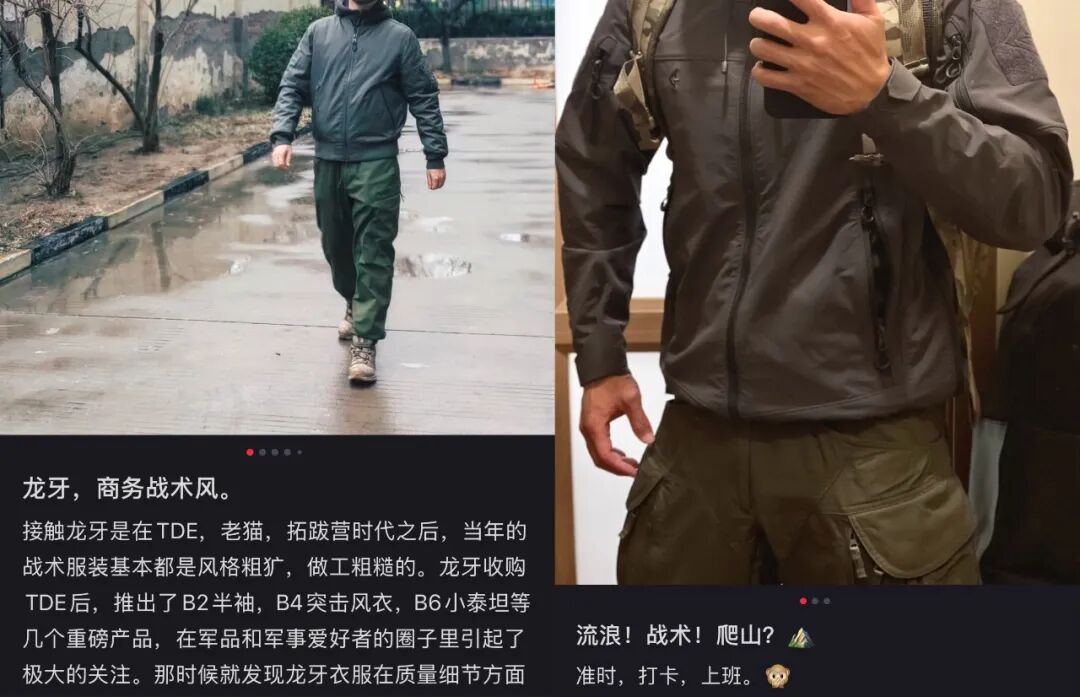
Examples of solving these "overlooked demands" can also be found in Dragon Tooth's sizing system.
For a long time, whether for men's or women's wear, the apparel market has had a pain point: it's hard to find perfectly fitting clothes. The pants might be the right length but the wrong waist size; or the waist fits but the crotch is too tight. The reason is simple: most clothing brands, to save costs, only offer 8 to 15 sizes, with noticeable gaps between each size.
Dragon Tooth seized this gap. It launched a "23-size long pants system," with some casual pants even having 32 sizes, separating waist size from pant length adjustments. This near-"custom-tailored" strategy has attracted a lot of consumers. Some people buy Dragon Tooth not for high-risk sports, but simply because it's easier to find pants that fit.
Besides, the price doesn't shut out ordinary consumers. Tmall flagship store data shows that core tactical pants are priced from 350 to 630 yuan, short-sleeve T-shirts from 150 to 380 yuan, and only some down jackets and windbreakers for cold weather cost over 1,000 yuan.
This is the key to Dragon Tooth's breakout: it didn't keep "tactical" confined to military fans' imaginations, but broke down the hero dream into ordinary people's specific needs.
Durability means no more frequent pants replacement; multiple pockets mean convenient storage for commuting; movement gussets make sitting, squatting, and cycling more comfortable; a complex sizing system finally lets middle-aged men find pants that fit.
However, once any niche brand goes mainstream, it faces the same test:
Is the tactical garment it sells now still the same as the original one?
You can't "have your cake and eat it too"
"Dragon Tooth's tactical vibe is fading. It's becoming 'old-fashioned' and trying to lecture consumers."
Recently, discussions about Dragon Tooth's wide-leg pants emerged on social media. The issue started when a consumer, following current fashion trends, asked Dragon Tooth's staff if they would launch a wide-leg cut, only to be told that wide-leg pants don't meet tactical requirements.
Around the same time, Jiang Lei, via his personal account "Principal Jiang," said Dragon Tooth would launch loose-fit pants in 2026. But half a year later, the product still hasn't officially appeared.
This was originally a small online episode, but it sparked a debate over whether Dragon Tooth's positioning is starting to wobble.
One group of consumers argues that Dragon Tooth sticking to its tactical positioning and not blindly chasing trends helps maintain brand differentiation; the other group believes that since Dragon Tooth has decided to go mainstream, it can't just expect the public to understand the brand.
Especially since one of the reasons Dragon Tooth won over ordinary consumers is that it seriously addressed many pain points ignored by traditional menswear. But when users put forward new wearing demands, if the brand only responds with "tactical requirements," it will inevitably seem awkward.
The real underlying question is: What kind of company does Dragon Tooth actually want to be?
In 2026, Dragon Tooth replaced its 47-year-old brand ambassador Zhang Yi with 59-year-old Guo Tao. The public interpreted this as Dragon Tooth wanting to refocus on mature men and reinforce its "middle-class tough guy" brand image. If this judgment holds, then not launching wide-leg pants in the short term makes logical sense.
But on the other hand, growing complaints about "declining quality control" show that Dragon Tooth hasn't fully retained its old users.
Most of these controversies focus on workmanship flaws and fabric quality changes. Longtime users have posted comparison photos of products from different batches, noting that newer versions differ from earlier ones in fabric rigidity and stitching density.
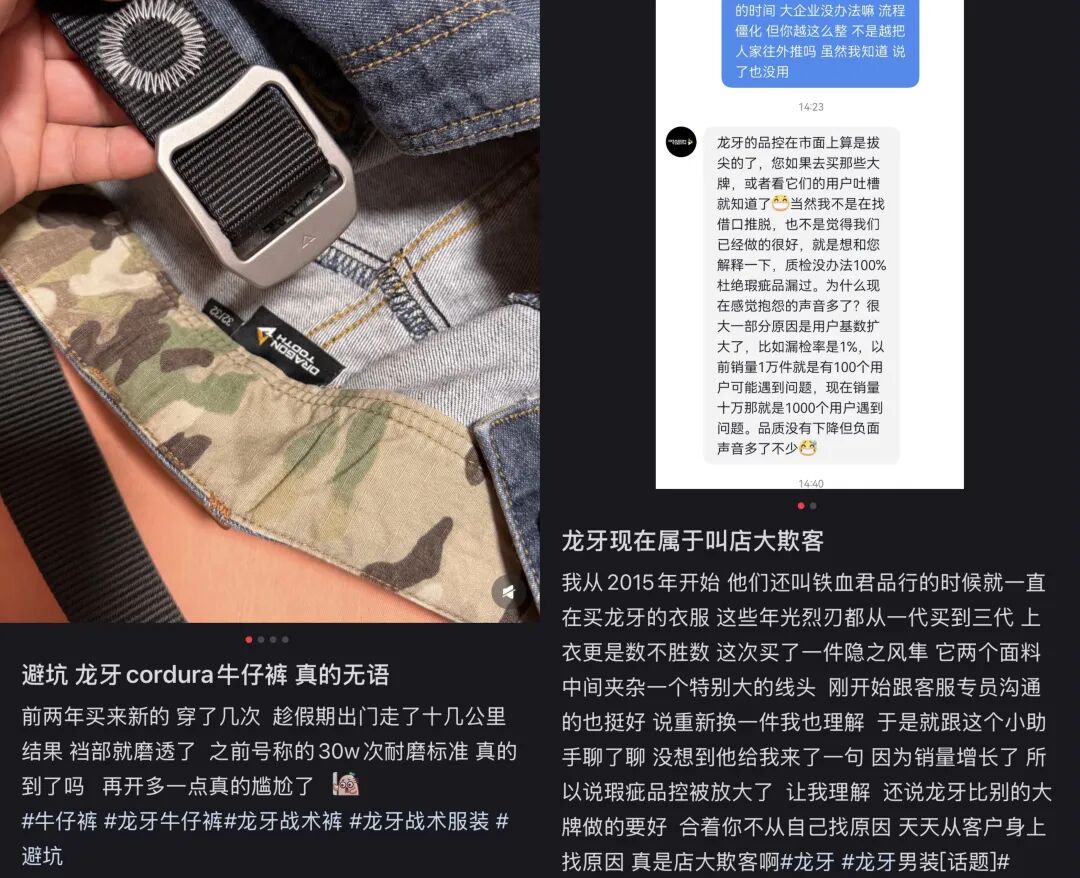
Dragon Tooth has actually acknowledged these quality fluctuations. Under a social media post accusing the brand of "using lower and lower quality materials while raising prices," customer service responded: "Woven fabric products have experienced some fluctuations due to production expansion, and we are working hard to rectify the situation."
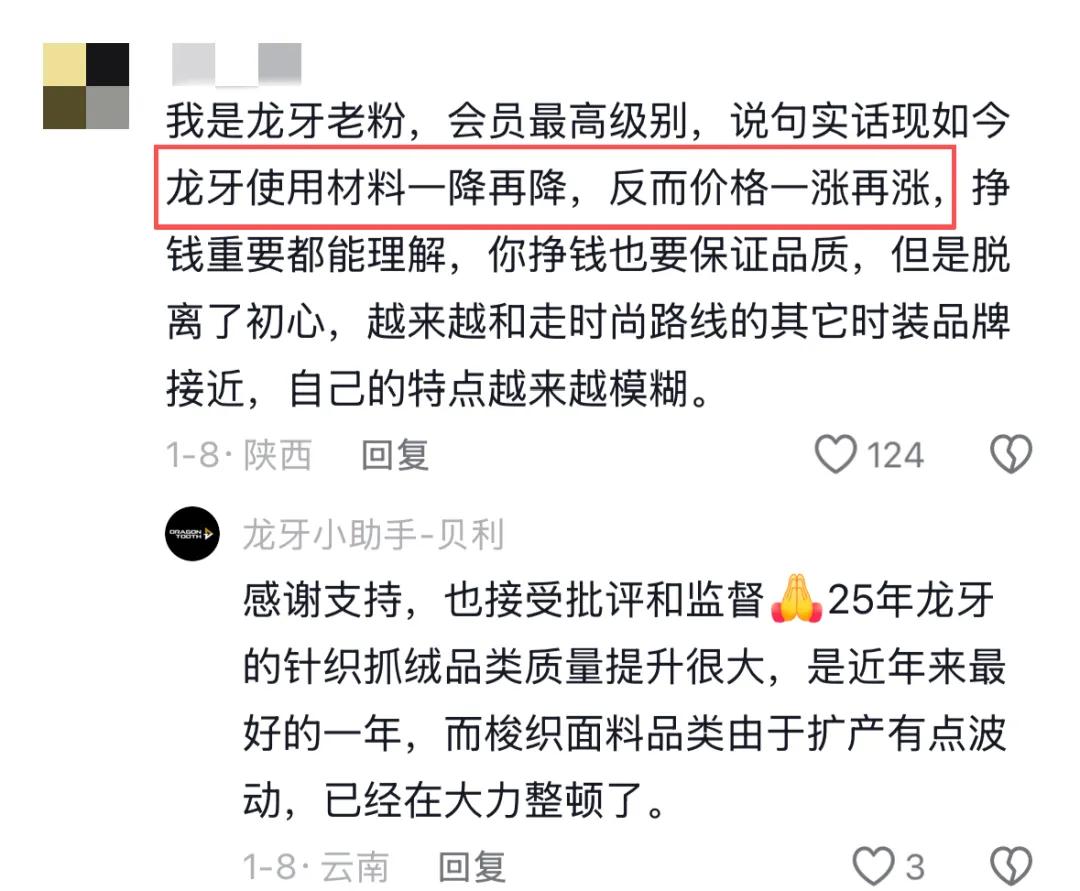
Even so, longtime fans still feel that Dragon Tooth, in its push into the mass market, has weakened some of its fabric technology advantages. But that was exactly the key factor that drew old fans in, and Dragon Tooth's core brand asset.
After all, Dragon Tooth doesn't rely on visual symbols like streetwear brands to create premium value, nor does it rely on historical stories like luxury brands to maintain fantasies. What Dragon Tooth has long built is a trust: "low-profile, but highly capable." Once this trust in fabrics falters, consumers will ask a sharper question:
If Dragon Tooth is no longer that hardcore, why should people keep buying it?
This is Dragon Tooth's most delicate situation right now.
It wants to build a lifestyle brand while maintaining its reputation in the professional field; it wants to scale up without fully catering to mass demands; it hasn't truly integrated into young trendsetters, yet some old users feel its professionalism is being diluted.
If this imbalance continues, Dragon Tooth could end up pleasing no one.
What's more, the tactical apparel track has started to heat up.
Domestically, there are "pure-blood players" like Arc'teryx's tactical line Arc'teryx LEAF and European tactical brand Helikon-Tex. Meanwhile, outdoor brands like Camel have also been launching "pan-tactical products" with multiple pockets, durability, and water repellency.
Especially in June this year, Sanfo Outdoor opened a tactical outdoor flagship store in Beijing, gathering professional brands like Mystery Ranch, 5.11, and Danner. Its sub-brand X-Bionic also launched the Tactical Outdoor series, using elements like camouflage and tear resistance to strengthen tactical associations and further penetrate the market.