New luxury boutiques are flocking to outlet malls.
GUCCI Exits in Batches, While More Luxury Brands Rush In. The Wave of Luxury Outlet Store Openings Unfolds Amid a Market of Stark Contrasts.
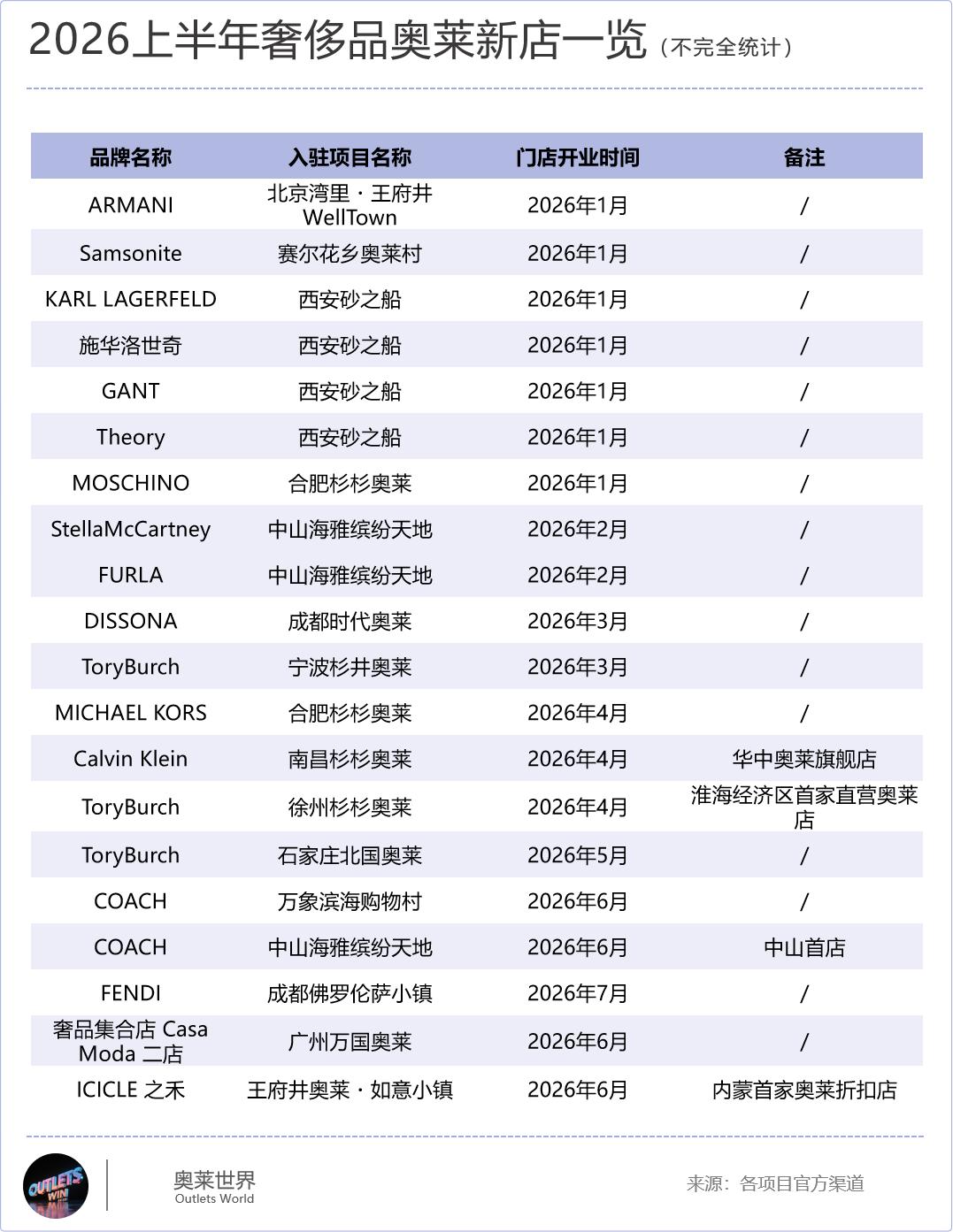
Winshang's tracking statistics of over 80 key outlet projects nationwide show that in the first half of this year, more than 30 new or renovated luxury brand outlet stores opened. Chain and regional outlet operators including Shanshan, Sasseur, Bailian, Times Outlet, The Mall, and Beiguo Outlet are all vying to attract new luxury brand tenants.
Among them, the "Big Three of Outlet Luxury" — COACH, MICHAEL KORS, and Calvin Klein — are going all out, deploying heavy resources in the outlet channel through new and renovated stores.
Additionally, Tory Burch has opened three new outlet stores this year, while brands such as ARMANI, "China's MaxMara" ICICLE, and FENDI have also launched new outlet locations one after another...
The core of competition in the outlet industry ultimately boils down to a contest over the lineup of high-end luxury brands and the tier of resources. After all, luxury brands are not only the "traffic engines" that drive foot traffic across the entire venue, but also the "golden signboards" that define the project's market positioning.
So what is driving this boom of luxury outlet store openings? What differences exist in the site selection logic and channel strategies for luxury outlet stores of different tiers? Using over 110 outlet projects and more than 680 luxury stores as exclusive samples, this article dissects the secrets behind luxury outlet locations.
01.
Why Are New Luxury Stores
Flocking to Outlets?
The surge of new luxury stores into outlets has broken the sector's long-standing reputation as "very important but extremely inactive." This is no sudden development, but a joint outcome of shifting consumer demands, brand strategy adjustments, and the inherent operational cycle characteristics of outlet malls.
Surge in Demand for "Affordable Luxury"
The *2025 Altagamma - Bain Global Luxury Market Monitor* points out that the ultra-high-net-worth class has significantly reduced pure material luxury spending, instead turning to premium experiences in travel, hospitality, and sports.
At the same time, affordable luxury fashion is rebounding strongly, as brands successfully attract downward-trading consumers, re-engage traditional customer relationships, and capture cost-conscious Gen Z shoppers.
Against this trend, outlets have successfully attracted a large number of consumers pursuing "value for money" by offering accessible luxury products, demonstrating far greater growth resilience than other physical retail channels such as shopping malls and department stores. Clearly, increasing investment in outlet channel deployment has become a rational move for luxury brands to adapt to market trends.
Full-Price Store Channels Contract, While Luxury Brands Double Down on Outlets
Driven by the "conservative strategy" of luxury brands, their overall deployment of full-price stores in shopping malls is shrinking. Winshang Big Data shows that the opening-to-closing ratio for luxury stores in shopping malls (excluding outlets) was 0.56 last year, and 0.58 in the first half of this year — meaning "once a store closes, it is rarely replaced."
Seeking new growth opportunities, these brands are adjusting their channel weightings, increasing investment in high-quality secondary core channels, and setting their sights on outlet malls. According to incomplete statistics from Winshang Big Data, across over 540 commercial projects nationwide with more than 3,900 luxury brand stores, outlets account for over 680 locations, representing approximately 17.5% of the total.
This shows that outlets are one of the three core commercial formats where luxury brands concentrate their presence. No longer a simple clearinghouse for overstock, outlets have become the most important strategic supplementary channel.
Benchmark Outlets "Upgrade Status," with Luxury Brands as Their Strongest Asset
With four REIT products now in place in the outlet industry, the sector has entered a "big year of asset management," shifting its operational logic entirely to the two core goals of long-term asset appreciation and stable cash flow.
Projects boasting a matrix of rare luxury and high-end brands significantly outperform other outlets in terms of subscription popularity, asset valuation, and long-term rental premiums. Therefore, leading benchmark projects are strengthening their luxury brand portfolios as a core lever for asset quality improvement.
According to incomplete statistics from Winshang, all outlet projects that have completed new luxury store openings or renovations this year are national or regional benchmarks, including Qingpu Bailian Outlet, Ningbo Shajing Outlet, Xi'an Sasseur, Beiguo Outlet, and Chengdu Times Outlet. With years of operational accumulation, a solid customer base, and mature membership systems, these projects have stable operational fundamentals, stronger qualifications for status elevation, and can secure more "headquarters-to-headquarters" cooperation resources with luxury brands, forming a hard-to-replicate asset moat.
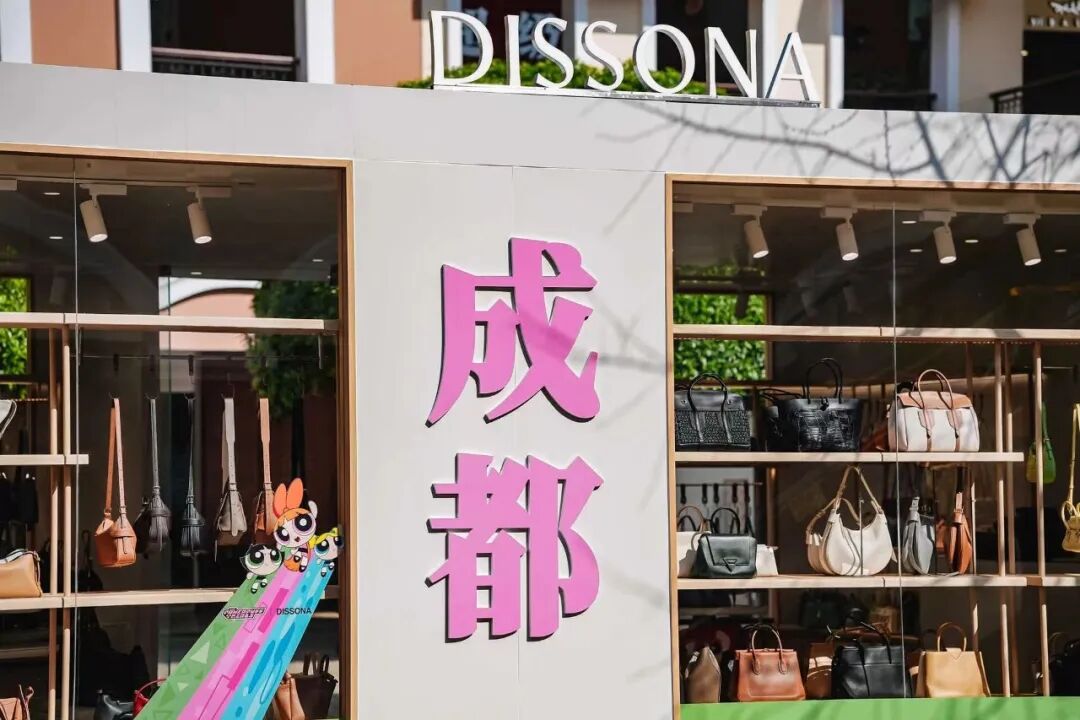
New DISSONA Store at Chengdu Times Outlet
02.
Luxury Outlet Site Selection: "Monopoly is King"
The competition among outlets for luxury brands is a brutal "jungle war." Luxury brands that follow the risk-averse strategy of "winning through stability" strictly adhere to the iron law that "only the strong are worthy of the strong."
Currently, of the over 680 luxury outlet stores in China, the top seven leading chain outlet operators including Sasseur, Shanshan, Bailian, Capital Land, and The Mall hold over 500 locations, accounting for more than 70% — demonstrating strong monopolistic characteristics.
Specifically, the two Bicester Village locations together account for 10.2% of the total. The 6 The Mall projects in mainland China capture over 19% market share. Bailian, Shanshan, and Sasseur rely on their scale advantage, each holding 10~11% of luxury outlet stores.
Partnering with leading chain outlet operators is the optimal path for luxury brands to expand their outlet channel scale, enabling deep strategic-level cooperation terms such as headquarters-to-headquarters partnerships, annual store opening frameworks, exclusive outlet-exclusive products, and regional exclusive store rights.
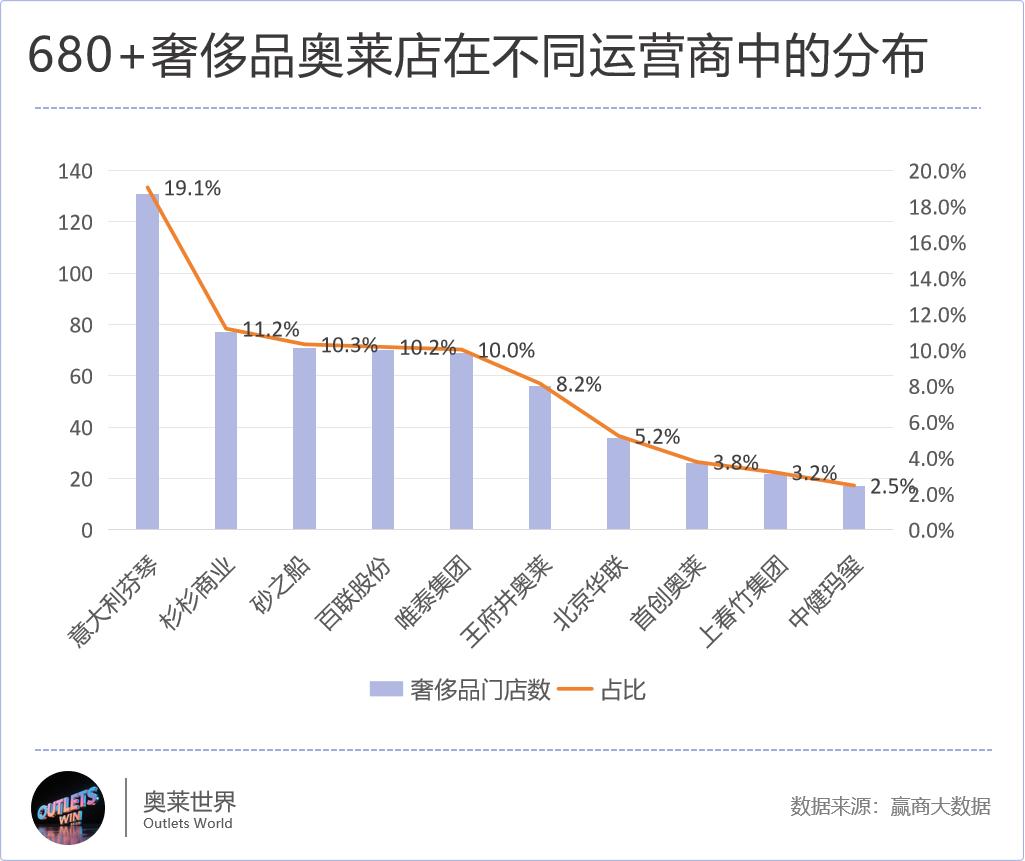
Upon in-depth analysis of the site selection logic behind these 680+ luxury outlet stores, we find that under the "monopoly is king" rule, they exhibit more specific preferences when choosing cities and projects.
Cities: High-Tier Cities Take the Lion's Share, Third-Tier and Below Get the Leftovers
Of the 680+ luxury outlet stores, first-tier and quasi-first-tier commercial cities account for a combined 480+ locations, over 70% of the total. Second-tier commercial cities host 120+ luxury outlet stores (about 18%), while third- to fifth-tier commercial cities make up merely 11%.
The city selection criteria for luxury outlet stores almost perfectly overlap with those for full-price luxury stores, rooted in luxury brands' unified customer screening and channel risk control logic.
Full-price stores anchor core business districts to build brand image, while outlet stores in suburban areas handle brand inventory. Only cities with a sufficient number of full-price stores and stable operations can generate enough overstock and discounted products to supply local outlet locations.
Zooming into individual cities, those with 10+ luxury outlet stores are mostly first-tier cities, provincial capitals, and core second-tier cities. Among them, Shanghai and Beijing lead by a wide margin with 99 and 84 stores respectively, driven by abundant outlet projects (10+), large urban populations, and strong consumption fundamentals derived from their high city tier.
Despite growing talk of "outlets expanding into lower-tier cities" in recent years, luxury brands have very low willingness to penetrate these markets. While consumption power in some third- to fifth-tier cities has seen partial surges, their overall scale, sustainability, and stability are insufficient to support full-price counters, making it impossible to sustain a large number of luxury outlet stores.
Projects: Target Leading Locations to Ensure Maximum Operational Stability and Minimum Risk
Luxury outlet store site selection follows the Matthew Effect, concentrating in top benchmark projects. There are approximately 20 outlet projects hosting 10~30 luxury brands, among which The Mall takes 4 spots, while Bailian and Sasseur each have 3.
The 30+ tier consists of a small number of "top-tier outlet projects": only Florence Town Tianjin, Bicester Suzhou and Shanghai, and Badaling Outlet backed by SKP. These locations hold massive luxury authorization barriers and a complete luxury brand matrix;
The 15-29 tier is mostly made up of mature long-established outlets. Shanghai Qingpu Bailian Outlet and three The Mall projects leverage their stable high-net-worth customer flow to secure a full lineup of luxury brands;
The 10-14 tier mainly comprises regional benchmark projects, with typical examples including Xiasha Outlet Zhejiang, Zhengzhou Shanshan Zhongmou Store, and Wuhan Bailian. These projects' competitiveness generally focuses on deep radiation across cities, urban agglomerations, or regions.
03.
Luxury Brands Rush Into Outlets:
Who Is Expanding, and Who Is Contracting?
Using 110+ outlet projects nationwide with 680+ luxury outlet stores as samples, we find that luxury brands' distribution in the outlet channel can be roughly divided into four tiers.
Ultra-Luxury Brands Protect Prestige, While Affordable Luxury Focuses on Scalability
Luxury brand prestige and target customer positioning determine the weight of their outlet channels: the higher the positioning and the more the brand emphasizes status symbols, the more conservative its outlet deployment; the more the brand targets the mass middle class, the higher its reliance on outlets.
Outlet-Insulated: Brands with 0% of their domestic physical store footprint in outlets. Top-tier luxury brands such as Chanel, Hermès, Louis Vuitton, Christian Dior, and Cartier do not operate any outlet stores, sticking to high-end shopping malls and standalone full-price stores to preserve their ultra-exclusive prestige and lock in the top-of-the-pyramid clientele.
Outlet-Cautious: Brands where outlet stores account for less than 20% of their domestic physical store network, consisting mainly of entry-level ultra-luxury and top-tier affordable luxury brands, including PRADA, Gucci, Givenchy, FERRAGAMO, DOLCE&GABBANA, BALENCIAGA, Bottega Veneta, Céline, LOEWE, and Loro Piana. Each of these brands operates 10-20 outlet locations.
For these brands, they only deploy outlets in benchmark projects in first-tier and quasi-first-tier cities, with almost no presence in lower-tier markets. Their discount channels are designed solely to clear inventory while protecting their premium full-price system.
Their restraint on the outlet channel is reflected in minimal new openings, renovations, or pop-up stores. Their merchandise mainly consists of classic off-season styles, and they reject marketing exposure through outlet channels. A few brands have even publicly expressed their intention to reduce outlet store counts, with GUCCI as a typical example — focusing on closing outlet stores, including several benchmark locations in key cities in 2025.
However, other ultra-luxury brands have not yet signaled clear plans to reduce their outlet footprint. Burberry opened its first Chongqing outlet store at Florence Town in 2024, and entered Shenyang Shengjing Grand Outlet in 2025. Its latest financial report shows it now operates 56 outlet stores globally. FERRAGAMO opened new locations at Wuhan Bailian and Ningbo Shajing in 2025, alongside a renovated Badaling Outlet store.
■ Outlet-Deeply Integrated: Brands where outlet stores represent 30%~50% of their domestic physical store network, dominated by second-tier affordable luxury and mass affordable luxury brands.
The "Big Three of Affordable Luxury" — COACH, Calvin Klein, and Michael Kors — each operate 70~85 outlet stores, making them staple "gatekeeper brands" in outlets. All three are typical "scale-driven" players with highly consistent outlet expansion strategies: prioritizing partnerships with chain outlet operators (the more projects an operator has, the more stores the brand opens there). Their store count ranking across chain operators is: Shanshan, Sasseur, Wangfujing, Bailian, Capital Land, and The Mall.
Notably, the "Big Three of Affordable Luxury" typically run 2~3 outlet stores in provincial capitals and strong second-tier cities, and show particular favor toward Beijing's outlet projects. Specifically, Beijing hosts 6 Michael Kors stores, 7 COACH stores, and 7 Calvin Klein stores. With a huge consumer base of 24 million people, the city gathers massive numbers of highly educated white-collar workers, middle-class families, and inter-provincial tourists — embracing both high-end full-price consumption at venues like SKP, as well as a large number of rational consumers pursuing "affordable luxury."
In addition, FURLA and Kate Spade New York, which have retreated from shopping malls in recent years, have shifted their focus to the "outlet route." In our sample data, the two brands operate only 18 and 10 outlet stores respectively, yet these represent 50~60% of their total domestic physical store footprint.
Premium Outlet Stores Emerge, Selling More Than Discounts — Emphasizing Experience and Emotional Value
While luxury brands of different tiers have varying levels of reliance on the outlet channel, they are all working hard to break the "overstock store" stigma and transform outlets into one of their core channels for sustainable incremental revenue.
The most obvious change is that they no longer rest on their luxury laurels or neglect store design. Their store models are completely renewed: in terms of store specifications, they focus on grand image stores, flagship stores, and debut locations with photogenic aesthetics; in product mix, they no longer only sell discounted items, but also emphasize full categories and new styles (latest releases, co-branded collections, celebrity-endorsed items); paired with "check-in-level" themed pop-up activities, they create social media buzz to expand traffic reach.
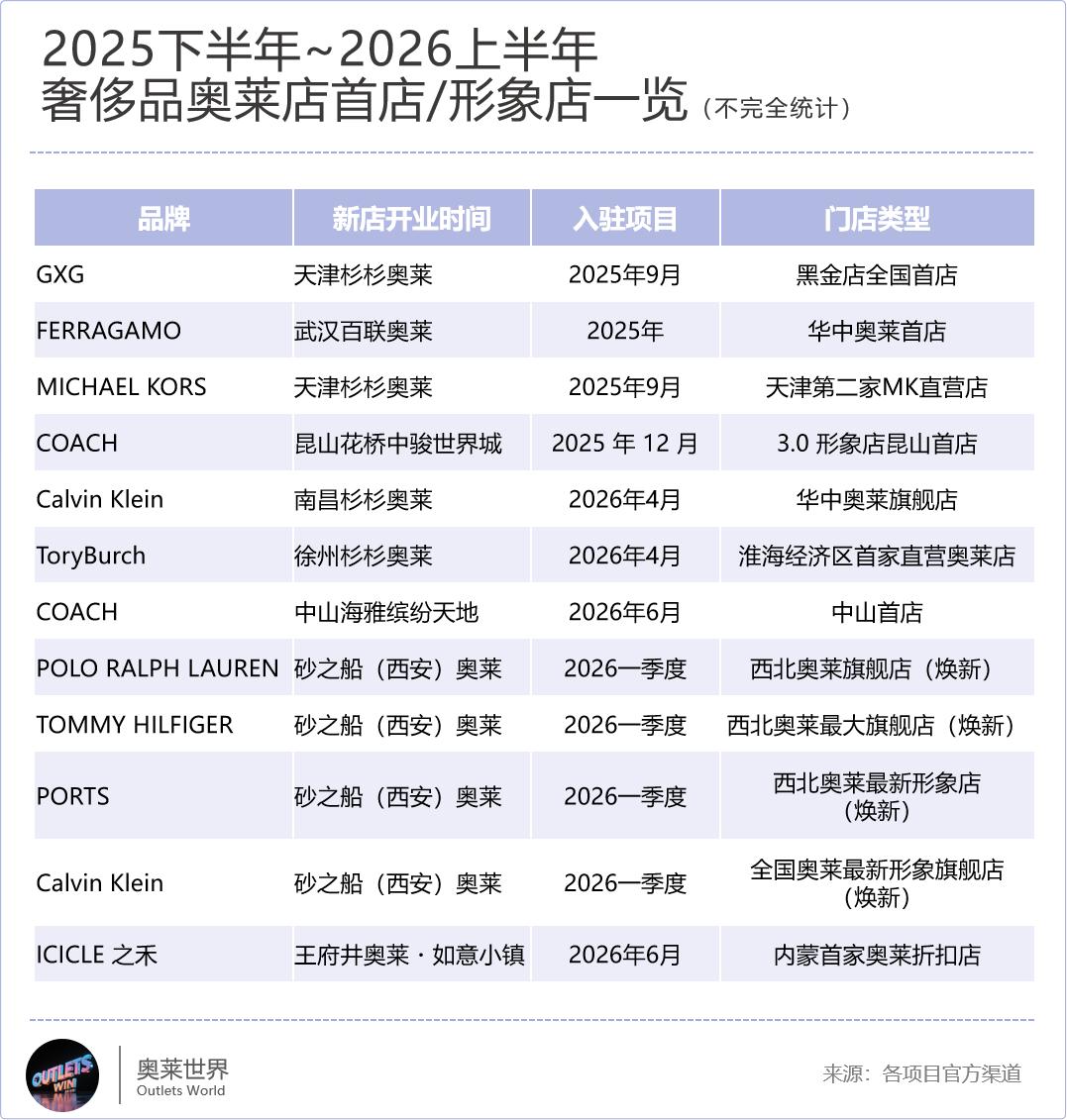
FERRAGAMO's first outlet store in Central China opened last year at Wuhan Bailian Outlet. Beyond classic and discounted products, it uses "dopamine bright" styles to attract younger customers. The Ningbo Shajing store and the renovated Badaling Outlet store also feature fresh designs, carefully crafted lighting atmospheres, and an elevated aesthetic.
Since the first half of this year, multiple luxury brands at S