SpaceX has fallen to its lowest price since going public
On July 7 Eastern Time, following the close of U.S. stock trading, SpaceX was quoted at $149.47, plummeting 6.83% for the day, with an intraday low touching $149.09. This marked a new all-time low for the company's stock price since its Nasdaq listing on June 12, falling below its $150 opening price on the first trading day while still remaining above its $135 IPO offering price.
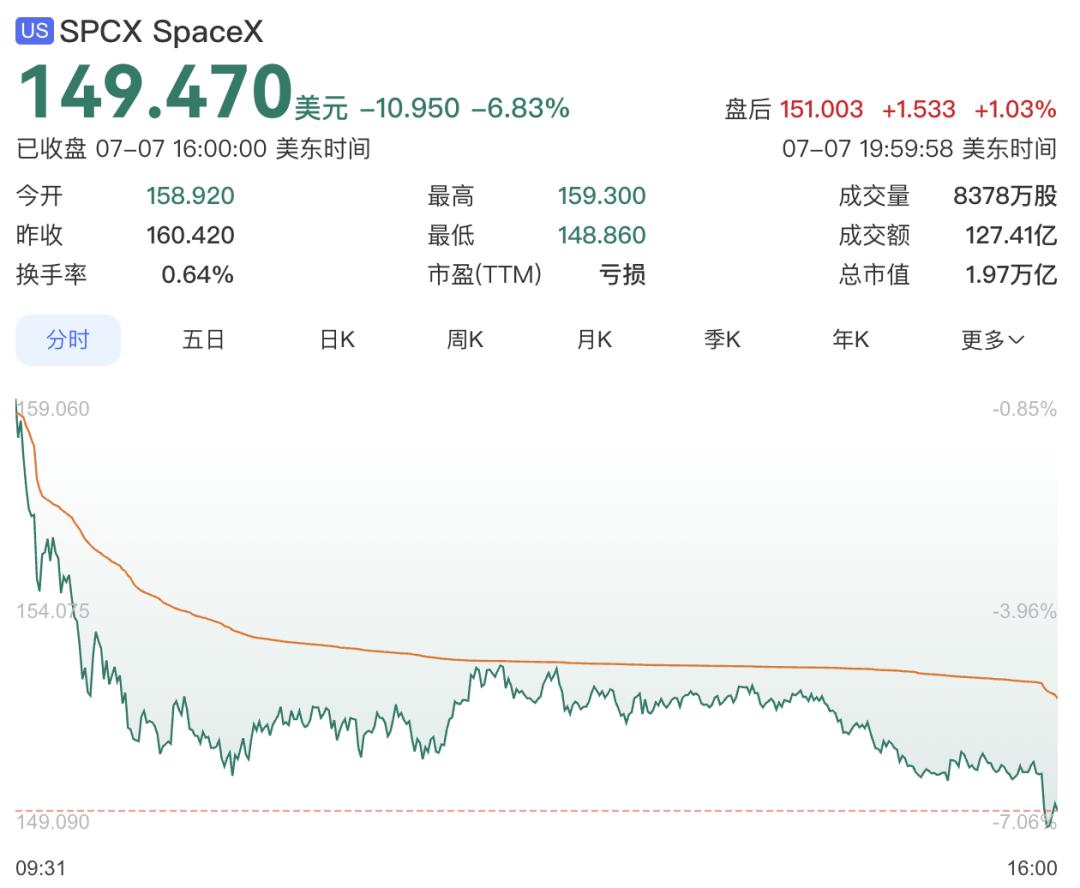
The day coincided with the stock's official inclusion in the Nasdaq 100 Index, which was expected to bring a favorable window of support from passive capital flows. However, the stock price moved in the opposite direction, compounded by a broad market correction across the entire tech sector, creating a confluence of negative factors that pushed the stock into a deep adjustment trajectory.
The overall U.S. stock market sentiment was extremely subdued, with all three major indices closing in negative territory: the Dow Jones Industrial Average settled at 52,925.15 points, down 0.25%; the S&P 500 Index was quoted at 7,503.85 points, declining 0.45%; and the Nasdaq Composite Index closed at 25,818.69 points, tumbling 1.16% to record the largest drop among the three benchmarks.
The core drag pulling the Nasdaq lower was the AI computing power and semiconductor track, as the Philadelphia Semiconductor Index plummeted 4.65% for the day. Intel dropped 9.66%, AMD fell 6.51%, and Micron Technology declined 4.71%. Capital concentrated on selling off high-valuation hardware tech assets, and SpaceX — fresh off its post-IPO hype cycle with its valuation bubble not yet fully deflated — naturally became the top target for short-term profit-taking capital to exit en masse.
Notably, the market had previously universally anticipated incremental capital inflows driven by SpaceX's inclusion in the Nasdaq 100. Under the new fast-track listing rule introduced by Nasdaq in 2026, SpaceX secured its spot as a Nasdaq 100 component after just 15 trading days post-listing, setting the record for the fastest inclusion in the index's history.
Calculations from JPMorgan Chase show that ETFs and index funds tracking the Nasdaq 100 collectively manage over $800 billion in assets under management. The index rebalancing will trigger approximately $4.3 billion in mandatory purchases of SpaceX by passive funds, and when combined with the expected simultaneous inclusions in MSCI and FTSE Russell indices, the theoretical total buying volume from global passive allocation capital could reach the $35 billion range.
Meanwhile, yesterday, as SpaceX's IPO quiet period came to an end, several Wall Street investment banks that participated in the underwriting initiated research coverage. Aggregated data shows that at least six brokerages, including Morgan Stanley, Goldman Sachs, and UBS, have assigned "Buy" or equivalent ratings, expressing confidence in the company's long-term growth prospects. Morgan Stanley issued an "Overweight" rating, citing the company's ability to massively scale the computing power required for artificial intelligence to capture opportunities in the new wave of AI development. The bank set a target price of $300 per share, implying approximately 90% upside from Monday's closing price, the highest target price offered by Wall Street institutions.
In addition, Royal Bank of Canada (RBC) and a Brazilian investment bank both set a $225 target price; UBS, Goldman Sachs, and Stifel assigned target prices of $210, $205, and $190 respectively.
Analysts acknowledge that while the market continues to focus on SpaceX's profitability, execution risks, and valuation levels, its long-term growth potential in the aerospace and artificial intelligence sectors is widely recognized as promising.
On one hand, investment banks are outlining trillion-dollar long-term growth narratives, while on the other, the company faces imminent substantial operational risks materializing in the short term.
Recently, an environmental advocacy group filed a lawsuit demanding the court issue a shutdown order to decommission the gas turbines supporting the Colossus 2 data center, alleging that the equipment was put into commercial power operation without obtaining a full operational permit. Colossus 2 is SpaceX's core hardware infrastructure for fulfilling large-scale computing power orders from major AI enterprises. Back in May this year, the company signed a $450 billion long-term computing power supply agreement with AI unicorn Anthropic, which stipulates a monthly computing power service fee of $1.25 billion, with the cooperation period running through May 2029.
The ongoing litigation risk threatens to disrupt the aforementioned partnership. Industry legal experts interpret that lower courts are highly likely to issue a temporary shutdown order. Even if a remediation grace period is granted, any interruption in computing power delivery will trigger contract termination clauses, granting both parties the right to terminate the agreement with 90 days' advance notice. If the partnership is scaled back or canceled entirely, the AI computing power growth projections embedded in all Wall Street valuation models will be drastically revised downward.
Structural flaws in the free float share base have further amplified the downward price volatility. SpaceX only released 4.3% of its total shares for public trading in this IPO, with Elon Musk retaining a personal ownership stake as high as 49%, leaving an extremely scarce volume of freely tradable shares available in the market. In the early post-listing phase, SpaceX's stock price was driven up to an all-time high of $225.64 through thematic hype, with shares concentrated in the hands of short-term speculative capital. Once negative signals emerge, this creates conditions ripe for a stampede-style sell-off. At present, global capital's risk appetite for high-valuation unprofitable tech stocks continues to cool, prompting investors to re-evaluate SpaceX's business realization timeline: Starlink's global expansion, Starship mass production, and data center deployment all require massive capital expenditures, making stable large-scale net profits difficult to achieve in the short term, leaving the lofty valuation without support from current operating performance.
Nevertheless, the secondary market's performance has not impacted the company's strategic deployment in the space sector. Just this week, SpaceX submitted a new application to the U.S. Federal Communications Commission (FCC) for the deployment of its third-generation Starlink constellation, planning to add 100,000 new low-orbit satellites arranged in layered ultra-thin orbital bands ranging from 323 km to 477.5 km, providing coverage across all inclination airspaces globally.
Filing documents indicate that the third-generation Starlink is positioned as a global AI communications backbone network, capable of delivering ultra-low-latency symmetric bandwidth for autonomous driving, cloud-based large models, and massive IoT terminals — a distinct upgrade from the basic functionality of the first two generations, which only served remote broadband access. It should be clarified that the third-generation Starlink constellation is a separate system from Starmind, SpaceX's space data center project. Previously, SpaceX submitted an application to the FCC planning to launch up to 1 million satellites equipped with on-board AI computing units.
Morgan Stanley projects that by 2040, SpaceX's annual revenue could exceed $3.3 trillion, primarily driven by the entirely new market space it has opened up in connectivity and "physical AI" services. However, the bank's report also highlights corresponding risks, including the company's heavy reliance on founder Elon Musk, conflicts of interest related to Tesla, and regulatory and geopolitical uncertainties. Additionally, the company's enormous funding requirements combined with limited market liquidity could potentially slow down the deployment of new technologies.
This article originates from the WeChat Official Account "Jiemian News", authored by Song Jiannan, and is published by 36Kr with official authorization.