Tourists are flocking into Xinjiang, but local chartered tour vehicle operators are collectively suffering huge losses.
01
An "official warning document" recently sent shockwaves through Xinjiang's tourism industry.
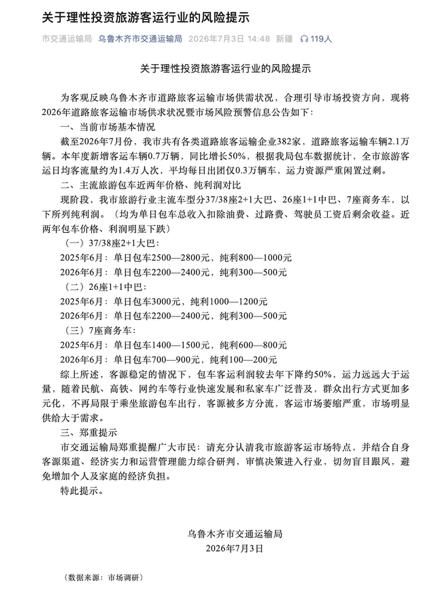
On July 3, the Transport Bureau of Urumqi, Xinjiang, issued the Risk Warning on Rational Investment in the Tourist Passenger Transport Industry (hereinafter referred to as the Passenger Transport Risk Warning), explicitly issuing two key alerts:
First, local road passenger transport capacity resources are severely idle and oversupplied.
As of July 2026, Urumqi has a total of 382 various road passenger transport enterprises and 21,000 road passenger transport vehicles.
In 2026, 7,000 new passenger vehicles were added to the city's fleet, representing a 50% year-on-year increase.
According to statistics from the local chartered vehicle market, the average daily passenger flow for tourist passenger transport in the city is approximately 14,000 people, with only 3,000 vehicles departing for tours each day on average.
Calculated based on this figure, the average daily idle rate of road passenger transport vehicles in Urumqi reaches as high as 86%.
For every 10 road passenger transport vehicles, fewer than 2 can receive orders each day, and the remaining 8 vehicles get no business at all.
Second, local chartered passenger transport profits have plummeted by 50% year-on-year.
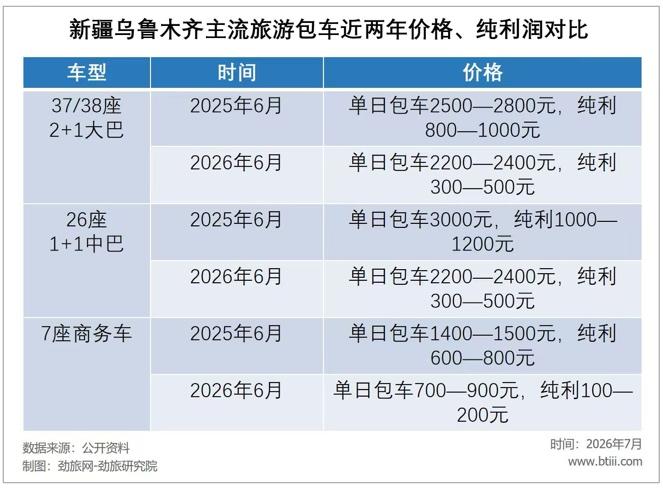
The mainstream vehicle models for local tourist chartered services in Urumqi are the "37/38-seat 2+1 coach", "26-seat 1+1 minibus", and "7-seat commercial vehicle".
Taking the most common "37/38-seat 2+1 coach" as an example: In June 2025, the daily chartered fee for this type of coach was 2,500-2,800 yuan, with a net profit of 800-1,000 yuan. In June 2026, the daily chartered fee for this type of coach dropped to 2,200-2,400 yuan, with a net profit of only 300-500 yuan.
In just one year, fees have tumbled sharply and profits have been cut in half.
In fact, the fees and net profits of the three main vehicle models for Urumqi's tourist chartered services have all plummeted this year, with an overall decline exceeding 50%.
In light of the above warnings, the Urumqi Transport Bureau reminds that the local tourist chartered vehicle market has shrunk severely, with supply clearly outpacing demand. Tourism practitioners are advised to make prudent decisions before entering this sector and avoid blind, unthinking participation.
02
The addition of 7,000 new tourist passenger transport vehicles in just half a year naturally raises a curious question:
Who exactly is flocking to enter Xinjiang's tourist chartered vehicle industry?
"Most of the new tourist chartered vehicles added in the past two years are purchased by individuals, who usually participate in market operations by affiliating with formal local fleets."
A seasoned Xinjiang tourism practitioner, Mr. A, explained to our correspondent that based on his observations of these new market entrants, their backgrounds are extremely diverse: some previously worked as designated drivers, some were online ride-hailing drivers, and others had no prior experience in the tourism industry at all, switching careers to seek profits when they found it difficult to make money in other sectors.
The vast majority of these people's understanding of tourist passenger transport remains at the simplistic level of "buy a vehicle, get an affiliation, take orders, and make big money".
Rather than being new suppliers in Xinjiang's tourist passenger transport sector, they are simply a group of blind followers.
"There is a powerful driving force behind this group of followers," Mr. A revealed. The domestic automotive market has experienced explosive growth in the past two years, and a large number of new vehicles have been put into the passenger transport market.
Many car manufacturers, especially new energy vehicle makers, have spared no effort to exaggerate the advantages of individuals buying vehicles to run tourist chartered services in order to boost sales. For example, they claim investment costs are low, with a new vehicle purchasable for just tens of thousands of yuan; charging and energy consumption costs are minimal, keeping vehicle maintenance costs low; and as long as you are willing to work nonstop, earning over 10,000 yuan a month is easily achievable... They have packaged the tourist chartered vehicle business as a surefire, risk-free profit opportunity, which once deceived many people struggling to find decent jobs and earn a stable income.
Another underlying reason is that regulatory authorities have loosened approval requirements for tourist passenger transport vehicles too much in the past two years, leading to a sudden surge in short-term supply.
This has created a complete chain: many people worry about the difficulty of finding jobs and making money - car manufacturers seize on this pain point to hype high investment returns - official approval standards are overly lax, leading to the emergence of a large number of tourist passenger vehicles - market supply explodes, causing a temporary imbalance between supply and demand.
This is a typical death spiral, with a logic somewhat similar to that of the once-booming shared bicycle industry.
The only difference is that shared bicycles burned through capital from investors, while the tourist chartered vehicle business is burning through the money of ordinary people.
03
After this "official warning document" was exposed, many people were somewhat puzzled: Xinjiang's tourism has been extremely popular in the past two years. Urumqi is not only a top tourist destination, but also a transit hub for travel between northern and southern Xinjiang, with passenger flow continuing to grow. How could it not absorb a mere 20,000 vehicles?
Xinjiang's tourism has indeed maintained strong momentum in recent years.
From 2023 to 2025, the number of tourist visits to Xinjiang continued to rise.
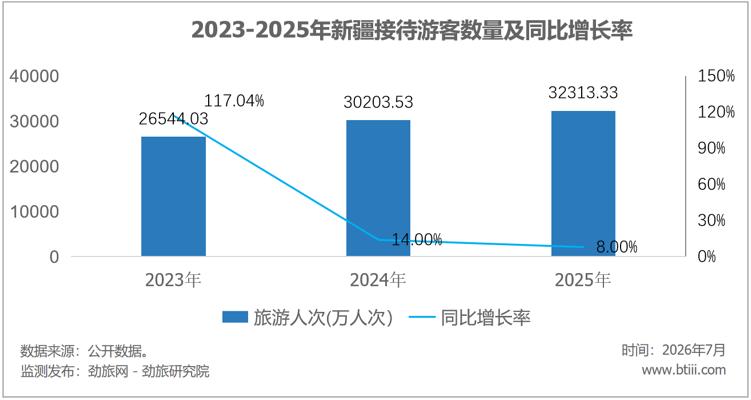
This summer vacation, Xinjiang has continued this strong growth trend.
According to data from the travel app VariFlight, during this year's summer travel peak, the number of domestic flight bookings to Xinjiang exceeded 1.27 million, a year-on-year increase of approximately 6%. Urumqi, Kashgar, Ili, Altay, Korla, Aksu, Hotan, Turpan, and Hami are the most popular cities in Xinjiang; flight bookings to cities such as Hejing and Qitai once surged, with a year-on-year growth rate exceeding 100%.
Railway department data shows that during this year's summer travel peak, Xinjiang's railway sector is expected to send 12.7 million passengers, with an average daily passenger volume of 205,000, representing an increase of 240,000 passengers year-on-year, a 1.9% rise.
When these three sets of data are compared, the fact becomes very clear: the number of tourist visits to Xinjiang continues to grow, but its growth rate has already slowed down significantly.
Xinjiang's tourism also has a fatal flaw: tourist flow is highly concentrated in the short peak season represented by summer vacation, which means the potential passenger volume of Xinjiang's tourism is not destined for unlimited growth, but has a clear ceiling.
Another overlooked point is a line from the Passenger Transport Risk Warning: With the rapid development of civil aviation, high-speed railways, online ride-hailing services, and the widespread popularity of private cars, people's travel options have become more diversified, no longer limited to taking tourist chartered vehicles, leading to passenger sources being diverted by multiple channels.
The differentiation in Xinjiang's passenger transport market is particularly obvious: for short and medium-distance trips, tourists are more accustomed to directly booking online ride-hailing services, which are cheap and convenient. For long-distance trips, airplanes, high-speed railways, and trains offer higher cost-effectiveness and efficiency.
In addition, many scenic areas have set up internal shuttle buses that restrict access for tourist chartered vehicles. With private cars widely available and car rental agencies blooming everywhere, self-driving travel among young people has become a trend.
All these travel options are seizing market share from the traditional tourist chartered vehicle sector.
On one side, supply is expanding without limit, while on the other side, demand growth is slowing and being diverted.
For Xinjiang's tourist chartered vehicle industry, even a large market cannot sustain this situation.
04
The explosive growth in supply of Xinjiang's tourist chartered vehicles has made it one of the most fiercely competitive market segments, plagued by intense internal rivalry.
At the height of the price war, the daily chartered price of a large 7-seat commercial vehicle was pushed down to just over 700 yuan. After deducting necessary expenses such as fuel and tolls, the driver earns only a little over 100 yuan. This is not even net profit; after accounting for vehicle depreciation, monthly loan payments, and insurance costs, the driver barely makes any money, and even loses money in some cases.
Low-price cutthroat competition is just the beginning.
The endless variety of fancy renovations and modifications to Xinjiang's tourist chartered vehicles is an arms race with no end in sight.
When choosing chartered vehicles, tourists naturally select vehicles with luxurious interiors and advanced equipment. As a result, space modifications for chartered vehicles in Xinjiang have become increasingly common: leather sofas, seat heating, car refrigerators, in-vehicle TVs... operators are scrambling to stuff all these features into their vehicles. Vehicle exteriors are also heavily decorated, the more flashy the better, to produce more eye-catching photos for social media.
In addition to hardware modifications, service quality must also be upgraded.
Onboard travel photography and drone shooting have almost become standard features for Xinjiang's tourist chartered vehicles, and the viral "acrobatic aerial shot trick" that became popular online was a new creative technique developed by tourist chartered vehicle drivers.
All these hardware and software upgrades may look impressive, but behind them are skyrocketing operating costs.
If the prices of Xinjiang's tourist chartered vehicles had been rising all along, these costs could have been gradually offset; now that prices are continuously falling, these costs have become a heavy, unmanageable burden, leaving tourist chartered vehicle drivers gasping for breath.
"Operating at a loss" has become the new normal for Xinjiang's tourist chartered vehicle drivers.
Many tourists have complained on social media that Xinjiang's tourist chartered vehicle drivers are generally bad-tempered. "If you woke up every day burdened by heavy debt, you wouldn't be happy either," Mr. A laments. Incidents where drivers undercut each other to grab customers, hurl insults, and engage in fierce arguments have become increasingly common, with some even escalating into public opinion hot topics, which is directly linked to the enormous pressure this group is under.
Xinjiang's chartered vehicle drivers know they are trapped in an inescapable vicious cycle of internal competition, but they can no longer stop, and can only drift with the tide, living in constant anxiety.
05
Some people have put forward a viewpoint that the sharp drop in prices of Xinjiang's tourist chartered vehicles will instead attract more tourists. After all, with increased demand, the industry's situation will naturally improve.
Reasonable price reductions are a normal market adjustment mechanism, but Xinjiang's tourist chartered vehicle sector is now hovering on the edge of vicious price competition.
If Xinjiang's chartered vehicle drivers continue to attract customers at low prices for a long time and cannot earn reasonable profits, tourists will only benefit in the short term. In the long run, this is harmful to both sides of the market.
"What I am more worried about now is that the internal rivalry in Xinjiang's tourist chartered vehicle sector is spreading to upstream and downstream segments of the entire tourism industrial chain," Mr. A explains. In the past two years, Xinjiang's tourism investment has been booming, with large amounts of hot money pouring into various market segments, most notably the accommodation sector.
In recent years, new hotels and homestays have emerged in waves across Xinjiang, ranging from high-end luxury properties to budget chain hotels, covering all price ranges and categories.
Since last year, the occupancy rates of some hotels have dropped sharply, and the situation this year may be even worse.
If Xinjiang's tourist chartered vehicle industry is the first domino to fall due to overheated supply, the accommodation sector may very well be the next.
The only difference between the two is the time lag.
The tourist chartered vehicle industry has a short investment cycle, so its bubble bursts quickly; the accommodation sector has a long investment cycle, so its bubble bursts later.
But what is destined to happen will eventually arrive.
In the summer of 2026, while tourists are still immersed in the breathtaking scenery of "Great Beauty Xinjiang", a smokeless life-or-death elimination contest for the entire industry has already begun, starting from Xinjiang's tourist chartered vehicle sector.
This article is from the WeChat public account "Jinlv Wang", written by Chen Jie tigereat, and republished with authorization from 36Kr.