Capital is fleeing frantically. At the critical moment of A-share market, Morgan Stanley has issued a major warning.
Recently, global tech stocks have experienced a drastic and volatile swing.
In the A-share market, the Sci-Tech Innovation 50 Index, which led gains in the first half of the year, plummeted by nearly 10% cumulatively in July; across the ocean, the Philadelphia Semiconductor Index suffered successive sharp declines, and data from Goldman Sachs shows the tech sector has seen four consecutive weeks of net selling. The South Korean market fared even more severely, with the KOSPI Index tumbling as much as 8.22% at one point during yesterday's session, leaving two core giants Samsung Electronics and SK Hynix both reeling from heavy losses.
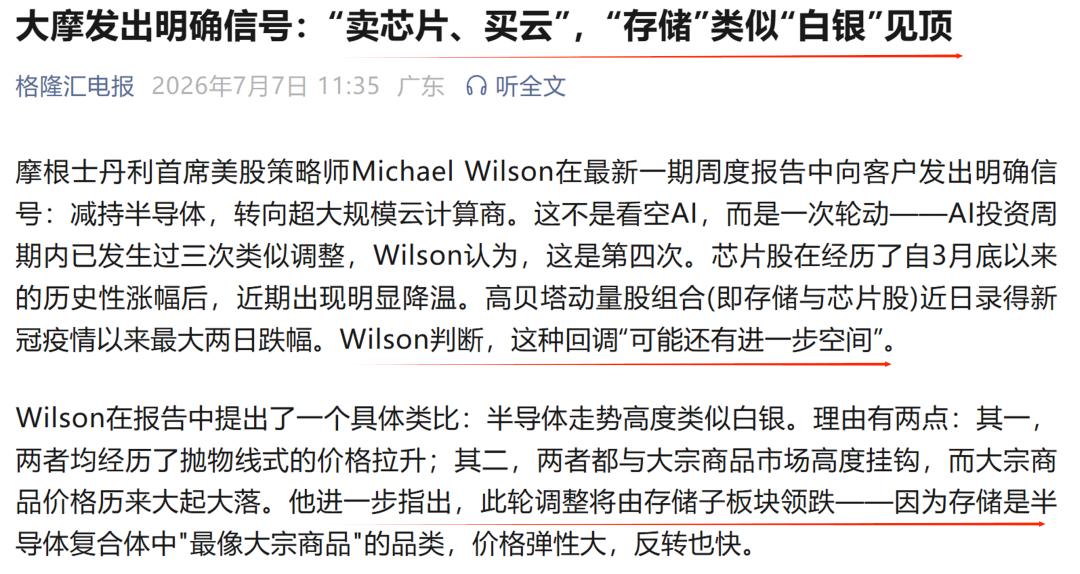
Just as market panic was spreading, Michael Wilson, chief US equity strategist at Morgan Stanley, sent a clear signal in his latest research note: Underweight semiconductors, shift to hyperscale cloud computing providers. He defined the current correction as the fourth similar pullback within the AI investment cycle, and stated bluntly that the trend of semiconductors is highly analogous to silver — both have experienced parabolic surges, are highly linked to the commodity market, rise sharply, and fall just as fast. He further judged that this round of correction will be led by the memory sub-sector, as memory is the "most commodity-like" category in the semiconductor complex, with high price elasticity, rapid reversals, and the pullback "may have further room to go".
For a moment, "whether the tech bull market has ended" has become the top concern of global investors. So, is the recent collective decline of global tech stocks a normal phased correction within a bull market, or the prelude to a bursting bubble? This article will conduct an analysis on this topic.
I. Three Core Pressures Driving the Global Tech Pullback
This round of correction in global tech stocks can be attributed to the concentrated release of three core pressures: valuation frothiness, crowded trades, and loosening market narratives. These three pressures are intertwined, jointly triggering this cross-market resonant adjustment.
(1) Valuation "Frothiness": No Peak Is Steady for Long
Excessively high valuations are the most fundamental source of pressure for the tech stock pullback. Data shows that as of July 3 this year, the PE of the Sci-Tech Innovation 50 Index reached as high as 231.7 times, and its PB hit 9.2 times, both standing at the 99th percentile of historical levels; the TTM PE of the Philadelphia Semiconductor Index stands at 43.9 times, and the PE of the Nasdaq Index is around 40 times. The Philadelphia Semiconductor Index in the US stock market even surged more than 80% in the second quarter, with its first-half gain exceeding 100%. Against this backdrop, any news that falls short of expectations could trigger a sharp valuation contraction, followed by continuous selling pressure. Especially when stock prices have fully or even overdrawn the performance growth of the coming years, the market's sensitivity to negative news will rise sharply, and a single straw could even break the camel's back.
The Morgan Stanley assertion that "semiconductors are like silver" mentioned at the beginning of this article is precisely an accurate footnote to this valuation risk: after a parabolic price surge, the market is bound to face a drastic repricing process.
(2) Crowded Trades: The Fuse for a Stampede
Over the past two years, capital has been extremely concentrated in the AI track, forming a highly crowded trading structure. The crowding level of the TMT sector had previously climbed to an extreme historical range. When too many people squeeze onto the same boat, a stampede is inevitable once the wind shifts. Data shows that the Goldman Sachs High Beta Momentum Portfolio, which is mainly composed of chips and memory chips, has posted a cumulative decline of 19% over the past two weeks, a typical reflection of the reverse unwinding of crowded trades. Goldman Sachs traders explicitly pointed out that this round of sell-off "is more like the combined result of multiple factors including end-of-quarter rebalancing, summer seasonal factors, crowded positions, and trading style rotation".
In the A-share market, it has become a consensus among institutions to reduce positions in high-flying AI stocks, leading to a massive outflow of profit-taking orders. However, the capital released from position reduction has not formed a unified switching direction, with consumer, pharmaceutical, undervalued Hong Kong stocks, and AI power sectors all having their proponents. This precisely indicates that the current market state is closer to position rebalancing rather than a systematic exit.
(3) Loosening Narratives: Cracks in Market Conviction
If valuations and crowded trades are internal hidden dangers, then the loosening of market narratives is the direct fuse that ignites the pullback. In particular, the following three narrative shocks have been densely superimposed in a short period of time, bringing huge shocks to the global tech sector.
The first is the expectation reversal triggered by Meta selling computing power. On July 1, Bloomberg reported that Meta was planning to lease out its surplus AI computing power to external customers. The market quickly deduced the most pessimistic logical chain: "selling computing power → computing power is no longer scarce → tech giants cut capital expenditure → the hardware industry chain peaks". On that day, the Philadelphia Semiconductor Index plunged 6.27% in response, and panic quickly spread across the globe. Although this logic cannot withstand close scrutiny, and institutions at home and abroad have successively released research reports to clarify the situation, under the highly tense market sentiment at high levels, any marginal change could be magnified into a signal of systemic risk.
The second is the wavering of conviction caused by SK Hynix slowing down HBM4 capacity expansion. On June 23, South Korean media reported that SK Hynix was shifting its focus to general-purpose DRAM and slowing down the expansion of HBM4 production capacity. As one of the most certain bottlenecks for AI chips, the supply-demand pattern of HBM4 had previously been almost unilaterally pointing to "short supply". When the market begins to question the tightness of this bottleneck, it is essentially a repricing of the certainty premium for AI hardware.
The third is the dual disturbance from macro expectations and performance verification. The repeated shifts in Fed rate hike expectations (the hawkish dot plot in June versus the expectation reversal after weak non-farm payroll data) continue to pose uncertainty to valuations; as the interim report disclosure window approaches, the market begins to worry whether high valuations can be supported by performance, and part of the profit-taking capital chooses to "vote with their feet" to lock in returns in advance.
The result of these three pressures interacting and reinforcing each other is: The higher the valuation, the more drastic the fluctuations caused by loosening narratives; the more crowded the trades, the more rapid the chain reaction of a stampede. Therefore, the recent huge shocks in the global tech sector are naturally inevitable.
II. The Underlying Logic of the Tech Bull Market Has Not Collapsed
Whether this round of global tech pullback is the end of the bull market or a mid-way rest fundamentally depends on whether the underlying logic supporting the bull market has reversed. In my view, the answer leans toward the latter, and the reasons come from the following three layers of logic.
(1) Industrial Logic: Global Resonance Continues, the Upward Cycle Is Far From Over
The global AI industry is currently in a deepening stage, evolving from "single-point breakthroughs" to "systemic coupling", and the high synergy of the industrial chain means the trend has extremely strong inertia.
In terms of capital expenditure, Goldman Sachs estimates that global AI-related capital expenditure will reach 7.6 trillion US dollars from 2026 to 2031, with annual investment rising from 765 billion US dollars to 1.64 trillion US dollars. Barclays predicts that the capital expenditure of the top five hyperscale cloud vendors will rise from 368 billion US dollars in 2025 to 674 billion US dollars in 2026, and further increase to about 1.16 trillion US dollars in 2028. Bank of America Securities estimates that global AI capital expenditure will exceed 800 billion US dollars in 2026, a year-on-year increase of 67%. This is not a lone fight in a single market, but the collective expansion of the global industrial chain.
In terms of prosperity, current AI infrastructure is driving the global semiconductor industry to launch a multi-year capacity expansion cycle, and global capital expenditure by IDMs and foundries is expected to reach 272 billion US dollars in 2026. HBM supplies from Micron, SK Hynix, and Samsung are already sold out through 2026. JPMorgan Chase explicitly pointed out: "Meaningful new supply is unlikely to arrive before 2028." Global shipments of AI servers are expected to grow by more than 28% year-on-year in 2026. WSTS forecasts that the global semiconductor market size will reach 1.511 trillion US dollars, with memory chip sales posting a year-on-year increase as high as 249.5%. Behind these figures is real demand driving growth, not concept speculation.
(2) Policy Logic: Strategic Determination Remains Unchanged, Global Competition Drives Sustained Investment
The policy-level support intensity has not weakened due to stock price fluctuations. Domestically, this year's Government Work Report has proposed for the first time to "build a new form of intelligent economy", elevating intelligent computing clusters to a national strategy; the "Action Plan for Accelerating Independent Innovation in the Semiconductor Industry (2026-2030)" has been issued, with the 344 billion-yuan National Integrated Circuit Industry Investment Fund Phase III launched, pushing the localization rate to break through 45%. Globally, major economies have successively introduced industrial policies covering semiconductors, aerospace, and intelligent manufacturing, with planned investment reaching the trillions of US dollars level. In particular, South Korea recently announced three major project plans for semiconductors, physical AI, and AI data centers, with a cumulative investment scale close to twice South Korea's 2025 GDP, which can be described as a huge investment "betting on the country's future".
All these are sufficient to prove that AI is no longer just a temporary tech trend, but the main battlefield of major countries' tech competition; and this strategic-level competition will never shift due to the ups and downs of a few trading days.
(3) Profit Logic: Performance Is Being Delivered, Shifting from "Storytelling" to "Focusing on Actual Numbers"
If the 2025 tech bull market was mainly driven by valuation expansion, the key change in 2026 is that profit growth is taking over as the core driving force.
In the first quarter of 2026, the profit of non-financial A-share companies increased by 11.8% year-on-year, and the profit growth rate of STAR Market companies reached as high as 209.03% year-on-year. The rises of the Sci-Tech Innovation 50 Index and the Nasdaq Index are mainly driven by systematic upward revisions of EPS, rather than pure valuation frothiness. Interim report previews further verify this: Jiangbolong expects its half-year attributable net profit to be between 9.2 billion yuan and 11 billion yuan, a year-on-year surge of more than 600 times. Referring to institutional judgments, industrial trends such as the supply-demand gap in memory chips, MLCC price hikes, and indium phosphide shortages have not been disproven, and their performance is fully certain.
However, it should be noted that the market is shifting from "listening to stories" to "calculating the books". Companies with real orders and continuous profit improvement will continue to win capital favor, while pure concept stocks without implemented businesses will face a brutal valuation regression — which is actually a sign that the bull market is moving toward health.
It is worth noting that another current market fear comes from historical shadows, as many people equate the current global AI wave with the dot-com bubble of 2000.
But it must be pointed out that there are essential differences between the two: back then it was pure concept speculation without profit support, while today's wave is led by mature giants such as NVIDIA, Microsoft, and Google, with real computing power demand and commercial monetization capabilities. NVIDIA's revenue in fiscal year 2026 reached 216 billion US dollars (+65%), with data center revenue hitting 194 billion US dollars (+68%). Goldman Sachs explicitly stated: "The imbalance signals seen before the 1990s bubble burst are not visible at present, and strong profit tailwinds can sustain the investment boom."
Interestingly, even the Morgan Stanley chief strategist who issued the "sell chips" signal is not bearish on AI. His core suggestion is to "buy cloud", that is, rotate within the AI industry chain from upstream hardware to mid- and downstream cloud computing. This precisely illustrates that the total demand of the AI industry is still expanding, and value is only being redistributed across different segments.
At this point, the conclusion is very clear: The underlying logic of the tech bull market has not collapsed, nor have the three logics supporting the global tech bull market changed. What has changed is the market's pricing logic: the era of making money by buying any AI stock blindly is over, and the future belongs only to high-quality enterprises that can truly deliver value. The recent pullback is precisely the coming-of-age ceremony for the market to move from fanaticism to rationality.
III. Conclusion and Outlook
Based on the above analysis, this round of tech bull market is not over, but is undergoing a key transition from broad gains across the track to performance differentiation.
In the short term, tech stocks face three pressures: high valuations require time to digest, crowded trades need rebalancing, and narrative shocks need fundamental verification. Some institutions believe that the conditions for style switching are not yet mature, as the capital expenditure and profit expectations of AI leaders have not slowed down; meanwhile, this round of AI tech group trading will not end easily for the time being, and its core main line positioning has not been shaken by the high-level fluctuations in stock prices.
In the medium term, the tech bull market is moving from its first stage to the second stage. If we describe the market characteristics of the first half of the year as "winning by picking the right track", with the investment logic being "broad gains across the track and valuation expansion", then the pricing core in the second half of the year will gradually shift to "performance delivery and individual stock differentiation". Companies with real orders and continuous profit improvement will continue to win capital favor. Companies that rely solely on concept speculation without implemented businesses will face a brutal valuation regression. As Goldman Sachs trader Benny Quek summarized in a report:
"The current market mentality is still buying on dips rather than selling on rallies, but there is a key shift: this is no longer a market where you can buy any AI stock, and the market will reward quality and execution again, rather than pure beta exposure."
In the long run, the AI industry cycle is still in an upward channel, global capital expenditure is still expanding, policy support at home and abroad continues to increase, and profit growth is gradually verifying the industrial logic. The resonance of the global AI industry is not a short-term sentiment transmission, but the result of high division of labor, synergy, and coupling across the industrial chain. Therefore, we should maintain a positive and optimistic attitude toward domestic tech assets and the trend of AI accelerating its catch-up.
For investors, the key is to grasp three transitions: shifting from "buying the track" to "selecting individual stocks", from "focusing on concepts" to "verifying performance", and from "chasing beta" to "finding alpha". The tech bull market is not over, it has just become more selective — it only rewards high-quality enterprises that can truly deliver value.
The drastic market swings may be the only way for a bull market to mature. Those tech enterprises that complete valuation digestion during the pullback and prove themselves with performance will eventually continue to lead the market in the next stage. For investors who can see through short-term fog and identify long-term trends, the current correction is not a risk, but an excellent window to adjust their position structure and anchor high-quality assets.
A real tech bull market has never been a smooth road. Instead, through repeated volatile washouts, it drives out those with wavering conviction, allowing the steadfast to go through the cycle and embrace the vast future of hard technology.
This article is from the WeChat Official Account "Star Atlas Financial Research Institute", written by Fu Yifu, and published by 36Kr with authorization.