Kai-Fu Lee is set to build an upgraded version of Palantir, 01 AI launches "No.1 AI"
In the past year, Kai-Fu Lee met hundreds of CEOs. He said that during every conference break, some business leaders would pull him aside and talk nonstop about how many Agents their AI had built and which model they were using. He would only ask one question: What impact has this had on your financial statements? The response he got was total silence.
On July 7, 01.AI launched the Wance AI platform and three "Decision-Making AI for Top Leaders" products — CEO AI, Top Sales AI, and Investment Officer AI. Kai-Fu Lee himself is a heavy user of CEO AI, using the tool to track the execution of meeting commitments, identify operational risk signals, and even ask it "which of my remarks were inappropriate."
Five weeks ago, Kai-Fu Lee disclosed in an all-staff letter for 01.AI's third anniversary that the company had secured 500 million yuan in orders and 250 million yuan in audited revenue in 2025. In the first five months of 2026, orders exceeded 1.5 billion yuan, with a target of going public in 2027 and striving to become "China's first profitable AI 2.0 company." He said, "Don't call us one of the 'Little Six Tigers' anymore. We should be called the 'Money Leopard'."
From abandoning large model pre-training to fully transforming into industrial AI and benchmarking against Palantir, 01.AI completed its transformation in a year and a half. Wance AI is the product form that embodies this transformation.
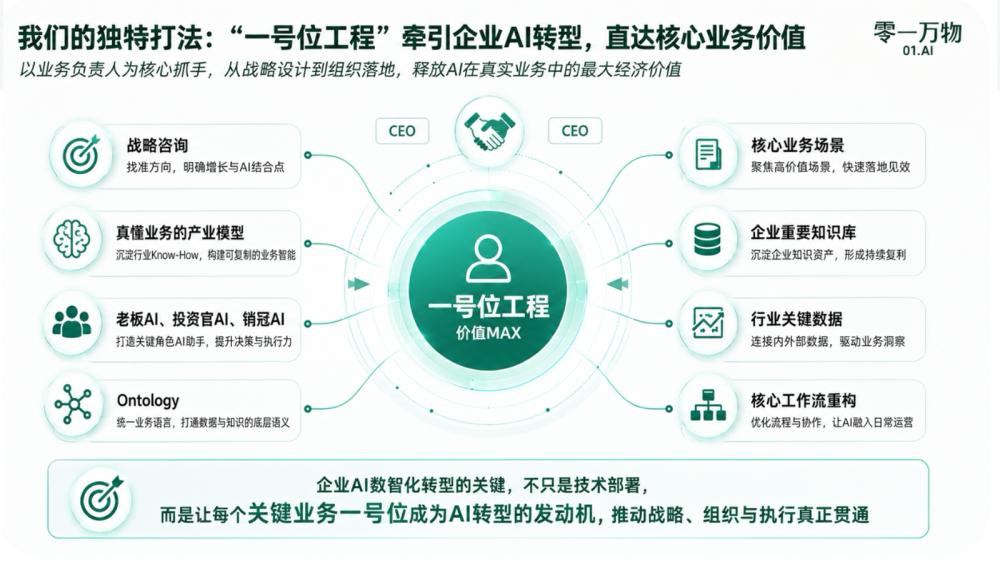
Kai-Fu Lee attributes the failures of enterprise AI transformation to three reasons: First, AI does not understand the company's business. "It's like hiring the top student from Tsinghua University into the company, but he knows nothing, and his contribution is zero in the first three months." Second, enterprises treat AI as a software procurement. "They install AI the same way they install SAP," and end up creating "beautiful bonsai that can never grow into a forest." Third, there is a misalignment in decision-makers. Matters that can improve financial statements are not the CIO's responsibility; only the CEO can personally drive them forward.
The core architecture of Wance is summarized into four components: the Brain (large model, responsible for reasoning and judgment), the Map (enterprise Ontology, defining business logic and entity relationships), the Navigation System (dynamic context engine, tracking real-time business status), and the Operating System (converting judgments into safe and controllable actions). Kai-Fu Lee claims that its Ontology solution is the "2.0 version," which represents a generational improvement over Palantir.
In terms of the business model, the Wance platform and the three Top Leader AI products are charged separately — "similar to the relationship between Windows and Office" — and all adopt a subscription system. Kai-Fu Lee clearly stated that these are not products for small and medium-sized enterprises. The target customers are about 2,000 to 3,000 large enterprises worldwide, and the company has already contacted 500 to 600 of them.
Kai-Fu Lee also revealed a key figure: after 01.AI itself used Top Sales AI, its order volume increased by 5 times, and the lead conversion rate doubled. "Since we advocate such a methodology, we must lead by example no matter what, otherwise customers will not be convinced."
After the launch event, Kai-Fu Lee and Can Yao, Head of Product at 01.AI, had an in-depth exchange with the media, addressing questions about product boundaries, the Token economy, implementation practices, and overseas expansion.
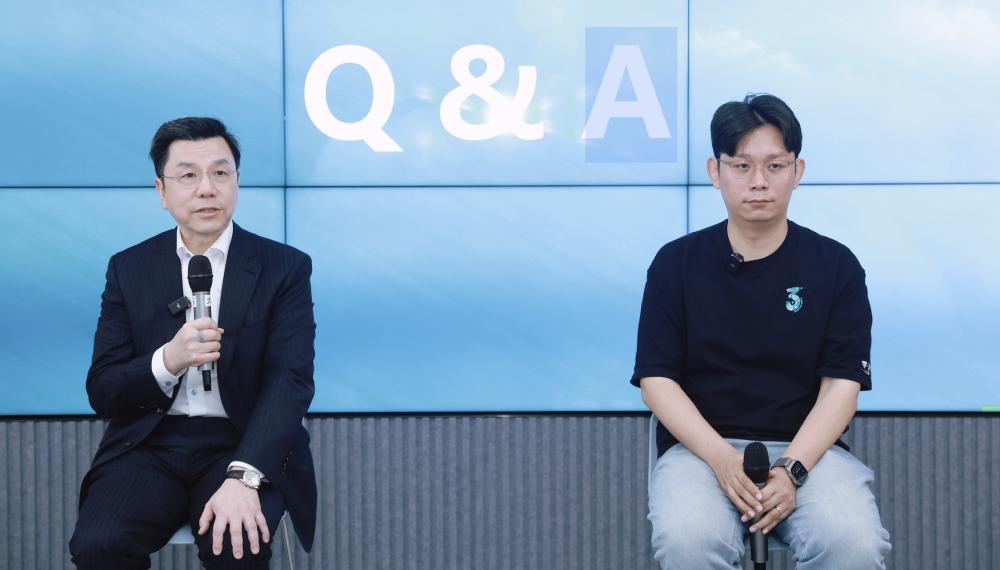
The following is an edited transcript of the conversation:
01
Product Positioning and Differentiation of Wance AI
Q: What is the essential difference between Wance and the AI plug-ins of BI and traditional ERP in the market?
Can Yao: Our goal is not to replace traditional BI tools, management cockpits, and CRM. Enterprise operational data is not only stored in ERP and CRM but also scattered in meeting systems, daily and weekly reports, and communication records. We integrate data from all scattered sources, build relationships around the goal of improving financial statements, and enable AI to understand which paths to take and which data to integrate to achieve the goals.
Kai-Fu Lee added: Do you know any CEO who makes decisions through a management cockpit? As far as I know, none. Top Leader AI awakens a large amount of silent data — meetings, communications, and Q&A between sales and customers — which ERP and management cockpits could not cover in the past. We not only activate this data but also combine it with existing data to provide an interface that CEOs can use directly.
Q: How to achieve differentiated decision-making tailored to each enterprise?
Can Yao: The core business operation logic of different industries and different customers is completely different. There is no universal decision-making methodology that works for everyone. Our three Top Leader AI products are precisely tailored for the three most critical decision-making scenarios in enterprises: operational decision-making, capital decision-making, and revenue decision-making.
Kai-Fu Lee: The product is relatively complete in terms of productization, but it is not yet ready for out-of-the-box use. It still requires the assistance of FDE (Field Deployment Engineers) for implementation. Industries with a high level of digitalization (such as investment) are easier to implement, while traditional manufacturing requires more time. This is not a solution that small and medium-sized enterprises can afford.
Q: Compared with other companies, what is the hardest part of 01.AI to replicate?
Kai-Fu Lee: In the early stage of promotion, I had some unique advantages to reach core users. But after gaining in-depth understanding of users, we have gradually grasped the common needs, generalized the product, and made more in-depth progress in underlying technologies such as Ontology. This has become a systematic project. For example, the advantage of Microsoft Windows is not any specific technology, but systematic accumulation.
Can Yao added: Enterprises are shifting their focus from whether AI technology itself has advantages to whether AI can deliver positive business results. Our products impress top leaders because they can help them see the final effect. AI transformation strategy is a systematic project.
02
Top Leaders Never Focus on "Tokens"
Q: Palantir's CEO criticized that the Token model has value issues. What's your view on this?
Kai-Fu Lee: Tokens obviously have value. So many companies use it as a business model, which must mean there are customers buying it. Some tasks can be fulfilled with very cheap tokens, while others require top-tier tokens (such as programming).
But the vast majority of enterprises have different businesses and different decision-making needs, and the Token model cannot solve the problem of differentiation. The more challenging the problem and the more unique the enterprise, the less applicable the Token model. In many scenarios, tokens can reach 80 or even 85 points; but for those particularly difficult and high-value tasks, customers will not accept 85 points — they must reach 99 points, which requires a product system like Palantir's or ours. The two models do not conflict.
Can Yao: What enterprise top leaders care about are business indicators — "CPI, exposure rate, revenue growth" — never tokens. When the Token economy cannot be translated into key business indicators, tokens become a cost rather than a benefit. Our mission is to truly translate tokens into growing numbers on financial statements.
Kai-Fu Lee added an analogy: Excel solves most people's problems, some at 65 points and some at 90 points, but why don't all companies standardize on Excel? Because there are unique needs. The relationship between tokens and decision-making AI is similar.
Q: Has the gap between large models in China and the United States changed in the past month?
Kai-Fu Lee: The gap fluctuates back and forth. After DeepSeek-R1 came out, the gap shrank to 3 months; after Mythos was released, it widened to 15 months. But enterprise customers don't care. Models are increasingly becoming a foundational capability like "electricity." What enterprises care about are effectiveness, cost, reliability, and sustainable iteration capabilities, not the brand of the underlying model.
Q: Can you share specific customer cases?
Kai-Fu Lee: A super-large investment firm is using Investment Officer AI. We helped them fill the gap where their team could not fully cover all fields. Even an investment institution with nearly 100 people cannot be proficient in everything. We have completed a large number of case studies in two fields, and the customer is very excited about the results.
Can Yao: One of our clients is a large investment institution that had a Pre-IPO investment project. The institution originally estimated that the PS ratio would only be a few times, but when Investment Officer AI analyzed the materials, it found that once the project's product was connected to large models, it had huge potential. The company has now gone public, and its market performance has reached a PS ratio of 20-30 times. The market has verified that Investment Officer AI's advice was correct, which is also the core reason we won the contract.
Q: The deep co-creation model has a long delivery cycle and slow payment collection. How can you achieve an IPO in 2027?
Kai-Fu Lee: What I said is that we hope to be profitable in a certain quarter next year, not this year. There is a time lag between getting an order and recognizing revenue. Our orders are charged in installments, and revenue recognition is completed within one to three years. Each order delivers key technologies, and there is delivery every year based on the foundation of the previous year. So far, customers are very satisfied. For government and enterprise customers, in terms of both binding degree and payment collection time, we have achieved the best performance in the industry.
Q: Tacit knowledge is difficult to digitize. How does Wance AI overcome this?
Can Yao: Many process-based data in enterprises are tacit experiences — approval nodes, approval opinions, and decision-making processes. Traditional systems in the past only saved the results and ignored the processes. Our Top Leader AI not only mines the results but also analyzes how people make decisions in the process, how experiences are made explicit through the expression of language and processes, and precipitated into experience memory and contextual feedback to form a data flywheel.
Kai-Fu Lee: I often ask CEO AI "how can I do my job better." Every meeting has a complete record, and it will tell me which of my remarks were inappropriate and what I should talk more about in the future. The suggestions it gives are very pertinent.
Q: Ontology is a concept from abroad. What difficulties are there in implementing it in China?
Kai-Fu Lee: There is not much difference in cognition between China and abroad. It takes time to explain, but it's actually quite simple — if you ask a large model "tell me what I look like in your eyes," the two or three pages of report it gives you is roughly Ontology.
In the cold start phase, the data is in the enterprise's existing financial statements, workflows, etc., which can be used directly. It just requires a good method to organize the data and resolve conflicts between different data, which can be completed in about one or two months. Subsequent maintenance is relatively easy. With the continuous data closed loop, most problems are solved by AI itself. It's human-machine collaboration that doesn't require much human effort.
The founder of Ontology is Tim Berners-Lee, the inventor of the World Wide Web. With the advent of large models, using natural language to express entities and relationships is much simpler than the rule systems in the past. If business leaders want to check Ontology, they can ask CEO AI to print the three most important pages and see if there are any problems.
04
Without Kai-Fu Lee, What Else Does 01.AI Have?
Q: Is the Top Leader Project highly dependent on Kai-Fu Lee personally? Without Kai-Fu Lee, what else does 01.AI have?
Kai-Fu Lee: As a CEO, I must ensure the long-term success of the company. This kind of dependence is not something I am proud of. First of all, I am in very good health, and the company can expect my long-term service. But now more and more Top Leader cases are won by the team, not by me, and this proportion is increasing.
The Top Leader Project is just for making the first contact, converting some orders, and maintaining relationships, which doesn't take up much of my time. Using CEO AI has freed up a lot of my time. Two weeks ago, I met nearly 200 CEOs through a speech and 30 of them one-on-one.
There are about 2,000 to 3,000 large enterprise customers worldwide that we focus on serving, and we have already contacted 500 to 600 of them. It is completely feasible to cover all key customers in the next two years. The Top Leader Project is not an over-reliance on my personal abilities. These capabilities are being precipitated into the team and products.
Q: What progress has been made with the first batch of partners? Has the special incentive boosted morale within the company?
Kai-Fu Lee: The company's morale has always been good. I just approved the first batch of the new incentive program. The partners still need time to be observed, and they will definitely be confirmed in 6 to 9 months, which may not be publicly disclosed. We will make the company flatter and give partners and DRIs more authorization. For example, we confirmed a DRI yesterday. Since we advocate this methodology, we must lead by example.
Q: Will CEOs using AI for decision-making bring new pressure to employees?
Kai-Fu Lee: No. AI will not ask employees any questions. It just collects data, puts forward judgments and suggestions, and the final decision is still made by the CEO. After I used CEO AI, the number of times I met employees did not decrease, but the questions I asked became more relevant, sharper, and more helpful to them.
In the past, employees might think that if they slacked off, the boss wouldn't notice, and it was okay not to fulfill their commitments, and the boss would forget the tasks assigned at meetings. But that's not the case anymore. The boss has become smarter and has a better memory, so every employee is motivated to do their job well.
05
The View That Large Models Have Hit a Bottleneck Is Completely Wrong
Q: Chinese AI enterprises are going global and facing different business cultures and regulations. What is their core competitiveness?
Kai-Fu Lee: Outside of China and the United States, there is a considerable information gap in almost all countries. While we are already discussing decision-making hubs and CEO AI, many countries have not even made good use of Agents. We provide a full range of services from entry-level products to Wance and then to Top Leader AI.
American companies focus on the United States, Europe, or Japan (where returns are fast and the culture and language are familiar). There is still a huge global market that has not been covered. These countries also need FDE for implementation, but American enterprises are unwilling to send engineers to serve these customers. Chinese enterprises have the ability to help these countries, especially the Belt and Road countries.
In terms of data, we will not take Chinese data out, nor will we bring their data back. This is a bottom line; otherwise, we cannot get orders at all. Countries that Palantir has not yet covered are our opportunities, and we will not face strong competitors when entering these markets.
Q: What does it mean that AI's programming capabilities have surpassed humans?
Kai-Fu Lee: Take 01.AI as an example. 90% of all code is generated by AI, and only about 10% is written by humans, and this proportion is still increasing. But the last thing we need to worry about is programmers being replaced — the value of programmers lies in their thinking, decision-making, and execution processes (breaking down problems, planning, and debugging).
AI having programming capabilities means that it is no longer just a tool to answer questions, but a tool that can call systems, execute tasks, advance processes, and participate in decision-making. People's demand for code and programming is endless — "In the past, personalized programming was difficult to achieve due to the high cost of programmers; today, customized programming can be done according to everyone's needs, which will bring huge changes to the entire economic landscape."
Q: Have large models hit a bottleneck?
Kai-Fu Lee: This view