The "Genius Young Man × DeepSeek" on the Hot Search: What kind of company is Pine AI, where Li Bojie once served as Chief Scientist?
On July 6, Li Bojie, a former Huawei "Genius Youth" and Chief Scientist at Pine AI, publicly criticized DeepSeek's interview process on social platforms, sparking widespread attention.
According to his account, after passing the written test, DeepSeek delayed arranging an interview for half a month, during which he had already received offers from other companies. During the second interview, the interviewer was not only late but also accused him of "copying code" simply because he used dual monitors, which made him feel "seriously offended" and he terminated the interview on the spot.
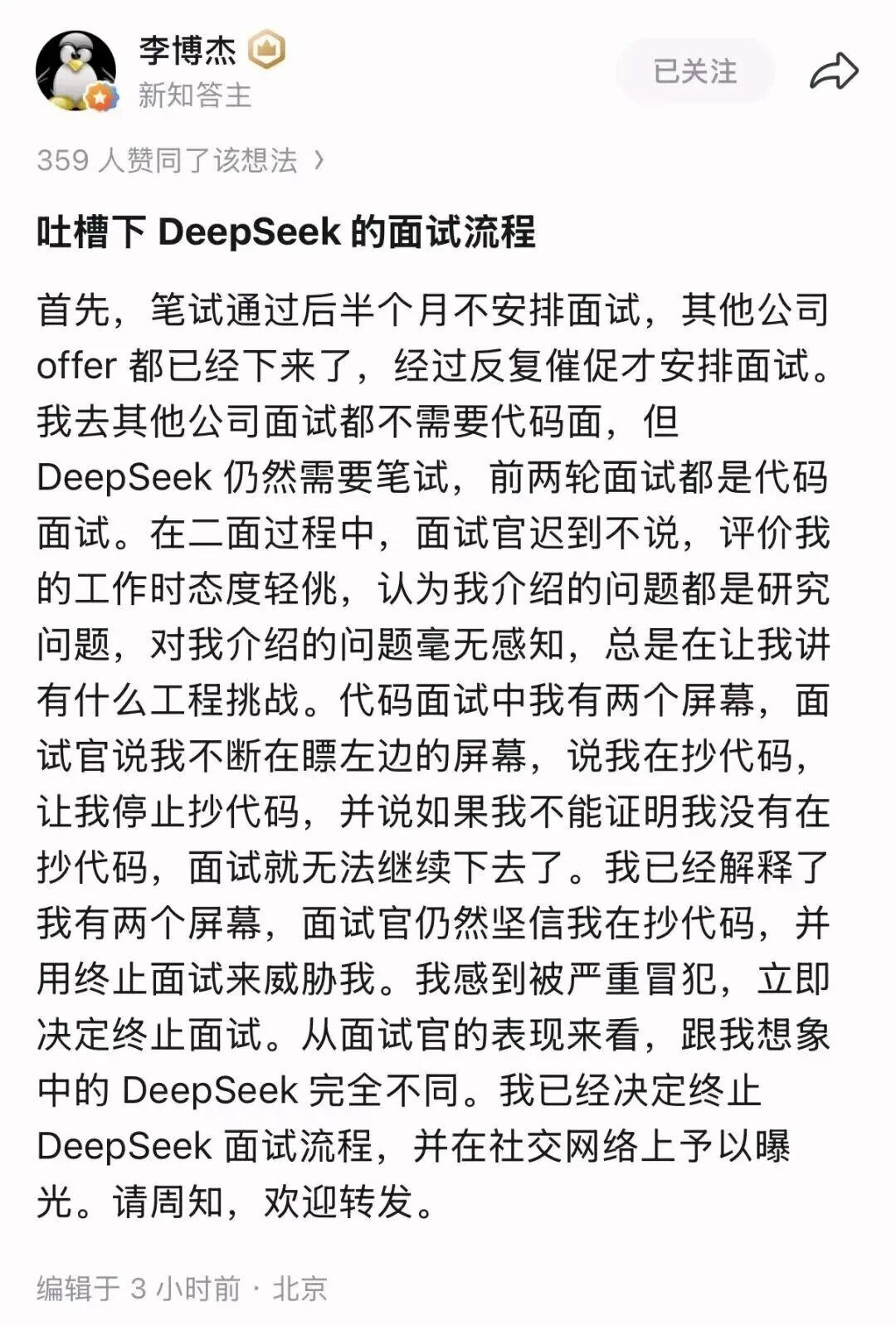
As the incident spread, two interpretations emerged in the public: one view holds that this exposed talent recruitment and management issues during DeepSeek's rapid expansion period; the other interpreted Li Bojie's career change as a signal from Pine AI, seemingly implying that the company was facing poor management or directional problems.
The latter is obviously a misinterpretation.
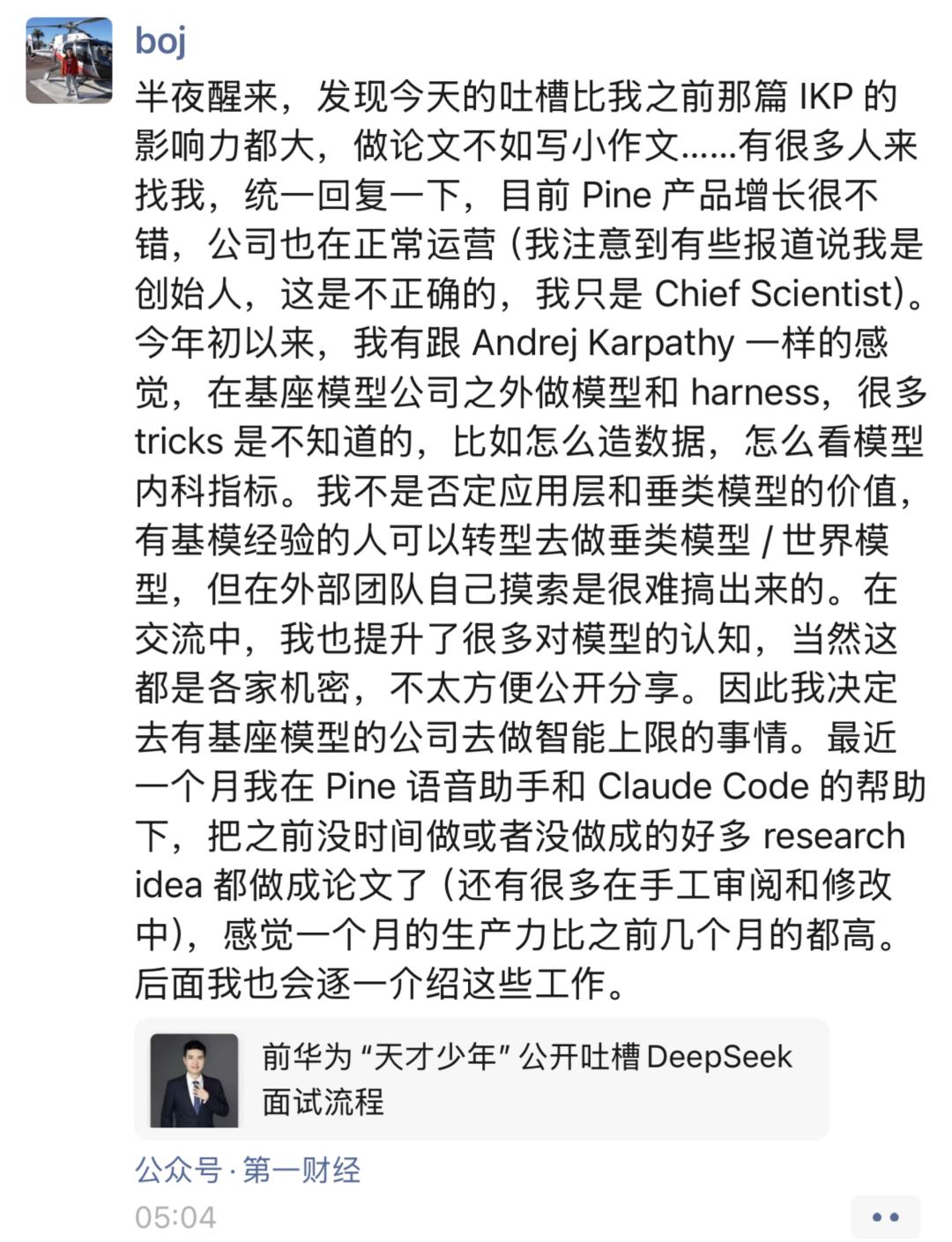
In the early hours of July 7, Li Bojie posted another response. He clearly stated that Pine's product growth is very strong at present and the company is operating normally. At the same time, he corrected the deviations in some reports, clarifying that he is not the founder of Pine AI, but the Chief Scientist.
Later that day, Vincent Sun, CTO & Co-founder of Pine AI, also clarified to Decoding NewSight: Li Bojie has been participating in Pine AI's daily work as a consultant since June 2024, and then officially joined as Chief Scientist in February 2025.
"Li Bojie's interview with DeepSeek took place after he left Pine AI. He has a very good relationship with Pine AI, and his departure was simply due to different research directions."
On this point, Li Bojie mentioned in his response that since the beginning of this year, he has had a feeling similar to Andrej Karpathy's. When building models and harnesses outside of a foundation model company, many tricks are unknown, such as how to generate data and how to monitor internal model metrics, which are very difficult for external teams to figure out on their own.
As he increased exchanges with industry peers, his understanding of foundation models deepened, so he decided to join a foundation model company to conduct research closer to the "upper limit of intelligence".
He specifically emphasized that this is not a denial of application-layer AI or vertical domain models. People with foundation model experience can transition to working on vertical models or world models. This career change is more like a researcher who has long been engaged in AI infrastructure and model evaluation hoping to get closer to foundation model training and capability boundaries.
In other words, Li Bojie did not leave because Pine AI was underperforming, but because he wanted to explore another technical path.
However, this interview controversy suddenly brought Pine AI, which had been almost unknown in China, into the public spotlight.
This is an AI Agent company founded in 2024 targeting the U.S. consumer market, with a team boasting strong Chinese representation and deep AI Infra backgrounds.
CEO Stanley Wei previously served as Chief Strategy Officer and Chief Operating Officer of Agora.io, and Managing Director at Hillhouse Capital. CTO and Co-founder Vincent Sun was formerly a Partner and VP of Engineering at Agora.io, where he long oversaw large-scale real-time audio and video networks and AI Infra engineering systems.
U.S. Technical Partner Tyler Diaz is a serial entrepreneur, who previously served as CEO of a YC W22 enterprise software automation company, and also founded a low-orbit satellite communications company that launched two satellites.
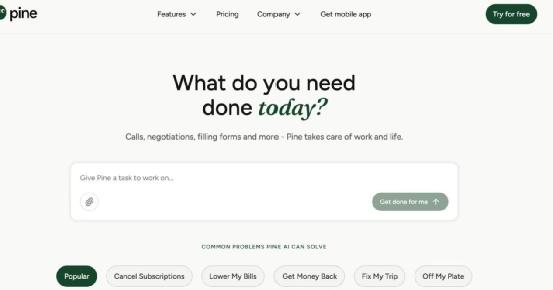
Different from general AI assistants such as ChatGPT, Claude, and Gemini, Pine AI does not just answer questions — it steps into the real world to actually get things done.
For example, users do not ask "how can I lower my phone bill", but expect Pine to truly represent them to contact the carrier and reduce the bill; users do not ask "how to cancel a subscription", but expect Pine to actually go through the customer service process to confirm that the subscription is canceled and no further fees will be charged.
It can be understood that Pine AI handles low-tolerance execution tasks in the real world.
Such tasks involve scenarios including credit cards, banking, telecommunications, healthcare, insurance, and travel. If the system misinterprets, clicks the wrong button, or says the wrong thing, it may cause real losses to users. Therefore, what Pine AI needs to solve is not just whether AI can understand clearly, but whether AI can reliably perform correctly.
According to official data from Pine AI, its AI assistant has helped consumers save more than $3 million on bills from service providers such as AT&T, Charter, and Verizon, with a 93% success rate in bill negotiations, saving users an average of 270 minutes per issue. A reporter from *The Boston Globe* tested Pine AI to find a cheaper home insurance plan, ultimately saving about $1,000 per year.
After polishing its product for about a year and a half, Pine AI officially launched its GTM strategy in early 2026. The company has completed a $25 million Series A financing round led by Fortwest Capital. Its service adopts a subscription model, with professional plans starting at $30 per month. Currently, it supports English and Japanese.
The interview controversy between Li Bojie and DeepSeek has generated a lot of discussions and traffic in the short term. But from an industrial perspective, what may be more noteworthy is the trend behind it: more and more top AI and engineering talents are shifting from outside the foundation model field to real-world task execution, vertical Agents, and user value closed loops.
Pine AI is exactly a sample in this trend, built by a core team of Chinese descent, rooted in the U.S. market, and serving U.S. consumers. What it builds is not an "AI that is better at chatting", but an "AI that can handle affairs on behalf of users".
At the stage when the AI industry is moving from model competitions to practical application implementation, Pine AI provides a direction worth observing. The value of future AI products does not necessarily only come from "giving better answers", but may also come from "actually getting things done".
Disclaimer: This article is written based on publicly available information or information provided by interviewees, but Decoding NewSight and the author do not guarantee the completeness and accuracy of such information. Under no circumstances shall the information or opinions expressed in this article constitute investment advice to any person.
This article is from the WeChat Official Account "Decoding NewSight", author: Wang Xinyu, published with authorization from 36Kr.