Over 50,000 Private Schools Have Closed in 6 Years, Latest Official Data Released, and Private Education Undergoes In-Depth Restructuring
Recently, the Ministry of Education released the *2025 National Statistical Communiqué on the Development of Education* (hereinafter referred to as the "Statistical Communiqué").
Behind the impressive figures such as the gross enrollment rate for higher education steadily rising to 61.3%, a set of statistics in the private education sector has drawn particular attention.
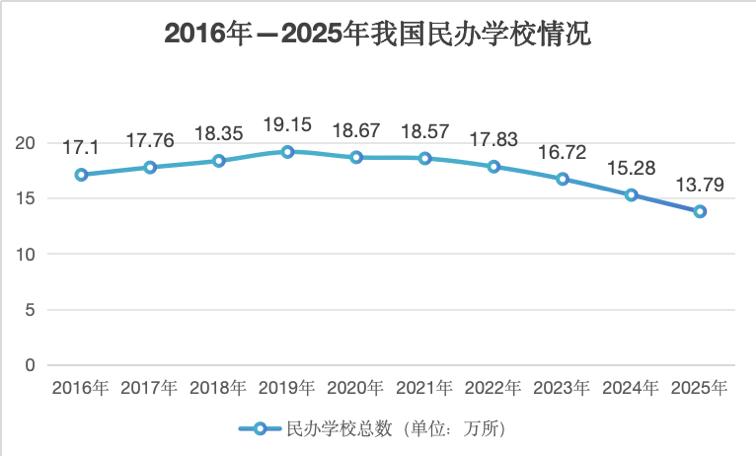
The Statistical Communiqué shows that by the end of 2025, there were 137,900 private schools of all types and at all levels across the country, a decrease of 14,900 from the previous year, representing a drop of nearly 10%.
This marks the sixth consecutive year of decline in the number of private schools, with a total reduction of over 50,000 schools in six years, signifying that private education is undergoing a profound structural adjustment.
Gross Enrollment Rate for Higher Education Reaches 61.3%
Full-Time Teachers Decrease by 150,000
Overall, this is a report card with outstanding highlights, and positive progress has been made in multiple fields from preschool education to higher education.
According to the Statistical Communiqué, in 2025, there were 440,700 schools of all types and at all levels nationwide, a slight decrease compared to the previous year. In 2024, the total number of schools of all types and at all levels across the country stood at 470,000.
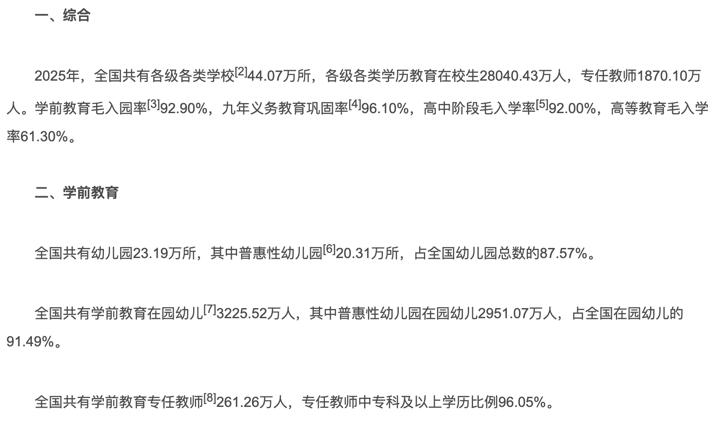
On the other hand, in 2025, the gross preschool enrollment rate in China reached 92.9%, the consolidation rate of nine-year compulsory education was 96.1%, the gross enrollment rate for high school education was 92%, and the gross enrollment rate for higher education hit 61.3%.
Except for the gross high school enrollment rate which remained unchanged, the gross preschool enrollment rate, the consolidation rate of nine-year compulsory education, and the gross higher education enrollment rate all increased year-on-year.
In 2024, China's gross preschool enrollment rate, nine-year compulsory education consolidation rate, and gross higher education enrollment rate were 92%, 95.9%, and 60.8% respectively.
However, compared with the above indicators, the number of full-time teachers in China decreased, dropping from 18.851 million in 2024 to 18.701 million in 2025, a reduction of 150,000 in one year.
The Statistical Communiqué also introduces the educational operation of different school-age groups and various education types, including preschool education, compulsory education, special education, high school education, higher education, and private education.
In 2025, there were 231,900 kindergartens nationwide, of which 203,100 were inclusive kindergartens, accounting for 87.57% of the total number of kindergartens. The proportion of inclusive kindergartens further increased, compared to 87.26% in 2024.
The total number of schools at the compulsory education stage was 180,000, a slight decrease from 188,400 in 2024.
The number of special education schools increased from 2,396 in 2024 to 2,464 in 2025, while regular senior high schools reached 16,100, up from 15,800 in 2024.
The total number of higher education institutions across the country was 3,167, an increase of 48 year-on-year. Among them, there were 1,278 regular undergraduate schools (including 149 independent colleges) and 87 undergraduate-level vocational schools, both of which saw an increase.
In 2024, there were 3,119 higher education institutions nationwide, including 1,257 regular undergraduate schools (including 154 independent colleges) and 51 undergraduate-level vocational schools.
Private Schools Decrease by Nearly 15,000 in One Year
Six Consecutive Years of Decline
It is noteworthy that changes in the private education sector are particularly prominent.
In 2025, there were 137,900 private schools of all types and at all levels nationwide, accounting for 31.29% of the total number of schools of all types and at all levels. The number of enrolled students reached 43.4449 million, making up 15.49% of the total number of students at all educational stages.
These figures have shown a decline compared with 2024.
In 2024, there were 152,800 private schools of all types and at all levels across the country, accounting for 32.52% of the total number of schools of all types and at all levels. The number of enrolled students was 46.2159 million, representing 16.13% of the total number of students at all educational stages.
This means that the number of private schools in China decreased by 14,900 in just one year.
More notably, the downward trend of private schools is not a short-term phenomenon, but a multi-year continuous trend.
After sorting through the data, Red Star Education Media · Oak Lab found that since 2020, the number of private schools in China has declined for six consecutive years, with more than 50,000 schools ceasing operation.
China's private education has a long history, and a series of policies have been promulgated in recent years to promote its development. In 2010, the *National Medium and Long-term Education Reform and Development Plan Outline (2010-2020)* clearly proposed to vigorously support private education, stating that private education is an important growth point for the development of education and a key force to promote education reform.
In 2016, the *Several Opinions of the State Council on Encouraging Social Forces to Run Education and Promote the Healthy Development of Private Education* clearly put forward the goal of actively guiding social forces to establish non-profit private schools and promoting the sound development of private education.
Against this background, the number of private schools in China grew rapidly, rising from 119,000 in 2010 to 191,500 in 2019, with more than 8,000 new schools added in 2019 alone.
However, since then, the number of private schools has been declining year by year.
Compiled by Oak Lab from public data of the Ministry of Education
In 2020, there were 186,700 private schools of all types and at all levels nationwide, a year-on-year decrease of 4,820; in 2021, the number dropped to 185,700, a reduction of 989 year-on-year; in 2022, private schools decreased to 178,300, down 7,451 year-on-year; in 2023, the number fell by 11,092 year-on-year to 167,200...
Wang Feng, director and researcher of the Institute of Educational System and Mechanism Reform at the Chinese Academy of Educational Sciences, pointed out in his article *High-Quality Development of Private Basic Education: Era Value, Practical Challenges and Governance Strategies* that with the decline of the birth rate and the improvement of education popularization, the development space of private basic education is undergoing structural adjustment.
In terms of the number of newborns, China had 17.23 million newborns in 2017, followed by an overall downward trend. The number fell below 10 million in 2022 and further dropped to 7.92 million in 2025, hitting a new low in recent years. The continuous reduction in the total student population has directly affected the enrollment scale of schools at all levels and of all types.
Facing this realistic trend, Wang Feng believes that the way out for private schools is to accurately identify their own positioning and achieve differentiated development and complementary coexistence with public education. Specifically, private basic education at different stages should be guided to develop with distinctive features by category. For example, private kindergartens should generally adhere to the inclusive development direction, strive to make up for the shortage of public preschool seats, and those with conditions can appropriately expand childcare services for children aged 0-3 to steadily realize the transformation of "integrated childcare and preschool education".
In addition, the government should encourage private schools to give full play to their flexible institutional advantages, expand the boundaries of educational services, and find new growth points in a broader education ecosystem. It is necessary to support in-depth cooperation between private and public schools to provide high-quality educational services through entrusted management, curriculum output, and teacher resource sharing; extend the education chain, participate in after-school services, and explore new models of childcare services; rely on digital technology to develop new educational products such as online courses, smart learning platforms, and virtual simulation training, so as to promote the digital transformation and upgrading of educational services.
This article is from the WeChat Official Account "Oak Lab", written by Oak Author, and authorized for release by 36Kr.