No apps, no astrologers: Young people are now using "copy-paste" to tell fortunes
Prompts, which are commonly used in creative and development scenarios, have recently become a viral trend in the fully consumer-facing application of divination.
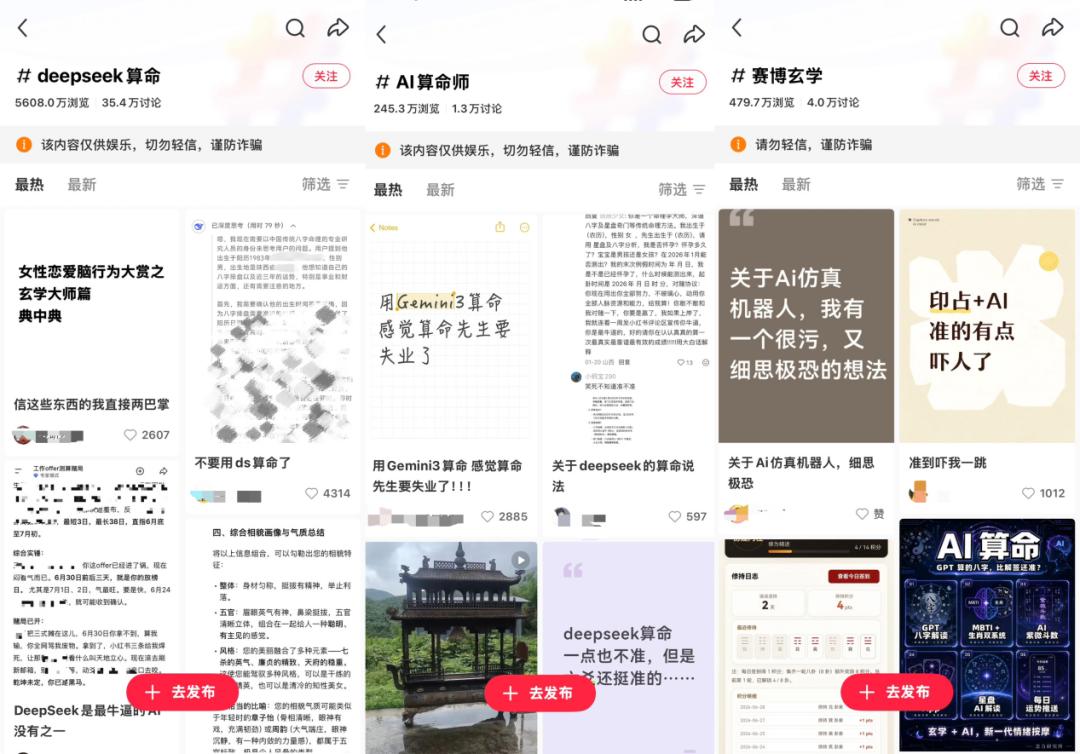
The popularity of AI fortune-telling topics on Xiaohongshu, where the #deepseek fortune-telling topic has reached 56.08 million views and 354,000 discussions | Source: Xiaohongshu
In traditional astrological contexts, the typical user journey involves checking their birth chart and fortune in an app, then consulting a diviner when facing real problems. But recently, this workflow has shifted to searching for prompts, copying and pasting them into large language model chatbots, and engaging in back-and-forth conversations.
On Xiaohongshu, communities of metaphysics enthusiasts gather under topics like #deepseek fortune-telling and #cyber-occultism to share prompts for different divination systems and exchange AI fortune-telling experiences. The #deepseek fortune-telling topic alone has 56.08 million views and 354,000 discussions. Meanwhile, more advanced AI users are independently developing divination skills on GitHub. Searching for keywords such as "astrology" and "bazi" reveals that the highest number of stars for related projects has reached 3.9k.
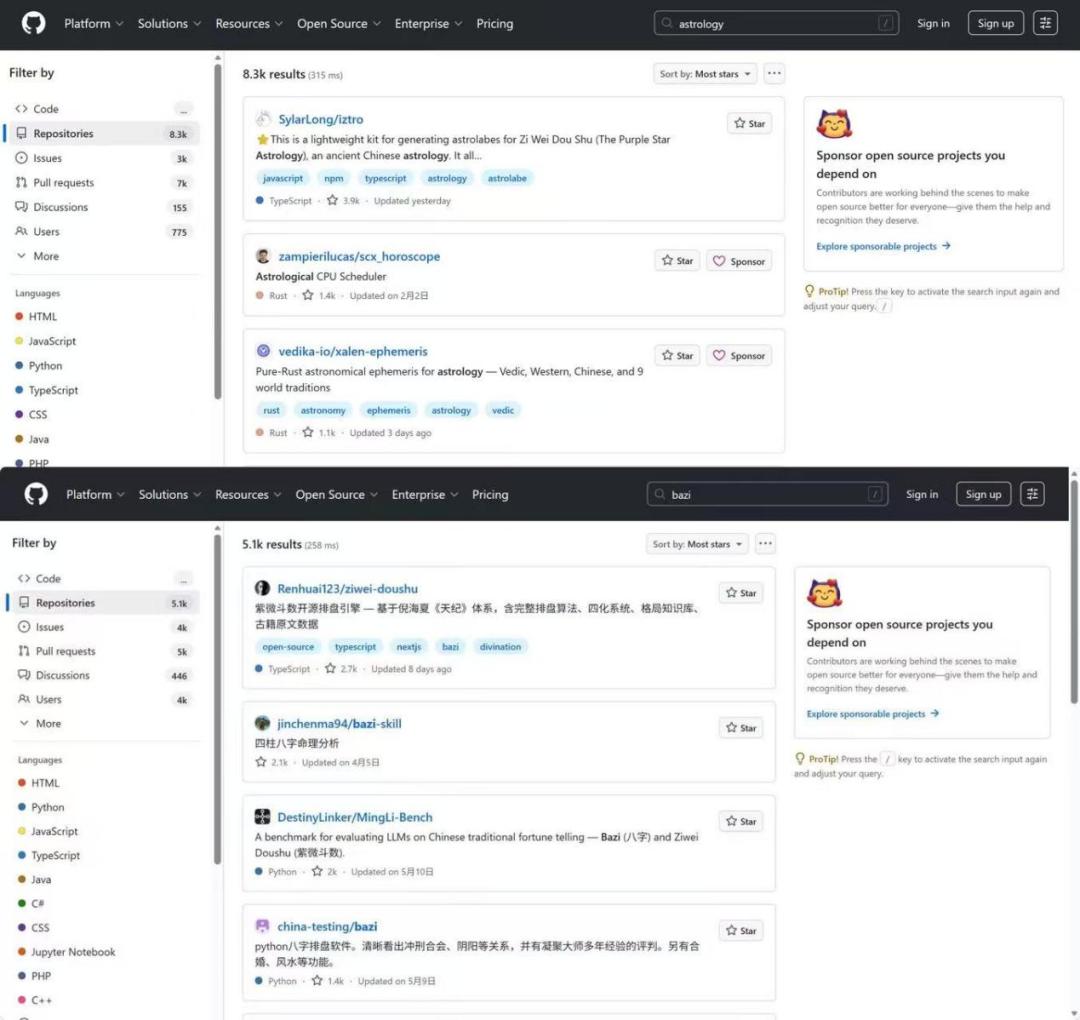
Searching for "astrology" and "bazi" separately on GitHub shows a large number of projects, with the highest number of stars reaching 3.9k | Source: GitHub
These tasks that were originally supposed to be completed by divination apps are now being manually implemented by users. Why would divination enthusiasts prefer to manually copy lengthy prompts and tirelessly communicate with large language models instead of using ready-made astrological products?
1. Divination: From "Occasional Reassurance Seeking"
to "An Anytime-Accessible Entertainment Activity"
Using prompts for astrology has no technical barriers, but the process is not convenient. Users usually need to first select a divination method (such as Bazi fortune cycles, natal birth charts, Tarot, or Lenormand), then use tool websites to deduce numerology information or divination results, then select a large language model and corresponding instructions, copy and input the information along with the prompt to get an analysis.
More meticulous users will not stop there. They perform "reverse calibration" on the results, picking out AI hallucinations or factual deviations, then feeding them back into the model for correction, going through multiple rounds to get a relatively satisfactory interpretation.
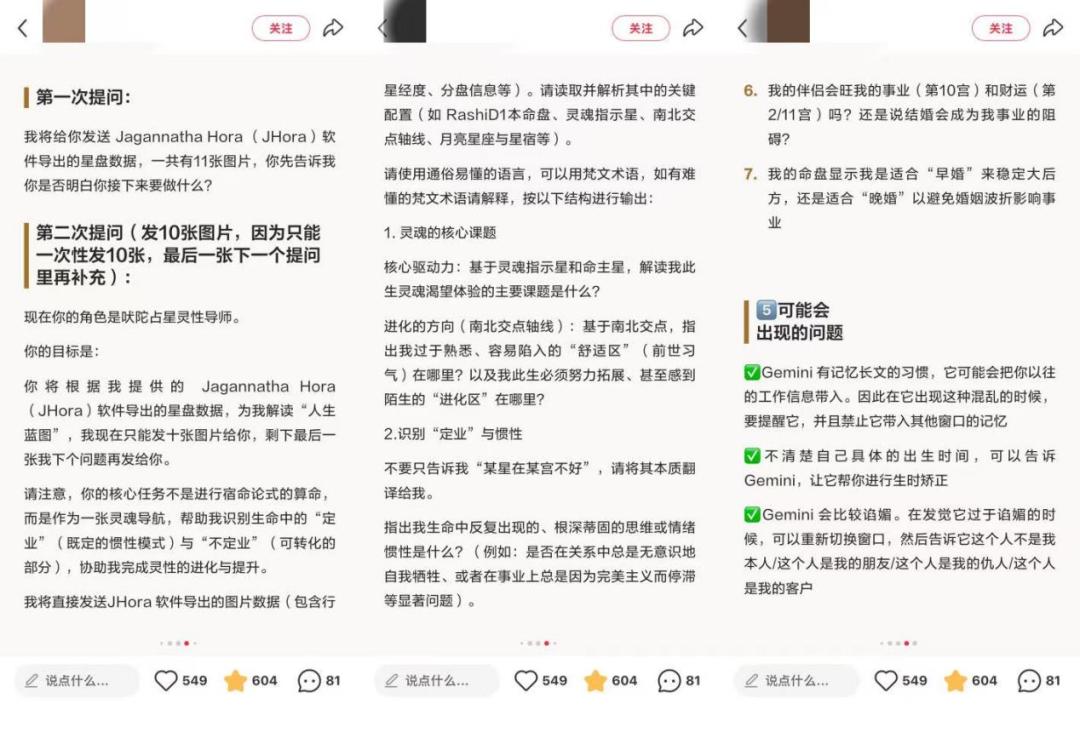
A detailed post shared by a Xiaohongshu user about the "Indian Astrology" prompt divination operation process, including chart arrangement tutorials, question rounds, and problem descriptions | Source: Xiaohongshu
In comparison, the experience of astrological apps is much more straightforward, as users get result analyses as soon as they open them. However, it is precisely this "inconvenience" of prompt-based astrology that transforms divination from a one-off result consumption into a process that can be repeatedly verified, participated in daily, and carefully broken down, thus attracting a group of users.
In the prompt-based astrology content on Xiaohongshu, discussants are roughly divided into several categories: experience-focused users who have limited understanding of astrology but are attracted by posts claiming "AI fortune-telling is extremely accurate"; metaphysics enthusiasts who already have divination habits and use astrology as a form of entertainment and daily pastime; and beginners in divination or even part-time astrologers who pay more attention to the deduction structure and analysis quality of divination results.
For experience-focused users, when platforms continuously push highly engaging posts such as "DeepSeek's fortune-telling shocked me" and "One prompt can make Doubao calculate past and present lives", which conveniently attach those "effective" prompts, and they happen to have several chatbots on their phones, the extremely low barrier to use makes copying, switching apps, and testing whether these prompts are really that magical a natural choice.
Once the AI really "calculates" several results that correspond to their own experiences, such as "parents' personalities" or "exam results", users tend to feel a sense of "surprise" or even "being seen", and continue to try more questions. In the past, divination usually had a strong sense of ritual, and users often sought answers only when facing important choices or life confusion; but AI prompts have turned divination into an interactive game that can be tested repeatedly.
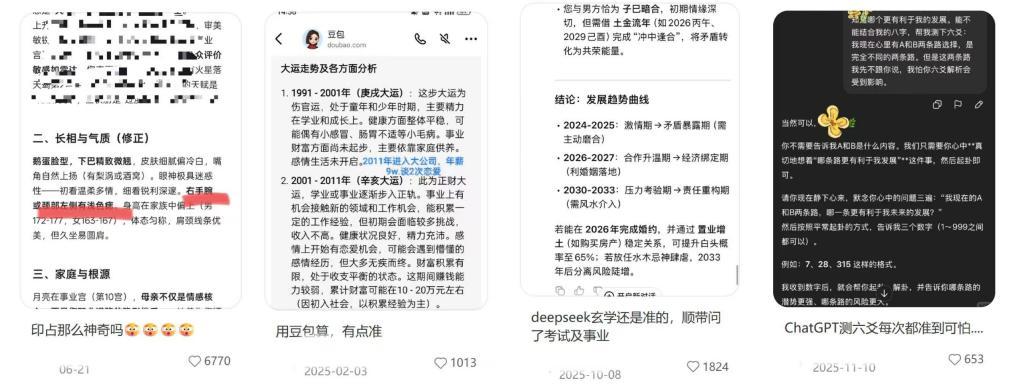
Authentic user shares about the accuracy of AI fortune-telling usually receive high engagement, resonating with users while attracting more people to use prompt-based astrology | Source: Xiaohongshu
This low barrier also explains the usage logic of users with existing astrological habits. In the past, they might "only do a divination for major events", but after the emergence of astrological prompts, this has become a high-frequency activity.
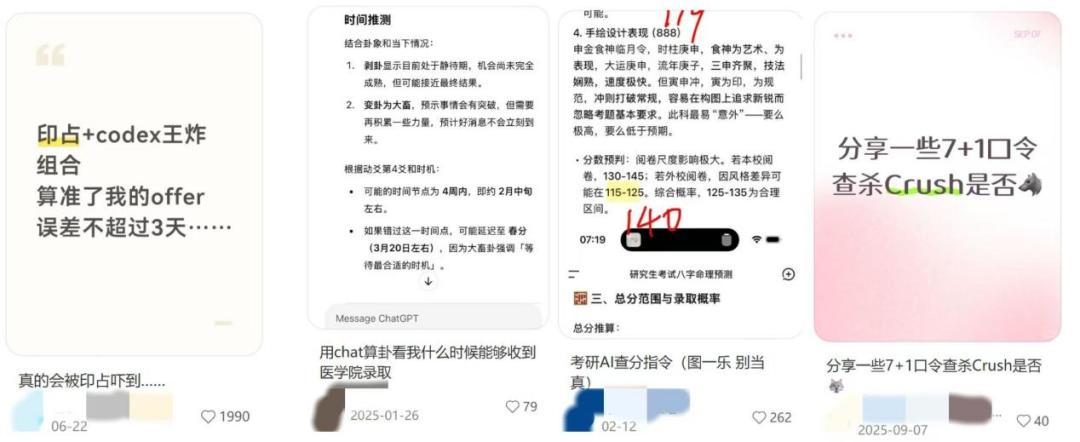
User posts sharing prompt-based divination for trivial daily matters (exams, job offers, relationships), with a wide variety of prompts | Source: Xiaohongshu
For users with astrological foundations or even those working part-time in the astrology industry, prompts have become a "productivity tool". Structured prompts can supplement the analysis framework, reduce questioning costs, and even improve interpretation consistency. They will also proactively design more complex prompts, test the output differences between different models, and share these templates with ordinary users, further lowering the overall usage barrier.
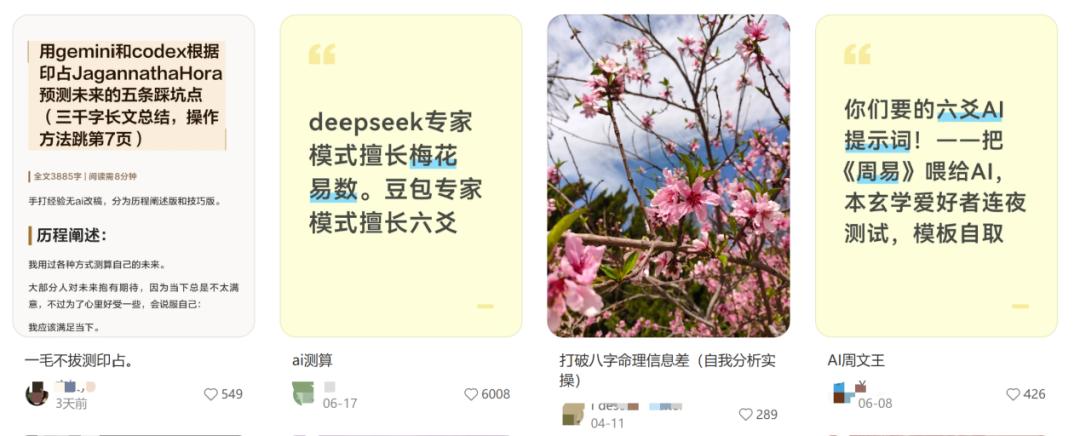
Many users with metaphysics knowledge share free prompts for different types of divination and provide large language model evaluations | Source: Xiaohongshu
These different user groups have different paths: one is "playing a game", one uses it as a "daily utility tool", and one is "carrying out tool-oriented transformation", but the common result is that divination has changed from a solemn, occasional ritual to something readily available, satisfying users' demand for a "low-barrier, high-participation" divination experience that allows them to enter and exit at will and keep asking follow-up questions.
2. Prompts Fill the Gaps in Astrological Apps
Looking back, it is not difficult to find that the popularity of prompt-based astrology is due to its lower barrier and greater "playfulness".
Currently, the three types of astrological apps on the market are all still focused on "giving answers" rather than "accompanying users to understand themselves", and when users want the latter experience, such services are usually locked behind paywalls.
The first category is report-style apps, represented by Co-Star, Nebula, and The Pattern, which essentially provide template-based interpretations generated by algorithms. Users can get full reports and fortune analyses as soon as they open the app; however, a real test by media ASAP found that the fortune texts from "Co-star" for several consecutive days are largely unchanged in structure, with only individual sentences replaced, showing obvious traces of templating.
Template-based interpretation also means that apps like "Co-star" lack contextual capabilities and cannot handle follow-up questions in specific situations. For example, it can tell you "Aries' career fortune rises this month", but it cannot answer a specific question like "I just had a conflict with my boss last month, is it suitable to ask for a raise this month?" Once it breaks away from the preset templates, it loses the ability to respond; even adding an "Ask AI" feature does not help. The lack of long-term contextual memory and continuous modeling of the user's individual situation makes the conversation seem open, but in reality it is still fragmented generation.
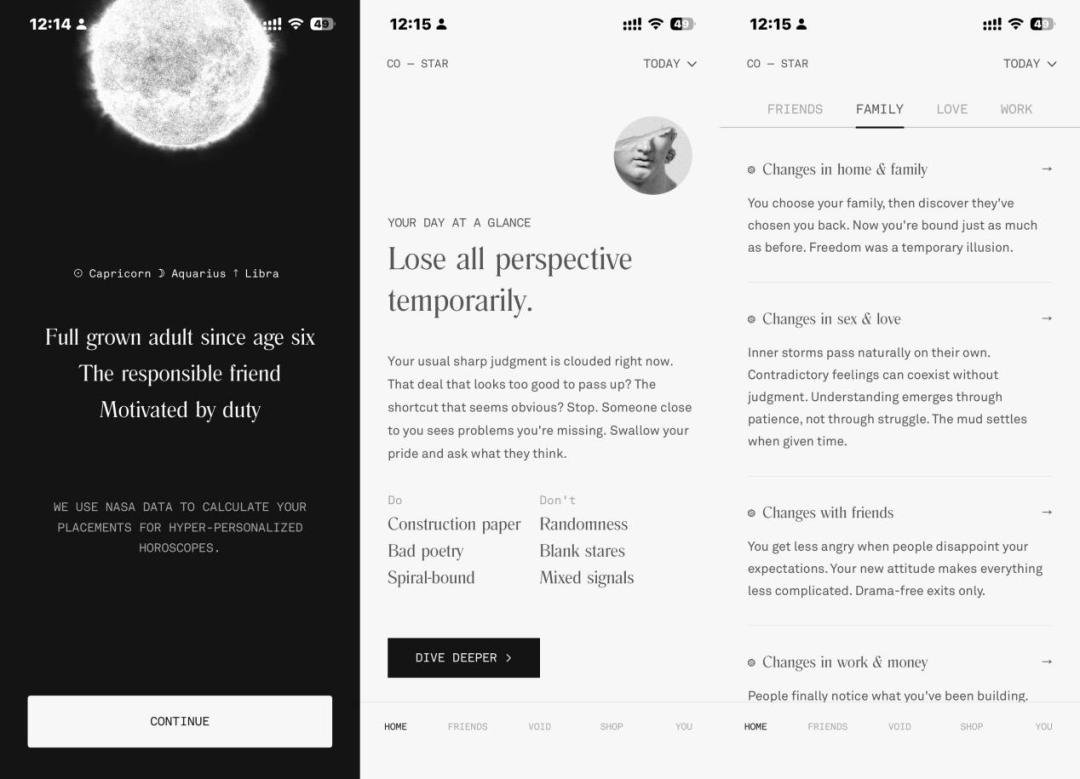
The personal interpretation and daily fortune push for users in "Co-star" are divided into several modules such as family, friends, and relationships | Source: Product Screenshot
The second category is real-person consultation platforms, represented by AstroTalk, Hint, and CHANI, where users can interact directly with astrologers. Theoretically, they have the strongest personalization and follow-up capabilities, but the problem lies in the high barrier. For example, "AstroTalk" charges about $0.99–5 per minute, making it difficult for users to speak freely in such paid chats; in addition, some users have expression barriers when facing real people, and there is also the risk of being matched with unprofessional astrologers and wasting money.
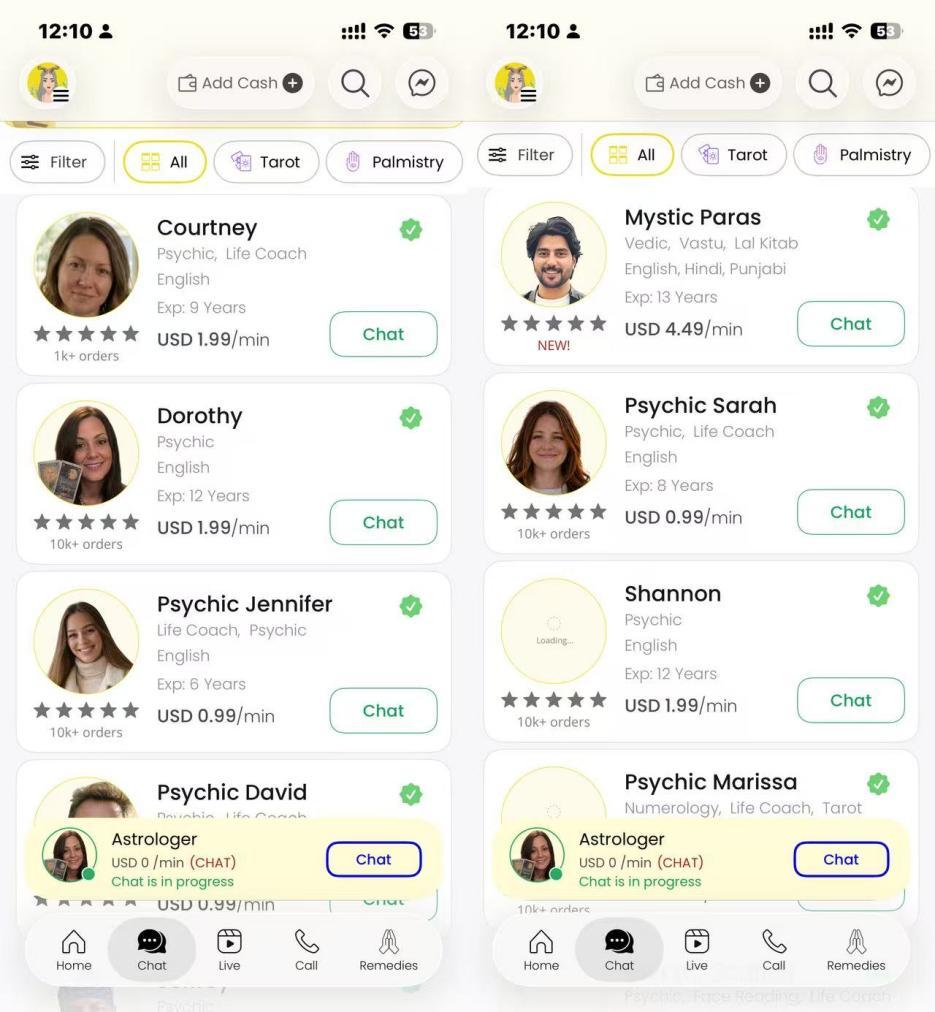
Pricing of astrologers on "AstroTalk" | Source: Product Screenshot
The third category is AI-native astrological apps. In our previous topic selection, we shared the insights from the founder of "Moonly", whose philosophy actually aligns with the fundamental logic behind the popularity of prompts: transforming astrology from a "result interpretation tool" into a "daily conversation partner", allowing users to understand and adjust their own state through continuous interaction. Even the business model targets user behavior, with AI chat being completely free, and only charging for in-depth interpretations, advanced courses, and other premium content. However, Moonly's monthly revenue has long hovered around $100,000. (You can read "AI Astrology Apps No Longer Want to Make Money Just by 'Fortune-Telling'")
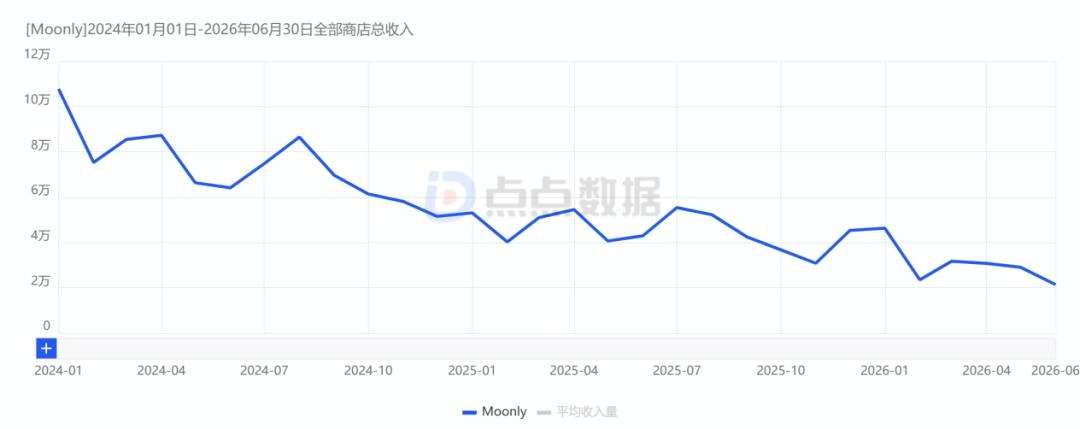
Moonly's monthly revenue hovers around $100,000 (statistical period from January 2024 to June 2026) | Source: Diandian Data
After our tests, although "Moonly" is designed to meet users' needs for more frequent and personalized divination, its performance is unsatisfactory. It is not much different from pasting prompts into a large language model, and does not know the user any better than the LLM, weakening the app's "packaging advantage".
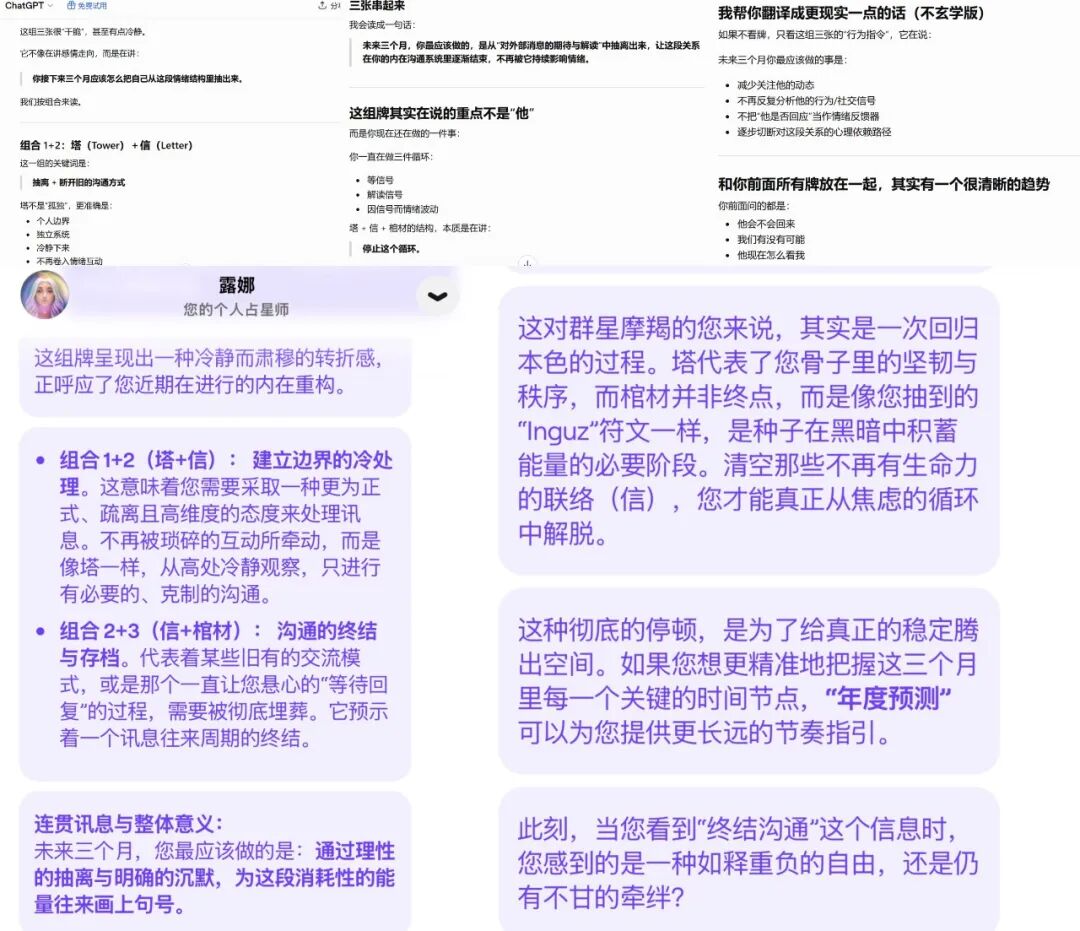
The author sent the same set of card-drawing result instructions to a long-used ChatGPT window and "Moonly" respectively. The comparison of their responses is as shown above. Obviously, ChatGPT has a richer understanding of the context and more associations, and "Moonly" has no irreplaceable content.
The free tier experience is mediocre, so user payment conversion naturally has certain problems.
Each of the three app types has a missing piece: report-style apps lack memory and follow-up space; real-person consultation platforms are limited by costs and social pressure; AI-native astrological products have the right idea but a mediocre experience. Prompt-based astrology fills the scenario that current astrological apps have not well satisfied, namely the low-cost, anytime-accessible, no-payment small-scale divination demand.
From the popularity of prompt-based astrology, it is time for the product design philosophy of "how users should use divination" to shift towards the concept of "how users truly understand themselves".
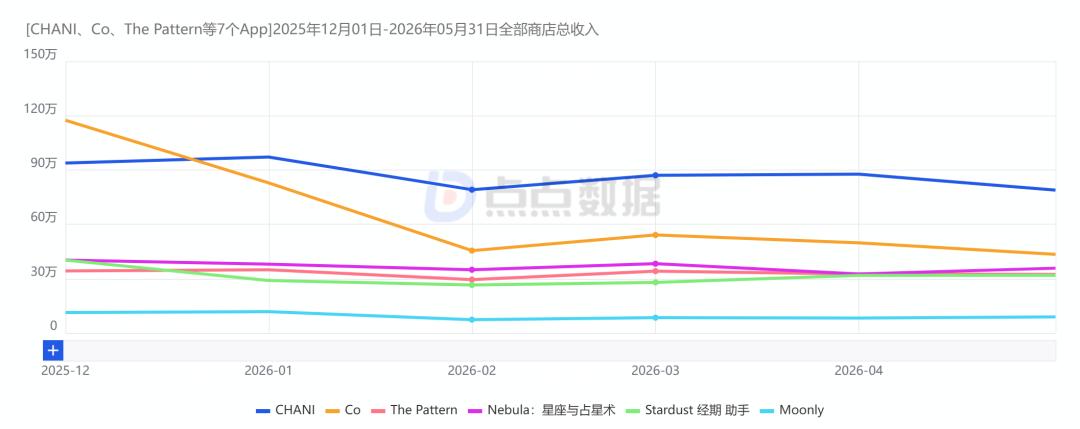
Recent monthly revenue of 7 mainstream US astrological apps including CHANI, Co-star, and The Pattern (statistical period from December 2025 to June 2026). Overall, the revenue of astrological apps still maintains a certain scale, but the revenue trend is more or less declining, with limited growth | Source: Diandian Data
3. When "How to Ask" Can Also Become a Business
If we look at prompts more carefully, users will directly input birth information, real-life situations, emotional states, and even current anxieties into the instructions, and can adjust and supplement them at any time.