Exposed to have laid off 3,200 people in one go: Is this a major earthquake in the gaming industry?
The largest headcount loss the Xbox division has ever faced.
On July 6th, the Xbox official website released an internal all-staff letter titled "Resetting Xbox". This public document addressed to all global employees directly finalized a new round of large-scale personnel and business restructuring plan.
The letter clearly outlined that throughout fiscal year 2027 (note: Microsoft's fiscal year runs from July 1 of the previous year to June 30 of the current year), Xbox will cut a total of 3,200 positions, with 1,600 layoffs implemented on the very same day. In addition, four of its subsidiary studios will be separated from Xbox's control and handed over to new management teams for operation.
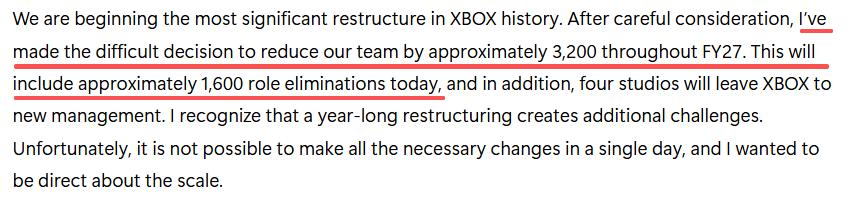
Previously, we sorted out the personnel contraction trends of major global game technology enterprises in the first half of the year. Phased layoffs by large industry players are no longer new news, but this latest open letter not only simply announced the layoff figures, but also fully exposed a series of deep-seated problems such as bloated internal structure of Xbox, unbalanced business investment, and re-evaluation of studio assets, putting all the long-accumulated operational pressure of the business on the table.
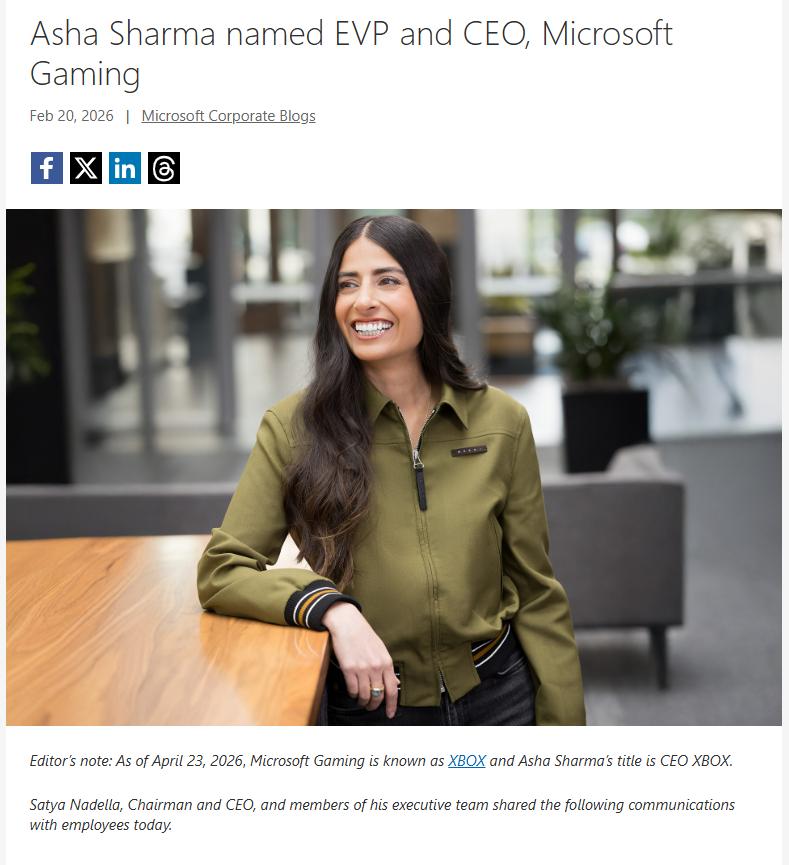
This large-scale adjustment was not a last-minute decision. Since the first half of this year, Microsoft's gaming business has successively released multiple key public documents, gradually paving the way for this full reset. In February, Microsoft officially announced a personnel change: Phil Spencer, who had led the gaming business for 12 years, officially retired, and Asha Sharma, former president of CoreAI products, took over as the top leader of Xbox.
Four months later, on June 10, Asha Sharma and Chief Content Officer Matt Booty jointly released the 100-day review letter titled "Next 100 Days: Xbox Reset", which for the first time disclosed Xbox's poor financial status, hardware cost crisis, and after-effects of business expansion, sending a signal of strategic contraction in advance.
In just five months, from a major reshuffle of senior management, a 100-day business review, to the implementation of thousands of layoffs and the spin-off of multiple studios, a series of intensive adjustments have pieced together all kinds of long-standing operational problems of Xbox, and also made overseas players feel a little sympathetic towards Asha Sharma, the new leader who took office hastily in February.
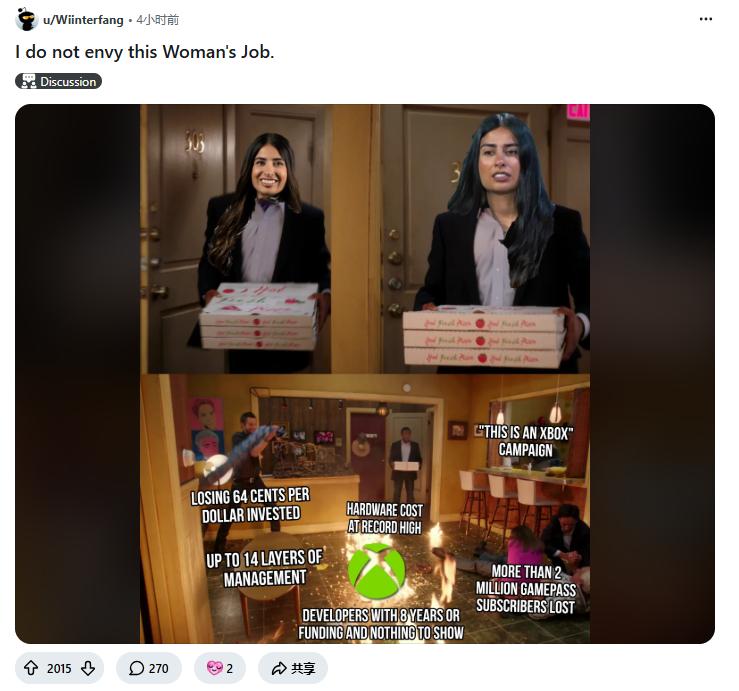
(Netizens joke that Asha Sharma, just after taking over the business, has to deal with mountains of accumulated problems)
01
Comprehensive Business Adjustments
It should be noted first that Microsoft has carried out multiple large-scale personnel adjustments in recent years. In early 2023 (fiscal year 2023), Microsoft completed layoffs of 10,000 people. In January 2024 (fiscal year 2024), after the acquisition of Activision Blizzard was finalized, Microsoft's gaming division cut 1,900 positions to sort out redundant internal staff. In May 2025 (fiscal year 2025) and July 2025 (fiscal year 2026), Microsoft carried out two rounds of layoffs worldwide, with about 6,000 and 9,000 people respectively, totaling 15,000 people. Combined with existing statistics, in these two rounds of adjustments, the number of affected personnel in game-related departments was less than 1,000. In this latest all-staff letter, Asha Sharma plans to control the total number of layoffs in the Xbox division at around 3,200 in fiscal year 2027, including the 1,600 layoffs implemented that day.
At the same time, Microsoft also announced on the same day that it would immediately lay off 4,800 people, accounting for 2.1% of its total employees. This means that the layoff scale of the game-related department alone accounts for one-third of the total number of layoffs this time. Whether in terms of number or proportion, this is the largest personnel adjustment in the history of the Xbox business.

The emergence of such a large-scale personnel reduction is mainly related to Microsoft's continuously rising capital expenditure. In the previous fiscal year 2025, Microsoft's planned capital investment was 80 billion US dollars, while the latest estimate shows that this figure will rise to 148 billion US dollars in fiscal year 2026. Financial report data shows that the capital expenditure in the second quarter of fiscal year 2026 alone reached 37.5 billion US dollars. The growth in expenditure mainly comes from data center-related projects, which has directly pushed up the overall operating cost of the company.

(Expenditure growth trend)
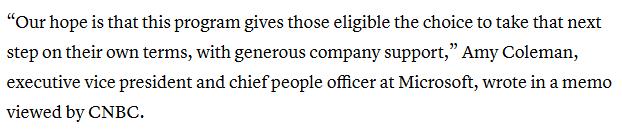
Prior to that, on April 23, Microsoft also launched a voluntary retirement buyout program for its US employees, which was the first such program implemented by the company. The program targets employees in the US at the level of senior director and below, whose combined age and years of service add up to 70 years, covering about 7% of the 125,000 local employees, roughly 9,000 people. Sales incentive positions are not included in this program. Participating employees can receive cash compensation and medical insurance-related benefits.
Amy Coleman, Microsoft's Executive Vice President and Chief People Officer, said in an internal memo that the program was launched to allow eligible employees to independently plan their career development and provide them with corresponding welfare support. From a practical perspective, this voluntary resignation method can effectively reduce legal risks and public opinion pressure, while helping the company control labor costs, and also pave the way for this subsequent large-scale personnel adjustment.
In this internal letter, Sharma also announced three business adjustment plans to complete the overall business re-organization.
The first is to adjust the game content layout. Sharma mentioned that since 2018, the number of new game releases in the industry has grown rapidly, and the output in a few years even exceeds the total of the previous ten years, making industry competition increasingly fierce. At present, Xbox's return on content investment is not ideal: for every dollar invested, it generates a loss of 64 cents.
In order to improve the situation and enhance competitiveness, the official has determined the future development direction of multiple studios. Compulsion Games, the developer of *South of Midnight*, and Double Fine Productions, the creator of the *Psychonauts* series, will be operated by their original management teams and transformed into independent studios. The two teams can retain their own intellectual property rights and past works, and also obtain financial support for new game development;
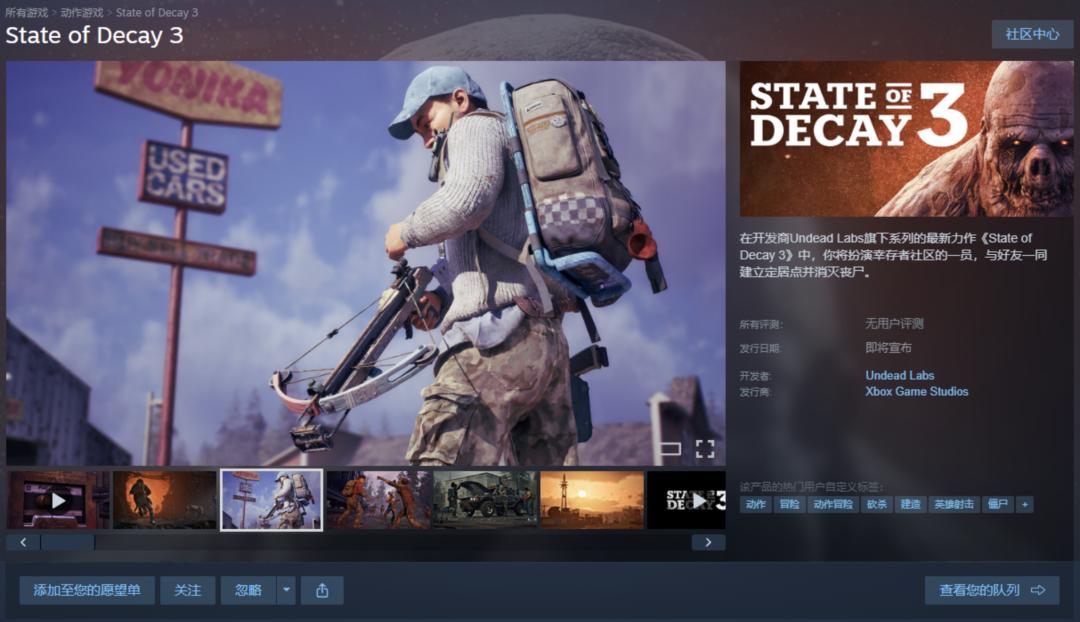
Ninja Theory and Undead Labs have already confirmed new buyers, who will provide funds to ensure the smooth completion of the two new products *Senua's Saga* and *State of Decay 3*;
The management of Arkane has also communicated with the local works council in France to evaluate the feasible future development direction of the team.
For larger studios such as Bethesda, Blizzard, King, and Mojang, Xbox will reduce non-core investments and concentrate resources on higher-priority projects. The official also stated that all first-party games and projects that have been announced to the public at this stage will not be terminated due to this adjustment.
Among them, Mojang and King will report directly to Sharma next. These two teams bring the largest number of monthly active users to Xbox on the platform, and are also the key to enriching the platform's user structure and forming differentiated advantages.
The second is to optimize the internal management model. Sharma admitted frankly that some departments of Xbox had up to 14 management levels in the past. The cumbersome structure not only slowed down decision-making efficiency, but also blurred the division of responsibilities, making it difficult for player feedback to be implemented quickly.
In response to this problem, Xbox plans to streamline its organizational structure, compressing the overall management levels to less than 5, ideally 3. The new flat structure will be built around three core positions: producers, technical managers, and direct responsible persons. In addition, the team will unify collaboration tools, streamline the code system, integrate internal shared services, and cut third-party cooperation-related expenditures by half.
The last is to change the overall operational thinking. As the team continues to expand, it is difficult for different departments and studios to maintain a unified development rhythm.
To this end, Xbox has established the Chief Operating Officer position for the first time, which will be fully responsible for the revenue and expenditure management of all sectors including content, hardware, platforms, and services. Helen Chiang officially took up this position and will report directly to Sharma in the future.
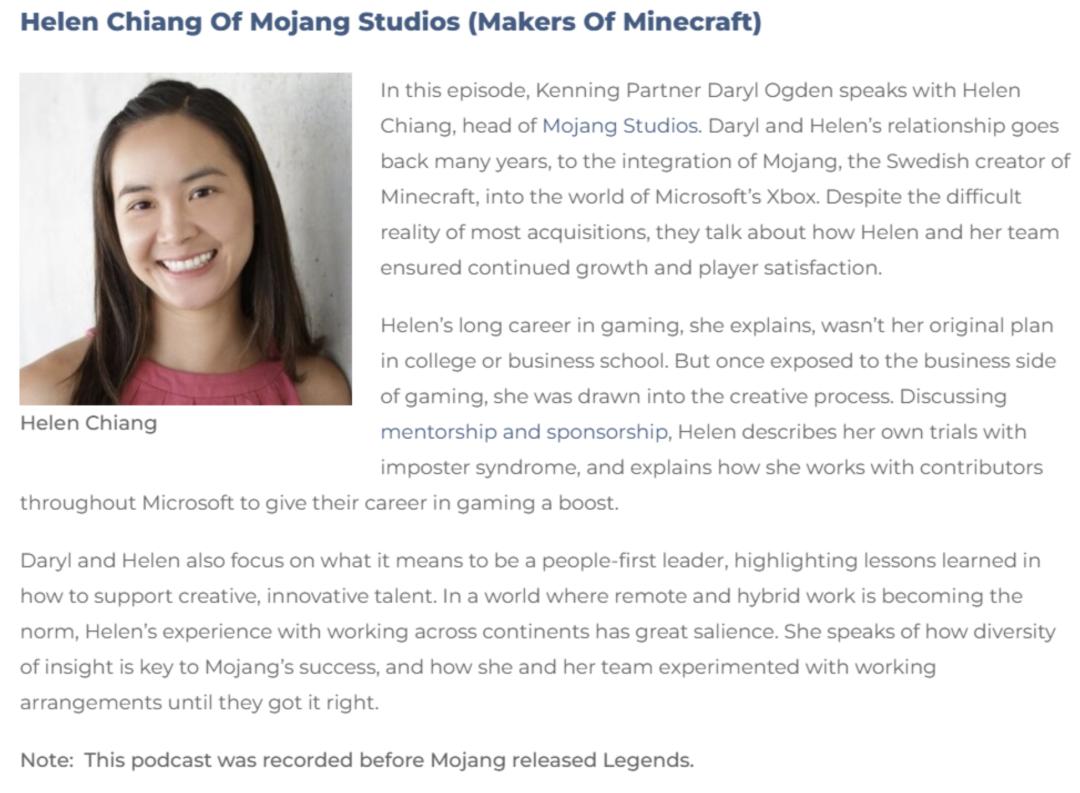
In her nearly 20 years of tenure, Helen Chiang has participated in the creation of many core Xbox businesses. She not only led the construction of Xbox Live, but also was responsible for the overall operation of Mojang and the *Minecraft* series. Next, she will coordinate all businesses, unify operational standards, promote the team to make reasonable investment judgments, summarize experiences and problems in project operations, and be responsible for the final results.
In short, this round of personnel reduction and structural adjustment is essentially a re-evaluation of the overall work efficiency of Xbox employees and a comprehensive reshaping of the entire business.
02
"The Kids Need to Start Making Money on Their Own"
Going back a few months to February this year, Microsoft's gaming business saw a senior leadership change: Phil Spencer, who had led the relevant business for 12 years, officially retired. Asha Sharma, former president of CoreAI Products, took over as CEO of Microsoft Gaming, and Matt Booty was promoted to Chief Content Officer, reporting directly to Asha Sharma.
During Phil Spencer's tenure, Microsoft successively completed the acquisitions of ZeniMax and Activision Blizzard, expanding the scale of its gaming business by nearly three times. However, this model of relying on financial subsidies to achieve business expansion has become unsustainable in fiscal year 2025. Microsoft also hopes that the new leader, who has experience in expanding consumer-grade platforms, can lead the gaming business out of the continuous investment acquisition phase and turn to a stable and viable operating model.
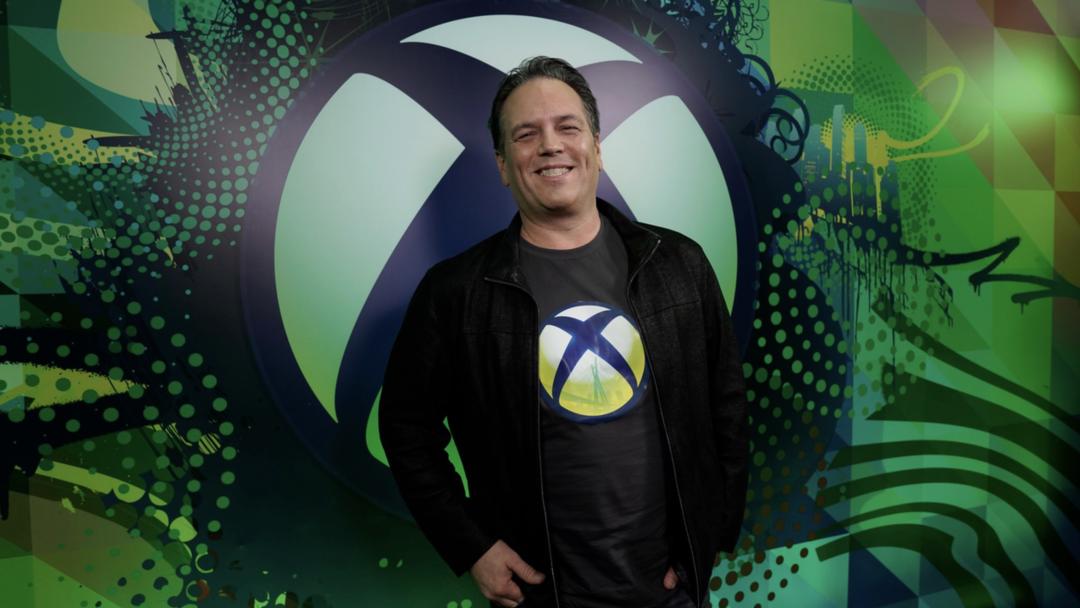
(Phil Spencer)
After taking over the work, Asha Sharma also clarified three development directions: putting high-quality game content first, focusing on core console players, promoting the "Return to Xbox" strategy, while exploring new business models and creating diverse gaming experiences. She also made it clear that she would not blindly apply AI just to fill the ecosystem, and refused to produce related content lacking creativity and core value.
Overall, the new team's development ideas mainly revolve around two points: first, retaining Xbox's original development characteristics, and second, supplementing the rules and control of business operations.
It wasn't until June 10 that Sharma released an open letter titled "Next 100 Days: Xbox Reset", where she and Chief Content Officer Booty jointly disclosed the department's financial status.
The data shows that excluding Activision Blizzard-related businesses, Xbox's total investment in game content, platform construction, and hardware subsidies over the past five years has exceeded 20 billion US dollars, but its overall annual revenue has decreased by nearly 500 million US dollars, and the accountable profit margin for this fiscal year is estimated to be only 3%. In the latest internal all-staff letter, Sharma further mentioned that Xbox's current profit margin is three to ten times lower than that of similar gaming platforms and publishing enterprises in the industry.
Sharma also clarified the current development goals: the department's accountable profit margin will continue to decline after the end of this fiscal year. The team also plans to gradually upgrade the technical architecture, comprehensively sort out Xbox's existing business capabilities, and does not rule out expanding business layouts in hardware, PC, mobile, and cloud gaming through mergers, acquisitions, and cooperation. Along with this overall business adjustment, Xbox will also open up development tools to independent creators and provide traffic support to help them complete their works.
At the same time, Microsoft CEO Satya Nadella also bluntly pointed out the situation in an interview: Microsoft has continuously invested in Xbox for 25 years, but the revenue generated by related game content has mostly flowed to the YouTube platform, and Microsoft itself has not obtained equivalent returns.
