Why do World Cup teams all stay in villages?
The World Cup is in full swing, with goals, scores, and eliminations taking center stage for most fans. But if you shift your gaze away from the pitch and look around the stadiums, you'll notice a far more interesting phenomenon: 39 teams whose bases are located in the continental United States are not staying in major cities.
This is not driven by the widely cited demand for privacy, though that is indeed one factor. The more fundamental reason is that even in small towns and rural areas across the U.S., sports facilities themselves are often world-class.
According to official FIFA data, North America has "a vast number of cities and towns that offer impressive infrastructure and easy access to 16 host cities" — these locations range from university campuses to MLS professional club training centers, from private high school athletic fields to resort integrated sports complexes, covering every type of facility one could imagine. These were not built temporarily for the World Cup, but are a pre-existing, continuously operating network of venues.
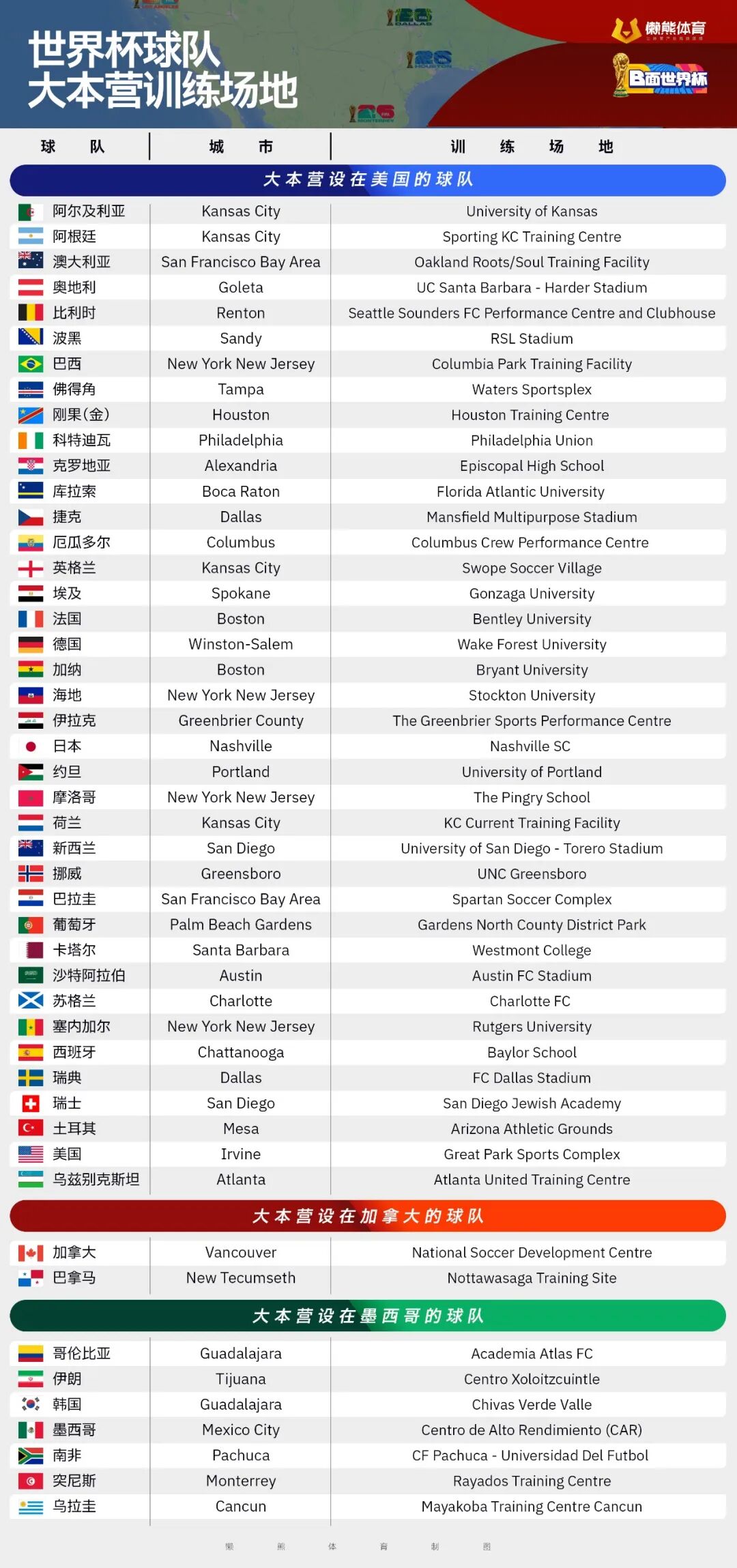
Spain's team traveled to Chattanooga, a small Tennessee city with a population under 200,000, and set up their training base at the private Baylor School. France selected Waltham, Massachusetts, 20 miles west of Boston, with their headquarters at Bentley University. Germany chose the Graylyn Estate in Winston-Salem, North Carolina, where players can bike to the training fields at Wake Forest University in less than 10 minutes each day.
Argentina, England, the Netherlands, and Algeria are all clustered around the Kansas City area. England is using the 9-field Swope Soccer Village. The Netherlands' training base is in Riverside, Missouri, a small town with a permanent population of just over 4,700. Algeria is stationed at the University of Kansas in Lawrence.
Brazil's training base is in Morristown, New Jersey, using the New York Red Bulls' Columbia Park Training Facility. Iraq selected White Sulphur Springs, a small West Virginia town with a population under 3,000, and trains at The Greenbrier Sports Performance Center.
Some of these locations are high schools, some are universities, some are professional club training grounds, and others are resorts with complete sports facilities — all different in type. But they share one common trait: these venues have their own regular users on normal days, and the World Cup simply brought in a new group of temporary occupants.
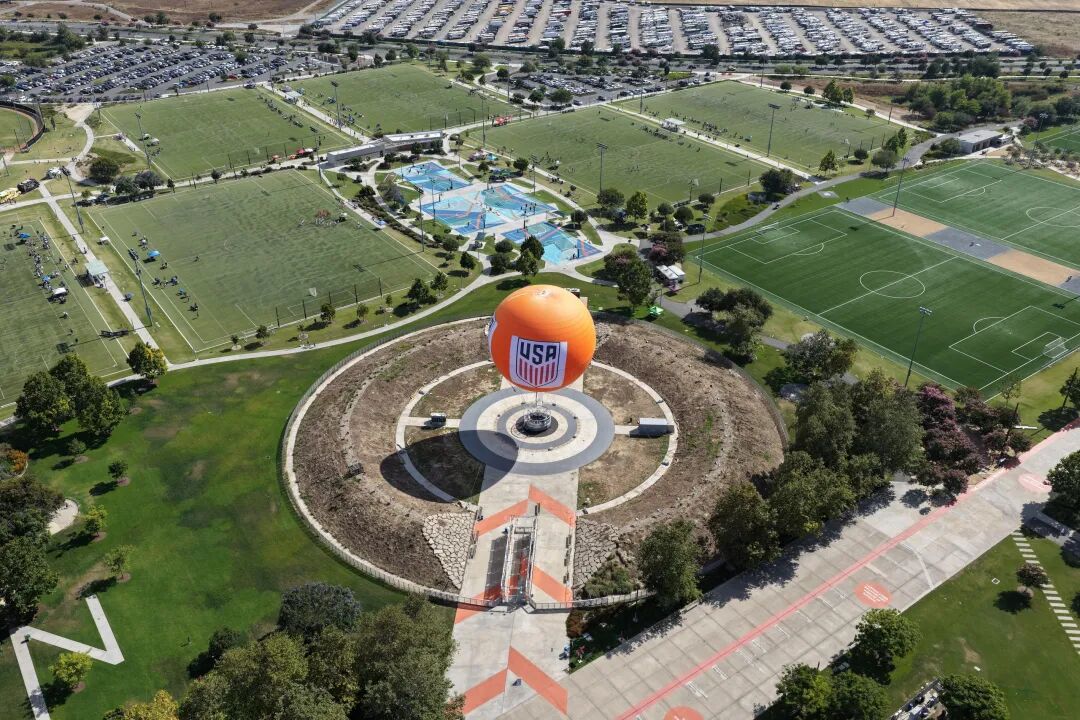
▲Irvine, California, USA (the US Men's National Team's World Cup base)
Baylor School hosted New Zealand's Auckland City FC for the FIFA Club World Cup in summer 2025; The Greenbrier Sports Performance Center has previously hosted training camps for multiple NFL teams. These are not exceptions — the accessibility and standard of sports facilities in the United States exceed most people's expectations.
According to FIFA's published list, the 48 World Cup teams' training bases are spread across the three host countries: 39 in the U.S., 7 in Mexico, and 2 in Canada. These bases are not located in the core districts of major cities like New York, Los Angeles, or Miami, but are scattered across small towns and suburban areas. Beyond the 16 host match cities, 25 other cities that are not hosting any matches have become part of the World Cup simply because of the teams' presence.
Take Kansas City as an example: Argentina, England, the Netherlands, and Algeria all set up their training bases here, making it one of the most concentrated training hub regions of this World Cup. Argentina's chosen Sporting KC Training Center is the daily training facility for Sporting Kansas City. Opened in 2018, the $75 million venue features five fields, plus a gym, sports performance lab, hydrotherapy pool, training rooms, locker rooms, player lounges, offices, classrooms, and media studios. The Argentine Football Association stated when confirming their selection that after multiple inspections, Kansas City was the ideal choice "considering inter-city distances, and more importantly, the facilities available to the team."
England's selected Swope Soccer Village opened in 2007 with nine fields. Its facilities include natural grass and artificial turf pitches, plus approximately 650 square meters of indoor space with locker rooms, offices, a gym, training rooms, equipment rooms, and classrooms. The Netherlands is using the KC Current Training Facility, while Algeria is stationed at the University of Kansas' Rock Chalk Park in Lawrence.
According to The Wall Street Journal, over the past 15 years, the Kansas City region has invested nearly $700 million in building world-class training facilities and stadiums. This is just one city's investment. Similar stories have played out repeatedly across the United States.
Looking elsewhere: The Graylyn Estate in Winston-Salem selected by Germany spans 55 acres and is described as "secluded and steeped in history." The German team booked the entire estate for the tournament, and players can bike less than 10 minutes daily to train at Wake Forest University's W. Dennie Spry Soccer Stadium. Germany's head coach Julian Nagelsmann previously said they found exactly the same conditions at Graylyn Estate as their headquarters in Germany, with most required facilities available on-site rather than needing to be shipped from Germany.
France selected Bentley University, a business school with fewer than 5,000 undergraduate students, whose training fields are adjacent to an ice hockey arena that the French team uses for training areas and locker rooms. Bentley's athletic director noted this was not a profit-driven project, but it is net positive overall, generating a small surplus without using any university funds.
The Columbia Park Training Facility used by Brazil spans 80 acres and cost over $100 million. According to the New York Red Bulls' official announcement, the venue features 8 full-size outdoor soccer fields with configurations including heated natural grass and artificial turf, plus a gym, dining hall, medical suites, and innovation lab. One pitch uses exactly the same turf as MetLife Stadium, the World Cup final venue. Brazil's head coach Carlo Ancelotti said: "The training center is new, modern, and provides every condition we need for our work."
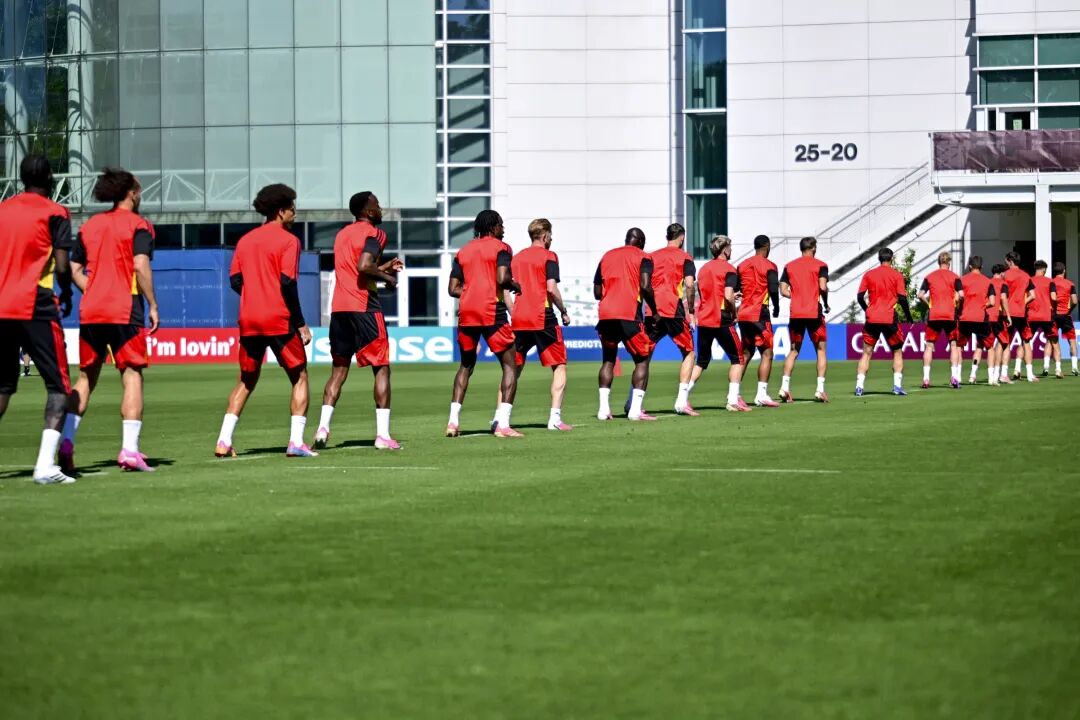
▲On July 5, 2026 local time, in Seattle, USA, the Belgian national football team trained at their base, the Seattle Sounders FC's home ground in Renton.
Belgium's choice is equally illustrative. The Belgian team selected the Seattle Sounders FC Performance Centre and Clubhouse in Renton, a 4,645-square-meter facility opened in 2024 with four full-size training fields (two natural grass, two artificial turf). Australia set up camp at the Oakland Roots/Soul Training Facility in Alameda. Croatia selected the Episcopal High School in Alexandria, just a 15-minute drive from Washington, D.C.
These facilities are not limited to soccer. The Greenbrier Sports Performance Center in West Virginia selected by Iraq can function as a soccer field when marked with white lines, or an American football field when marked with yellow lines. Swope Soccer Village's nine fields can also accommodate both soccer and other sports simultaneously. The same turf can serve different sports, with only the users changing. These venues are multi-purpose and accessible to all types of activities.
Why does the United States have so many such facilities? The answer is not soccer itself, but high demand, diverse use cases, and sustained commercial returns.
Professional sports teams need training camps, university teams need regular practice, amateur leagues and tournaments run year-round, and sports tourism is widespread across the country. U.S. sports demand is sufficiently large and use cases sufficiently diverse that football, baseball, ice hockey, lacrosse, soccer, and more all share this single facilities network.
According to Propmodo, the U.S. sports facilities market was valued at $36 billion in 2024, and is projected to reach $262 billion by 2034 — meaning over the next decade, U.S. investment in sports facilities will average enough to build a new batch of world-class sports complexes every year. Data from S&P Global Market Intelligence shows that in the first five months of 2026, private equity investment in the amateur sports sector reached $2.11 billion, nearly four times the $550 million total for all of 2025.
The logic behind these investments is clear: where there is demand, there is supply. Venue rentals, hotel bookings, and food and beverage spending all generate predictable revenue streams.
Using West Michigan as an example, a report from the West Michigan Sports Commission (WMSC) shows that 105 youth and amateur sports events in the region in 2025 attracted over 300,000 visitors, generating an $83.5 million economic impact. These families drive in for the weekend, stay at hotels, dine out, and spend locally — that is the most direct form of demand.
Where there is demand, there is supply, and developers have recognized this business case. According to Bisnow, a 159-acre project in Ocoee, Florida, includes 17 multi-purpose fields, two hotels, and 350,000 square feet of dining, retail, and entertainment space. The project's developer put it plainly: "You might only come for two hours of sports activity, but then your whole family can enjoy 22 hours of hospitality services."
The $83.5 million impact in West Michigan is not an isolated case. According to an industry report from Sports ETA, the total economic impact of sports tourism across the U.S. reached $274.5 billion in 2025, generating $111.2 billion in direct spending — meaning thousands of "West Michigans" across the country are producing the same results simultaneously. These facilities have operated for many years, serving the daily demands of U.S. sports.
From private high schools to professional club training centers, from university campuses to resort sports complexes, these facilities do not exist independently. Together, they form a nationwide sports facilities network covering the entire United States. Different types of venues serve different types of demand, with universities playing a unique role in this network.
On FIFA's published list of 48 training bases, more than 10 teams are stationed on university campuses. Germany is at Wake Forest University, France at Bentley University, Egypt at Gonzaga University, Ghana at Bryant University, Jordan at the University of Portland, New Zealand at the University of San Diego, Senegal at Rutgers University, and Algeria at the University of Kansas. NCAA regulations require that soccer fields built after 1995 have a minimum width of 70 yards (about 64 meters) and a minimum length of 115 yards (about 105 meters). For FIFA, this means a vast, ready-to-use network of high-standard, widely distributed training fields.
This nationwide network is supported by several foundational conditions: low land costs make large-scale construction feasible, an extensive highway network makes cross-regional competition routine, and the tournament economy allows these facilities to remain sustainably profitable. The combination of these three conditions has enabled the U.S. to build this far-reaching facilities network that even extends into rural areas.
When the World Cup came to the U.S., FIFA found that qualified, ready-to-use training venues were everywhere. Teams chose to stay in "small towns" because those locations had everything they needed: high-quality pitches and facilities, sufficient privacy, and convenient transportation.
After the World Cup ends and the teams leave, these facilities will continue operating. They will return to their regular routines of hosting professional leagues across various sports, pro team training camps, and weekend tournaments. The World Cup was just a temporary change of customers in their long operational history. As for who the next batch of users will be, when they will arrive, and what they will use the facilities for — that is a story for another time.
This article is from the WeChat Official Account "Lanxiong Sports" (ID: lanxiongsports), written by Wang Shan, and republished by 36Kr with authorization.