Behind the Trend of Coffee Turning into Desserts: A Hidden Health Account
Coffee was originally the "life-sustaining drink" for office workers to fight fatigue. Amid the nationwide trend of sugar reduction, the public naturally associates drinking coffee with self-discipline and health.
However, when this public perception translates into market dividends, the freshly prepared beverage industry is undergoing a hidden "ingredient-adding involution". More and more milk tea brands are venturing into the coffee business, adding cheese foam and thick cream to lattes, turning the originally low-calorie coffee into "liquid desserts". According to test data, a flavored latte labeled "no extra sugar added" from Guming contains as many as 400 calories, equivalent to eating a double-patty hamburger.
Behind the collective cross-border move of milk tea brands lies a game between two sets of logic: on one hand, consumers demand coffee products that are "daily, low-burden, and life-sustaining", while on the other hand, brands reuse their old supply chains and mindsets to chase traffic and earn more revenue. When the "addition inertia" of hit product thinking collides with the "health subtraction" of the era, the freshly prepared beverage industry is ushering in a thorough consumption shift.
01
"Dessertification through piled ingredients"
A quick-profit business even in coffee
At some point, more and more viscous flavored lattes topped with cheese foam and thick cream entered the market. Tea brands such as ChaPanda, Hushang Ayi, and Guming have all joined the coffee battle—reusing their milk tea supply chains at low cost, directly transferring existing cheese foam, syrups, and thick cream to coffee product lines, and adding a coffee machine in stores to launch new products quickly.
But when the ingredient-piling logic of hit milk teas is applied to coffee cups, the most direct impact is that coffee, which seemingly carries health attributes, hides milk tea-level calories.
This is not alarmist talk. Most consumers who choose to buy coffee from tea brands assume it is "healthier than milk tea". But the truth behind it is that a cup of sugar-free flavored latte can exceed the calorie count of dessert-style milk tea. The most representative example is the Bitter End Citrus Latte launched by Guming in January this year, whose regular version contains nearly 400 calories.
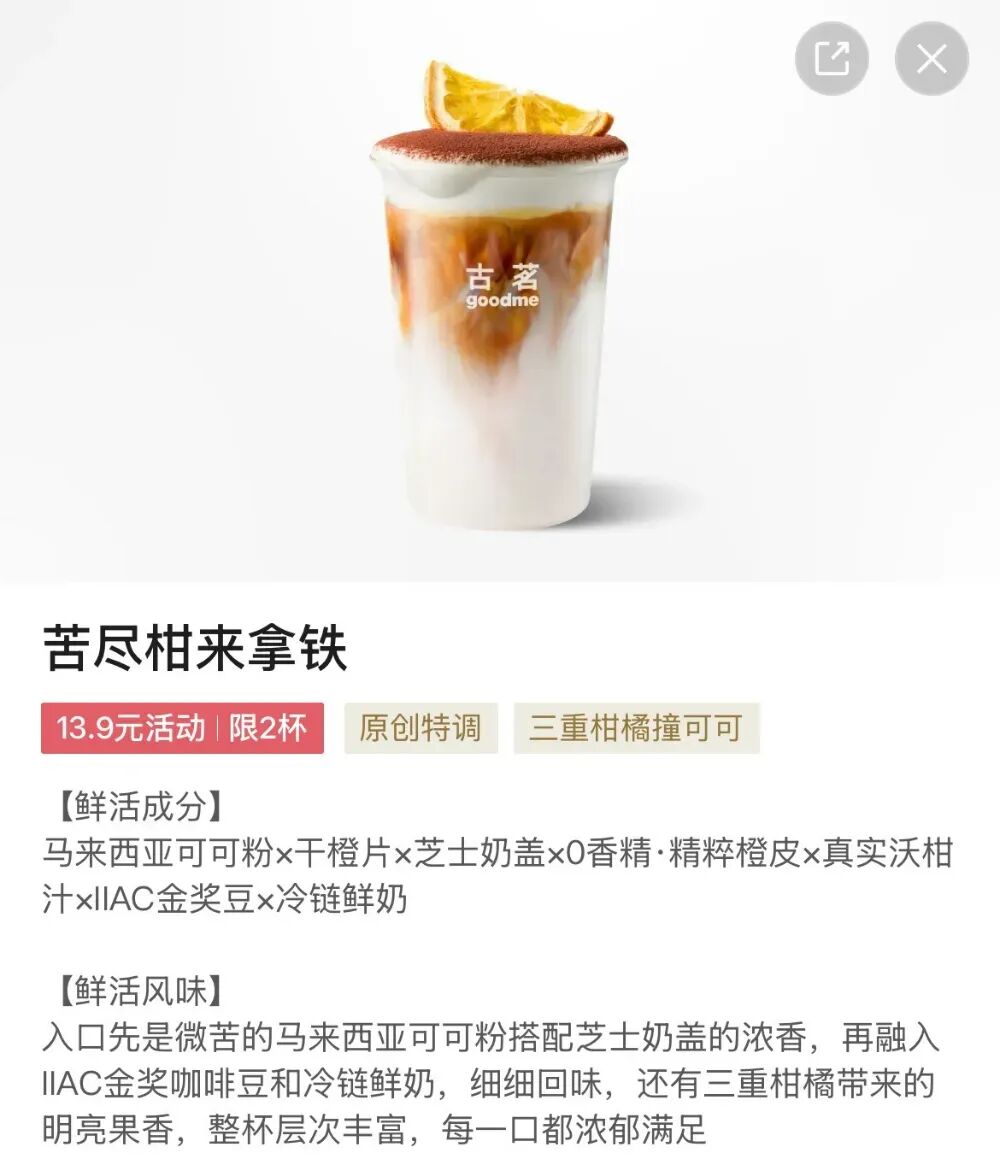
▲ Product information of "Bitter End Citrus Latte" Source: Guming Mini Program
In a professional food laboratory, "Huangjia Lab" tested 9 best-selling flavored lattes from 6 major brands using national standard methods. The top 3 products in terms of calorie count are all from milk tea brands, and these flavored lattes generally have higher calories than regular coffee. Behind the great taste lie unseen calories and sugar.
Over the past few years, the entire freshly prepared beverage industry has fallen into a vicious cycle of "ingredient-adding involution". The paradox of business is that when the habitual "piled-ingredient thinking" of hit milk teas is applied to coffee cups, the mismatch between supply and demand begins to emerge.
According to the recommendation of "Chinese Dietary Guidelines (2022)" that "daily added sugar intake should not exceed 50 grams", many flavored lattes already have a sugar content close to the critical line in a single cup. Coupled with the fat brought by thick cream and cheese foam, they have essentially become hidden sources of weight gain.
A more hidden problem is that even if consumers actively choose "no extra sugar", the finished product often still has a strong sweet taste. The so-called "natural sweetness of milk" cannot explain this taste at all. In fact, it is mostly hidden sugar that has already been pre-mixed in the base milk and flavored syrups. Consumers thought they were buying a low-burden life-sustaining drink for work, but when they inserted the straw, they got a high-calorie beverage instead.
From the perspective of business rules, "dessertification through piled ingredients" is a proven short-term path. It sacrifices the core public perception of the category in exchange for short-term traffic, and its dividend period may not last long.
Cheese foam is the most fitting precedent. Back in 2017, one supplier, Fonterra, sold 200 million servings of raw materials for cheese foam tea, and the industry chanted "whoever gets cheese foam wins the market". However, less than three years later, the sales of sugar-free pure tea from Nayuki surpassed that of cheese foam tea. Heytea later shifted its main products back to pure tea and fruit tea. Today, according to WeChat Index, the popularity of cheese foam milk tea is only one-tenth of that of fruit tea.
The cycle of dirty milk tea was even shorter. The dirty milk tea that rode the popularity of "dirty bread" in 2018 was essentially brown sugar pearl milk tea with a new "coated cup" look. At its peak, a cup was speculated from 20 yuan to 50 yuan by scalpers. But without real product barriers, its life cycle was less than a year before it was replaced by the next internet-famous concept.
This curve is almost identical to the trajectory of current dessertified coffee: using heavy milk fat and high syrup to create taste differences, boosting sales through visuals and marketing in the short term, but inevitably being overtaken by clean ingredient formulas in the long run. After all, no one drinks desserts as water every day.
Piling ingredients may create traffic-grabbing and visually appealing products, but they can never be healthy or long-lasting. The fate of cheese foam and dirty milk tea has already revealed a lesson: ingredient piling relies on marketing cycles rather than product strength, and the tide recedes faster than people imagine.
02
From flavor to health
The inevitable path for freshly prepared beverages
It must be admitted that it is understandable for general tea brands to add coffee machines in their stores to boost revenue by reusing existing supply chains and filling the gap in morning customer flow from a business logic perspective.
In fact, in recent years, the boundaries of freshly prepared beverages have been blurring. Milk tea and coffee have both evolved into high-frequency consumer goods for the public, with market competition continuing to intensify, even sinking into county-level markets. The emergence of more and more chain brands with 10,000 stores also reflects the industry's intense involution—brands with insufficient efficiency will fall behind.
However, when the piled-ingredient thinking of hit milk teas is applied to coffee cups, balancing "addictive flavors" and "long-term health needs" has become a common proposition for all cross-border players and native coffee brands.
Essentially, cross-border milk tea brands follow a "strong revenue-oriented mindset", while professional coffee brands adhere to a "strong product-oriented mindset". The different starting points of the two determine the fundamental differences in their product paths.
Tea brands tend to develop flavors with a "taste-first" orientation. Many cross-border brands lack in-depth accumulation in the coffee industry chain, making it difficult to have obvious cost advantages in raw materials.
To balance costs and ensure universal palatability, they usually use blended beans or lower-cost Robusta beans, which have strong miscellaneous flavors and burnt bitterness. To mask the potential burnt bitterness and off-flavors of coffee beans, products often rely on "flavor masking"—using coffee liquid as a base, layered with cheese foam, ice cream, and flavored syrups, while minimizing the cost of added ingredients.
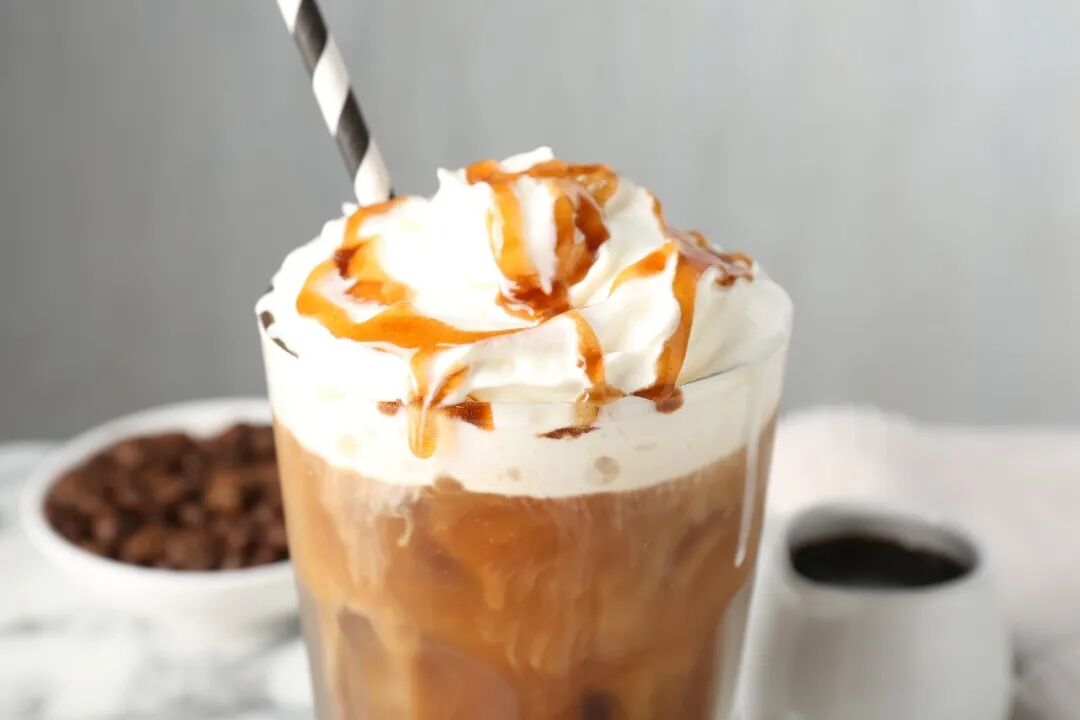
However, there are no shortcuts in the business world. Accumulating ingredients may be cost-effective for milk tea, but for coffee, it not only easily leads to price wars but also deviates from the core public perception of coffee as "daily and low-burden". Under the trend of low-calorie consumption across the country, consumers can hardly form long-term, high-frequency repeat purchases after trying new products.
The cultivation of China's coffee market lags behind that of milk tea. In the early days, coffee brands faced a market that was more accustomed to milk tea, with aesthetic and taste preferences leaning toward milk tea. In the early stage, Luckin Coffee also opened up the mass market with sweet flavored lattes like thick cream lattes. It is no exaggeration to say that this was the coffee consumption enlightenment for a group of Chinese consumers.
But after years of market competition, the logic of coffee has shifted to "drinking well"—pursuing the inherent flavors of coffee itself, which is a subtraction logic that essentially competes on the hard power of the supply chain.
The core competition among professional coffee brands no longer focuses on the cost-effectiveness brought by piled ingredients, but on heavy-asset layouts such as direct sourcing from core producing regions and deep roasting techniques, as well as the supply capacity of high-quality SOE single-origin beans, to capture public perception through the unique natural flavors of coffee beans. Manner has secured its position in the market with affordable prices by making accessible specialty coffee that tastes good without being expensive.
The development history of global coffee chain giants has proven this point. In the early days, many giants relied on high-sugar, high-fat flavored products to drive sales. But under the impact of the health trend, the market quickly shifted to cold brew and plant-based options. This is even more true today—for a large number of milk coffee orders in stores, consumers actively switch to low-burden bases such as oat milk.
More and more coffee brands are choosing to make no added sugar, optional plant-based milk, and transparent ingredient lists standard features. Many brands even allow customers to customize the number of espresso shots and the type of milk, essentially returning the right to choose healthily to consumers.
Even in the involutionary sinking market, the final trump card in competition is still rigid demand attributes, not unlimited ingredient piling. By offering basic Americanos and lattes at 9-yuan prices, coffee has become a low-burden daily drink for county consumers.
Therefore, whether it is global leaders, local chains, specialty shops, or the sinking market, professional coffee brands generally adopt a subtraction approach, focusing on low calories, plant-based ingredients, and clean formulas. Otherwise, they cannot meet consumers' demands for "daily drinking and low burden".
In the past, beverage brands sparked widespread public discussions due to debates over "0 sucrose" and "0 sugar". The lesson from business history is: consumers can accept that "happy drinks" such as cola and milk tea are unhealthy. But for coffee, which seems healthy and refreshing, if it eventually becomes a calorie bomb due to piled ingredients, once the "emperor's new clothes" are exposed, the entire industry will suffer.
03
The end is set:
Healthification is never an optional choice
Looking back at global consumption history, the end of freshly prepared beverages inevitably moves toward "low burden, daily use, and high-frequency repeat purchases", especially in the coffee industry. The core scenarios of coffee are sustaining energy during commutes and staying alert at work, which require frequent drinking, determining that "dessertification through piled ingredients" can never become mainstream.
In the 1990s, Starbucks made money through high-sugar, high-fat Frappuccinos. But in 2018, amid the global health trend, Frappuccino sales plummeted, and the brand's growth fell into crisis. Starbucks launched a hidden sugar reduction initiative internally, shifting its product focus to cold brew and plant-based options. Up to now, data shows that in Starbucks stores in first- and second-tier cities, nearly 40% of milk coffee orders are actively switched by consumers to plant-based bases such as oat milk.
This trend is equally clear in the Chinese market. After breaking through in the mass market, Luckin Coffee has adopted a subtraction approach in its products. From offering standard sugar control options like "half sugar / less sugar / no extra sugar" when ordering, to launching a light plant-based series now, all these moves essentially cater to consumers' low-burden demands.
Even affordable chains targeting the sinking market such as Cotti Coffee and Lucky Coffee do not rely on dessertified piled ingredients for their long-term repeat purchase moat. Instead, they return to the professional attributes of coffee and follow a cost-effective daily consumption path.
On Xiaohongshu, there are numerous coffee brand calorie reviews. A clear detail is that the flavored lattes from most professional coffee brands only contain around 200 calories. To some extent, this is an active choice made by coffee brands after market competition.
Data from the "2026 China Freshly Prepared Beverage Health Trend Analysis Report" released by Xinhua News Agency is very illustrative. When consumers choose freshly prepared beverages today, more than 30% prioritize checking whether the ingredient list is clean and free of additives, and another 30% value low-calorie and low-sugar attributes. More than half of consumers will actively request less sugar, remove cheese foam, or switch to plant-based milk when purchasing, and this proportion is nearly 60% among high-frequency consumers. People do not stop loving flavored lattes—they want ones that "taste good without burden", not ones that "taste good but make you feel guilty afterward".
The market demand for clean-formula, low-burden beverages is also driving the development of a healthier coffee supply chain. B-side raw material manufacturers are also competing in technology and R&D toward healthier directions, launching "light milk", "zero-trans-fat thick cream", and "low-sugar plant-based milk" to implement subtraction for freshly prepared beverages from the source.
At the same time, external objective constraints are also accelerating industry transformation. Multiple cities in China have taken the lead in piloting nutrition grading labels for freshly prepared beverages, directly marking calories, sugar, and fat content on menus so that consumers can clearly see the information when ordering. For example, Shanghai has pioneered the "Nutrition Choice" ABCD grading labels, directly returning the right to make healthy choices to consumers.
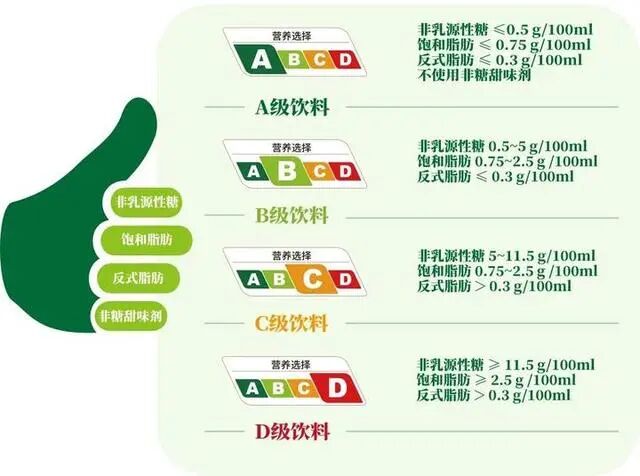
▲ Source: Shanghai Center for Disease Control and Prevention
When the "hidden health account" is fully exposed to the public, allowing consumers to see clearly at a glance when ordering, the trial cost and customer loss rate of products disguised as coffee that maintain high sweetness through piled ingredients will rise exponentially.
The major consumption shift has already occurred. Supply chain giants that produce sugar are developing sugar substitutes, and dairy giants are focusing on "zero-trans-fat" and "light milk". For freshly prepared beverage brands, true long-termism does not lie in trapping consumers' taste buds with sugar-coated "delicious" traps, but in responding to real health demands with the sincerity of "drinking well". Only by exposing ingredient lists to the public and returning the right to choose to consumers can brands secure competitiveness in the future.
As a daily necessity, the underlying logic of coffee is to be low-burden, repeatable, and suitable for drinking every day. This fundamental mismatch determines that the practice of dessertifying coffee through piled ingredients is unsustainable from its inception.
Players who make dessertified coffee through piled ingredients can gain traffic with the help of marketing dividends in the short term. But once consumers figure out this health account, as nutrition grading labels are gradually rolled out, and people realize that they "paid for coffee but got a sugary drink with milk tea-level calories", the tide will recede even faster than it did for cheese foam tea and dirty milk tea in the past.
After all, drinking coffee should eventually return to its original state—daily and healthy.
This article is from WeChat Official Account "Huashang Taolue