Those who refuse to be fast followers all aspire to create a brand-new world | 36Kr Offline Meetup Session 3
"The reasonable man adapts himself to the world; the unreasonable one persists in trying to adapt the world to himself. Therefore all progress depends on the unreasonable man."
This assertion from George Bernard Shaw in *Man and Superman* actually omits a critical premise: to make the world adapt to you, you must first envision a world that no one else has yet perceived.
It is undeniable that over the past two decades, a relatively mature path has taken shape in China's technology industry: fast follow. Observe what Silicon Valley builds, then replicate it faster and at lower cost. This approach has spawned a number of outstanding companies, but it inevitably created a blind spot: when there are no reference points ahead, where should we go?
On the evening of June 27th, we stepped outside Beijing for the first time and partnered with NIO Capital to host the third Offline Gathering event, "Chasing Fireflies" in Shanghai.
firefly is NIO's smart electric premium compact vehicle brand, but for our salon, it carries another metaphor: we believe the state of entrepreneurs, or entrepreneurship itself, is like fireflies — in a blurry, uncertain environment, you first let yourself emit a faint glimmer, send out a signal, then as these signals gather, they gradually attract more glimmers to converge, illuminating a whole unknown territory. This is exactly the process of entrepreneurship moving from uncertainty to conviction to growth, and the process of an ecosystem transitioning from fragmentation to cohesion.

The pursuit of direction and certainty is arguably the top priority for tech practitioners today. That's why the event turnout exceeded our expectations: more than 70 entrepreneurs and investors gathered in response to the signal from our Offline Gathering, marking the largest in-person attendance at any of our events to date.
During the bar-side conversation segment, the four guests we invited came from vastly different backgrounds.
Xu Chi, Founder of XREAL, has always firmly believed that AR glasses represent the next generation of computing terminals, and he is committed to building a global brand born in China; Yao Chengsheng, Founder of Hyden Hydrogen, aims to replace petroleum with green hydrogen to power the world — just last week, his company secured hundreds of millions of yuan in investment from Saudi Aramco and China Conch Cement; Pu Yang (AKA Mai Kaopu), Head of firefly Brand Marketing and Head of NIO Life Business, is a seasoned industry veteran with over a decade of marketing and operations experience. He has worked at top-tier giants like Apple and Tesla, founded his own business, and is now moving forward on a path that lets his light shine more freely; Guan Yufan, Partner at NIO Capital, has persisted in the energy industry for 20 years since a time when "there were no VC opportunities in the energy sector." From lithium batteries to hydrogen energy and nuclear fusion, he placed early bets on the biggest investment opportunities in the energy space over the past 10 years.
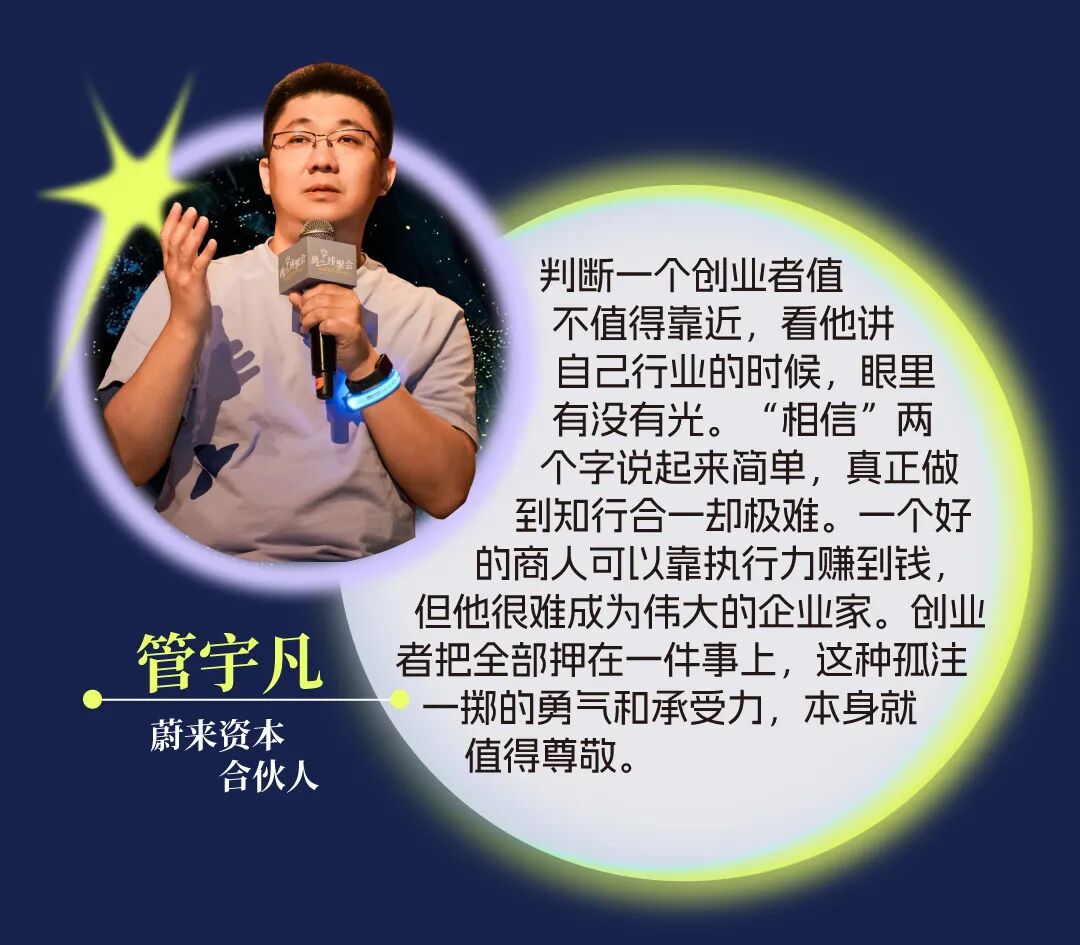
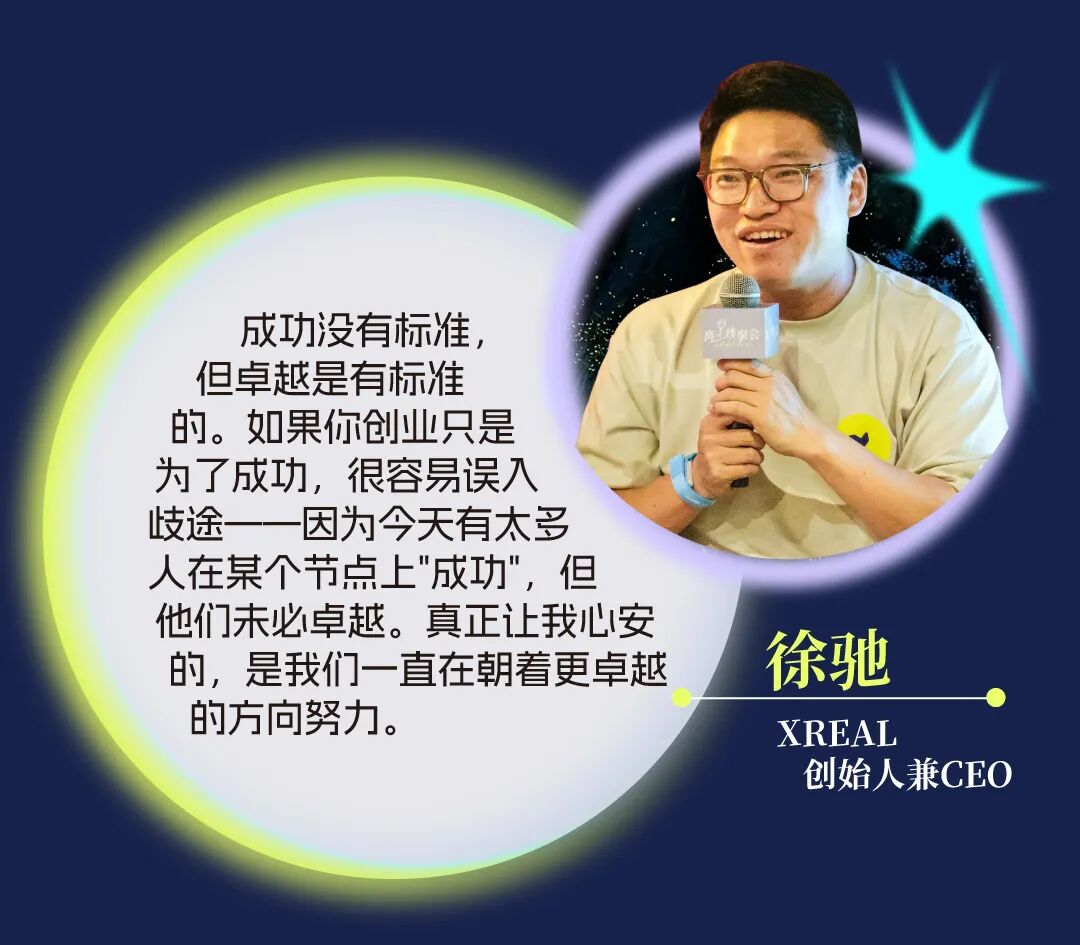
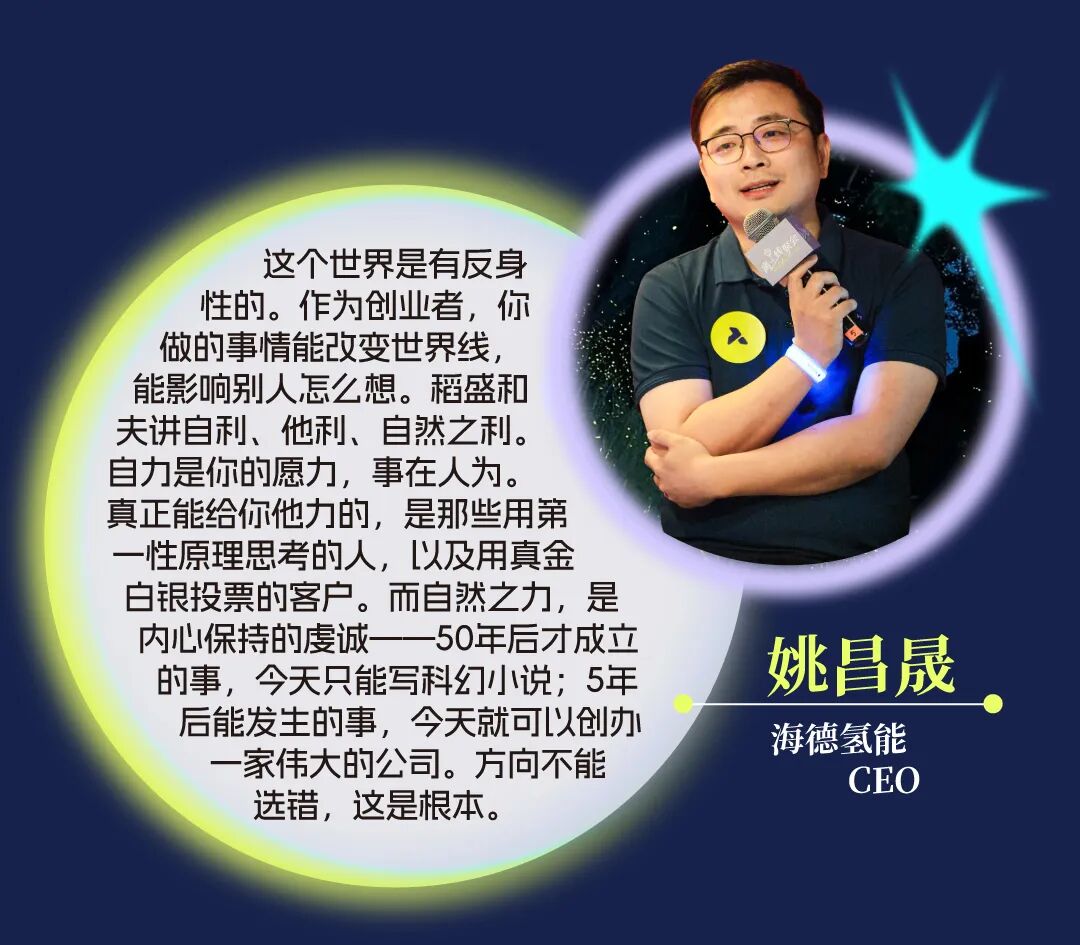
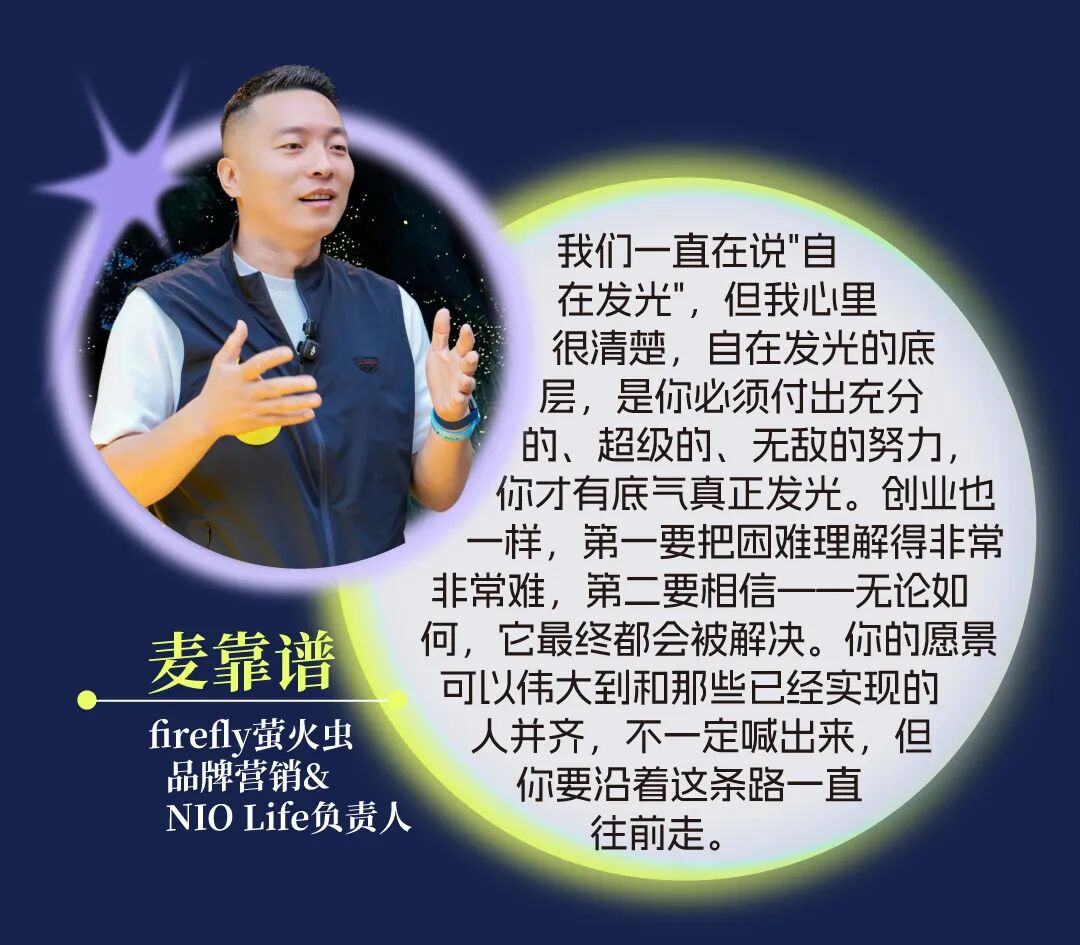
Yet beneath these differences lie commonalities. Whether developing AR terminals, green hydrogen energy storage, frontier tech investments, or new consumer brands, all these guests are doing one thing: discovering opportunities in uncertainty and creating new value.
We selected several highlights from the salon to show how they "shine their light" and find partners to move forward together (you can scan the QR code at the end of this article to listen to the full conversation).
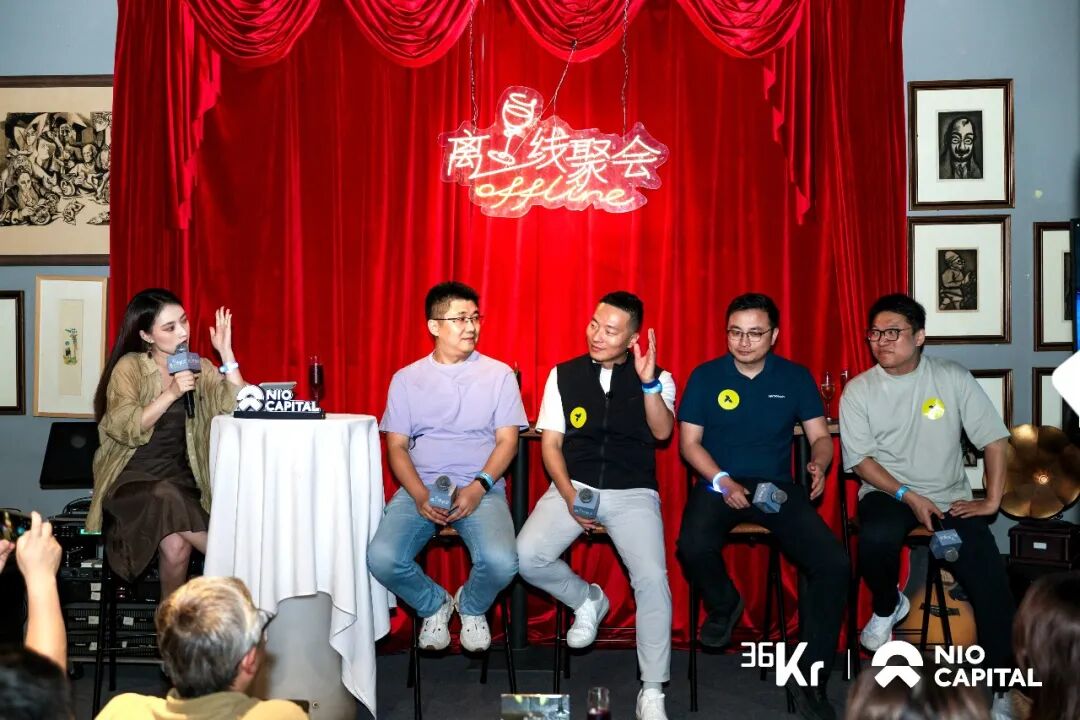
Choose the Right Path, Optimistic Paranoia
The work all these guests are engaged in shares one common trait: it is extremely difficult, with almost no existing reference points. The ability to find the right direction almost entirely determines future outcomes.
After earning his doctorate, Xu Chi joined NVIDIA to work on GPU architecture, only to discover that "a few senior leaders had already mapped out the roadmap for the next decade." Young people had almost no room to make an impact, which left him feeling disillusioned.
Later at Magic Leap, Xu Chi got his first exposure to the AR industry, and he felt "struck" — this was the next iPhone-level opportunity.
In 2017, Xu Chi returned to China to officially found XREAL. He was crystal clear at the time: in terms of technical expertise and industry seniority, "this project shouldn't have been my turn to lead, but if I didn't go back, I would have regretted it for the rest of my life." Today, XREAL has ranked first in the global consumer AR glasses market for four consecutive years.
He says he has always believed in one principle: "If the direction is correct, many difficult problems will resolve themselves. Conversely, most of the troubles you encounter likely stem from choosing the wrong direction in the first place."
This aligns with the three keywords he uses to describe himself: a pragmatic idealist, paranoid, and optimistic.
Xu Chi's experience struck a deep chord with Yao Chengsheng, who calls the work his team is doing the third energy revolution.
In his view, the energy revolution follows a clear historical trajectory: coal replacing firewood was the first revolution, oil replacing coal was the second, and renewable energy replacing oil is the third — each of these revolutions has reshaped the global balance of power.
What Hyden Hydrogen is doing is taking clean wind and solar power, using fluctuating water electrolysis technology to produce hydrogen, and converting it into equally clean green molecules — green hydrogen.
He has a benchmark for evaluating and judging directions: Something that will still be valid 50 years from now might only make a science fiction novel today, but something that can happen in 5 years is something you can build a successful company around right now.
Five years ago, Yao Chengsheng spotted the opportunity in the green hydrogen sector and founded Hyden Hydrogen — today, the company is undeniably a success. Around 2021, there were roughly 200 to 300 companies in this industry, but today only about 10 of them actually hold valid commercial orders.
"We are now standing at the intersection of AI and the third energy revolution. An era like this is something most people in the room will rarely experience in their lifetime. If you look back to 1940 to 1970, that was the era of nuclear weapons, satellite launches, and moon landings." Everything that seemed like science fiction back then gradually became reality through deliberate planning.
The key is to lock onto a direction and stick with it.
Mai Kaopu's focus circles back to questions of "people" and "organizations." In his view, entrepreneurs are not gods, and a new brand will never be understood by default. The real challenge is that before a shared consensus even forms, you must turn your judgments into actions, then wait for systematic investments to gradually reach the productive stage.
This kind of judgment comes from firsthand experience. For one thing, he was one of Tesla China's earliest employees and helped build the early Tesla owner community. He also founded his own new energy bus operation business, which at one point became one of the largest private new energy bus fleets in China — he even lived through a freezing Beijing winter night with temperatures below -20°C, when all vehicles failed to start and he was on the verge of bankruptcy overnight.
On the other hand, he gained more experience after joining NIO. He once led NIO China's sales operations and went through the period of maximum sales pressure.
During that phase, it was easy for the team to attribute problems to various external factors. But Li Bin told him: don't misattribute issues. Many of the systematic investments made back then had not yet entered the productive stage. Autonomous driving hardware, the battery swapping network, sales capabilities, and service systems had not yet formed real competitive advantages. Results that seem easy to explain in hindsight were nothing but noise at the time.
As NIO's premium compact vehicle brand, firefly itself represents a counter-trend choice against the industry's universal obsession with large 6-seater 3-row SUVs. What Mai Kaopu is pushing for is a new kind of directional consensus: urban development and autonomous driving will restore the value of personal vehicles, and vehicle weight will also impact energy efficiency, user experience, the environment, and social resource consumption. Compact vehicles regaining their place in future urban life is an inevitable trend.
Beyond that, NIO Life is another "main quest" he leads — it can do almost everything except build cars, rebranding lifestyle products into professional brands focused on individual vertical categories.
firefly's slogan is "Shine Freely," which is also a fitting self-description for Mai Kaopu. But the foundation of this freedom is "sufficient, superhuman, invincible effort."
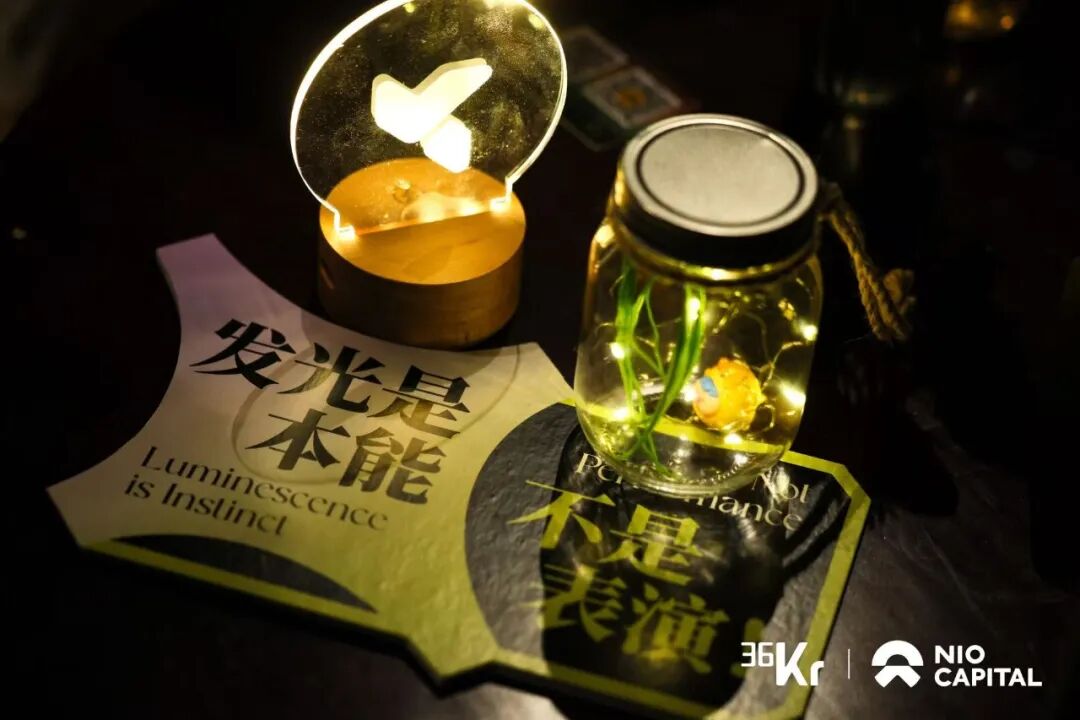
Chasing Fireflies in the Dark
Entrepreneurs search for direction in the dark, while investors must judge which faint glimmer is worth leaning toward.
When NIO Capital was raising a fund back in 2018, an LP once asked a question: "You only invest in new energy? Isn't that track too small?" Looking back today, that question seems somewhat misaligned, but at the time it represented a widely held mainstream view.
In the new energy wave, it's not just the market buzz that's changing — the underlying structure of the entire energy industry is being reshaped. In Guan Yufan's view, coal and petroleum from the first two industrial revolutions were essentially resource-based industries. To put it simply, "if you owned a mine, you could make money without breaking a sweat."
But the third energy revolution is different. Renewable energy sources like wind and solar can be converted into multiple energy forms including electricity, green hydrogen, and green ammonia. "Energy is transforming from a resource-based industry into a technology + manufacturing industry. That's where VC investment opportunities emerge. We invest in the most cutting-edge, most advanced tech companies, because we believe this is the biggest investment opportunity in the past 10 years."
Especially with the widespread adoption of infrastructure like photovoltaics and EV chargers, every industrial and commercial entity, even every household, is both a consumer and a producer of electricity. The one-way power grid has evolved into a two-way physical network more complex than the internet.
It is precisely within this structural transformation that VC investment opportunities have truly emerged.
At NIO Capital, this investment logic is summed up as "starting from the end." Starting from lithium batteries and lithium battery materials, to energy storage, photovoltaics, and wind power, then expanding into nuclear energy in 2022 and becoming one of the first domestic institutions to invest in nuclear fusion — the core strategy has always been to build a portfolio around the entire new energy industry chain.
That's also why NIO Capital generally invests in only one company per sector, and occasionally two companies with different technical routes. Because we firmly believe that "we should only invest in the leading, greatest, and most innovative companies."
When it comes to judging entrepreneurs, Guan Yufan uses a very simple, down-to-earth standard: see if the entrepreneur "genuinely believes" in what they are doing.
Early-stage tech projects are often extremely technically complex. Guan Yufan admits that when entrepreneurs explain highly technical details, investors cannot naturally understand every single field — though AI and external verification can help. What really matters is the founder's judgment of industry logic, long-term vision, and level of dedication.
"When you talk to them, they have their own unique insights into the industry, their eyes light up when they talk about their work, and they truly believe in what they're doing."
This is completely different from rehearsed, scripted talking points. Guan Yufan has met some entrepreneurs who received standardized training on investor pitches, "they might be good businessmen, but they can hardly become great entrepreneurs."
This is exactly what "chasing fireflies" means in an investment context: it's not about how bright the light is right now, but whether the person holding the light truly knows where they are heading.
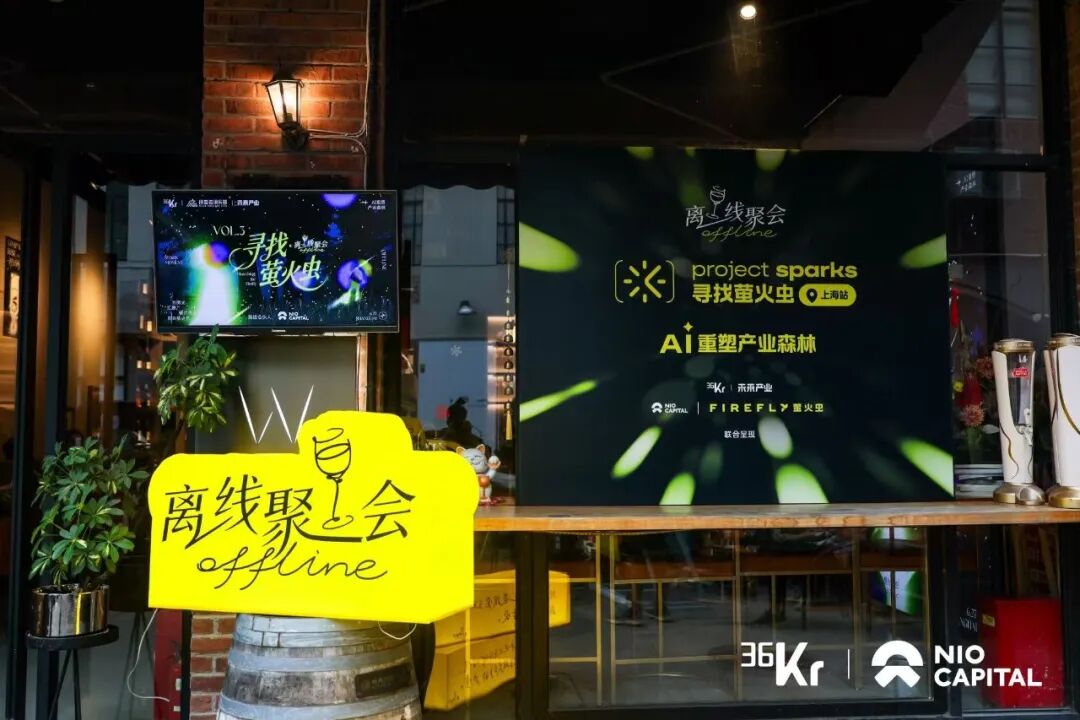
You Are Not Walking Alone in the Dark
Sticking to what you believe is right is never easy.
Mai Kaopu shared the rollercoaster experience his team went through on the day the firefly launched. The product announcement hit the top of Weibo's trending searches without spending a penny — but the initial reason was that most people thought the car looked ugly.
This was the complete opposite of the team's internal judgment. Mai Kaopu said they had full confidence in firefly's original design, but when public opinion turned overwhelmingly negative, anxiety was unavoidable. The team held an emergency overnight meeting and ultimately decided to launch a co-creation program called "Shine Together."
AI image generation was just emerging at the time, and a huge number of users participated in redesigning vehicle livery and visual expressions. firefly received massive user-submitted artworks from all over the world. The original controversy that was fixated solely on the car's appearance was gradually broken open by more diverse design languages. More critically, survey data showed that younger demographics were far more willing to embrace this kind of product aesthetic.
"I'm not exaggerating — if we had launched this program one day later, we might not have made it through." Today, firefly has already