Who is reconstructing the underlying logic of China's garment manufacturing?
Text by | Jing Xun
Over 90% of China's garment industry consists of micro, small and medium-sized factories. Scattered across numerous domestic industrial belts including the Pearl River Delta and the Yangtze River Delta, they form the world's most complete supporting and highest-density textile and garment manufacturing network, and underpin China's industrial foundation as the world's largest garment exporter.
However, the whole process of a piece of clothing going from needles and threads to the wardrobes of global consumers is being rewritten.
The driver that reshapes this process is the cross-border e-commerce that has grown rapidly in the past few years. As a representative of the new form of foreign trade, the rapid growth of cross-border e-commerce and the in-depth integration of "cross-border e-commerce + industrial belts" are bringing tangible changes to traditional industries such as textile and garment.
In the midst of this change, "chain leader" enterprises represented by SHEIN are carrying out an ambitious initiative.
Rather than merely delivering Chinese fashion products including garments to broader markets, they are deeply rooted in the industry. Starting from the depths of the supply chain, they are trying to reconstruct the underlying logic of garment production with the flexible on-demand model, technological tool innovation running through the entire industrial chain, and talent cultivation covering both internal and external parties of the industrial chain, so as to build a more sustainable and benign industrial ecosystem.
Reconstruction Starting from the Source
"Previously we passively accepted orders, but now we can proactively make judgments based on data." The changes are visible, and the growth is tangible. Deng Ming, a sportswear supplier based in Panyu, Guangzhou, saw his factory's first hit product on SHEIN receive continuous reorders for more than two years. Over the past five years, the overall sales scale of his factory has increased by 15 times.
To understand SHEIN's industrial role, we need to clarify one perception first. Its dual-engine model of "self-owned brand + platform" and its role as a "chain leader" enterprise in the fashion industry are the important identifiers that distinguish it from other cross-border e-commerce players.
As an independent fashion brand, SHEIN is backed by a large-scale system of supplier factories, with deep involvement in the entire chain from product planning to production management. At the same time, it also fulfills platform functions, serving as the overseas expansion window for some third-party merchants and brands.
This is completely different from other e-commerce platforms whose main function is to match supply and demand. While platforms focus on transaction volume, the chain leader cares about whether every supplier in the upstream and downstream can achieve better development. After all, the capability level of suppliers directly determines the upper limit of the brand itself. It is this deep bond that allows SHEIN to intervene in the supply chain down to the capillaries of every link to carry out transformation.
The starting point of the transformation is the "small-batch, quick-response" flexible supply chain.
The measurement unit of traditional garment production is "batch". The minimum order quantity is thousands of pieces, with a payment term of several months, and a production line is locked for a quarter or even half a year. If the products do not sell well, inventory backlogs will form on the brand side, while factories will fail to receive payment for their goods.
The "small-batch, quick-response" model reduces the production unit from "batch" to "piece". The first order usually ranges from 100 to 200 pieces, and the reorder pace will be determined based on market feedback.
Compared with the traditional garment manufacturing model, this new model boasts full flexibility and speed. The more profound significance lies in that the information flow has changed from one-way to circular. With the help of SHEIN's free and open digital tools, real signals from the demand side are transmitted back to the production end in real time, and adjustments on the production end can also quickly drive product iteration.
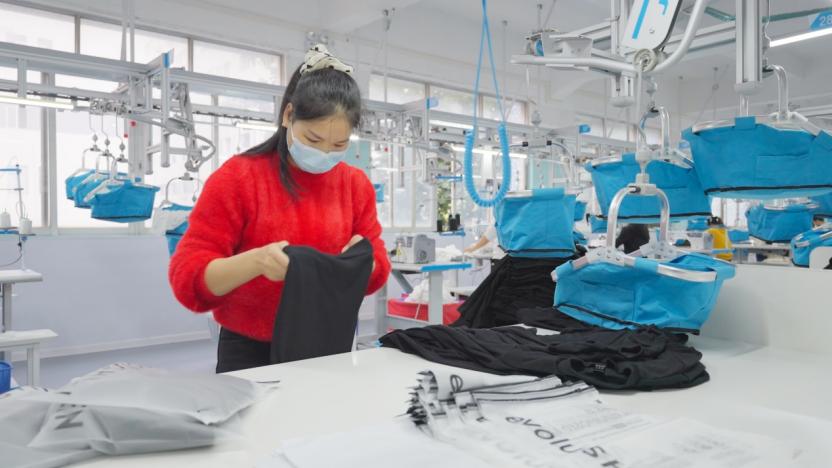
Supplier factory empowered and transformed by SHEIN
"Previously, I produced as many products as the customer ordered, but I never knew how well the products sold or what the market feedback was." Deng Ming described his past days this way. With many years of experience in traditional foreign trade, he was accustomed to the passive execution position of factories at the end of the industrial chain. After the goods left the factory, apart from the long waiting period for payment recovery, nothing else was related to him. He knew nothing about the sales performance or the time of reorders.
In 2022, after he became a supplier of SHEIN, he decided to shift from traditional sportswear to sportswear with more complex craftsmanship, and for the first time he was truly connected to this circular system. On SHEIN, he can see the full life cycle of products in the market, arrange subsequent production by tracking the growth curve, and optimize and improve production processes based on the data performance of key indicators and intuitive consumer reviews.
Factories have changed from passively accepting orders to making proactive judgments, and production has shifted from "large orders with long payment terms" to "agile response and quick payment recovery", which is the real value unlocked by the small-batch quick-response model. The underlying support for the operation of this model is the self-developed and continuously iterated digital management tools of SHEIN. Through online production scheduling, full-process control and real-time data collaboration, suppliers are gradually building the capability foundation of industrial internet.
Zheng Tao, a supplier based in Jinjiang, Fujian, the core domestic swimsuit industrial belt, had nearly 10 years of experience in traditional foreign trade before. He admitted that he once refused to take customers with small order volumes. But after cooperating with SHEIN, the benign order cycle, accurate consumer trend matching, and production innovation tools that can greatly improve efficiency, let him see a completely different growth logic. "Young people all prefer personalized and stylish products, and this production model can exactly match such consumption trends."
After starting the transformation, the maximum monthly shipment volume of Zheng Tao's factory exceeded 200,000 pieces. Now, his factory has even realized "one-piece customization". After confirming the order, the cooperative printing factory completes the printing process immediately, the factory uses laser cutting to finish the cutting work, and the production team completes the production and quality inspection to achieve fast delivery.
It is worth noting that this model is not limited to SHEIN's own suppliers, but also extends to the broader ecosystem of industrial belts.
In SHEIN's "Overseas Expansion for Industrial Belts in 500 Cities Nationwide" initiative, third-party sellers can also access the flexible on-demand system. Can the same set of supply chain capabilities be replicated outside the self-operated system?
For this question, Wang Kai, the owner of a jersey factory in Panyu, gives a positive answer. With nearly 10 years of experience in jersey manufacturing, he was used to the rhythm that it would take half a year to figure out the market response of a new product. After settling in SHEIN's platform in 2024, this cycle has been shortened to around 10 days.
During the recent FIFA World Cup in the US, Canada and Mexico, he keenly noticed that orders for Mexico-themed jerseys were continuously rising, so he quickly iterated the design direction and carried out extended development in line with the platform trends.
According to Wang Kai's estimation, his factory is expected to produce 150,000 pieces of products during this World Cup, more than twice the 60,000 pieces produced during the last Qatar World Cup. With the reform of the competition system, the continuous consumer demand brought by 48 participating teams and a longer schedule cycle is being efficiently undertaken by the flexible supply chain system after digital transformation.
Deeply Diving into Technological Innovation
After the production unit becomes smaller, the flexibility and agility of factories have been significantly improved, while new challenges have also emerged. In response to the diversified and personalized fashion demands with small batches, high frequency and endless new trends from the global market, how can the traditional manufacturing system keep up with the market iteration speed and quality requirements of "on-demand production"?
What SHEIN is doing is to embed technological innovation into the entire industrial chain.
In traditional perception, the more sophisticated the craftsmanship is and the higher the added value of the product is, the more difficult it is for small and medium-sized factories to master.
This point does hold true. For example, materials such as sequins, bead embroidery and hot drilling fabrics used to appear almost only in formal dresses and haute couture. The reason is that the craftsmanship is too complex: needles are easy to break during the sewing process, fabrics are prone to wear, and the stitched edges may cause skin irritation. There are no reliable devices on the market, and the whole process can only be completed through multiple manual procedures by veteran technicians. With high technical thresholds, long time consumption and unstable quality, small and medium-sized factories were blocked from this field.
What SHEIN Garment Manufacturing Innovation Research Center is doing is to break down common process difficulties into standardized tools. Take bead embroidery fabric as an example. In traditional craftsmanship, when problems such as stuck needles or broken needles occur, workers have to destroy the embroidery beads on the path first and then continue the work, which is time-consuming, laborious and easy to damage the fabric.
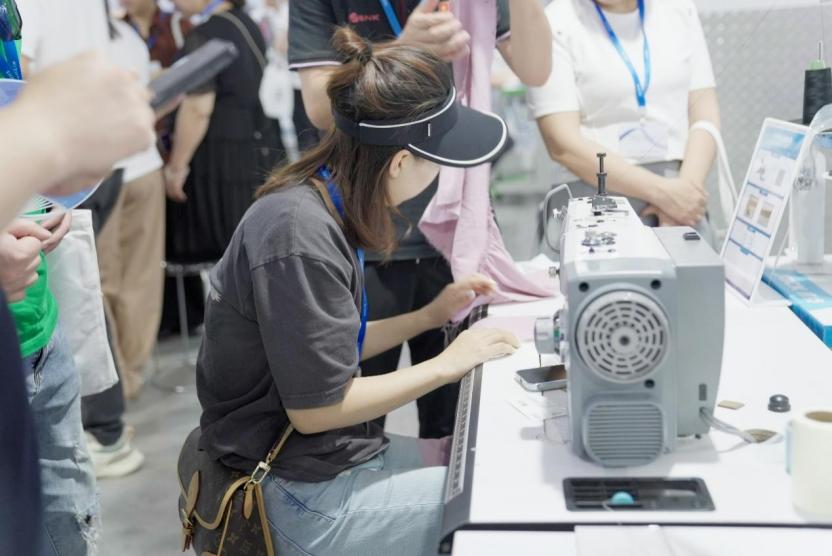
Supporters experience the innovative tools developed by SHEIN on site
To solve this problem, the research center developed the "bead embroidery presser foot", a special presser foot several millimeters wide and shaped like a bird's beak. It will automatically push the embroidery beads away during sewing and let the needle pass through the gap, which not only protects the embroidery beads but also avoids needle breakage. This tool has been continuously iterated since its launch in 2024 and is very popular among suppliers. The use of these innovative tools has brought more differentiated hit products with related craftsmanship.
Another example is the "compression vacuum packaging machine", a tool specially designed by SHEIN for fluffy categories such as down jackets and plush toys. It can effectively compress the product volume, directly reduce storage and logistics costs, and has also become a popular product among suppliers.
By the end of 2025, SHEIN has cumulatively developed more than 180 such innovative tools that turn "veteran technicians' skills" into "standardized, low-threshold operations", and delivered 7500 units to suppliers, which improves the efficiency of related processes by 35% on average. In the first quarter of this year, SHEIN delivered another 1200 self-developed tools and devices.
Of course, every factory has various long-standing problems that are difficult to solve with their own strength.
The factory of supplier Wang Feng focuses on heavy craft formal dresses, which is a relatively niche track.
In this category, the fishbone craftsmanship is the core selling point, and it has also been the long-standing production pain point for Wang Feng: the finished fishbone is either too large to be delicate, or extra procedures need to be added which brings the risk of damaging the clothes.
However, all kinds of improved tools commonly used in the industry before only support double-needle sewing machines, which are not compatible with the interlock sewing machines in Wang Feng's factory. After becoming a supplier of SHEIN in 2021, he directly raised this problem to the R&D staff of SHEIN Garment Manufacturing Innovation Research Center. After multiple rounds of iteration, the problem was finally solved by the new tool.
The upgrading of tools, devices and processes ultimately changes the business boundary of factory owners.
"Previously I could only say that my factory can't make this style, but now whenever I encounter a problem, I can contact SHEIN's team immediately, and they can even customize tools according to my demands." In addition, for factory owners like Wang Feng, recruiting workers is another major problem as tricky as craftsmanship difficulty. A newly recruited worker usually needs at least half a year of training. Tools that can simplify procedures and make craftsmanship easy to learn just solve this problem. "A novice can master the operation in only 30 minutes."
From general tools to customized solutions and then to on-site technical support, small and medium-sized factories have for the first time supplemented the capabilities that are almost impossible to obtain on their own.
According to Hu Qimu, Deputy Secretary-General of the China Digital-Real Integration 50 Forum, SHEIN is no longer a simple brand or e-commerce enterprise. Through the "digitalization + tools" model, it has become an enabling platform for the entire garment industrial chain, which allows individual enterprises that originally do not have intelligent manufacturing capabilities to accelerate their digital and intelligent transformation, promote industrial collaboration on a larger scale, and form a more resilient industrial ecosystem.
This "full-chain" layout is not empty talk. Public reports show that in 2025 alone, SHEIN carried out continuous in-depth cooperation with universities, third-party professional institutions and relevant enterprises in green carbon reduction and process technology breakthroughs. On the material side, it jointly developed a new generation of recycled polyester solutions with Donghua University, and built a joint laboratory with Transfar Chemical to explore new processes for high-end fabrics. On the logistics side, it cooperated with Dongfeng Motor Group, China National Heavy Duty Truck Group, CATL and other enterprises to put more than 100 new energy logistics vehicles into operation, realizing the first large-scale application of green logistics in the industry...
It must be admitted that no small or medium-sized factory can independently build such a deep technical system. To some extent, this is exactly the meaning of the existence of the chain leader: turning the manufacturing capabilities that a single enterprise cannot reach into public resources of the entire supply chain.
Talent Development Lights Up Industrial Belts
Technologies can be innovated, tools can be iterated, but the growth of talents requires long-term investment, which is the most easily underestimated but the most valuable part for long-term development in industrial upgrading.
SHEIN is making talent cultivation a normalized industrial infrastructure. The training density for suppliers is very high and the content is very practical. In the first quarter of 2026 alone, nearly 100 training sessions have been held, with suppliers participating in training for nearly 8000 person-times. The content covers not only special production processes, but also extends to helping factories build financial statement systems and construct profit analysis capabilities.
Deng Ming recalled his early days of transformation, "We participated in normalized learning covering defective rate management, production efficiency improvement, production scheduling and quality inspector training and certification."
What is of more far-reaching significance is the expansion of the training boundary. Since 2025, SHEIN has cooperated with multiple departments including the Guangdong Provincial General Trade Union to carry out "zero-based" skill training for the public. After passing the assessment and obtaining the skill certificate, the trainees can be prioritized for employment in enterprises within SHEIN's supply chain system.
Huang Xi, a trainee who participated in the training, said that from the pattern making of skirts and dresses to sewing, grading and material layout, "we started from zero foundation, and truly learned the complete process of garment production from scratch."
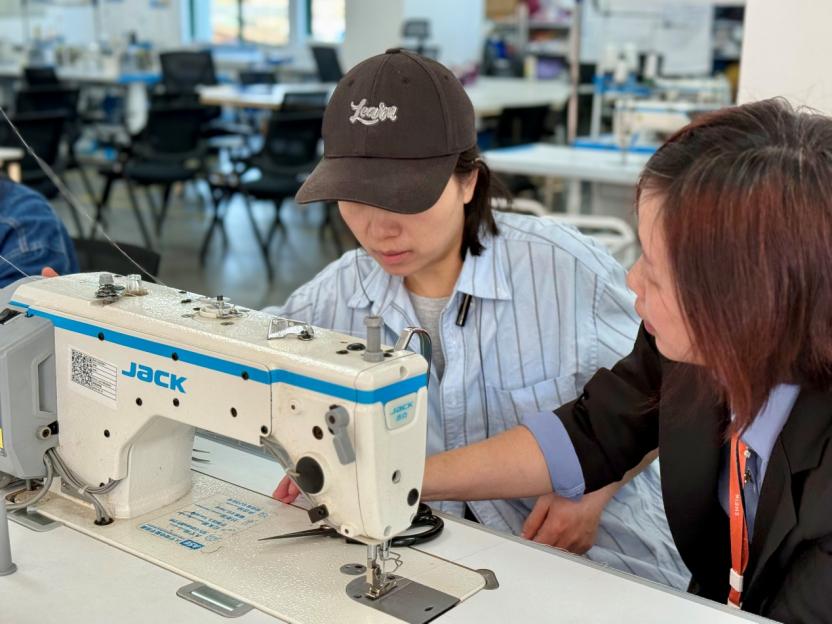
SHEIN skill training site
Recently, the 2026 Guangdong Provincial Garment Pattern Maker Vocational Skills Competition, which is co-organized by SHEIN, has also opened registration, aiming to promote learning and training through competitions.
From employing talents at the end of the chain to cultivating talents at the front end, from internal enterprises to external parties of the industrial chain, the end point of this path is not the efficiency of a single enterprise, but whether the entire industrial belt can continuously find talents who are willing to learn and can master relevant skills.
As a chain leader enterprise, SHEIN, together with colleges and chain member enterprises, has built a four-in-one model of "job demand + skill training + skill evaluation + employment service", which addresses the long-term structural mismatch between talent supply and demand in the textile and garment industry: it is building a talent foundation for the entire industry and accumulating long-term momentum for sustainable development.
If we look at the three lines of production model, technical tools and talent cultivation together, it is not difficult to understand SHEIN's real role in the transformation and upgrading of the garment industry.
The more open the tools are, the more factories can use them; the wider the training coverage is, the more people can participate in the industry.