China leads the world in fintech patents, far outpacing the United States
In the field of "FinTech" that shapes the next-generation competitiveness of financial institutions, China has begun to lead the world. Banks and technology companies have successively launched new technologies, and the number of patent applications has surpassed that of the United States to rank first. Finance is a critical industry that governs the flow of global wealth. Alongside artificial intelligence (AI) and other cutting-edge technologies, competition for dominance in this sector is becoming increasingly fierce.
FinTech refers to technologies that innovate financial services through information technology. It covers multiple domains including payments, financing, asset management, and crypto assets (virtual currencies). Global financial institutions and tech companies are racing to advance development, with the potential to reshape the power landscape of the financial industry.
U.S.-based McKinsey & Company forecasts that the global FinTech market will triple by 2030 compared to 2025 levels, reaching $2 trillion.
With the assistance of patent research firm Patent Result (Chiyoda Ward, Tokyo), Nikkei conducted a survey on FinTech-related patents filed across 118 countries and regions over the 10-year period ending in 2025. There were approximately 120,000 total applications, nearly tripling from the previous 10-year period (2006–2015).
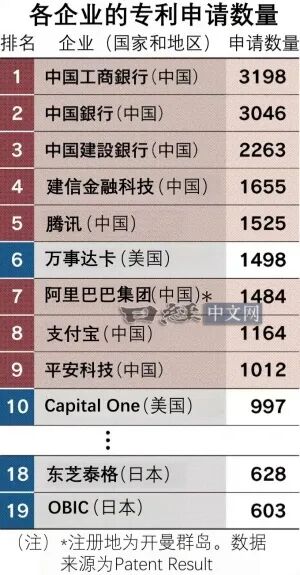
By applicant nationality, China accounts for the largest share at 38% of the total. The United States follows at 17%, South Korea at 9%, and Japan ranks fourth at 8%. In the prior 10-year period, China ranked third behind the U.S. and South Korea. However, China's application volume grew tenfold in the subsequent decade, surpassing the U.S., which saw only modest growth.
Ranked by company, Industrial and Commercial Bank of China (ICBC) takes the top spot. The top 5 positions are all held by Chinese enterprises including China Construction Bank and Tencent Holdings. Among the top 50 companies, 22 are Chinese state-owned banks leading technological development. U.S.-based Mastercard ranks sixth, whereas previously American firms such as Bank of America dominated the leading positions.
China's patents also demonstrate high quality. After scoring and analyzing patent value and competitiveness, China ranks first, followed closely by the U.S. and Japan. By enterprise, e-commerce giant Alibaba Group tops the list. The shift in leadership for next-generation financial technologies between China and the U.S. is clearly evident.
Like consumer electronics, automobiles, and AI, China aims to secure a leading position in the global financial market. Its goal is to reduce the world economy's reliance on the U.S. dollar in global trade and establish the renminbi as a prominent international currency.
China is advancing cashless initiatives through national policy, striving to make its domestic companies' new technologies and services the financial infrastructure for other nations. Hong Kong is also dedicated to developing stablecoins pegged to fiat currencies to compete with the U.S.
The development of new technologies centered on AI is particularly notable.
Industrial and Commercial Bank of China applies AI in areas such as loan risk prediction. It possesses technology that uses AI to analyze customer behavioral data, income, and other credit indicators to precisely calculate the probability of bad debts. The bank also holds patents for AI-powered systems that formulate efficient cash replenishment plans based on user location and weather information to reduce operational costs.
China maintains advantages in cutting-edge blockchain technologies such as virtual currencies. Bank of China not only has a secure automated virtual currency transfer system, but also technology for managing customer risks and controlling transactions on the blockchain. Additionally, Tencent has received high recognition for its system that enables secure asset transfers across different blockchains.
Japan has fallen behind, with 9,115 patent applications — only one-fifth of China's total. Among Japanese companies, Toshiba TEC, which holds intellectual property related to point-of-sale (POS) systems, ranks highest at 18th place. There remains a significant gap between Japanese firms and major Chinese banks.
China's Patent Quality Has Also Improved
Ten years ago, the quality of China's FinTech patents lagged behind that of Japan and the U.S. However, according to the "Patent Score" — an index calculated by Japanese patent analysis firm Patent Result to measure factors such as patent independence — China has recently surpassed Japan and the U.S. It has become clear that improvement is not limited to application quantity, but extends to patent quality as well.
As an index measuring patent quality metrics including public attention, independence, and influence over other companies, Patent Result calculated FinTech patent scores across the industry. Based on total cumulative scores from 2016 to 2025, China ranks first with 87,926 points, surpassing the U.S. (69,642 points) and reaching 4.2 times the score of third-place Japan (20,875 points).
China's patent scores have grown rapidly over the past decade. In 2015, its score stood at around 1,400 points, on par with Japan's, but rose to about 5,000 points in 2017 and approximately 10,000 points in 2018, overtaking the U.S. In the prior 10-year period (2006–2015), China ranked third behind the U.S. and Japan, with its total score amounting to only roughly 10% of the U.S.'s and 60% of Japan's scores during that period.
The underlying driver is China's national strategy to strengthen research and development in big data, artificial intelligence (AI), and other fields to revitalize key industries. In 2015, initiatives such as "Made in China 2025" and the "Internet Plus" action plan were launched, aligning with the expansion of supportive policies including subsidies and tax incentives.
The highest individual score belongs to Alibaba Group, China's largest e-commerce enterprise. The company has filed patents for systems that detect unauthorized use of cloud services and visualize cross-border remittance transaction status. Together with Industrial and Commercial Bank of China, which ranks second, these two firms account for 15% of the total combined score of the top 50 companies.
The third-place position is held by U.S.-based Capital One, while Japan's PayPay ranks 16th. PayPay's patents cover systems that analyze transfer history to recommend scheduled recurring payments and automatic remittances, as well as mechanisms to automatically transfer e-money received via digital wage payments to dedicated accounts.
This article is sourced from the WeChat official account "Nikkei Chinese Net" (ID: rijingzhongwenwang), authored by Nikkei Chinese Net, and published with authorization from 36Kr.