In the first half of the year, real estate enterprises acquired land in Zhejiang: Binjiang took the lead, and Hangzhou accounted for "half of the total share"
The first half of 2026 marked the official conclusion of Zhejiang's land market amid in-depth adjustments. While policy-driven favorable factors spurred a structural rebound in new home transactions across multiple Zhejiang cities between May and June, the majority of the region's urban areas remain in a critical phase of real estate inventory destocking.
As a result, the supply side of the land market has continued to contract. Cities have proactively reduced the supply of land parcels for basic residential needs in remote suburban areas, while significantly increasing the release of low-density, improvement-oriented land plots in central urban districts, reshaping the product structure from the source. The overall transaction volume of operational land has shrunk, with market heat showing clear divergence across different regions.
Operational Land Transaction Volume Contracts, With a Volume Surge in June
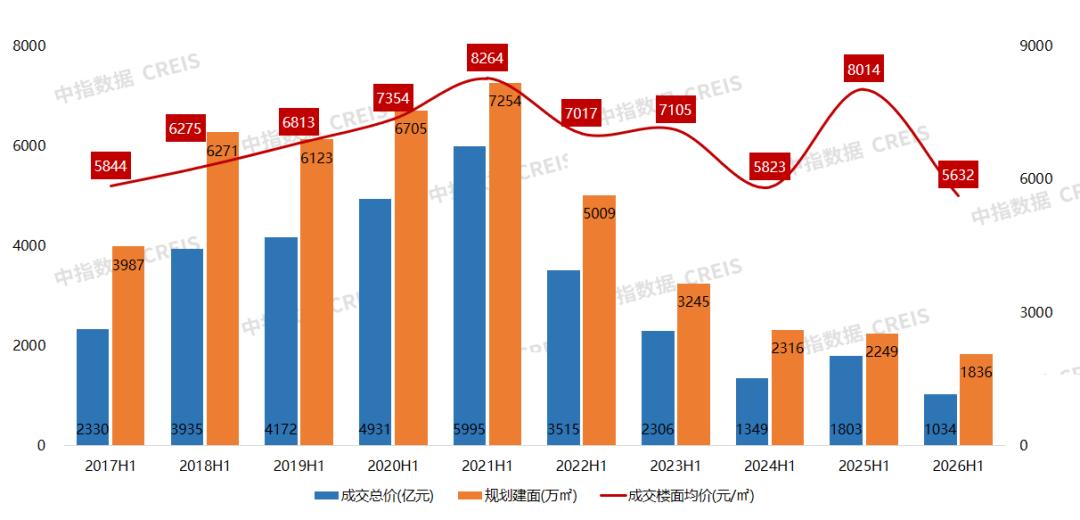
In the first half of 2026, the total planned floor area of operational land (including residential and commercial-office land) transacted in Zhejiang Province reached 18.36 million sq.m, down 18.4% year-on-year; land transfer fees totaled 103.4 billion yuan, representing a 42.6% year-on-year decline. When viewed against a 10-year time frame, both the transaction floor area and land transfer fees hit their lowest levels for the corresponding period in the past decade.
Figure: Operational Land Transaction Performance in Zhejiang Province in the First Half of Each Year Since 2017
In terms of monthly trends, the market has shown a stepwise recovery pattern of "low at the start and high at the end".
The market remained sluggish from January to February. Although transactions picked up in March, the majority of deals were low-priced land plots in remote suburbs. Starting from April, high-quality land parcels in core cities began to enter the market in large volumes, pushing total land transfer fees to 23 billion yuan. As the final month of the first half, June saw a transaction peak: 104 land parcels were transacted across the province, with a total planned floor area of 4.66 million sq.m, land transfer fees of 34.8 billion yuan, and an average premium rate of 23.3%. The single-month transaction value reached the highest point of the first half of the year.
The simultaneous rise in both transaction volume and prices in the closing month of June has injected a certain degree of confidence into the second-half market.
Private Enterprises Scale Back and Adopt a Defensive Stance, While Central and State-Owned Enterprises Select High-Quality Projects for Expansion
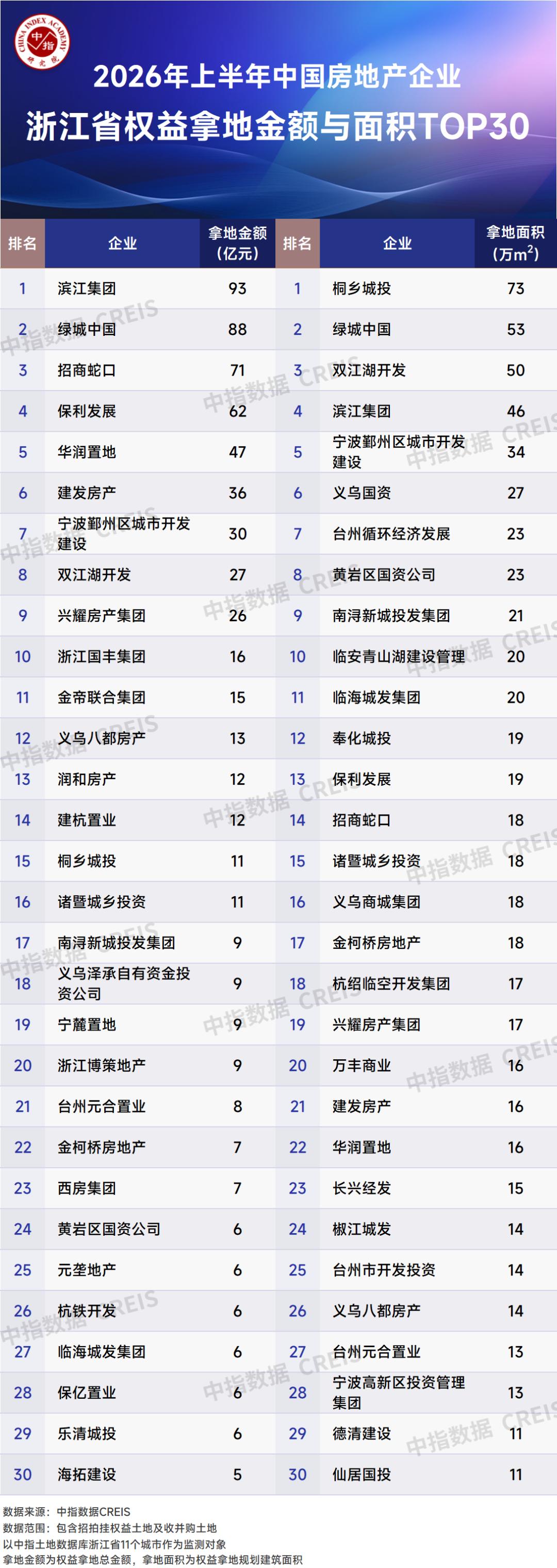
Among the top 30 enterprises by land acquisition expenditure on operational land in Zhejiang in the first half of 2026, around 18 are central or local state-owned enterprises (including urban investment platforms), accounting for 60% of the total. There are 11 private enterprises, including local players such as Binjiang, Xingyao, Guofeng, and Jindi.
Figure: Distribution of Equity-Based Land Acquisition Expenditure in Zhejiang Province in the First Half of 2025-2026
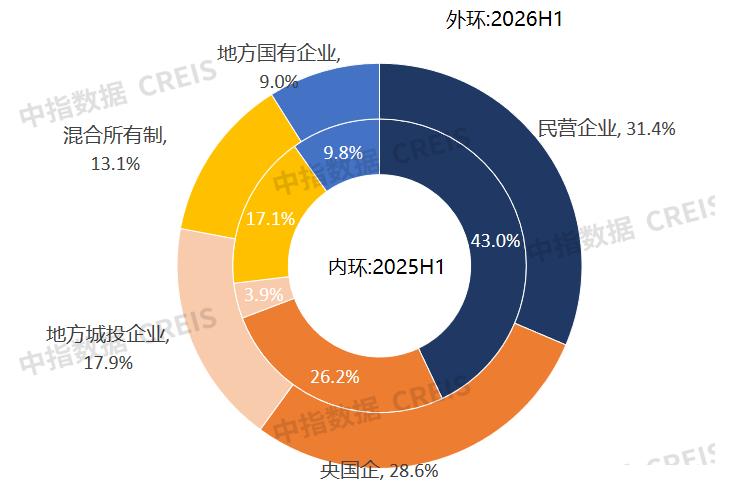
In terms of equity-based land acquisition expenditure, private real estate enterprises still account for the largest cumulative share, reaching 31.4%, but their proportion has dropped significantly by 11.6 percentage points compared to the same period last year, indicating a much more cautious investment strategy.
The proportion of land acquisition expenditure by central and state-owned enterprises has maintained a steady upward trend. Their share has risen slightly from 26.2% to 28.6%, an increase of 2.4 percentage points. During the market adjustment period, central and state-owned enterprises have maintained high market participation thanks to their capital advantages, becoming a key force stabilizing the land market.
The proportion of land acquisition expenditure by local urban investment enterprises has increased, jumping from 3.9% in the first half of 2025 to 17.9%, a rise of 14 percentage points. These enterprises mostly underpin land parcels in urban suburban areas at near-base prices.
Leading Enterprises Pull Ahead by a Large Margin, With Fierce Competition for Core High-Quality Land Parcels
Binjiang Group ranks first with a land acquisition expenditure of 9.3 billion yuan, followed closely by Greentown China with 8.8 billion yuan. These two local real estate enterprises form the "top-tier duopoly". China Merchants Shekou, Poly Developments, and China Resources Land take the third to fifth positions respectively with 7.1 billion yuan, 6.2 billion yuan, and 4.7 billion yuan, with the central enterprise camp delivering an overall steady performance.
In terms of urban layout, leading real estate enterprises have unanimously adopted the "focus on core areas" strategy. Binjiang Group has highly concentrated its land acquisitions in the main urban area of Hangzhou in the first half of the year: 8 out of its 9 newly acquired projects are located in Hangzhou, with the city accounting for as high as 94.6% of its total equity-based land acquisition expenditure, demonstrating its deep commitment and determination to cultivate the local market. Greentown China has implemented a dual-core development strategy centered on Hangzhou and Ningbo: among its 13 newly acquired land parcels, 8 are in Hangzhou, 4 in Ningbo, and 1 each in Jinhua and Jiaxing. While focusing on the two most core cities, it also meets diversified product demands covering both improvement-oriented and first-home buyers.
Central enterprises have also tilted their investment heavily toward Hangzhou. China Merchants Shekou won the land parcels in the Liangzhu East Unit and Binjiang Yongjiu River Unit of Hangzhou with high premium rates of 43% and 79% respectively. Poly Developments spent 4.81 billion yuan in just 5 days in March to consecutively acquire two core land parcels in Hangzhou's Chengdong New Town and Qianjiang Century City, and further secured a core plot in the Cloud City with 1.378 billion yuan in June. Both land parcels acquired by China Resources Land are located in high-quality core urban sectors, namely the Changhe sub-district in Hangzhou's Binjiang District and the core area of Ningbo's Haishu District.
Overall, the leading real estate enterprises have shown highly convergent investment strategies in Zhejiang's market in the first half of the year: taking Hangzhou as their absolute core focus, supplemented by supplementary land acquisitions in other core cities such as Ningbo, using the certainty of prime locations to hedge against market uncertainties. This logic is clearly reflected in Binjiang's deep localized cultivation, Greentown's dual-core development strategy, and the concentrated supplementary land acquisitions of the three central enterprises.
Notably, the threshold for the top 10 enterprises by land acquisition expenditure has dropped from 2.76 billion yuan in the same period of 2025 to 1.57 billion yuan, while the threshold for the top 3 has fallen from 10.17 billion yuan to 7.11 billion yuan. The total land acquisition expenditure of the top 10 real estate enterprises reached 49.66 billion yuan, accounting for 48.0% of the province's total residential-related land transfer fees. The market pattern of "the strong getting stronger" has not undergone fundamental changes.
Hangzhou Captures More Than Half of the Market Share, With Distinct Tiered Performance Across Cities
From a city-level perspective, the divergence between hot and cold spots in the provincial land market is prominent. Hangzhou's market scale is far ahead, forming a core highland within the province; Ningbo and Jinhua follow closely behind, while the transaction volumes in Lishui, Quzhou, and Zhoushan remain at low levels.
Figure: Operational Land Transaction Performance of Various Cities in Zhejiang Province in the First Half of 2026
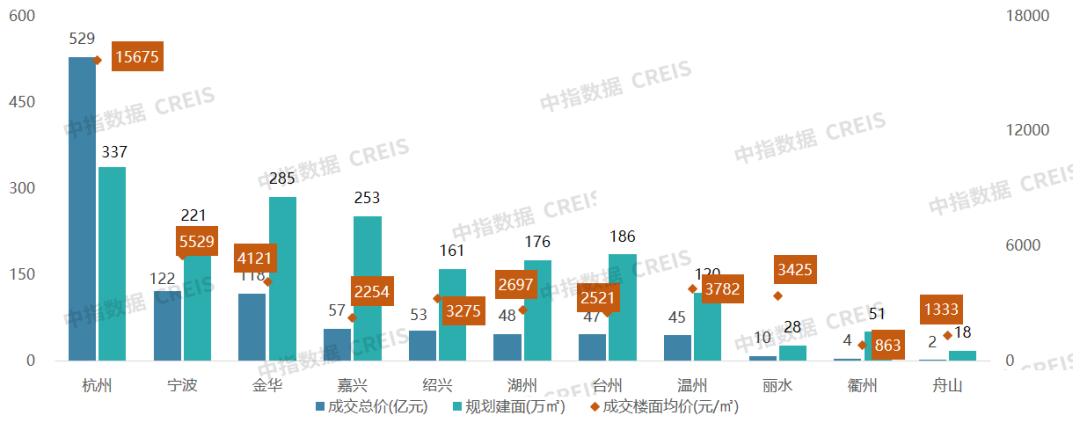
Hangzhou: With land transfer fees of 52.9 billion yuan, the city alone accounts for 51% of the province's total, with an average transaction floor price of 15,675 yuan per sq.m. The average premium rate for residential-related land parcels stands at 32.6%. This market performance of high unit prices and high premiums fully reflects that real estate enterprises generally believe Hangzhou's market has stronger risk buffering capacity and greater profit potential.
Ningbo and Jinhua: These two cities form the second tier, with land transfer fees both hovering around 12 billion yuan and roughly equivalent premium rates, showing a generally rational market.
Jiaxing, Shaoxing, Taizhou, and Wenzhou: These four cities belong to the third tier, with land transfer fees ranging from 4 billion to 6 billion yuan and similar average floor prices. Local platform companies are the main market participants, while market-oriented enterprises are relatively few in number.
Lishui, Quzhou, and Zhoushan: These cities have relatively small land transaction scales, and their market demand remains persistently weak.
Trends and Outlook: Adjustments Continue Alongside Structural Optimization
The divergent pattern of Zhejiang's land market in the first half of 2026 represents resource restructuring amid the industry's clearing cycle: central and state-owned enterprises with abundant resources are heavily investing in core assets, while high-quality private enterprises are scaling back their layout to focus on top-tier cities. The gradient of urban development continues to widen, and the real estate market is gradually evolving into a state where core cities dominate while county-level markets show uneven performance.
Looking ahead to the second half of 2026, Zhejiang's land market is likely to continue the trend of "in-depth adjustment + structural divergence": on the enterprise side, central and state-owned enterprises will remain the main force of land acquisition, while leading private enterprises will continue to exert their efforts; on the city side, the pattern of "Hangzhou standing out alone" is unlikely to change, Ningbo and Jinhua will see steady and moderate growth, while third- and fourth-tier cities such as Quzhou and Zhoushan will continue to face market pressure.
This article is sourced from the WeChat Official Account "China Index Academy", authored by China Index Research, and published with authorization by 36Kr.